Archive
Main Dossier
Research Focus
This project is a psycho–sociological and ethnographic field study of the modern secret society Ordo Templi Orientis (O.T.O.). It follows the participants not only through doctrines, magical practices, and rituals, but also through correspondence, rivalries, recollections, domestic arrangements, material objects, performances, gossip, and the administrative debris in which an order becomes visible.
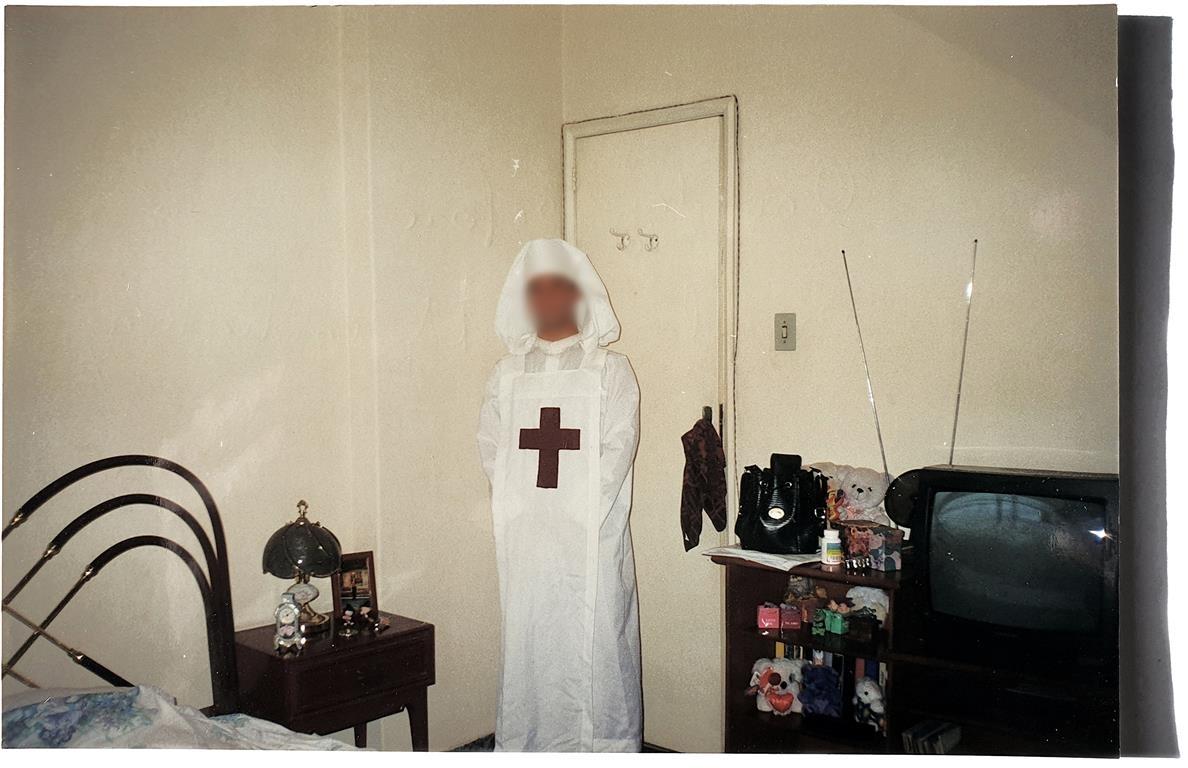
Occultism is observed with an occasionally wry eye. I am less interested in presenting esotericism as a doctrine in its own right than in documenting what its adherents do with it — and what it does to them. The occult does not begin and end with ritual. It continues in bedrooms and kitchens, correspondence and friendships, marriages and quarrels, collections, costumes, meals, money, and the distribution of access and prestige. A living room used for a lodge meeting, a study reserved for personal experiments, or a bedroom to which a visitor is denied access may reveal more than another description of a ritual. The room does not determine the activity: occasion, participation, permissions, housekeeping, and family proximity are part of the social structure.
Ossified ritual, theatrical mysticism, commercial opportunism, and ordinary struggles for status repeatedly occupy the same small stage. The sacred and the domestic are rarely cleanly separated. They coexist, overlap, and occasionally inconvenience one another.
The material is necessarily uneven: letters, interviews, lodge papers, retrospective testimony, rumours, photographs, and self–mythologising accounts do not carry equal evidential weight. They are presented as fragments whose provenance, bias, and contradictions form part of the subject rather than an inconvenience to be concealed.
Rumour and gossip belong to this material. They are not treated as proof that an alleged event occurred, but as social acts in their own right: ways of allocating prestige and stigma, defining intimacy and exclusion, policing boundaries, or constructing an enemy. Who could say what about whom, to whom, and with what consequences may reveal structures that formal doctrines leave entirely unmentioned. The recurring counterpoint is tabloid journalism, which converts the same fragments into certainty and spectacle.
Illustrations and graphic interventions occasionally create critical distance or expose the theatricality of the material. AI–treated or AI–generated images are identified as such; many are based on photographs I took myself or on stills from my own videos.
The phenomenon is labyrinthine, and so is its archive: bound as books, dispersed through articles, and perpetuated on this website. The front page is only an entrance; the continuing paper trail appears in Latest Updates.
The O.T.O. appears here less as a sealed esoteric system than as a social milieu in which alienation, exclusion, popular culture, science, spirituality, sexuality, family life, and the longing for distinction meet. Ritual provides one of its stages, but not necessarily the most revealing one. Sometimes the significant detail is what happens before the temple door opens, or after it has closed.
Because the sources are fragmented and partisan, their inconsistencies remain visible. Formal documents, recollections, photographs, domestic arrangements, gossip, and self–mythology illuminate different levels of the same social world. None is allowed silently to authenticate another.
I have assembled the available pieces as far as provenance, access, and legal limits permit. The gaps remain marked as gaps.
Cultural Appropriation
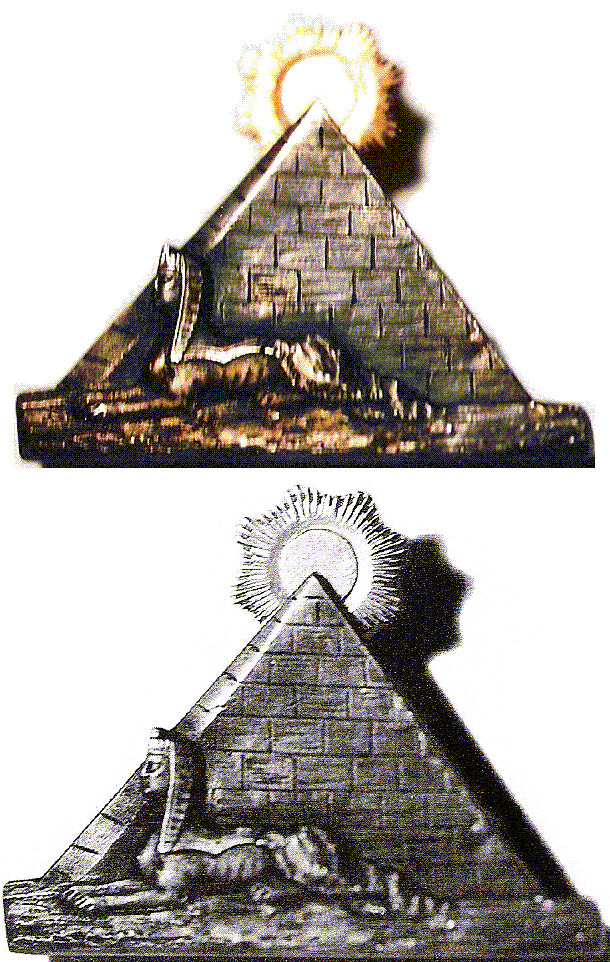
The French translation of the Thousand and One Nights gave Western Orientalism a powerful popular impulse at the beginning of the 18th century. Soon almost anything labelled Oriental could acquire a magical and sensual aura, tied to European fantasies of distant, unspoilt nature. Erotic motifs recur throughout Orientalist production, often nourished by the convenient belief that customs — and therefore morals — were looser elsewhere than at home.
Orientalism can be understood as a mode of thought that has been globalized since the 19th century, shaping not only perceptions of the Orient but also self–interpretations within it.
Following Napoleon's campaign in Egypt and Syria between 1798 and 1801, Europeans were gripped with Egyptomania, inspiring many to visit and document the country's cultural treasures firsthand.
During the colonial 18th and 19th centuries, Western scholars engaged with the cultures of the Indian subcontinent. British Orientalists translated Hindu scriptures in an attempt to comprehend their complexities. The advent of the telegraph and steamships in the 19th century accelerated communication between India and the West, facilitating the globalization of Hindu knowledge as travelers, researchers, and officials disseminated their findings through reports and publications.
European occultism filled its perceived cultural and spiritual gaps with imported customs, arts, philosophies, religions, and sciences — or, more precisely, with European reconstructions of them.
Within their own universe, modern occultists function as wandering encyclopaedias. It is quite state–of–the–art for them to plunder Ali Baba's coffers. The outcome is a construct of Western–influenced Egyptology and Orientalism, infused with elements from the Kabbalah and often interwoven with fabricated details.
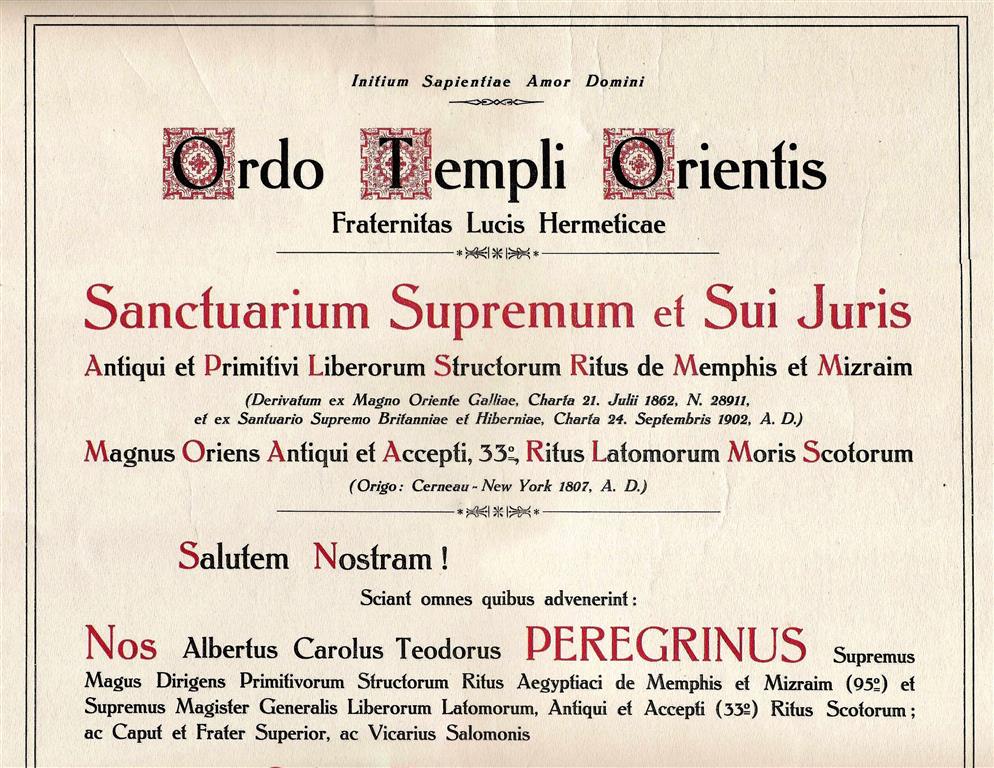
It was in just such a context that the Oriental Templar Order, the O.T.O., emerged publicly around 1905/06 under Theodor Reuss. He assembled it from the symbols, rituals, titles, and nomenclature of regular and irregular Freemasonry, adding an Oriental and neo–Templar scenery of his own. Period costume was, and remains, part of the performance.
The letters O.T.O. (or OTO) stand for Ordo Templi Orientis.
Neither the abbreviation nor the full name belongs historically to a single present–day group. Since the early O.T.O., numerous organisations have adopted the name and adapted it to their own interpretations, tastes, and purposes. Some claim descent from Reuss’s network; others simply appropriate the label. Only a few can document continuity with any part of the early organisation, and even then the meaning of continuity remains disputed.
Across the competing O.T.O.s, lineage matters because authority is imagined as the carrier of an initiatory or magical current. Less metaphysically, leadership may also confer control over names, archives, copyrights, and royalties — most visibly those attached to the literary estate of Aleister Crowley.
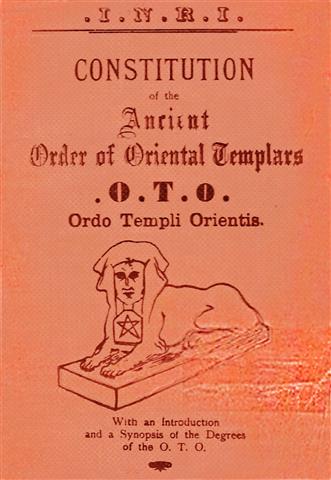
Most O.T.O. branches organise themselves, like Freemasonry, through a hierarchy of initiations. The number and designation of degrees vary, but the decisive secrets are assigned to the higher grades. In Reuss’s scheme, membership of the O.T.O. proper began only above the lay degrees; later branches rearranged the architecture while preserving the attraction of an inner sanctuary.
English version: Synopsis of Degrees.
Traduction française: Synopsis des Degrés.
Aleister Crowley: "Of the [highest] Eleventh Degree [of the Ordo Templi Orientis], its powers, privileges, and qualifications, nothing whatever is said in any grade. It has no relation to the general plan of the Order, is inscrutable, and dwells in its own palaces." (Liber CXCIV, 1919) "I am inclined to believe that the XIth degree is better than the IXth degree", diary entry 26 August 1916.
Religion As Decoration
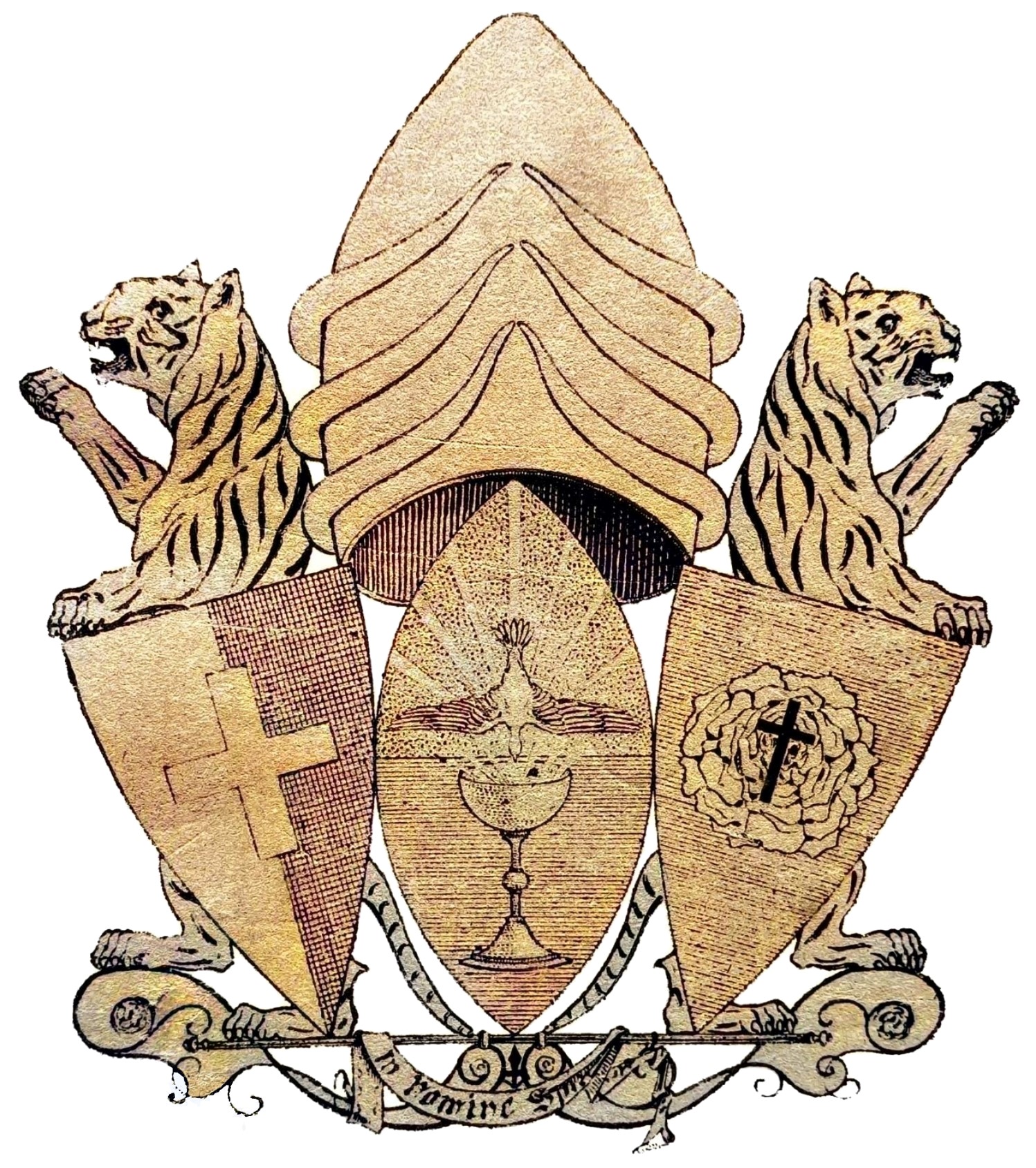
The O.T.O.’s initiatory machinery, resembling at times a Kafkaesque club game, acquired an ecclesiastical annex: the Gnostic Catholic Church. Religion supplied not only ritual scenery and the marketable commodity of salvation, but in some jurisdictions also tax advantages and a more defensible legal shell. Several O.T.O. variants have made strategic use of that shell.
The label used in this archive for the episcopal figures surrounding the O.T.O. phenomenon is Wandering Bishop, or Episcopus Vagans. It describes a bishop, not a bishopric, and says nothing by itself about character, learning, jurisdiction, or recognition. Many such figures operated outside canonical churches, historical sees, and recognised procedures.
Within the ecclesiological argument developed in these dossiers, apostolic succession is corporate and canonical rather than a private chain assembled from certificates. An isolated consecration does not by itself create jurisdiction, a historical see, or ecclesiastical recognition. The Holy Ghost, one might say, is not a notarial attachment.
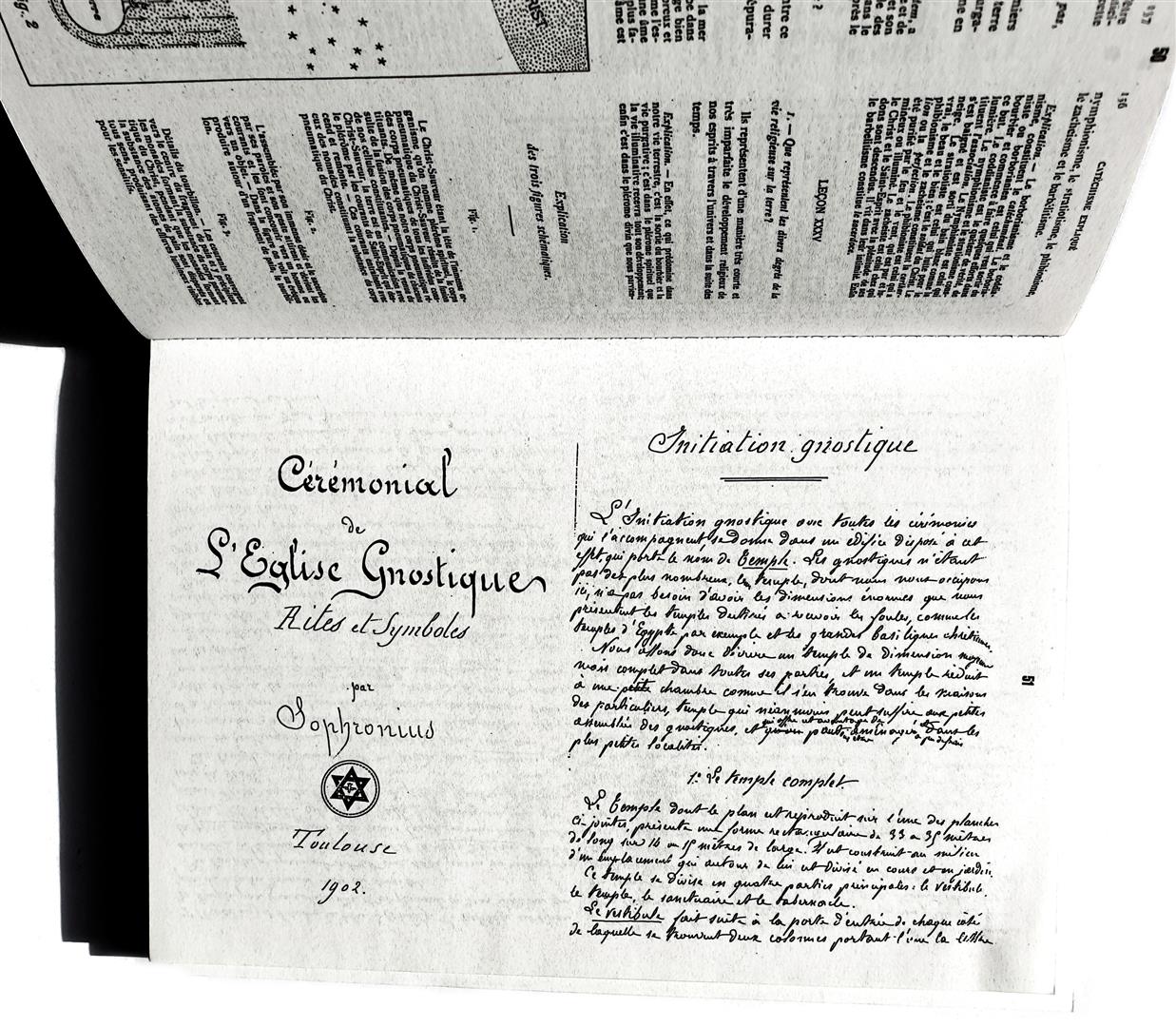
An instrumentum consecrationis records a ceremony; it does not settle the ecclesiological question. Nevertheless, Wandering Bishops are often devoted collectors of papers and diplomas, harbouring the hope that at least one recorded consecration has somehow taken.
A more detailed examination of the practices and adherents of Gnosticism will follow in the subsequent sections addressing the Gnostic Churches.
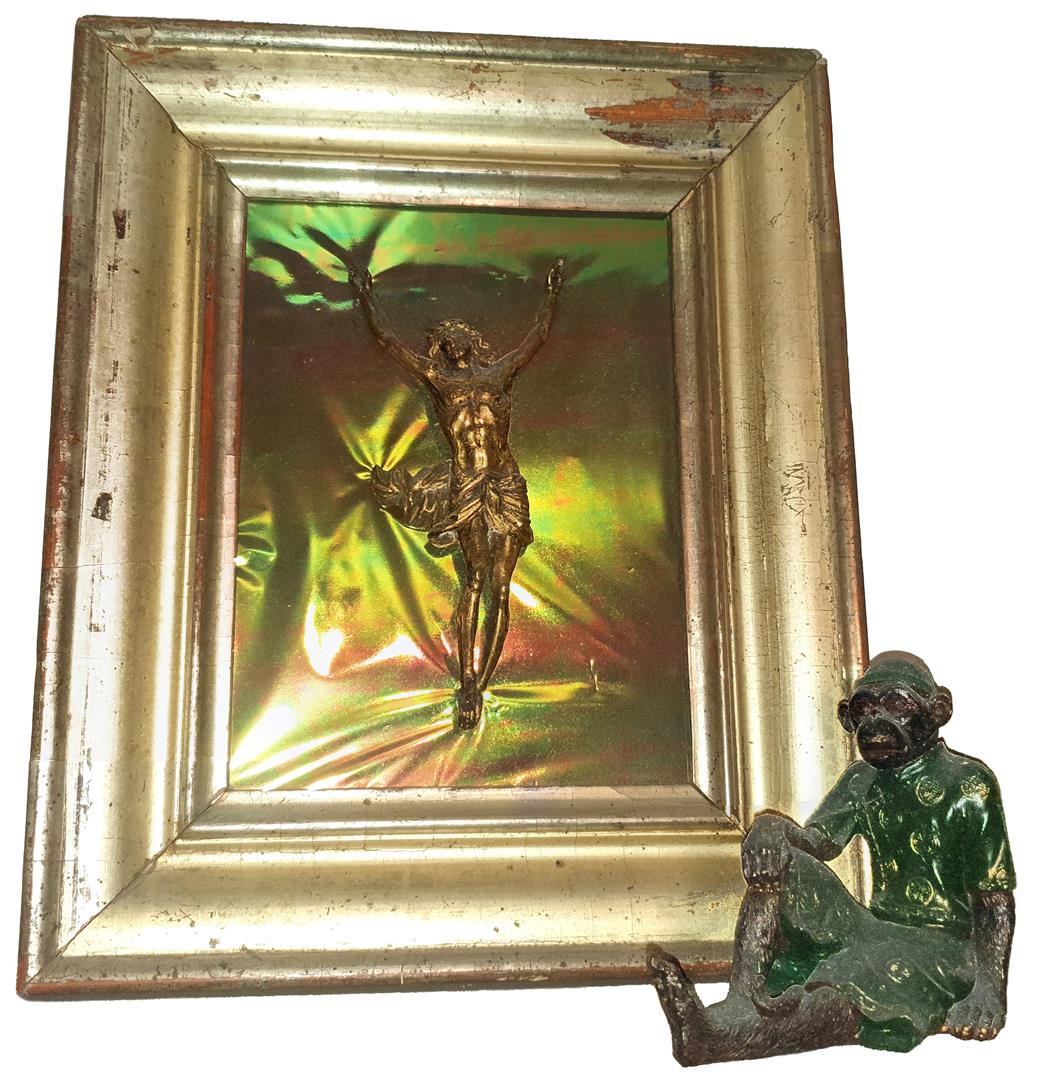
Discussions on the Nature of the O.T.O. Phenomenon
Critical theories and cultural reflections
There are many critical theories, but I don't adhere to any single one — because, in the end, they all have their uses. I don't approach texts, ideas, or people as if they were patients. Rationality, after all, is highly subjective. Or, as Paul Karl Feyerabend, the Austrian philosopher of science, put it: Anything goes.
The suitability of methods for thinking about occultism and esotericism is often judged by their results — though what counts as a result is another question entirely. As long as the insights remain discursive, innovative, and stimulating, even the most informal or unconventional approaches are not just permissible but necessary. Theories don’t drive evidence, nor should they. Analysis, then, is less about arriving at conclusions than about sustaining a dialogue between subject and researcher — one that can only ever yield provisional insights. Wayward ideas, however, can and should be viewed from wayward perspectives.
Reading Paul–Michel Foucault, Roland Barthes, Jacques Derrida, Félix Guattari, and Gilles Deleuze, or venturing into the works of Georges Bataille, Antonin Artaud, Terence Sellers, Jean Barraqué, Hermann Broch, Alain Robbe–Grillet, Maurice Blanchot, and Comte de Lautréamont (Isidore Ducasse) will not harm you. Have you tried Jacques–Marie Émile Lacan?
The Technology of Sex
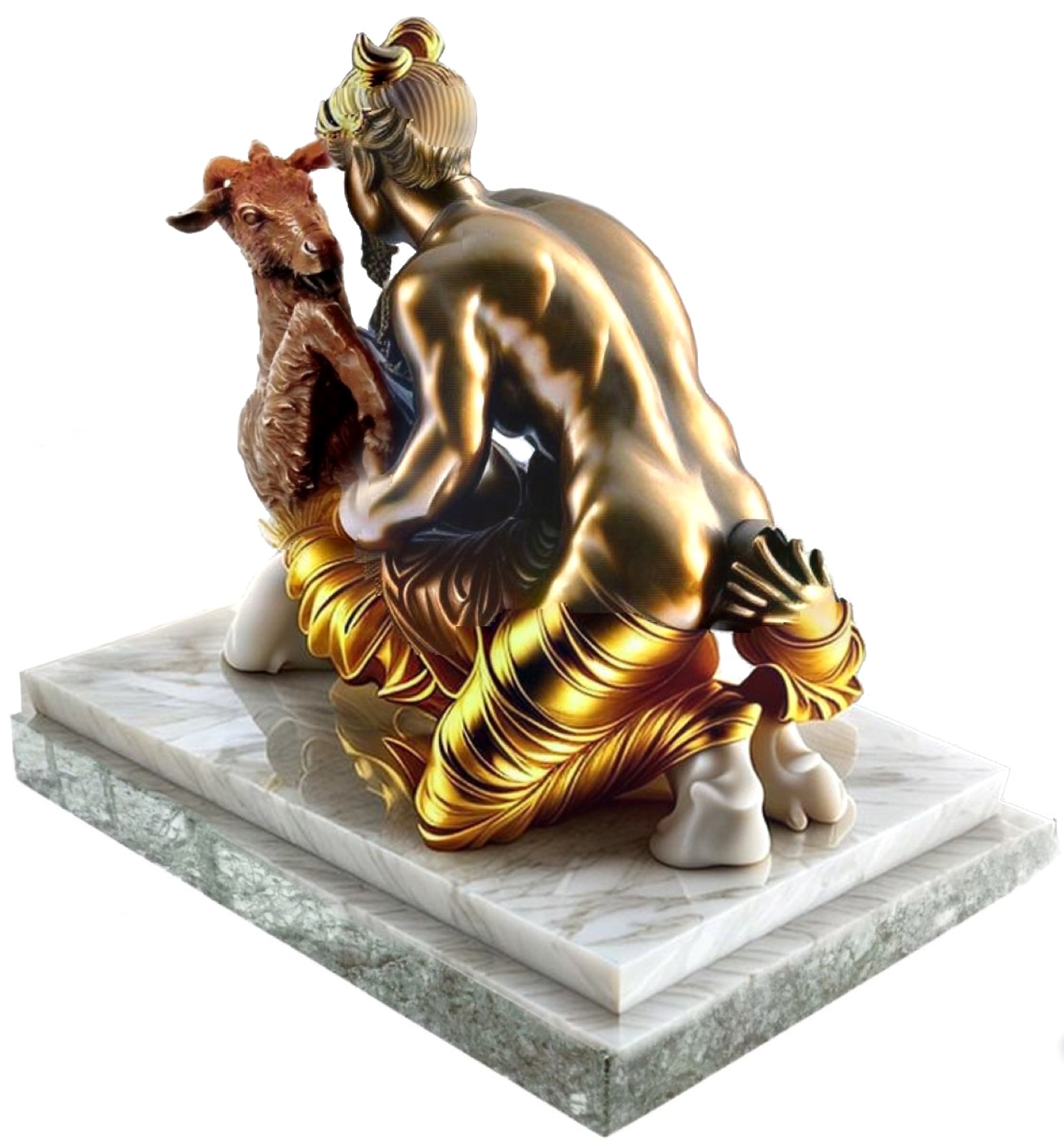
[AI–generated image]
Spermatophagy
Certainly, spermo–gnosis and sex–magic tend to invite rhetoric that veers towards sensationalism and may sound alarmist, not to mention titillating. I have diligently strived to steer clear of these potential pitfalls. Nevertheless, it is essential to declare from the outset that the subject requires candor, and I have not hesitated to provide it.
The presence of sexual or ritual material on this website should not be mistaken for sexuality being the central subject of my research. I do not study “sex” as an autonomous fetish, nor do I regard sexual explicitness as a category of historical significance in itself. Such material becomes relevant only insofar as it illuminates institutions and their histories, the psychograms of particular actors, relations of power and dependence, regimes of secrecy, the production and transmission of rituals, and the tension between doctrine, practice, and self–presentation. Sexuality functions here as a source, a symptom, or a structural moment — not as the sovereign centre of the inquiry.
A superficial thematic resemblance does not, therefore, establish scholarly relevance. Two milieus may both display sexual or ritual imagery while belonging to entirely different historical, social, aesthetic, and psychological formations. Explicitness alone neither proves continuity nor confers importance.
Foucault’s caution remains useful here. Those who present themselves as liberators of sexuality may in fact be engaged in its incessant production: naming it, depicting it, classifying it, and loading it with truth. Sex is not thereby released from power; it may instead become the centre of a new and very small regime of truth, in which the performance of certain acts is made to certify that one is initiated, radical, Gnostic, or admitted to a hidden network. Transgression then risks becoming its own discipline, and explicitness merely its uniform.
Sexuality emerges as a pivotal force in Gnostic traditions, oscillating between ascetic restraint and libertine indulgence, with both approaches channeling the divine pneuma to transcend earthly confines. Theodor Reuss arguably laid a sort of organized foundation (that is, a para–Masonic Order) for integrating sexuality and spirituality, introducing esoteric practices that would later be further radicalized. Aleister Crowley, who proclaimed that the mission of his sex–magical organization, the O.T.O., was "to restore Christianity to its real status as a solar–phallic religion," embedded sexual rituals within a framework of mystical transformation. These practices emphasized the concept of sperm as a carrier of the Logos, underscoring the gendered dimensions of salvation and its presumed divine potential. Rituals often reflected the enduring tension between ascetic and libertine orientations, embodying a dynamic interplay between restraint and indulgence in the pursuit of spiritual transcendence.
Spermo–Gnostics and the Ordo Templi Orientis — Introduction to the Ascetic and Libertine Gnostics, or The Erotization of Misery.
- Versione italiana: Origine dei gruppi O.T.O. e la Magia sessuale.
- Deutsche Version: Sperma–Gnosis und der O.T.O.
- Traduction française: Les Spermo–Gnostiques.
- Traducción castellana: Ordo Templi Orientis: Espermo–Gnósticos.
- Tradução portuguesa: Os Espermo–Gnósticos e a Ordo Templi Orientis.
- Česká verze: Asketictí a Libertinstí Gnostikové.
- Traducere în română: Sperma–Gnoza.
Clément de Saint–Marcq: The Eucharist, 1906.
"The Eucharist" explores the historical, theological, and esoteric dimensions of Christian faith, particularly its central sacrament. Saint–Marcq argues that religious knowledge, while framed as sacred tradition, often contains hidden meanings accessible only to initiates. He links Christianity’s origins to broader mystical traditions, controversially associating the Eucharist with ancient theophagic practices. Its transformation from an esoteric mystery into the public ritual of the Catholic Mass, he contends, represents an institutional cover–up of original sacred truths. He critiques transubstantiation as an untenable dogma, suggesting that the Church’s suppression of deeper meanings has contributed to its decline.
Saint–Marcq’s discussion aligns with esoteric interpretations later echoed by Theodor Reuss, particularly regarding the religious aspect of the O.T.O. Reuss asserted that "The Eucharist" concealed the ultimate initiatory secret: the ingestion of seminal fluid was believed to facilitate the internal manifestation of Christ within the individual. This doctrine positioned spiritual regeneration and divine communion as independent of traditional procreative rôles, negating the necessity of women in this mystical framework.
The engagement of the Neo–Gnostics with their favourite topic came through the romanticized lens of 19th and early 20th–century esotericism, which often reinterpreted Gnostic ideas rather than adhering to historical accuracy and scientific analysis. In some places, such an approach is even explicitly rejected.
The text below extends the previous research on Spermo–Gnosis and the O.T.O., examining the sex–magical and Gnostic practices shaped by Arnoldo Krumm–Heller and Ernst Christian Heinrich Peithmann, with reference to foundational texts such as the Pistis Sophia. Central to these doctrines is the symbolic rôle of sexual secretions as metaphysical substances, with semen often regarded as a vessel of divine energy, while femininity is marginalized. Peithmann's Gnostic Catechism elaborates on these principles, advocating ascetic practices — most notably the avoidance of ejaculation — as a means of spiritual redemption, in contrast to the libertine interpretations found in Theodor Reuss’ "mandatory reading for O.T.O.–Members". Similarly, Krumm–Heller promotes a Christian–ascetic Gnosis, rejecting Crowleyan excess in favor of spiritual discipline.
Peithmann’s Gnosticism articulates a radical rejection of the material world, depicting nature as an illusory force that entraps the soul in cycles of reincarnation and corporeal servitude. His theology centers on asceticism, particularly sexual abstinence, conceived as a direct challenge to the demiurge’s dominion, while simultaneously advancing a spiritualized notion of sexual energy transmutation. Though informed by classical Gnostic sources, Peithmann constructs an independent cosmogony, integrating elements of early Christian heresies with mystical techniques resembling Hatha Yoga. His critique of the O.T.O. as “without value” reflects his opposition to its libertine sexual doctrines, instead advocating a strictly ascetic path. Despite his condemnation of procreation, he paradoxically acknowledges the necessity of male–female polarity in spiritual redemption. His reliance on earlier Gnostic systems, particularly French neo–Gnosticism, underscores his doctrinal synthesis, yet his ambiguous stance on libertine rites leaves open the question of whether he merely reports on or tacitly endorses such practices. Ultimately, Peithmann’s worldview is characterized by radical dualism, esoteric Christianity, and an emphasis on sexual energy as the key to spiritual liberation.
By contrast, Chevalier Le Clément de Saint–Marcq's "L’Eucharistie" exemplifies a libertine perspective, interpreting the consumption of sperm as a sacramental act in which semen embodies the divine Logos. The Pistis Sophia, a foundational text for Krumm–Heller, underscores spiritual ascent through the reconciliation of dualities, distinguishing his moderate, integrative approach from Crowley’s extremes. In the end, both Krumm–Heller and Peithmann advocate a Gnostic practice grounded in balance and asceticism, setting their work apart from the libertine interpretations found in the teachings of Reuss and Crowley.
- The Correct Gnosticism: The ascetic roots of the O.T.O.
- Traduction française: Le Gnosticisme Correct.
- Traducción castellana: Gnosticismo Correcto.
- Traducere în română: Gnosticism Corect — Fenomenul Ordo Templi Orientis Informatii suplimentare.
The Secrets of the O.T.O.–groups.
Some Gnostic and magical ideas often spiral into ritualistic excess, fixating on bodily fluids and euphemized sexual choreography. While some O.T.O.–inspired groups devolve into personal fetishes cloaked as universal truths, others within this esoteric sphere offer entirely different interpretations of these themes. In this light, both fascination and absurdity become visible: occultism reveals its gravitational pull toward sexual symbolism until even the most private excretions are exalted as sacraments. The risk is always that scandal overshadows substance, with extravagant claims resting on diaries and speculation rather than established practice.
The account unfolds with a wealth of detail, close engagement with sources, and a critical tone that exposes the uneasy tension between lofty doctrine, eccentric practice, and modern reinterpretation. What emerges is a picture of occultism gravitating with irresistible force toward sexual symbolism, until the sacralization of bodily fluids appears less like an esoteric key than a fixation in search of cosmic justification. The result is a curious reduction of the grand mystical edifice into a monomania of fluids — semen exalted as elixir, menstrual blood recast as sacrament, Eucharistic cakes conjured from a kitchen of dubious alchemy. Other dimensions of esoteric philosophy are pushed to the margins, overshadowed by this peculiar obsession. Modern gestures toward historical nuance, shifting notions of gender, or symbolic reinterpretation enter only as side notes, scarcely enough to counterbalance the sticky weight of tradition.
What remains is less a balanced history than an act of deliberate deconstruction: a cabinet of curiosities — part revelation, part fetish, part fiction — where myth, ritual, and grotesque performance stand side by side, fascinating and tinged throughout with unintended spectacle.
Modern perspectives on identity and transgenderism further complicate these doctrines: when the sacralized phallus itself becomes negotiable, entire systems built on its cosmic indispensability risk collapsing into a theatre of improvisation, where revelation must suddenly share the stage with gender fluidity, and the once–stable mysteries look more like eccentric dress rehearsals for a play no one agreed to script.
Aleister Crowley’s Gnostic Mass culminates in the consumption of a Cake of Light, prepared before the rite from ingredients that may include bodily secretions. In the interpretation developed here, the Cake contains the Logos and the Childe, an aspect of Horus.
It is consecrated, not transubstantiated in the Roman Catholic sense. Its transformation is physiological and sex–magical: preparation, bodily contact, consumption, and digestion make the communicant part of the operation. No invisible substance changes while the chemistry remains untouched.
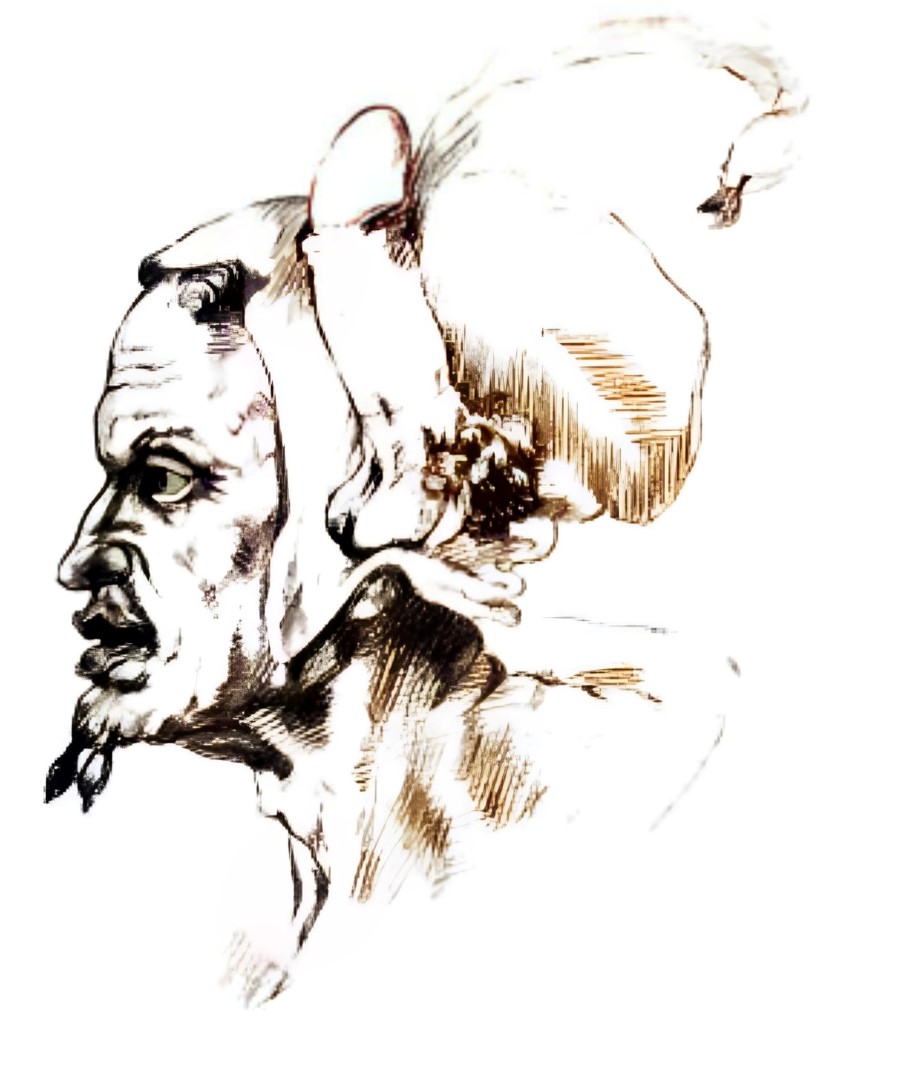
In the 1970s, the occult community embraced a heightened level of sexuality involving a variety of partners. This not only created but also reinforced the stereotype about occultists that persists to this day, shaping how some individuals define occultism. During that era, many embarked on a social experiment of extended proportions, likening it to a form of religion and using sex as its raw material.
A significant emphasis was placed on individuals' autonomy, encouraging the freedom to engage in whatever they desired. The expression of sexuality underwent a transformative shift from being carried out furtively to becoming a celebratory manifestation, embodying the newly liberated attitudes towards occultism.
The moment sex became available to everyone at a mouse–click, the power of discourse (to borrow Foucault's term) of those who constructed a truth–producing apparatus around sexuality, also crumbled.
Further discussion on the practices and adherents of Gnosticism will follow in the later sections addressing the Gnostic Churches. For now, however, the focus will shift to broader reflections on the general nature of key figures within the O.T.O. and their historical foundations. These protagonists will then be explored in detail in the subsequent sections.

Psychosocial and cultural study of the O.T.O.
The McDonaldisation of Occulture.
The present article, dating back to 1997 (and partly written in Ronda, Spain, in the same house where Rainer Maria Rilke once stayed), investigates the utilization of calculability and quantifiability as evaluative criteria by secret societies such as the O.T.O. Specifically, I examine the degree to which the American O.T.O. has adopted a supermarket–style approach characterized by McDonaldization in its organizational structure and practices. Furthermore, this concept is contextualized within the burgeoning realm of the internet, elucidating the potential implications of these developments on the nature and function of secret societies in contemporary society.
- Deutsche Version: Die McDonaldisation der Okkultur — Das Internet im Spannungsfeld potentieller Schöpfung.
- По русски: Макдональдизация оккультуры.
Aura of the O.T.O. Phenomenon. 2000.
The modern O.T.O. is portrayed as a conversation piece — an object of intrigue rather than influence — whose relevance is maintained through spectacle rather than substance. The essay deconstructs the organization’s claims to esoteric authority, revealing a pattern of myth–making, censorship, and ritualized control that insulates it from external critique while rendering it increasingly irrelevant in broader cultural and intellectual contexts.
- Tradução portuguesa: A Aura do Fenômeno O.T.O.
Halo of Flies.
This article, originally published in Richard Metzger's "Book of Lies" (2003), characterizes the 'Caliphate' O.T.O., as a commercialized occult organization cloaked in spiritual pretenses and rigid conformity. It portrays Thelema, Crowley’s doctrine, as a derivative, pseudo–rational framework that prioritizes manipulation and consumerism over genuine inquiry or transformative philosophy. The group’s hierarchical structure fosters a Borg–consciousness, enforcing dogmatic loyalty to Crowley and suppressing individuality through bureaucratic rituals likened to Kafkaesque systems of control. The 'Caliphate’s' commercialization of Crowley's legacy, through royalties and copyright enforcement, underscores its economic motivations beneath a façade of esoteric teachings. Ultimately, this O.T.O. is depicted as a performative and commodified "McOccultism", sustaining relevance through spectacle rather than substance.
Phantoms of the Paradise (2005).
The Ordo Templi Orientis emerged around 1905/06 under Theodor Reuss and was later recast by Aleister Crowley as a vehicle for Thelema. Reuss broke with Crowley in 1921; Crowley then proclaimed himself Outer Head of the Order, although Reuss had not appointed him as successor. Reuss died in 1923 without naming one. The resulting vacuum produced competing lines of authority. Decades later, the American faction led by Grady Louis McMurtry, subsequently nicknamed the 'Caliphate', used litigation and corporate organisation to consolidate its institutional and publishing position. The modern O.T.O. is therefore not the uncomplicated continuation advertised by its publicity, but one claimant within a fractured history in which ritual legitimacy, legal recognition, archives, and commerce repeatedly overlap.
Anonymous 2021: Burning Down The House.
Based on anonymous testimony from within the modern O.T.O., the article documents allegations of hierarchical imbalance, mishandled abuse complaints, and resistance to reforms. It examines William Breeze’s leadership, changes to oaths, and the exclusion of rival lineages as elements in an increasingly personal system of rule. It also places James Wasserman’s alignment with right–wing and far–right currents during Donald Trump’s first presidency within the organisation’s internal political tensions. The anonymity of the sources is part of the evidential problem and is stated as such; the dossier records the accusations rather than silently converting them into judicial findings.
Playgame of an O.T.O.–Fatamorgana 2011.
This dossier asks how much can actually be known about membership in the O.T.O. It revises earlier statistics while keeping their limits visible, and examines AIDS, AIDS denialism within the 'Caliphate' cabinet, reported suicides, admission to the Sovereign Sanctuary of the Gnosis, censorship, media coverage, and the organisation’s fondness for name–dropping. The figures are evidence with margins of error, not a census disguised as revelation.
- Traduction française: Jeu de rôle d'une O.T.O.–Fatamorgana.
- Traduzione italiana: La versione play–game di un O.T.O.–Fatamorgana.
- Tradução portuguesa: Versão Jogo de uma O.T.O.–Fatamorgana.

Fetish, Self–Induction, Stigma and Rôleplay. 2011.
The O.T.O. has a controversial history, and it has been linked to several allegations of misconduct. Individuals who participate in O.T.O. rituals or practices may, therefore, face potential risks stemming from the organization's history or reputation. It is worth noting, however, that this article does not concentrate specifically on negative effects. Rather, it provides an analysis of the use of fetishism, self–induction, stigma, and rôleplay in the context of O.T.O. rituals and practices.
- Traduction française: Fétiche, auto–induction, stigmatisation et jeu de rôle.
- Traduzione italiana: Il feticcio, l’auto–induzione, lo stigma, il gioco di ruolo.
- Tradução portuguesa: Fetiche, Auto–Indução, Estigma e Rôleplay.
- Tłumaczenie polskie: Fetysz, autoindukcja, stygmat i odgrywanie ról.
- По русски: Фетиш, самоиндукция, стигма и ролевая игра.
Gaps in the Script of Esotericism: Hypocrisy and Hypercrisis — Oscar Wilde: Ambition is the last resort of failure. 2012.
Religious affiliation has influenced academic research throughout history, with numerous scholars shaping their work to align with or legitimize their personal beliefs. Examples include Carl Schmitt ("Political Theology", 1922), who linked sovereignty to theological concepts; Immanuel Velikovsky ("Worlds in Collision", 1950), who sought to reconcile biblical events with scientific theories; and Georges Lemaître (1927), whose "Big Bang Theory" was sometimes framed in relation to Christian creation narratives. In esoteric studies, researchers are often either sympathizers or critics of the movement they study, leading to biases in both directions. A common methodological issue is the selective omission of inconvenient facts, allowing scholars to construct a favorable narrative by curating sources. Academics who are also members of the O.T.O. have a clear incentive to present the organization in a positive light. Such scholars often adopt an academic stance that frames the O.T.O. as a "Western mystery tradition" or "spiritual system" rather than an obscure occult order. Scientific neutrality in such contexts is frequently an illusion, as authors tend to downplay or reinterpret critical aspects when writing about their own religious affiliations. Controversial topics such as ritual sexual practices, authoritarian structures, or Crowley’s problematic history — including racism, drug addiction, and allegations of abuse — are often ignored or dismissed as "misunderstandings". The ultimate goal is to integrate the O.T.O. into the academic study of religion, lending it credibility and mainstream legitimacy, making these scholars function more as an "academic PR division" than as neutral investigators.
In the realm of academia, scholars, preoccupied with their interpretations of archived knowledge, form insular communities. Occultists disguise themselves as scholars, and vice versa. Laypersons, adept at employing langue de bois rhetoric, gravitate towards their preferred online platforms. A culture of self–affirmation prevails, accompanied by a chorus of indignant condemnation directed at others.

The Creative Power. 2017.
The text explores the mystical and alchemical creation of artificial life, contrasting the Jewish Kabbalistic Golem with the alchemical Homunculus, particularly through the perspectives of medieval Jewish scholars, Paracelsus, and later occultists. The Golem, rooted in the Sepher Yetzirah, is linked to divine creation, requiring ecstatic states to animate it, whereas the Homunculus, per Paracelsus, is a product of alchemical putrefaction and astrological timing. The concept evolved in European occultism, with Goethe’s Faust and later figures like Crowley incorporating it into magical and sexual rites, blending it with esoteric doctrines of reincarnation and divine usurpation. The theme also pervades literature, from Mary Shelley’s Frankenstein to early 20th–century occult fiction, reflecting anxieties over artificial life and divine power. The Saturnian lodges and occult orders reinterpret the concept in egregoric terms, seeing artificial beings as magical constructs fed by collective energy, aligning with notions of divine self–creation. The O.T.O. and similar orders emphasize the sexual–mystical transmission of power, attempting to embody magical potency in individuals or astral beings, often mirroring psychological structures of authority and dependency. Ultimately, the study characterizes these esoteric practices as psychological constructs shaped by unresolved paternal projections, highlighting the intersection of magic, power, and identity within Western esotericism.
Keywords: Paracelsus, Ordo Templi Orientis, Baphomet, Egregor, Fraternitas Saturni, Theodor Reuss, Hanns Heinz Ewers.
- Traduction française: Le pouvoir créateur.
- Traducere în română: Putera Creatoare.
- По русски: Творческая Сила.
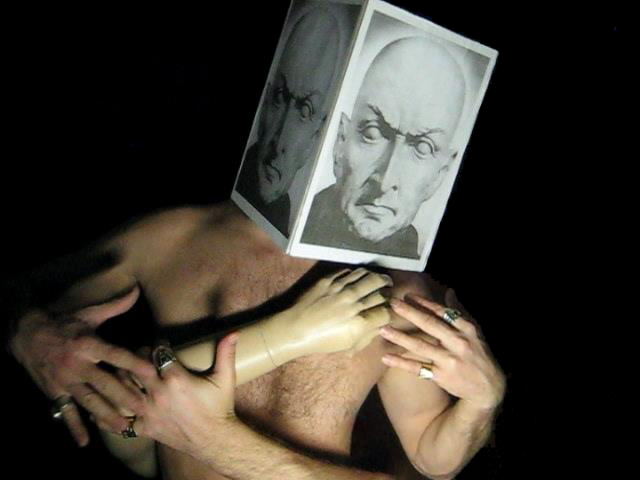
Aleister Crowley created a kind of a parallel world, with new values based on the injunctions of religion etc, called Thelema, in which he played the central rôle of a Prophet.
Ecstatic Creation of Culture.
The main ideas of this lecture, dated 1996, are the examination of Aleister Crowley's magical religion, the phenomenon of euphoric trance–images, the use of Cabbala as a verbal bridge between different realities, and the discussion of occultists associated with occult orders and free occultists.
- Deutsche Version: Ekstatische Erzeugung von Kultur [overdubbed version] — Die kommerzielle Plünderung der okkulten Leitfossilien. Version 2011.
- Tradução portuguesa: Criação Extática de Cultura.
Claas Hoffmann:
Hoffmann's text examines the connection between Crowley’s "Book of the Law", Lady Frieda Harris’ tarot paintings, and Projective Synthetic Geometry, tracing Harris' exposure to this mathematical system through her interactions with Anthroposophical thinkers. He situates Crowley’s tarot project within the esoteric and artistic context of early 20th–century Britain, emphasizing how Harris’ geometric choices reflect an alternative spatial understanding linked to Rudolf Steiner’s spiritual science. By exploring concepts such as polarity, infinity, and sun–space, Hoffmann draws parallels between esoteric geometry and the metaphysical doctrines embedded in Crowley’s work, suggesting that Harris’ tarot illustrations function as both visual expressions of The Book of the Law and practical demonstrations of Projective Geometry. His analysis also highlights the ideological tensions between Thelema and Anthroposophy, particularly through Olive Whicher’s dismissal of Crowley’s teachings, reinforcing the divide between these competing esoteric traditions. Ultimately, Hoffmann’s study frames the Harris–Crowley collaboration as a unique convergence of occultism, modern art, and mathematical mysticism, with Harris as a key figure navigating these intersecting influences.
- Projektive synthetische Geometrie in Lady Frieda Harris Tarotgemälden und in Crowleys Buch des Gesetzes.
- English version: Projective Synthetic Geometry in Lady Frieda Harris' Tarot Paintings and in Aleister Crowley's Book of the Law.

Regarding Crowley's antidemocratic, racist and misanthropic writings, followers point out: "The reason [...] aspects of Thelema are omitted [in public discussion] indicates the actual problem with presenting Thelema as a religion and attempting to get Thelema sanctioned by the government or approved by the public: Thelema is ultimately in contrast to and transgressive of normative society. Thelema rejects the morals and values of normative society and acts to transgress and violate these norms. From the inclusion of intoxicants in ritual, to the positive view of sexuality, which frequently is seen as promoting promiscuity, to the pro–authoritarian and Nietzschean aspects of Thelema, normative society has much to reject in Thelema and conversely, Thelema encourages its adherents to reject most aspects of normative society." ['Caliphate' O.T.O.'s "Journal of Thelemic Studies", 1;2, 2008, page 40]
Nicht alle Zweige des O.T.O. haben Crowleys Thelema übernommen. "Der Grund, warum [...] Aspekte von Thelema ausgelassen werden, zeigt das eigentliche Problem dabei, Thelema als Religion darzustellen und eine staatliche Anerkennung oder öffentliche Akzeptanz anzustreben: Thelema steht letztlich im Gegensatz zur normativen Gesellschaft und überschreitet deren Grenzen. Thelema weist die Moral und Werte der normativen Gesellschaft zurück und zielt darauf ab, diese Normen zu überschreiten und zu verletzen. Von der Einbeziehung berauschender Substanzen in Ritualen über die positive Auffassung von Sexualität, die oft als Förderung von Promiskuität wahrgenommen wird, bis hin zu den pro–autoritären und nietzscheanischen Aspekten von Thelema — die normative Gesellschaft findet vieles daran abzulehnen. Umgekehrt ermutigt Thelema seine Anhänger dazu, die meisten Aspekte der normativen Gesellschaft zurückzuweisen." ["Journal of Thelemic Studies", 1;2, 2008, Seite 40, übersetzt]
Concernant les écrits antidémocratiques, racistes et misanthropes de Crowley, ses disciples soulignent : « la raison [que quelques] aspects de Thelema sont omis [dans la discussion publique] indique le problème réel avec la présentation de Thelema comme une religion et essayant d'obtenir pour Thelema une sanction du gouvernement ou approuvé par le public : Thelema est finalement en revanche transgressive de la société normative. Thelema rejette la morale et les valeurs de la société normative et agit pour transgresser et violer ces normes. De l'inclusion des substances intoxicantes dans les rituels, à la perception positive de la sexualité, souvent considérée comme favorisant la promiscuité, le proautoritaire et l’aspect Nietzschéenne de Thelema, la société normative a beaucoup rejeter en Thelema et inversement, Thelema encourage ses adhérents à rejeter la plupart des aspects de la société normative. » [Journal of Thelemic Studies, 1;2, 2008, page 40, traduit].
In merito agli scritti antidemocratici, razzisti e misantropici di Aleister Crowley, i suoi seguaci precisano: «La ragione per cui [...] certi aspetti della filosofia thelemica sono omessi [nei pubblici contesti] indica l’effettiva difficoltà di presentare Thelema come una religione e al contempo ottenere una legittimazione dallo stato o la pubblica approvazione: invero Thelema trasgredisce e si contrappone alle norme sociali. Thelema rifiuta la morale e i valori della società normata e agisce per trasgredire e violare queste norme. Per l’uso di ‘sostanze’ nei rituali, per la magnificazione della sessualità, spesso fraintesa come spinta alla promiscuità, per gli aspetti pro–autoritari e nietzscheani, la società normata ha molto da respingere in Thelema e, allo stesso modo, Thelema incoraggia i suoi accoliti a respingere la maggior parte degli aspetti della società normata.» “Journal of Thelemic Studies”, 1; 2, 2008, p. 40.
Em relação aos escritos antidemocráticos, racistas e misantrópicos: "A razão […] de certos aspectos de Thelema serem omitidos [de discussões públicas] indica o real problema em apresentá–la como uma religião e tentar fazer com que seja aceita por governos ou aprovada publicamente: Thelema está, no final das contas, em contraste com a sociedade preceptiva além de transgredi–la. Thelema rejeita a moral e os valores dela e age para transgredir e violar tais normas. Desde a inclusão de intoxicantes em rituais, passando pelo ponto de vista positivo em relação a sexualidade — que com freqüência é visto como incentivo à promiscuidade — aos aspectos pró–autoritários e Nietzscheneanos de Thelema, a sociedade preceptiva tem muito para rejeitar em Thelema e, reciprocamente, Thelema encoraja os seus simpatizantes a rejeitar muitos aspectos dessa sociedade." "Journal of Thelemic Studies", 1;2, 2008, pag. 40.
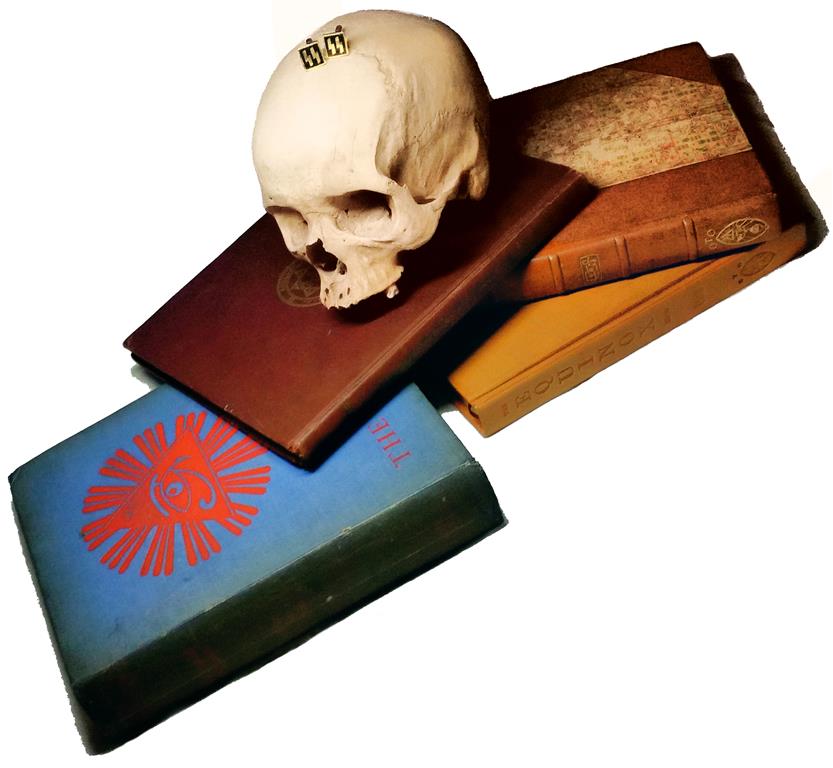
Das Milieu des Templer Reichs — Die Sklaven Sollen Dienen.
The argument presented in this discussion suggests that Aleister Crowley may be considered a political opportunist, who sought to build relationships with anyone, anywhere, in order to advance his personal interests, including the operation of his parareligion, Thelema. As he faced repeated failures in his political and utopian pursuits, Crowley increasingly emphasized his status as the founder of a religion, attracting followers from all walks of life. Therefore, it is beneficial to recognize the diverse range of people interested in this topic.
This article from 2006 will focus on notable individuals and organizations in this milieu, such as the Ordo Novi Templi, Fraternitas Saturni, and key figures such as Lanz von Liebenfels, Mathilde Ludendorff, Karl Germer, Christian Bouchet, Paolo Fogagnolo, and James Wasserman. The discussion will explore the political leanings of these groups and their members, as well as their attitudes towards anti–Semitism and religious intolerance. Additionally, the analysis will address the question of whether a consistent political direction can be identified within the O.T.O. Finally, the concepts of Ariosophy and paranoia will also be explored and illustrated with examples.
- English version: The Templar's Reich — The Slaves Shall Serve.
- Traduction française : Le Milieu du Reich des Templiers. Les Esclaves Serviront.
- Tradução portuguesa : O Ambiente do Reich dos Templários — Os Escravos Servirão.
- Traducere în română: Reich–ul Templier — Sclavii trebuie sa serveasca.
Proto–Fascist Elements in the O.T.O.
In 2000, P.R. Koenig, Jeroen Hoogeweij, KALIL, and Bryony Murds debated whether the modern O.T.O. struggles to balance mystique and modernity, elitism and inclusivity, dogma and inquiry. PRK and JH expose its authoritarian underpinnings, intellectual fragility, and reliance on theatrical rituals, while KALIL offers a romanticized counterpoint of individual empowerment. Murds’ editorial commentary sharpens the analysis, drawing parallels with Orwell, Ayn Rand, and religious fundamentalism to underscore Thelema’s paradoxical mix of libertarian rhetoric and hierarchical control.
Texts by Marco Pasi:
- Biobibliographical information, selected articles and books on Aleister Crowley.
- Lo Yoga in Aleister Crowley.
- Aleister Crowley und die Versuchung der Politik.
- Aleister Crowley e la tentazione della politica.
Rudolf von Sebottendorff: Der Talisman des Rosenkreuzers. With a preface by Albrecht Goetz von Olenhusen.
The Thule Society, often mythologized for its alleged ties to Adolf Hitler, has no credible evidence linking him directly to its activities. Sebottendorff’s claims of involvement with irregular Masonic orders, particularly the Memphis–Misraim Rite in Turkey, remain unproven but add to his self–crafted mystique. Alleged connections to occult groups like the O.T.O. in Switzerland or Ascona are similarly speculative, fueling conspiratorial narratives. Ultimately, Sebottendorff and Thule occupy a shadowy space between history and myth, where fact and legend blur to create enduring fascination.
Articles on the History of the Ordo Templi Orientis
Historical Figures and Organizations
Whether treated as object or subject, the very term O.T.O. is itself neither fixed nor coherent. The O.T.O. is not a compact, bounded set of categories, but consists of different individuals and more or less loose groupings, which often meet and part (or converge and diverge) with each other — and all at the same time.
Any historical account, any arrangement of these individual parts is perforce provisional, subject to rules of thumb and remains experimental in nature.
Fragmentation and rivalry within the O.T.O. groups
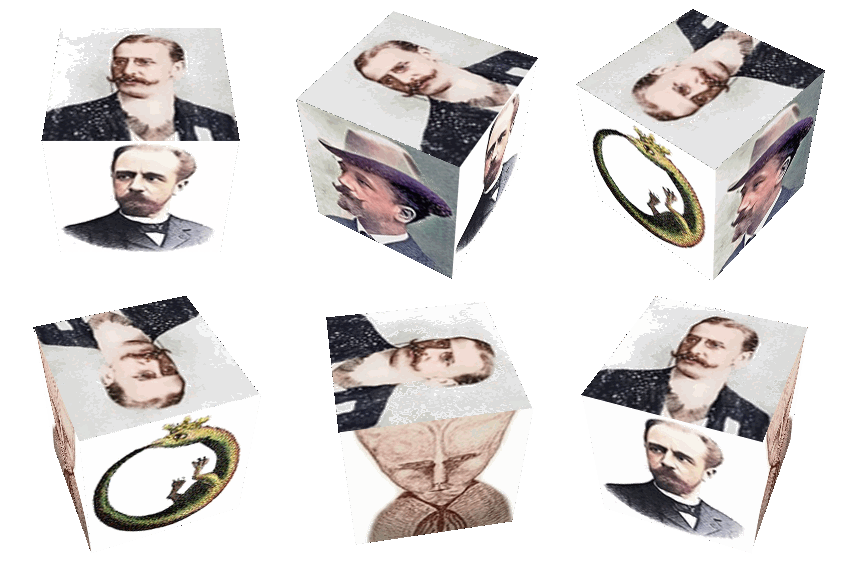
The history of the Ordo Templi Orientis, along with its variations, is marked by a considerable degree of complexity, with various claims to apostolic succession, mutual accusations, and expulsions. In this context, it is not surprising that there are significant overlaps and interconnections between different factions within the organization and its variations.
Background
- English version : Introduction to the O.T.O.
- Version française : Le Phénomène–O.T.O. — Introduction.
- Versione italiana : Breve Storia dell'O.T.O.
- Tradução portuguesa : Introdução à Ordo Templi Orientis.
- Traducción castellana : Introducción a la Ordo Templi Orientis.
- Česká verze : Fenomén O.T.O.
- По русски: История Ордена Восточных Тамплиеров.
- Dutch version : Ordo Templi Orientis.
- Mandarin translation : 东方神殿教的介绍.
- Traducere în română: Introducere in Ordo Templi Orientis.
Conflicts over leadership and legitimacy have played a defining rôle in the evolution of the O.T.O., particularly following the death of Theodor Reuss in 1923. Notably, Carl Kellner, often credited with its foundation, was never a member, and Aleister Crowley, despite his prominence, was expelled by Reuss in 1921. A succession of National Grand Masters (X°) oversaw various jurisdictions, though their legitimacy varied, and competing claims to the position of Outer Head of the Order (OHO) emerged after Crowley’s death in 1947. Some figures, such as Karl Germer, explicitly rejected the title of OHO, while others, including Kenneth Grant and Hermann Joseph Metzger, sought recognition despite contested legitimacy. Legal disputes, particularly involving the so–called 'Caliphate' O.T.O., have shaped modern perceptions of the Order, with rulings both for and against various factions, particularly regarding copyrights and trademarks. The Order’s internal structure and power dynamics have been subject to scrutiny, with claims of manipulation, censorship, and legal maneuvering playing a rôle in its post–Crowley development. Various documents and court cases highlight the Order’s contested lineage, internal schisms, and ongoing struggles for authority, particularly in the late 20th and early 21st centuries.
National Grandmasters and OHOs of the O.T.O.
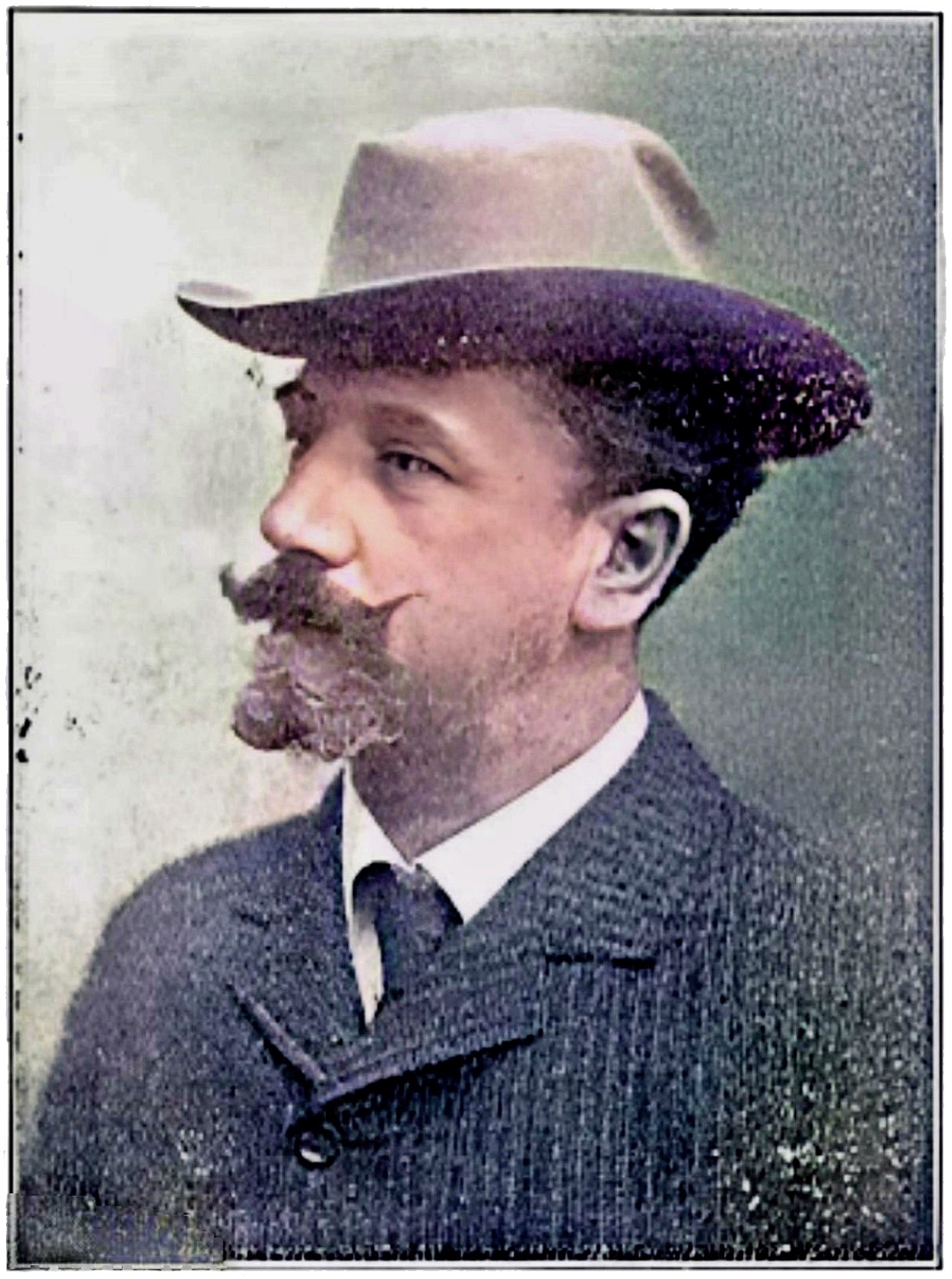
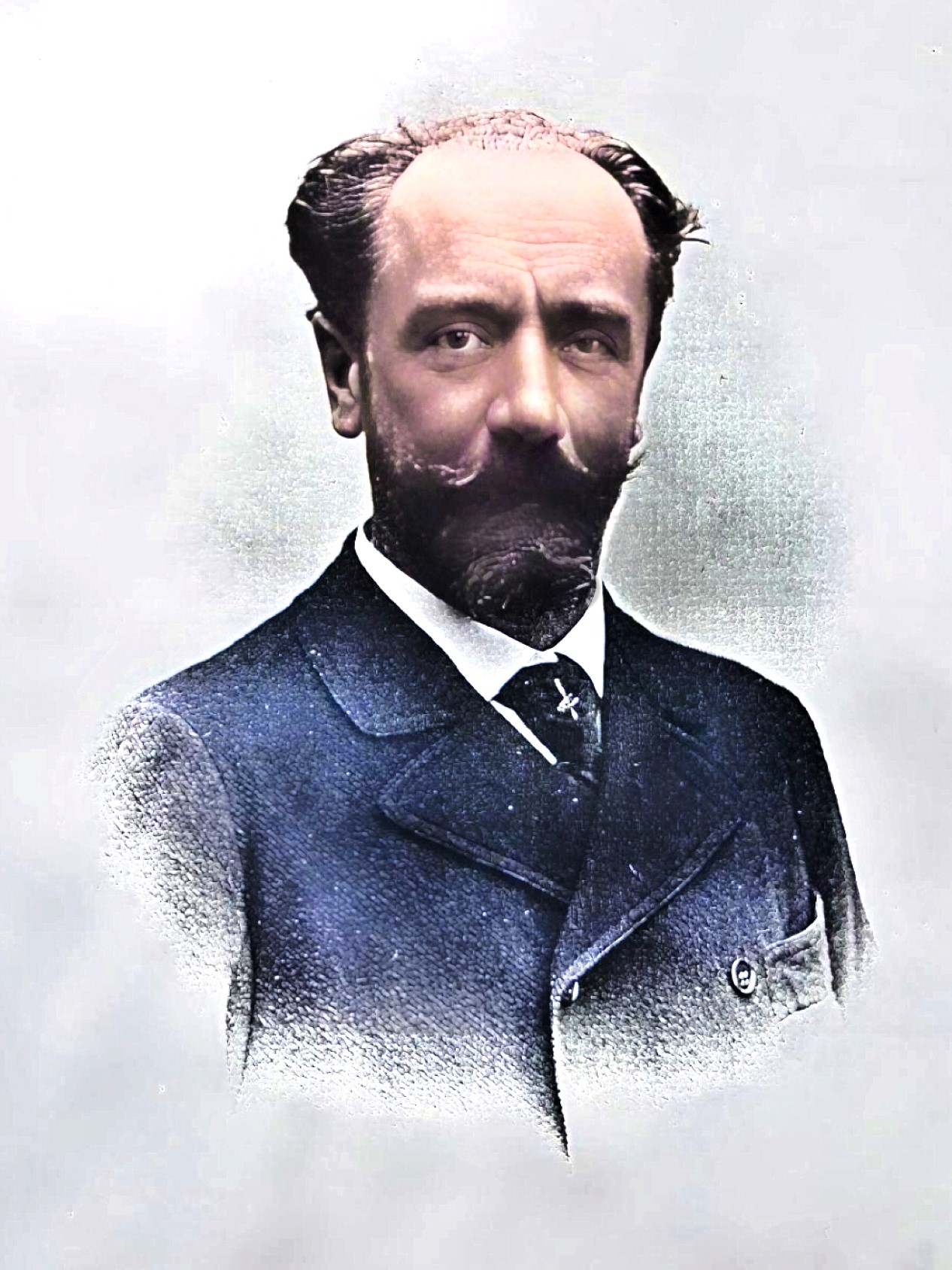
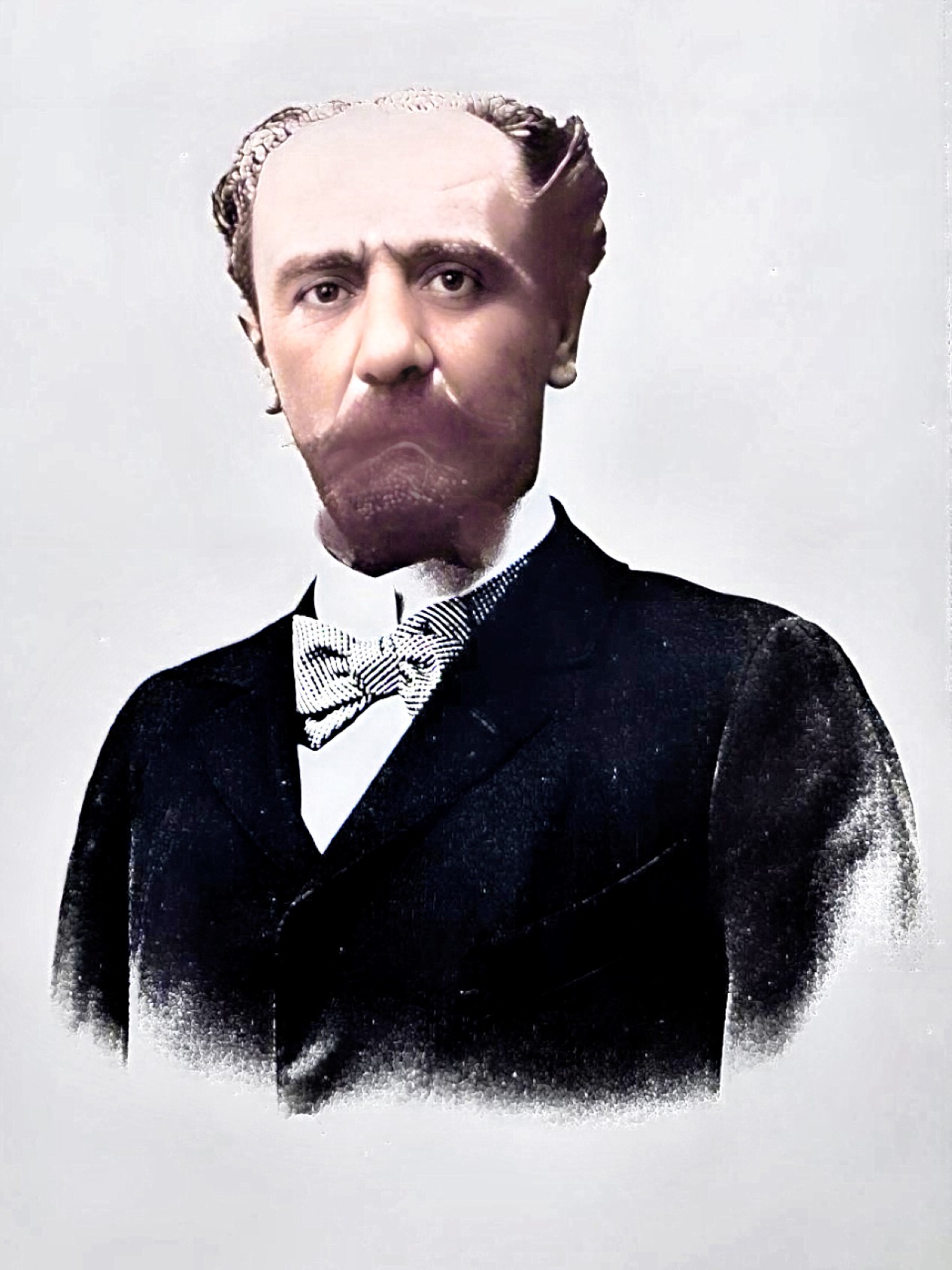
Carl Kellner
[Colored with AI]
[Colored with AI]

Details about Carl Kellner: Never a member of any O.T.O.
Josef Dvorak’s text below examines Carl Kellner as a complex individual who connected the realms of science, industry, and mysticism. While Kellner’s industrial innovations advanced material progress, they also had significant environmental and ethical consequences. His interest in mysticism reflects a broader cultural desire for spiritual meaning in a world becoming increasingly dominated by machinery and technology. Dvorak portrays Kellner as a representative of his time’s conflicts and contradictions: a trailblazer balancing the forces of creation and destruction, practical science and mysticism, and the physical and the spiritual.
- Josef Dvorak: Carl Kellner [collected gossip and speculation about Kellner's life, Franz Hartmann, Hatha Yoga and Baphomet].
- Deutsche Version: Carl Kellner.
- Türkçe çeviri: Carl Kellner.
Short biography of Franz Hartmann.
The pre–O.T.O. period was marked by fluid affiliations, ideological divergences, and personal rivalries. Theosophy provided a fertile ground for the exchange of ideas, but its splintering into factions mirrored the broader instability within the occult community. The interplay between figures like Hartmann, Kellner, and Reuss highlights the challenges of synthesizing diverse traditions and the difficulty of maintaining cohesive leadership in esoteric organizations.
Hartmann's contributions, though overshadowed by his estrangement from Reuss and posthumous misrepresentations, were significant in shaping the intellectual and spiritual foundations of modern Western esotericism. His connections to Theosophy, Memphis–Misraim, and prominent intellectuals demonstrate his pivotal, if contentious, rôle in the evolution of occult thought.
Joanny Bricaud: Notes Historique sur le Rite Ancien et Primitiv de Memphis–Misraim.
The document provides a historical account of the Ancient and Primitive Rite of Memphis–Misraim, an esoteric para–Masonic tradition originating in 18th–century France and evolving through numerous schisms, reforms, and international expansions. Regular Freemasonry’s dismissal of Memphis–Misraim as irregular highlights tensions between orthodoxy and heterodoxy within fraternal organizations.
Compiled primarily from Bricaud's writings, the narrative spans the mid–19th to early 20th centuries, highlighting key figures, dates, and events tied to the development of Memphis–Misraim, the O.T.O., and the Gnostic Catholic Church. The narrative reveals a complex interweaving of continuity and disruption.
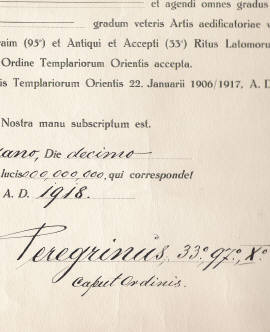
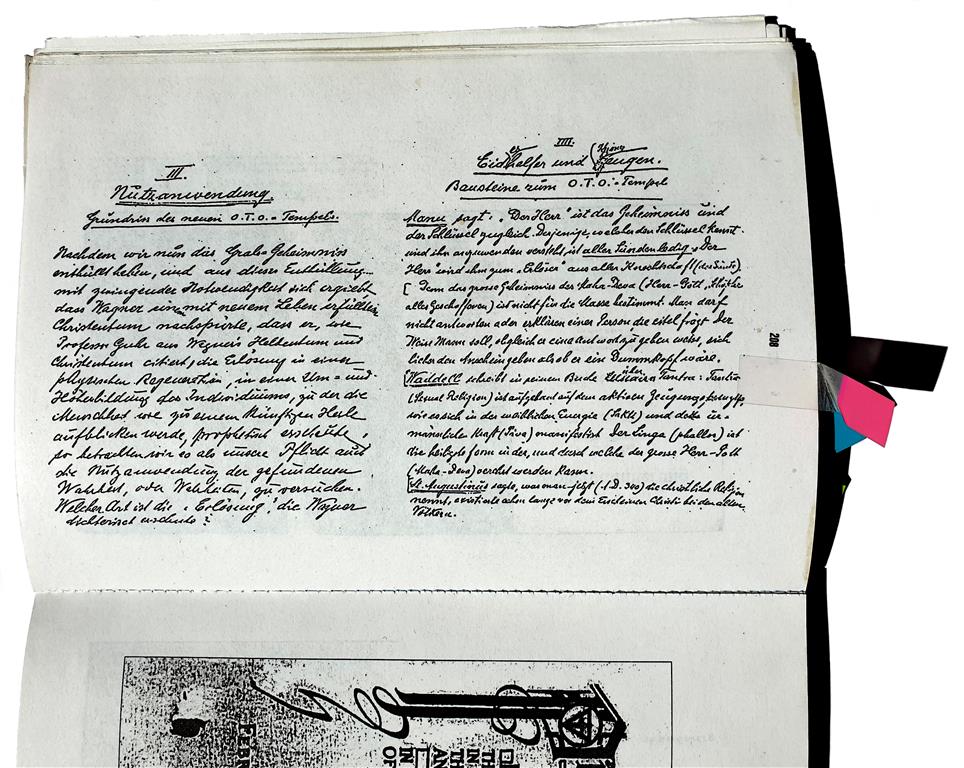
[From: 'Der Grosse Theodor Reuss Reader']
Theodor Reuss and Carl Kellner: Sort–of Biographies.
This corpus of sources on Kellner, Reuss, and the O.T.O. presents a mosaic of perspectives, ranging from scholarly neutrality to sensationalism and propaganda. While primary documents such as charters and 'Oriflamme' writings provide direct insight, they are self–serving and require critical evaluation. Secondary accounts, particularly those rooted in Nazi–era propaganda or occult sensationalism, offer distorted narratives that reflect broader cultural and political anxieties.
These sources must be approached with caution, cross–referencing reliable biographical accounts and documented charters against more dubious narratives. While the sanitized excerpts from antisemitic publications avoid explicit hate speech, their broader ideological context cannot be ignored. As such, they underscore the importance of situating these narratives within the complex interplay of esotericism, modernity, and political ideology.
— Primary Sources: Self–Produced Documentation
— Secondary Sources: Biographical Sketches
— Sensationalist Narratives
— Antisemitic and Politicized Narratives
— Esoteric and Masonic Writings
— Retrospective Interpretations
- Tradução portuguesa: Theodor Reuss: Avô da Sociedade Antroposófica?
- Česká verze: Theodor Reuss jako zakladatel esoterickych rádú — a — Preklad dokumentu.
A.P. Eberhardt: Von den Winkellogen Deutschlands [O.T.O., Illuminati, Memphis–Misraim, etc.]
- English translation: On German Irregular Lodges.
A letter from Francis X King to John Symonds about Theodor Reuss.
Reuss, a German journalist and singer, joined the Socialist League in 1885 and served on its executive committee alongside Edward and Eleanor Marx–Aveling. On May 7, 1886, he was expelled amid accusations that he had informed for the Prussian political police. Known for his coarse demeanour, he repeatedly irritated his comrades; after a League fundraising concert, Eleanor Marx–Aveling condemned his vulgar behaviour in a scathing letter.
Theodor Reuss' O.T.O. rituals © with an introduction.
Reuss mastered the art of presenting himself as the central axis of a paper empire, whose majuscule–laden titles sound more like operatic scenery than the sober minutes of a lodge meeting. His charters and warrants read as if penned by a sovereign intent on constructing a personal panorama of petty principalities, in which occult consecrations and constitutional phraseology coexist in fraternal harmony.
Beneath the respectable, theosophical veneer of his teaching, however, lies a carefully coded sexual magic, recognisable as such only to the initiated — a double–entry bookkeeping of esotericism that renders him socially presentable and at the same time subversive.
Questions of succession he resolved not by clear testament (he appointed his wife Pauline Reuss as custodian), but by fostering a competition of warrants, which after his death produced a veritable panopticon of competing “legitimate” heirs.
His network of relations with Encausse, Yarker, Hartmann, and Tränker was less a matter of doctrinal coherence than of mutual certification — a stock exchange of titles in the service of reciprocal legitimation.
The rituals themselves form a patchwork of Freemasonry, Martinism, Gnosis, and neo–Templar romance, composed in a style at once solemn and bureaucratic, and happily recycled when occasion allowed.
This performative polyphony was less an expression of systematic doctrine than a means of stabilising a fragile network through the repetition of familiar forms.
To read Reuss’s texts is thus not merely to peruse a collection of rituals, but to enter a stage on which authority, ambiguity, and solemn display are woven together with deliberate artifice.
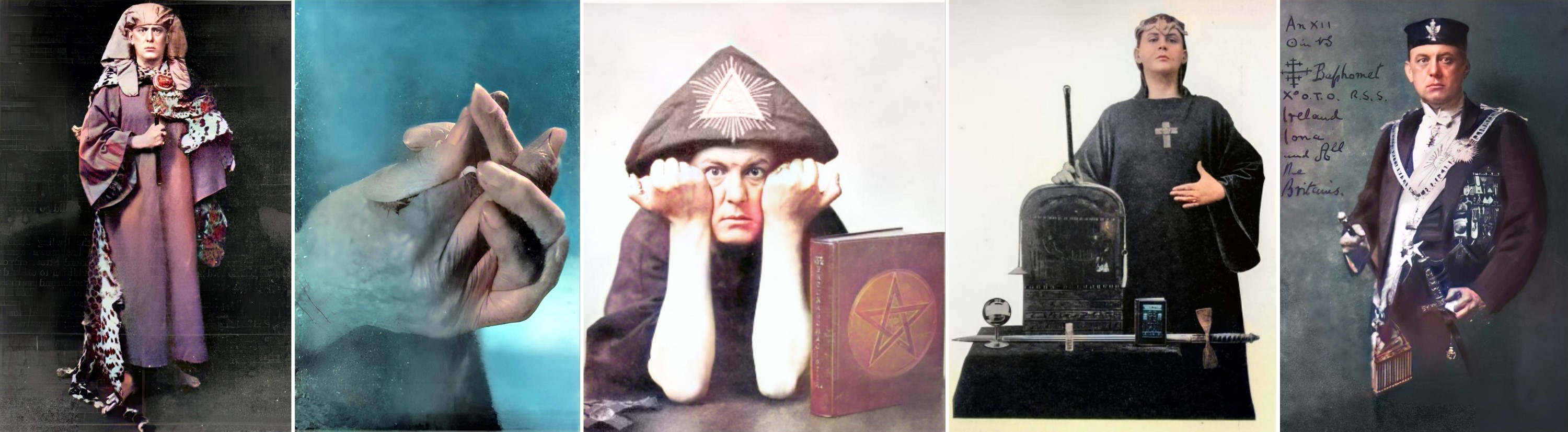
[Colored with AI]
Aleister Crowley's life, a paradoxical blend of opulence and chaos, is an odyssey through the annals of Western esotericism, marked by ambition, scandal, and an insatiable thirst for notoriety. Crowley, much like his contemporary Theodor Reuss, excelled in theatrically intertwining spirituality with its financial exploitation — a talent that underpinned much of his notoriety and his idolatrous appeal.
- English version: Aleister Crowley – A Biography
- Deutsche Version: Aleister Crowley – Eine Biographie
- Traduction française: Aleister Crowley – Une biographie
- Versione italiana: Aleister Crowley – Biografia
Aleister Crowley's O.T.O. rituals may appear deceptively simple at first glance, yet they follow a clearly discernible dramaturgy: they unfold like a precisely choreographed stage play, moving from poetically chivalric symbolism to an almost clinical directness. What begins veiled in the gestures of courtly allegory eventually culminates in a sober set of instructions for preparing an “Elixir” from bodily fluids — a transition that, one suspects, held particular appeal for those occult romantics who found insufficient “spice” in other secret societies. One high–degree text offers a curious blend of kitchen recipe and metaphysical dogma: “The Elixir… is to be preserved from contact with any material which might contaminate its purity” — a sentence that could just as well appear in a jam–making manual.
For those in search of a little taboo–breaking, there is the crucifixion of a frog. And here and there, a touch of anti–Semitism is worked in. In one “secret” instruction of the O.T.O., Crowley perpetuates a well–known anti–Semitic blood libel: he describes Jews as slaughtering the children of non–Jews for their Passover meals, in order to consume or use the blood for talismanic or sacramental purposes. His language betrays no trace of irony, presenting the claim as serious instruction: “Consider this.” From Crowley’s standpoint, anyone irritated by such accusations (and similar calumnies) is merely “monstrous and extravagant,” displaying nothing more than a “defect.” In other words, the fault, in his view, can never lie with the prophet Crowley, but must always reside in the reader’s own perception and judgment.
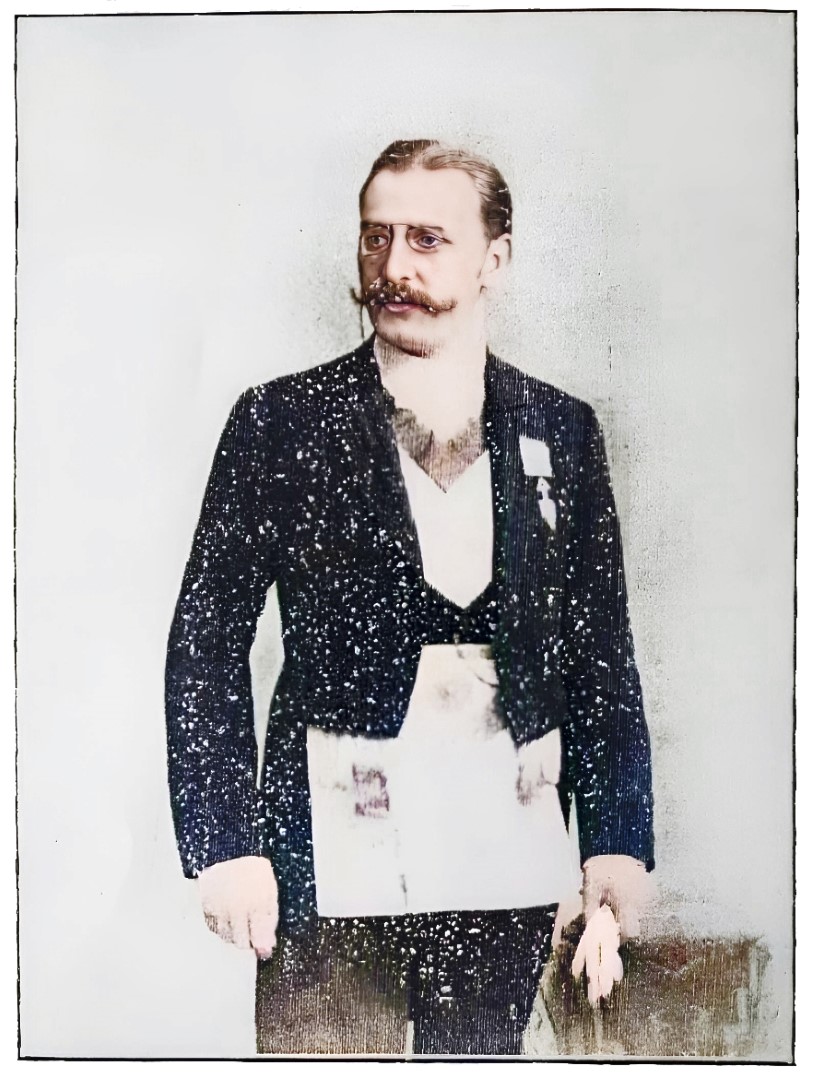
Theodor Reuss
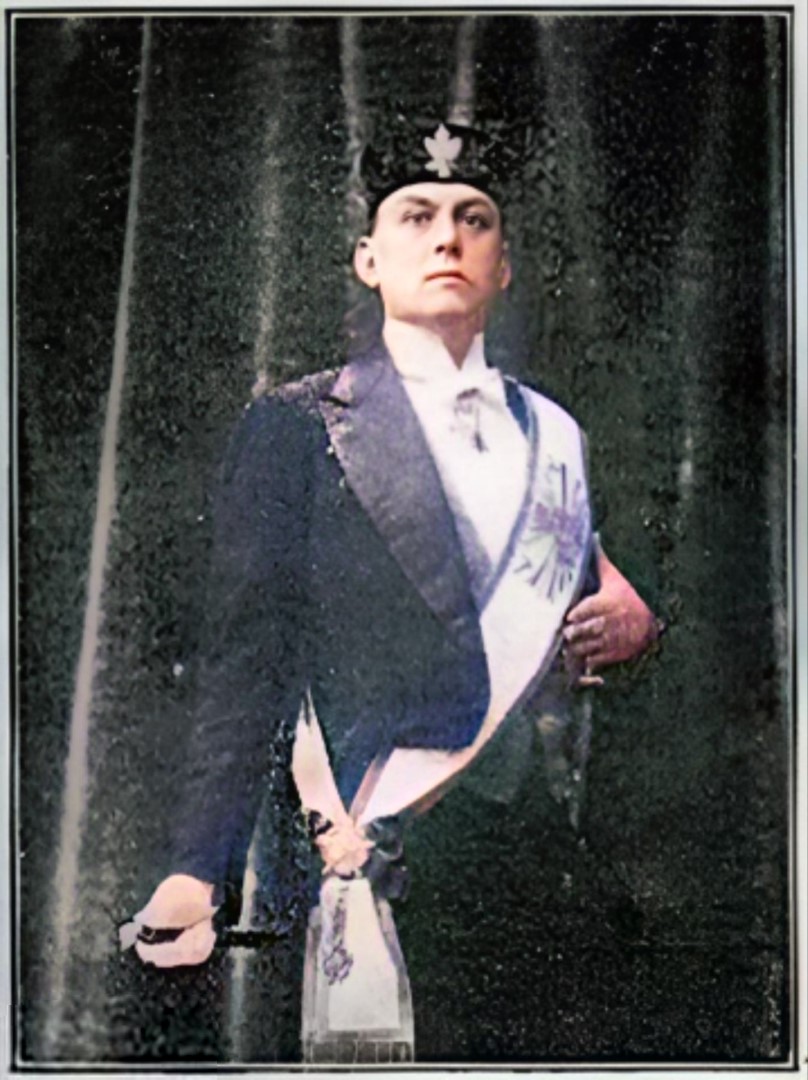
[Colored with AI]
Aleister Crowley
This 1998 interview dissects the O.T.O. as a chaotic blend of mysticism, opportunism, and theatrical absurdity. Emerging from Freemasonic traditions, the O.T.O. commodified spiritual legitimacy, with figures like Theodor Reuss selling charters and degrees, thus creating a labyrinth of pseudo–Masonic orders. Reuss’s eclectic mysticism culminated in Aleister Crowley, who refashioned his O.T.O. into a quasi–monarchical theater of self–glorification, draped in Thelemic doctrines and punctuated by rituals involving bodily fluids.
- English version: O.T.O. — Early Years and Development.
- Deutsche Version: Zur Geschichte des Ordo Templi Orientis.
- Versione italiana: Ordo Templi Orientis — I primi anni e la sua evoluzione.
- Traduction française: L’ancien O.T.O. et son évolution.
- Traducción castellana: O.T.O. — Original y su Desarrollo.
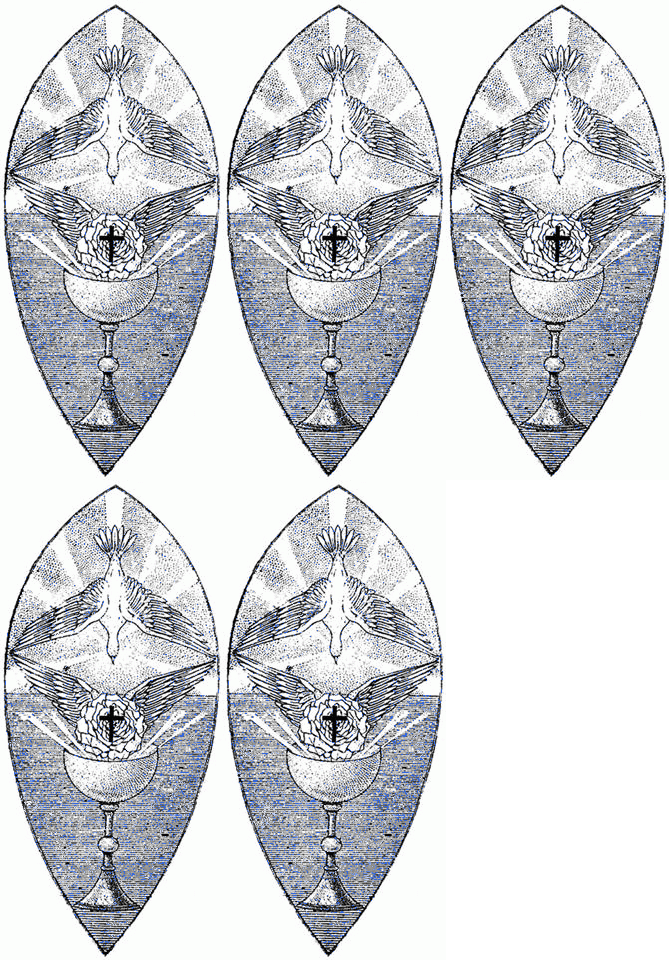
The pre–O.T.O. period under Theodor Reuss fused esotericism, opportunism, and a flair for mystic showmanship. Reuss drew inspiration from the Asiatic Brothers of the Rosy Cross, founded in 1781 by Hans Heinrich von Ecker und Eckhoffen, who claimed ties to the Seven Churches of Asia, blending Qabalistic and Gnostic elements into a pay–to–ascend system. Much like Ecker, Reuss attracted wealthy followers while facing accusations of financial exploitation, which he deflected with theatrical aplomb. His 1917 O.T.O. Constitution codified a hodgepodge of Craft Masonry, Rosicrucianism, and Illuminati symbolism, with rituals inspired by the 1866 "Der Signatstern" exposé of the Asiatic Brothers. Reuss modernized these rites by introducing a High Priestess, a nod to shifting gender sensibilities wrapped in a theatrical mystic veneer. Behind the mysticism lay a savvy marketer: Reuss admitted to Crowley that terms like “Hermetic Brotherhood of Light” were mere tactical rebrands. Reuss ultimately epitomized the spirit of late–19th–century occultism: a tireless architect of mystic systems, where spirituality and financial enterprise lived in uneasy but fruitful harmony.
- English: Theodor Reuss and the Brothers of Light in the Seven Churches of Asia. The origins of Brotherhood of Light of Theodor Reuss.
- Deutsch: Die Brueder des Lichtes der sieben Gemeinden in Asien. Theodor Reuss' Hermetische Bruderschaft des Lichtes.
- Français: Les Frères de Lumière dans les Sept Églises d'Asie. Les origines de la Fraternité de Lumière de Theodor Reuss.
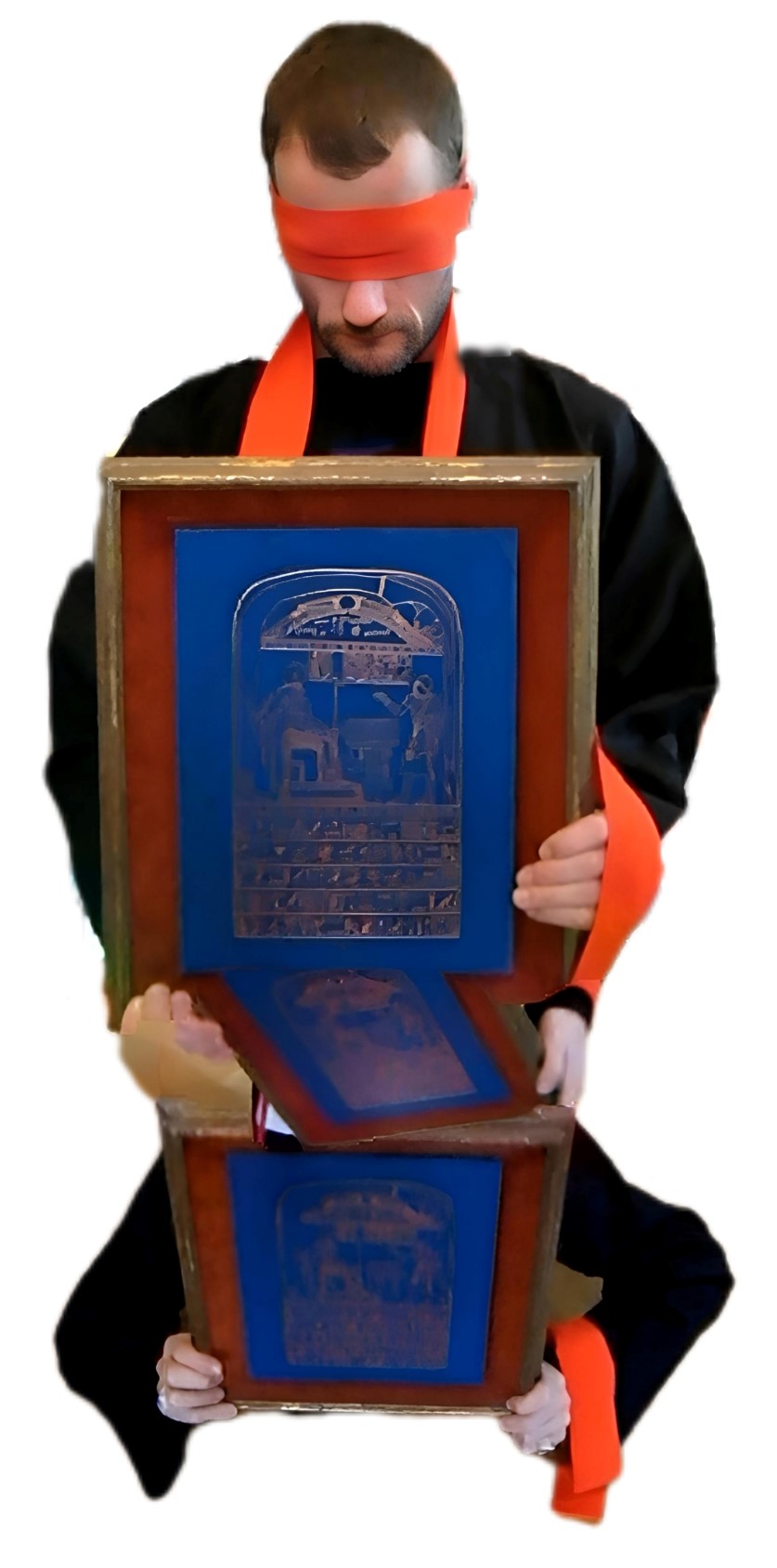
Rafal T. Prinke:
Czesław Czyński, a Polish occultist, moved through European circles of mesmerism, hypnotism, Martinism, and Reuss’s O.T.O. His biography is difficult to reconstruct because contemporary reports mix documents, self–advertisement, scandal, and claims of bilocation or clairvoyance. After a much–publicised Berlin bigamy trial, he entered the French occult revival around Gérald Encausse (Papus) and later became an important Martinist figure in Russia and Poland. His O.T.O. connection is significant but must not be overstated. In Reuss’s original scheme, the VII° admitted members to the O.T.O. proper and gave them theoretical access to the “sex secret”; it was not simply a practical sexual–magic degree. Rafal T. Prinke therefore offers a conjecture, not proof, that Czyński may have carried such teachings into Polish Martinist lodges. Press reports of Satanic rites, black masses, and ritual orgies belong to the history of accusation and scandal unless independently corroborated. His expulsion from the Martinists in 1926 and the later Order of the White Orient are documented; the lurid scenery around them requires more caution than the newspapers displayed.
- Deutsche Version: Polnischer Satanismus und Sexualmagie.
- English version: Polish Satanism and Sexmagic.
- Польский сатанизм и сексуальная магия.
Zbigniew Lagosz: NA OBRZEZACH RELIGII I FILOZOFII CZESLAW CZYNSKI.
The article "Na obrzeżach religii i filozofii" explores the historical tension between religious dogma and scientific rationalism, emphasizing the destabilization of traditional cosmologies due to modern scientific discoveries. This intellectual uncertainty led to a renewed interest in esoteric and occult traditions, which positioned themselves as alternatives to both religion and rationalism. Czesław Czyński, a Polish occultist active between the 19th and 20th centuries, exemplifies this shift, blending mystical traditions with contemporary philosophical and scientific currents. His involvement with the Martinist Order and later the Ordo Templi Orientis reflects a broader trend of syncretism in occult thought, where esotericism sought legitimacy through scientific and psychological discourse. The article also situates Czyński within the milieu of figures like Aleister Crowley, suggesting potential ideological or practical intersections, though definitive connections remain speculative. Ultimately, the study portrays Czyński as an enigmatic figure whose influence, while significant within Polish occultism, failed to reach the international prominence of his contemporaries.
Chronologically, we are approaching the death of Theodor Reuss in 1923. Yet, since the O.T.O. phenomenon moves in a vortex of interlocking currents and overlapping trajectories — topics at once seeming to converge and just as quickly to drift apart — it should be noted in advance that in 1936 Hans Rudolf Hilfiker claimed that John Yarker’s charter had endorsed him as Reuss’s successor. Hilfiker declared the O.T.O. defunct upon Reuss's death and regarded it as non–existent. He revived the Memphis–Misraim Rite under the leadership of Constant Chevillon, maintaining a deliberate distance from Crowley. With Chevillon’s collaboration, and with the assistance of Reuben Swinburne Clymer, he sought to unite Rosicrucian orders.
Chevillon consecrated Arnoldo Krumm–Heller in 1939, but was murdered by the Gestapo in 1944.
Let us for the moment concern ourselves with Hilfiker, who during Reuss’s lifetime was to play a significant rôle in the German–speaking O.T.O. The matter of Reuss’s death will be addressed in the following chapter but one, after examining Rudolf Steiner’s relationship with Reuss.
Consider the O.T.O. non existent.
- Variation française : Hans Rudolf Hilfiker (1882–1955) de la Verità Mistica sur le Monte Verità et de la Libertas et Fraternitas à Zurich se considérait après la mort de Theodor Reuss en 1923 comme son successeur et en 1936 l'O.T.O. comme non existant.
Beaucoup de documents et un fac–similé d'une nécrologie. Cette traduction contient, par rapport à d'autres versions en ligne, des documents supplémentaires concernant exclusivement Hilfiker. - Versione italiana: Considerare l'O.T.O. inesistente.
- Traducción castellana: Consideraban a la O.T.O. como no existente.
- Česká verze: Veritas Mystica Maxima.
The Monte Verità community was founded in 1900 around Ida Hofmann, Henri Oedenkoven, and their collaborators. Hofmann brought Theodor Reuss to the colony in January 1916; he promptly founded the O.T.O. lodge Verità Mistica. Oedenkoven’s wife Isabella reached the VII°, but the surviving material does not justify the simpler claim that Reuss merely “made Hofmann and Oedenkoven members”. The artistic colony, Rudolf Laban’s dance milieu, and Reuss’s lodge overlapped without becoming identical. Financial tensions, competing authorities, and Reuss’s habit of turning every contact into an order relationship soon produced conflict. By 1917/18 the constellation had fragmented, while Monte Verità continued its quite different career as a centre of modernist experiment.
- Discover the key figures and texts associated with Monte Verità and the O.T.O. through this curated selection of protagonists and documents.
Letter from Engelhard Pargaetzi to Hans Rudolf Hilfiker, April 4, 1920: Quarrel in Theodor Reuss' Swiss O.T.O. lodge.
Declaration that the relations between the Grand Orient and Theodor Reuss were definitely past history.
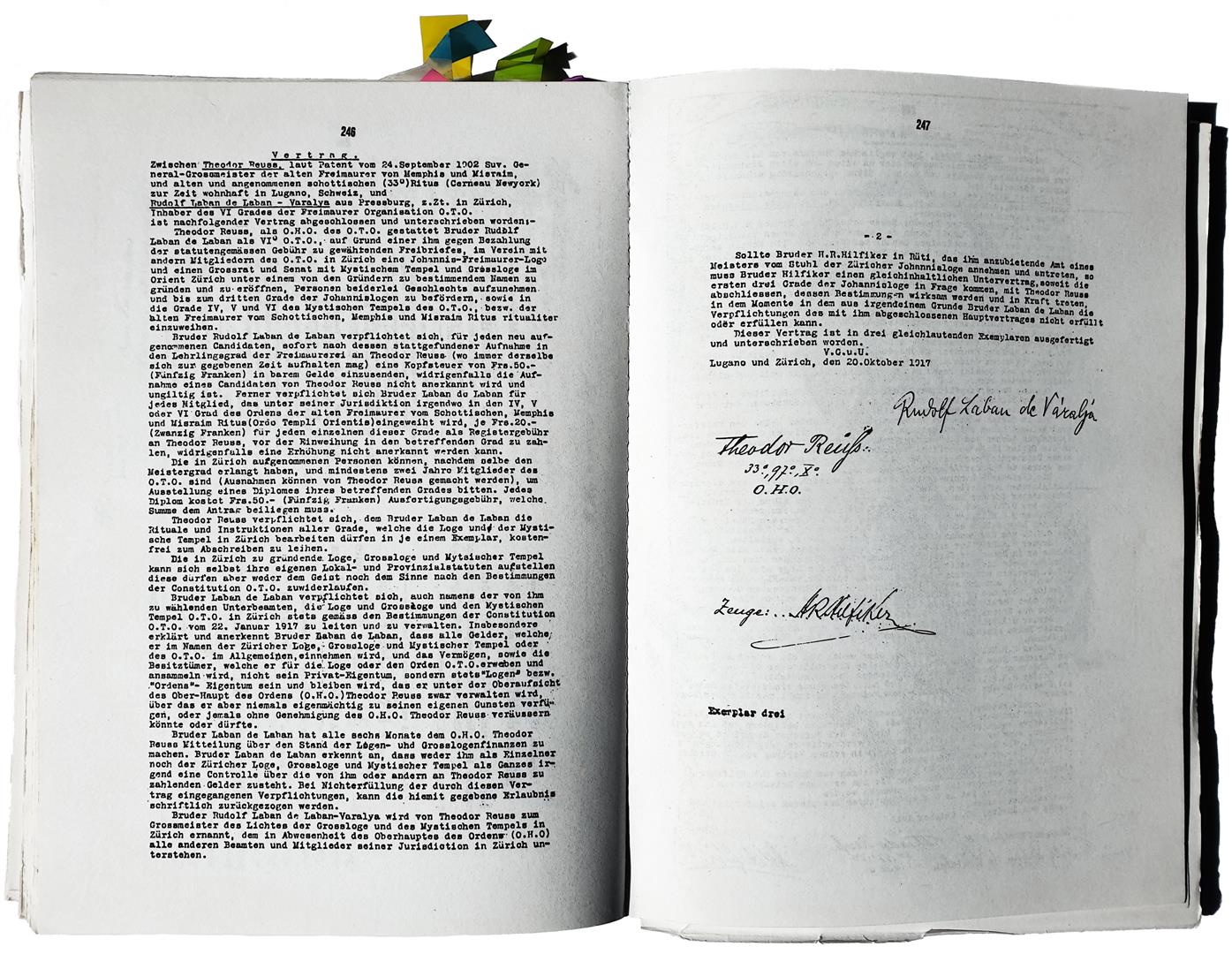
1917 Vertrag / Contract Theodor Reuss — Laban de Laban
[From: "Der Grosse Theodor Reuss Reader"]
[Gallery of some documents relating to Theodor Reuss.]
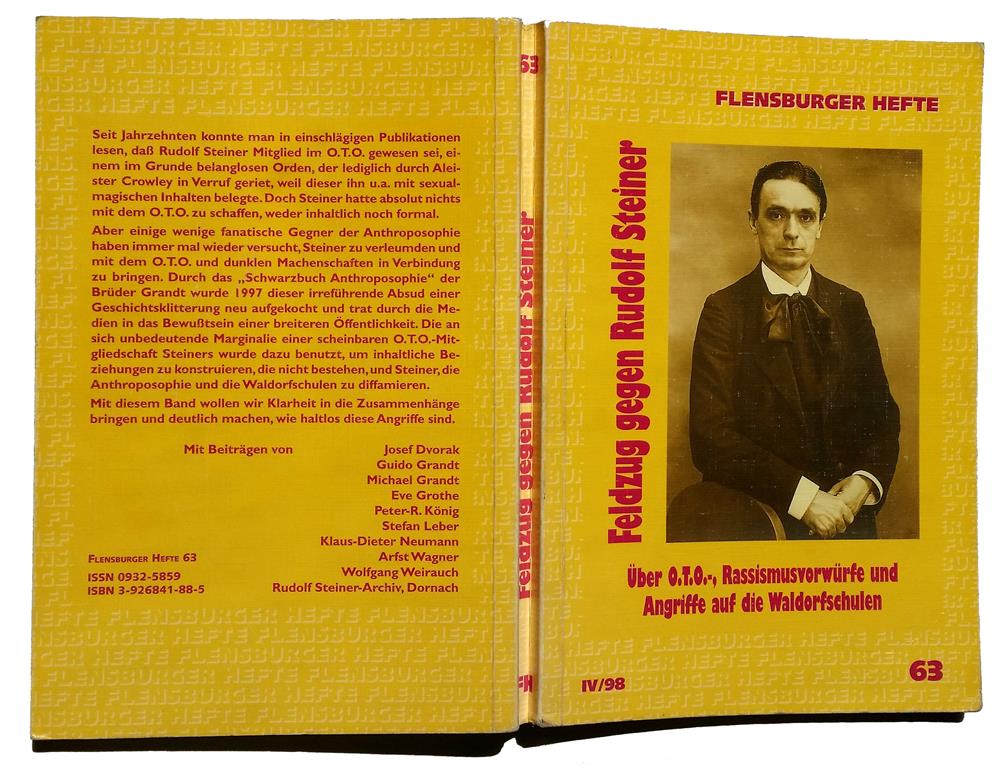
[From: "Feldzug gegen Rudolf Steiner", Flensburger Hefte 63 IV/98, Flensburg 1998]
Rudolf Steiner: Not a member of the O.T.O.
After decades of incomplete media reports and propaganda efforts by biased parties regarding Rudolf Steiner's alleged membership in Theodor Reuss' German lodge of the Ordo Templi Orientis, the archive of Rudolf Steiner's probate has finally opened its vault. This has given historians the necessary evidence to put the matter to rest. There is no evidence to suggest that Rudolf Steiner ever accepted anything from Theodor Reuss, except for his permission to use the term "Misraim". Additionally, there is no documentation that proves Steiner was ever a member of the Ordo Templi Orientis.
- Deutsche Version: Rudolf Steiner: Niemals Mitglied irgendeines O.T.O.
- Traduction française: Rudolf Steiner : Jamais membre d'un quelconque O.T.O.
- Dutch version: Theodor Reuss en Rudolf Steiner.
- Traducere în română: Rudolf Steiner: niciodata membru al vre–unui Ordo Templi Orientis.
- По русски: Рудольф Штайнер: никогда не был членом какого–нибудь Ordo Templi Orientis.
Online facsimile documents regarding Reuss and Steiner.
Two letters from Theodor Reuss concerning Franz Hartmann / Rudolf Steiner.
"Gestatten, Under–Cover Agent Peter–R. König" — Ein Interview für die 'Flensburger Hefte' zum Thema "Feldzug gegen Rudolf Steiner".
In an interview with Wolfgang Weirauch, König critiques the "Schwarzbuch Anthroposophie" by the Grandt brothers, a polemical work aimed at discrediting Rudolf Steiner. He characterizes their approach as a rhetorical strategy designed more to attract media attention than to ensure factual accuracy. He further underscores their reliance on selectively curated sources to substantiate their claims. Ultimately, König interprets their methods as a form of sensationalist “victimhood journalism”, in which personal attacks and misinformation take precedence over scholarly integrity.
Quellenedition Konfliktarchiv
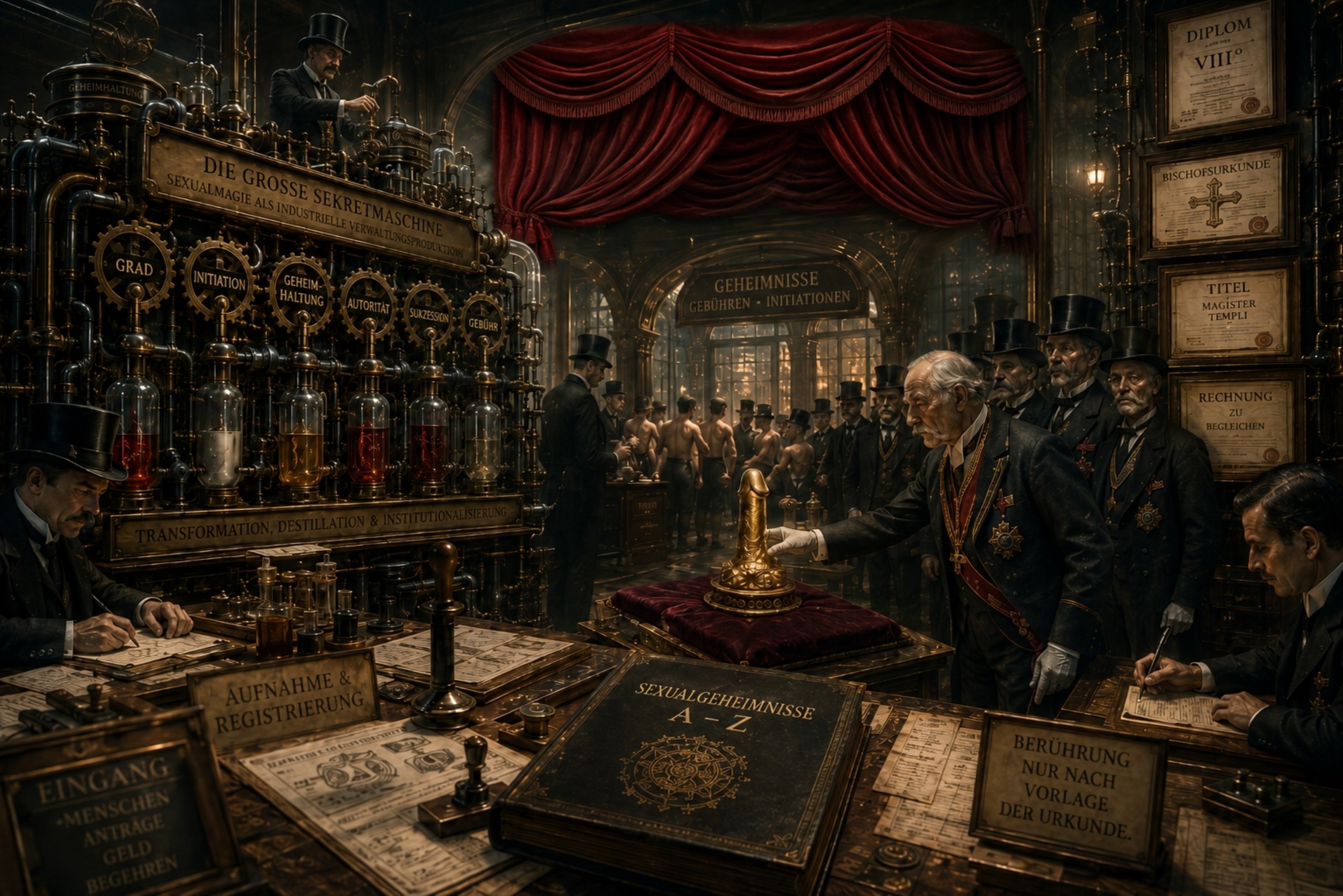
[AI-generiertes Image]
Ein frühes Dokument Adolf von Leonardis über Leopold Engel und sein Umfeld öffnet hier nur die Tür zu einem weit grösseren Konfliktarchiv um Theodor Reuss. Von 1900 bis 1921 ziehen sich die Akten durch Martinismus, Illuminaten-Orden und O.T.O., von Engel und Carl Kellner über Rudolf von Laban und Hans Rudolf Hilfiker bis zu Aleister Crowley: Hypnotismus, Geld und Darlehen, Kopfsteuern, Diplome und Chartas, Hatha-Yoga, sexuelle Vorwürfe, Lingam-Yoni, Schweizer Verträge, Prozesse, Austritte, Ausschlüsse und immer neue Kämpfe um Legitimität und Autorität. Die Quellenedition versammelt Briefe, Verträge, Patente, Polemiken und andere Dokumente zu einem Dossier darüber, wie Reuss seine Stellung durch Schriftstücke, persönliche Beziehungen, Gebühren, Ernennungen und Anerkennungsakte immer wieder neu herstellen musste — und wie die dabei produzierten Orden, Grade, Chartas und Nachfolgeansprüche ihn noch lange überlebten.
Succession, Legacy, and Sacral Usurpation after Theodor Reuss
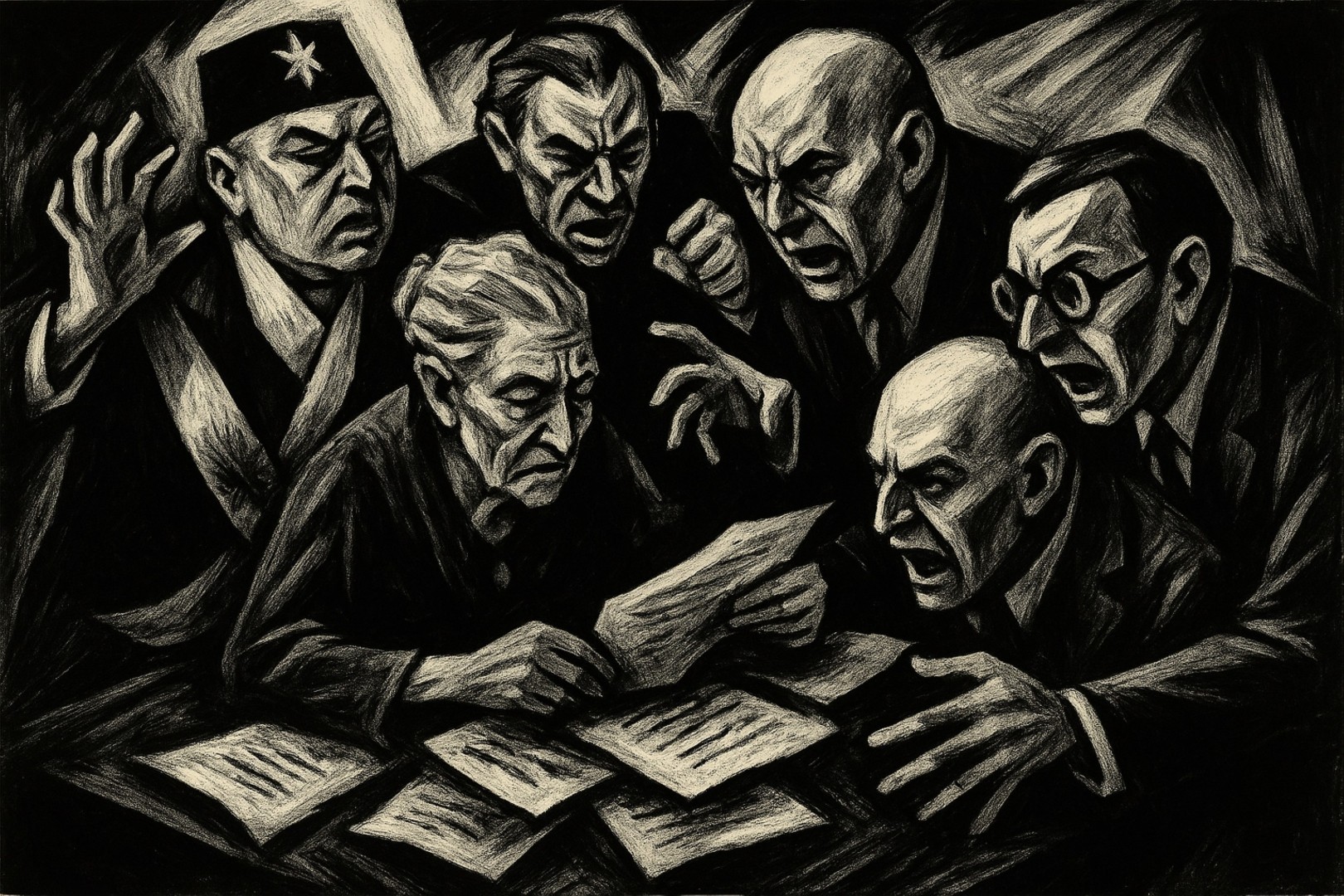
[AI-generated Image]
When Theodor Reuss died in October 1923, he left behind not merely an esoteric organization without a clear rule of succession, but also a symbolically charged estate whose disposition would shape the development of the Ordo Templi Orientis for decades. The ensuing struggle for power was conducted not on a juridical plane, but on sacral, political, and rhetorical terrain. As Heinrich Tränker, Charles Stansfeld Jones, and Aleister Crowley each articulated his claim to succession, questions of ownership, legitimacy, and spiritual authority became inextricably entangled. What begins here is an ideological and structural rupture in which the question “Who is the O.H.O.?” signifies far more than a matter of personnel — it becomes a question about the very nature of esoteric authority itself.
The Sealed Shrine
Dramatis Personae:
- Pauline Reuss, the Custodian of the Emblems
- Aleister Crowley, the Prophet
- Heinrich Tränker, the Negotiator
- Charles Stansfeld Jones, the Doubter
- Hans Rudolf Hilfiker, the Silent Heir
- Theodor Reuss, as a Spirit
The New Rosicrucians

Spencer Lewis and the O.T.O. which is a chapter of my 'Der O.T.O. Phänomen RELOAD'.
The history of the O.T.O. and the Antiquus Mysticus Ordo Rosae Crucis (A.M.O.R.C.) is a saga of ambition, opportunism, and fragile alliances. Theodor Reuss, perpetually in need of funds, offered Spencer Lewis inflated titles and a tenuous connection to Rosicrucianism in exchange for financial backing. Lewis, eager for legitimacy, saw in Reuss’s O.T.O. a useful façade but quickly distanced himself when Reuss’s demands grew excessive. Aleister Crowley, claiming leadership of the O.T.O., attempted to co–opt A.M.O.R.C. in 1935 through legal threats and bizarre schemes, only to be rebuffed. Reuss died in poverty, Crowley spiraled into financial ruin, and Lewis consolidated his position through clever marketing and alliances like FUDOSI. Behind their lofty claims of spiritual authority lies a tale of forged documents, contested charters, and bitter rivalries.
A.M.O.R.C.: Controverse Autour d'un Document — Harvey Spencer Lewis et l'O.T.O.
Robert Vanloo:
Vanloo's study examines the debated origins of the Ancient and Mystical Order Rosae Crucis (A.M.O.R.C.), questioning whether it was influenced by the Ordo Templi Orientis (O.T.O.). The controversy stems from a document held at the New York Public Library, which includes a handwritten "O.T.O." annotation, suggesting early ties between Harvey Spencer Lewis (A.M.O.R.C.'s founder) and the O.T.O. before his official 1921 charter from Theodor Reuss. A.M.O.R.C. denies the annotation's authenticity, asserting that the original lacks such a reference. Vanloo challenges this claim, arguing that the signature of A.M.O.R.C.'s early secretary, Thor Kiimalehto, matches the handwriting of the "O.T.O." addition, making forgery unlikely. The study further explores Lewis's evolving claims of Rosicrucian authority, shifting from alleged European initiations to affiliations with figures like Reuss and Heinrich Tränker. Crowley's correspondence with Lewis in 1918 and 1935 suggests that Lewis sought recognition from O.T.O. but distanced himself publicly. Vanloo concludes that while A.M.O.R.C. incorporated elements from O.T.O., it is ultimately Lewis’s creation, blending multiple esoteric influences. The study highlights how Lewis strategically sought affiliations to bolster legitimacy, raising broader questions about authenticity in modern esoteric organizations.
- Is the A.M.O.R.C. an offspring of the O.T.O. or not ?
- Version française: L’Ancien et Mystique Ordre de la Rose–Croix dérive–t–il de l’Ordre du Temple Oriental?
A.M.O.R.C.'s letter.
H. Spencer Lewis and Theodor Reuss.
- Version française: H. Spencer Lewis et Theodor Reuss.
Additional context can be found in this gallery.

Conqueror of the Grail.
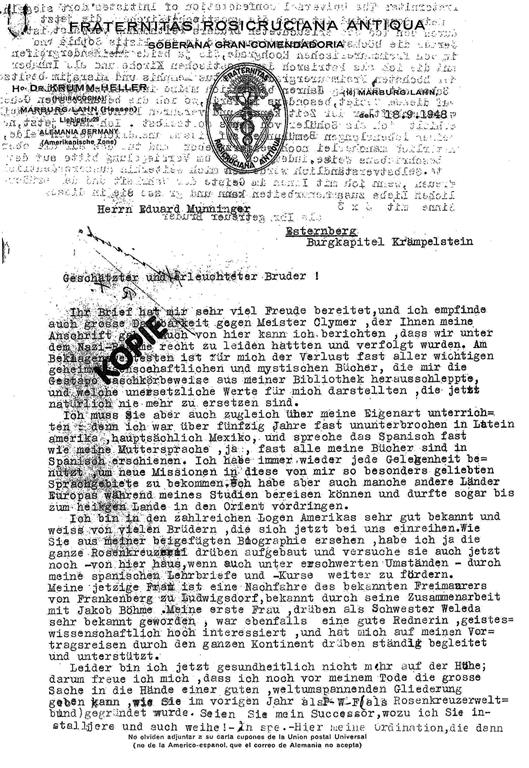
Arnoldo Krumm–Heller was a complex and multifaceted figure whose influence in Latin America surpassed Aleister Crowley’s in the Anglophone world, despite Crowley’s greater posthumous fame. The text highlights Krumm–Heller’s commitment to gnosticism, homoeopathy, and political engagement, portraying him as a vitalist who rejected materialism in favor of a spiritual worldview shaped by indigenous traditions. Yet this professed disdain for materialism sits uneasily with his considerable wealth: in Mexico, he amassed land, petroleum stocks, a mortgage–free tenement with 21 apartments, and a villa in Mixcoac. His identification with Mexico over Germany reflects his ideological and national loyalties, though his admiration for Hitlerianism remains an uncomfortable undercurrent. The essay discusses Crowley’s libertinism and hierarchical O.T.O. structure, contrasting it with Krumm–Heller’s more pragmatic and socially engaged esotericism, particularly regarding sexuality and spiritual discipline. Yet his gnostic vision carries a latent authoritarianism, notably in his claim that gnostic teachings could mold individuals into quasi–fascist leaders. While his legacy persists in Latin American esoteric circles, his gender essentialism and patriarchal views, especially on sexual control and women’s rôles, cast him as a product of his time rather than a revolutionary thinker.
- Traduction française: Le conquérant du graal — Arnoldo Krumm–Heller.
- Tradução portuguesa: O Conquistador do Graal.
- По русски: Завоеватель Грааля — Арнольдо Крумм–Хеллер.
Baphomet and Rosycross.
Before 1912, Krumm-Heller was already deeply embedded in esotericism: a Theosophist (since 1897) and Martinist, present at Gérard Encausse's (Papus) Paris experiments in 1906; from 1908 commissioned by Theodor Reuss with high Memphis–Misraim grades and authority for Mexico/Chile/Peru/Bolivia, under which — within Papus’s jurisdiction — he founded temples. In parallel he established a gnostic succession via E. C. H. Peithmann with his own Gnostic Church (including a rose-burning healing rite), published in the 1910 Humboldt Festschrift, and maintained ties with figures such as Franz Hartmann and the Freemason Jesús Medina — by 1912 a well-networked, ritually and organisationally hyperactive occultist.
Around 1912, Krumm-Heller stood at the heart of revolutionary Mexico while continuing his esoteric publishing.
Politically, he moved through the uprisings against José de la Cruz Porfirio Díaz Mori — the authoritarian long-time strongman who pursued “order and progress” via centralised power, oligarchic alliances, and foreign capital, and who fought against democratic opposition, free elections, and popular movements — and alongside Francisco I. Madero, the liberal-revolutionary champion of Sufragio efectivo, no reelección (effective suffrage, no re-election), who fought for democracy and the rule of law and against Díaz’s autocracy and repression. In this setting Krumm-Heller worked between field hospitals and the front, was pursued by opponents, and was ultimately imprisoned in the military gaol of Santiago Tlaltelolco — episodes he himself dates to 1912 and 1916 and later summarised in Für Freiheit und Recht (1917). In the same year, No fornicarás. Instrucciones sólo para ocultistas appeared in Mexico with Librería de la Viuda de Ch. Bouret — a slim, programmatic booklet securely attested for 1912, with an inscribed copy held in Madero’s library.
→ Arnoldo Krumm-Heller's No Fornicarás.
Doctrinally, he adapted Peithmann’s hard gnostic idiom into a measured practice: a pre-Thelemic, gnostic-ascetic programme of continence, retention/Karezza and sublimation — “arousal yes, discharge no” — to conserve the “light-seed/Logos” and raise the seminal current to the brain/pineal gland; less a catalogue of virtues than a user’s manual of transmutation, and explicitly distinct from Aleister Crowley’s later libertine-operational sacramentalisation of sex. Only later, in 1930, did Krumm-Heller meet Crowley (and Karl Germer) in Berlin, by which time his Mexican-formed profile and printed programme were long in place; he was consecrated a gnostic bishop in 1939.
He died on 19 May 1949 at 11:30 a.m. at his home in Marburg an der Lahn (Hesse, American Zone), bearing the style Dr Dr med. honoris causa. He left his third wife (apparently married in 1945), Maria Luisa Elisabeth Frieda Julie von Diringshofen of the Potsdam nobility, and his children: Hiram Aguirre (from his first marriage, in Concepción, Chile) and, by Carlotta, Guadalupe, Cuauhtémoc, Sieglinde, and the economist Parsival.
- Version française: Fraternité Rosicrucienne Antique. L'histoire de la F.R.A. n'échappe pas à l'agitation habituelle aux mouvements ésotériques ou maçonniques. Beaucoup des protagonistes de cette histoire furent également membres d'autres organisations, francs–maçons, martinistes, théosophes, et autres. C'est donc avec intérêt que le lecteur pourra recouper les informations contenues dans cet article avec d'autres études où l'on retrouve ses personnages.
- Dutch version: Fraternitas Rosicruciana Antiqua.
Dance the Adolf Hitler. This page presents English and German translations of Arnoldo Krumm–Heller’s “Hitlerianismo” and “El Problema Judío y Jesús el Nazareno.” Warning: the texts are overtly racist and function as examples of extreme anti-Semitic propaganda. It examines Krumm–Heller’s positions on Hitlerianismo and the notion of raza superior, and documents his anti-Semitic rhetoric (e.g., “sino Judíos los estafadores”) in Rosa–Cruz. Further context includes his son’s enrolment in a NAPOLA and Krumm–Heller’s use of the salutation “Heil Hitler” in correspondence.
Also featured are outtakes from Basil Thomson’s Queer People — Curious Visitor and a specially commissioned contribution by John Gaster, “Krumm–Heller in England.”
Eduard Munninger: Roses in Austria.
Munninger was a key figure in the Austrian Rosicrucian movement, shaping it through his order, Antiquus Arcanus Ordo Rosae Rubeae et Aureae Crucis (A.A.O.R.R.A.C.), while also transforming Burg Krämpelstein into a center for artists and esotericists. His ambiguous political position during the Nazi era led to government investigations, but he was later rehabilitated by the denazification commission. After World War II, he sought to unite various Rosicrucian factions, exchanged writings with international esoteric figures such as Reuben Swinburne Clymer, and attempted to establish a “Spiritual Culture Union”. Despite his organizational ambitions, his order remained fragmented, plagued by internal disputes and rivalries with groups like A.M.O.R.C., which hindered its long–term success. A public conflict with the tabloid press resulted in a high–profile lawsuit against Bild–Zeitung, but his influence declined after his death in 1965, with his son Thomas continuing the order for a few more years. Later attempts to revive the A.A.O.R.R.A.C. failed due to internal power struggles, financial difficulties, and the overall decline of the Rosicrucian movement in Austria.
The appointment of Munninger as the successor to Krumm–Heller is a particularly noteworthy event in the history of these organizations.
A gallery of protagonists and documents.
Of Booksellers and other Grand Masters of the O.T.O.
This article contains detailed biographies of Heinrich Traenker, Karl Germer, Henri Birven, Spencer Lewis, C.H. Petersen, and Eduard Munninger, who were all influential figures in the O.T.O. Additionally, it explores their relationships with the organization under the leadership of Reuss, Crowley, and H.J. Metzger.
Furthermore, the article provides Henri Birven's "Obituary on Karl Germer", which sheds light on Crowley's visit to Berlin in 1930.
Heinrich Tränker was a vibrant figure in the tumultuous world of early 20th–century German esotericism. As a Leipzig bookseller, he navigated financial collapse, founded the Pansophic movement, and collaborated with numerous occultists, including Theodor Reuss and Aleister Crowley, albeit with deep skepticism regarding their methodologies. In 1921, as the German Grand Master of Reuss' O.T.O., Tränker established Pansophia, an organization dedicated to publishing significant Rosicrucian texts and early writings of Crowley. The term "Pansophia" had previously been used by Reuss and Krumm–Heller in their letterheads and stamps, reflecting its resonance within broader esoteric circles. Despite his disdain for the O.T.O., which he criticized as structurally flawed, Tränker embraced leadership rôles, adopting noms de guerre such as Henkelkreuzmann [Ankh Man], Recnartus, Greif or Garuda. Following Reuss' death in 1923, the remaining Tenth Degree members, including Tränker and the American Grand Master C.R.J. Stansfeld Jones, were tasked with electing a new Outer Head of the Order (OHO). At the ill–fated Weida Conference of 1925, they initially endorsed Aleister Crowley as a "World Saviour", only to swiftly retract their support.
Pansophia disbanded after Traenker's death in 1956.
- 'Das O.T.O.–Phänomen', 1994, online–version.
- Heinrich Tränker und der O.T.O., auf Deutsch.
- Heinrich / Henri Birven über Karl Germer, mit Details zu Heinrich Tränker, Martha Kuentzel, Gerald Yorke, Aleister Crowley.
- Heinrich Traenker, O.H.O. of the O.T.O. in Germany: Die Sexualmysterien der Pansophie.
- Karl Germer about Heinrich Traenker. Letter to Max Schneider.
- Ritual I der Agape. Logos pneumaticos, Logos spermaticos.
- A.M.O.R.C., Martin Erler, ORA, Heinrich Traenker, Pansophie, H.J. Metzger, Schweizer O.T.O., Schikowski – H.D. H: Mein Besuch bei Heinrich Traenker / English translation: My visit to Heinrich Traenker.
- 'Das Beste von Heinrich Tränker'.
- Selection of on–line documents.
Fraternitas Saturni
Albin Grau first gained public recognition in 1922 through his work as production designer for the silent film Nosferatu — Eine Symphonie des Grauens. In addition to his contributions to UFA (Universum Film AG), he was active within the esoteric milieu of the Weimar Republic.
In 1921, Heinrich Tränker founded the Pansophical Lodge. Albin Grau was appointed Chair Master (Meister vom Stuhl) of the Berlin Orient, and Eugen Grosche served as the lodge secretary.
In 1925, a meeting took place in Germany between Aleister Crowley, Heinrich Tränker, and Karl Germer. Grau became entangled in the resulting conflicts and soon distanced himself from both Tränker and Crowley. In retrospect, he would characterize his association with Crowley as a mistake. This schism resulted in the fragmentation of the broader Pansophic network: Tränker’s O.T.O./Pansophia survived only in diminished form, while a new publishing initiative, Thelema-Gesellschaft in Leipzig, coalesced around Martha Küntzel and Karl Germer. From the Berlin working group of the Pansophic movement, the Fraternitas Saturni ultimately emerged under the leadership of Eugen Grosche. Grau was central to the intellectual and symbolic design of the new lodge.
The Fraternitas Saturni refers to itself as a “lodge” rather than an “order” because it stages itself as a working, quasi–Masonic circle rather than as a hierarchical structure of obedience in the style of a chivalric or religious order. Calling itself a lodge signals ritual work directed toward individual consciousness and saturnian self–development; it frames activity as inward, technical, initiatory practice.
The Fraternitas Saturni belongs to the wider milieu examined here through overlapping personnel, correspondence, publications, and competing claims to esoteric authority. Its designation as a lodge draws on Masonic forms. Grades, leadership claims, and personal autonomy have to be examined in their particular historical settings.
The surviving documents record different kinds of activity: lodge ceremonies, lectures and administration, experiments in smaller circles, and the personal work of individual members. A ritual instruction establishes what an author prescribed; it does not by itself establish what a lodge regularly performed. Living rooms and studies could become lodge rooms for a particular occasion, while other practices remained individual or involved only a few participants. Access, household arrangements, employment, money, and available time helped determine what could take place.
Eugen Grosche: Bericht über die Konferenz im Jahre 1926 in Thüringen / Weida: Crowley's disastrous visit to the homes of Heinrich Tränker and Karl Germer.
- Deutsch: Bericht über die "Geheim-Konferenz im Jahre 1926 in Thüringen"
- English: Report on the "Secret Conference in Thuringia in the Year 1926"
- Français : Rapport sur la « Conférence secrète de Thuringe en 1926 »
Closure of the "Pansophic Lodge", 1928.
Constitution of the "Secret Lodge Fraternitas Saturni", 1928.
Grau features prominently in the inaugural issue of the lodge periodical of the Fraternitas Saturni. His writings and diagrammatic contributions serve as a foundational element of the order’s symbolic identity. The Fraternitas Saturni did not present itself as a continuation of prior systems, but rather as an autonomous construct with a distinct cosmological and ritual framework.
History & Protagonisten
In Nomine Demiurgi Nosferati.
- Tradução portuguesa: In Nomine Demiurgi Nosferati.
- Dutch version: In Nomine Demiurgi Nosferati.
- Versiune română: Fraternitas Saturni. Istorie și protagoniști.
In my analyses, Saturn–Gnosis names a field of ideas, images, and claims to knowledge associated with the Fraternitas Saturni. The historical vocabulary includes the journal Saturn-Gnosis of 1928/29 and Johannes Göggelmann’s Saturnische Gnosis of 1953 in the postwar publications. My analytical use of the term draws on that vocabulary without treating its different occurrences as expressions of one coherent doctrine.
Grosche’s writings, Göggelmann’s speculations, and the constructions of Guido Wolther, Walter Jantschik, and Johannes Maikowski share references and sometimes borrow from one another. Their cosmologies, techniques, and ambitions nevertheless differ. Saturnian symbolism could authorise a personal claim, support a hierarchy, furnish a ritual, or organise a private interpretation of experience. These functions must be established from the particular document and its circulation, rather than inferred from a common label.
Since the 1990s, esoteric literature on the Fraternitas Saturni has increasingly claimed that its central initiatory principle lies in the doctrine of “Fire and Ice.” This reading, however, stems more from retrospective reinterpretation by later members — seeking alignment with contemporary symbolic expectations — than from any grounded analysis of early Grosche–era texts. Former members and Grand Masters consistently report no encounter with such a doctrine in either lodge practice or theoretical instruction. Upon closer examination, references to “Fire and Ice” in Grosche’s writings emerge as primarily stylistic constructs — a semantic surplus lacking operative substance.
The motif serves mood–setting and literary functions within the framework of Saturnian self–conception. Spiritual development is framed as a dialectic between destructive force (fire) and preserving form (ice), yet in practice, fire is subordinated to a controlled, authoritarian model of the self. The writings of the Fraternitas Saturni oscillate between lofty spiritual rhetoric and concrete magical technique. “Fire and Ice” thus fails to operate as a consistent or methodologically grounded model of knowledge and instead functions as mythopoetic ornamentation.
The theme’s narrative elevation arose from a particular moment in the lodge’s reception history: in the 1990s, younger members began using it as a tool of self–stylization, presenting themselves as guardians of exclusive esoteric insight. Subsequently, the theme was echoed by academic voices — partly through personal proximity, partly through uncritical adoption — and diffused into scholarly literature with little scrutiny. The resulting semantic inflation owes less to historical substance than to a complex interplay of esoteric–semiotic prestige economy, international reception dynamics, and the usual dose of academic herd behavior.
[AI–generated Image]
Modern History
The public image of the Fraternitas Saturni owes much to a small number of prolific or conspicuous members: Eugen Grosche (Gregor A. Gregorius), Guido Wolther (Daniel), Walter Jantschik (Jananda), Johannes Maikowski (Immanuel), and Johannes Göggelmann (Saturnius). Their prominence in the surviving material does not make their individual activities representative of the whole fraternity. The history of the milieu and the history of its public image overlap, but do not coincide.
Among the documents circulated by Adolf Hemberger and taken up by Horst Knaut and other commentators was Göggelmann’s account of having ritually killed a cat in the woods on January 8, 1955. The account establishes what Göggelmann wrote; its later publication establishes how that writing was used. Neither step independently verifies the event or turns it into a description of regular lodge activity. Selection, editing, and attribution helped an individual report acquire the appearance of an institutional characteristic.
From the 1970s onward, tabloid reporting and religiously or politically motivated criticism brought such material to a wider readership. Members also supplied, disputed, and recirculated documents. Scandal was produced through this traffic between personal writing, internal conflict, compilation, and public reporting. The most spectacular fragment could become the best-known one without becoming the most typical.
After Grosche’s death in 1964, competing groups claimed the inheritance of the Fraternitas Saturni. Names, grades, ritual papers, publications, and memories of appointments became resources in these disputes. Continuities of vocabulary or ceremonial style do not establish identical practice across generations and factions; later developments cannot silently describe the earlier fraternity.
[AI–generated Image]
Interne Konflikte und Symbolpolitik
Skandalisierung, Mythos und Dekonstruktion des Johannes Göggelmann (Saturnius) in der Fraternitas Saturni.
Die Untersuchung verfolgt, wie Johannes Göggelmanns Briefe, Zeichnungen und Berichte innerhalb des Milieus zirkulierten und durch Adolf Hemberger, Horst Knaut und Friedrich-Wilhelm Haack öffentlich gerahmt wurden. Göggelmann ist dabei ein aufschlussreicher Fall für die Verwandlung persönlicher Dokumente in ein Bild der gesamten Loge. Seine Stellung am Rand und die Intensität seiner eigenen Arbeit machen ihn jedoch nicht zum typischen F.S.-Mitglied.
Hembergers Zusammenstellungen, Knauts Boulevardtexte und Haacks konfessionelle Kritik besitzen unterschiedliche Interessen und Quellenbedingungen. Ausgewählte Berichte wurden bearbeitet, miteinander verknüpft und als Belege für „okkulten Wahnsinn“ oder eine vermeintlich einheitliche satanische Praxis gelesen. Der Weg vom einzelnen Dokument zur kollektiven Zuschreibung gehört deshalb selbst zur Untersuchung.
Walter Jantschik, Guido Wolther, Johannes Maikowski und andere Beteiligte erscheinen in dieser Geschichte zugleich als Gegenstand, Lieferanten oder Kritiker solcher Darstellungen. Wer Material weitergab, konnte dessen spätere Verwendung bekämpfen; wer eine Zuschreibung zurückwies, konnte an anderer Stelle selbst eine verbreiten. Kontrolle über Dokumente, Geheimnisse und Deutungen war Teil der internen Auseinandersetzungen.
Göggelmanns Äusserungen werden in ihren Entstehungsbedingungen und Überlieferungswegen gelesen: als persönliche Entwürfe, Selbstbeschreibungen und Versuchsberichte, deren spätere Wirkung gesondert zu erklären ist. Die spektakuläre Überlieferung eines Mitglieds ist kein unmittelbares Abbild des Logenalltags.
Vier Texte von Johannes Goeggelmann:
Bruchlinien und Machtstrategien in der späten Fraternitas Saturni.
Der bebilderte Text untersucht Konflikte und Nachfolgeansprüche in der F.S. zwischen etwa 1958 und 1970. Briefe, Logenunterlagen und spätere Erinnerungen – besonders jene Johannes Maikowskis – werden nach Zeitnähe, Autorschaft und Interessenlage unterschieden. Maikowskis Rückblick erschliesst seine Sicht auf Grosche und dessen Gegner; er entscheidet nicht allein über den Verlauf und die Motive der Auseinandersetzungen.
- Maikowski widerspricht der sakralen Aufladung der GOTOS–Büste. Diese sei ursprünglich ein rein profanes Geburtstagsgeschenk gewesen. Die spätere magische Umdeutung in den offiziellen Logenpublikationen erscheint ihm als symbolpolitisches Konstrukt zur nachträglichen Stiftung von Autorität.
- Der Putsch gegen Gregorius im März 1962 verband Nachfolge- und Autoritätskonflikte mit persönlichen und politischen Gegensätzen. Maikowski deutet die Rolle von Wolf Rösler (Ramananda), Karl Wedler (Giovanni) und Amenophis (E.P.H. Barth?) aus seiner Gegnerschaft zu diesen Akteuren und schreibt ihnen ein Interesse an magischer „Macht und Geld“ zu. Ihre politischen Biographien und die von ihm behaupteten Motive sind gesondert zu prüfen.
- Nach Grosches Tod 1964 konkurrierten verschiedene Nachfolgeansprüche. Margarete Berndt (Roxane) übernahm die Leitung und starb 1965. Die Weitergabe rituellen Materials durch Wedler an Guido Wolther (Daniel) und Maikowskis Berufung auf seine Ernennung durch Grosche zeigen, dass Dokumentenbesitz, persönliche Beauftragung und Anerkennung durch Mitglieder unterschiedliche Grundlagen von Autorität bildeten.
- Die spätere Veröffentlichung angeblicher sexualmagischer „Handanweisungen“ Gregorius’ an Walter Englert (Ptahotep) wirft grundlegende Fragen nach Authentizität, innerer Legitimation und Kontrolle esoterischer Diskurse auf. Maikowski weist den Inhalt kategorisch zurück und interpretiert ihn als ex post konstruierte Mythenbildung.
- Die Ipf-Zeremonien ab 1961 zeigen eine Nutzung öffentlicher Landschaft für besondere Anlässe. Ihre Überlieferung belegt eine bestimmte Praxis; sie beschreibt weder die Häufigkeit anderer Rituale noch den gewöhnlichen Ablauf einer Logenversammlung.
- Guido Wolthers Machtpolitik blieb instabil. Seine gesundheitlichen Probleme und privaten Krisen führten 1969 zur Selbstaufgabe seines Amtes. Der Versuch, eine einheitliche Struktur zu etablieren, scheiterte an mangelnder institutioneller Verankerung und zunehmender innerer Erosion. Sein Nachfolger wird Walter Jantschik.
Horst Kropp’s correspondence from the 1960s records efforts to make contact with Exorial, exchanges with Göggelmann and Jantschik, and frustration with other members. These letters describe a particular network of interests and attempts, rather than a programme shared by the whole lodge. Kropp’s severe visual impairment, his access to texts and images, and the arrangement of rooms in the household mattered to what he could undertake. References to substances such as mescaline must likewise be distinguished from evidence of their use in a particular experiment.

[AI–generated image based on text excerpts related to Horst Kropp.]
Frohe Wei♄nachten 1963: Ein kleines Nachfolgegeschichtchen der Fraternitas Saturni, das Logengesetz und Erinnerungslust sorgfältig nebeneinander stellt.
Das Evangelium nach Johannes Maikowski. Das Feindbild Karl Wedler. Zwischen Lametta, Logenprotokoll und Archivnotizen verschränken sich sakrale Weihen und vereinsrechtliche Wirklichkeit zu einer eher nüchternen Geschichte von Anspruch und Nachfolge.
Eine Abzugsmaschine, viel Papier und ein genauer Blick in die Quellen genügen für 20 Jahre Grossmeistergeschichten
Bis 1983.
Guido Wolther and the late Fraternitas Saturni: documents from 1966 to 1971 — election, Pluto ritual, coup narrative, struggles over authority, and the final reckoning. The demons remained. Then came the paperwork.
Guido Wolther’s leadership in the late 1960s intersected with financial disputes, health problems, and personal crises. His drawings, sexual-magical instructions, and accounts of experiments document different aspects of his work. Their relation to particular versions of the lodge rituals has to be established document by document. His personal production cannot simply stand for the aspirations or activities of the fraternity as a whole.
Guido and Miriam Wolther’s household was also a place of production and conflict. Guido made drawings and ritual constructions; Miriam wrote her own account in Amor Ex Nihil. Her role as author and participant coexisted with attempts to employ her as a medium. The resulting sources do not speak with one voice: marital dependence, literary composition, bodily experience, and claims to magical authority have to be read in their respective contexts.
The Wolthers drew on the literary and visual repertoire of their period: melodrama, erotic fiction, science-fiction and horror motifs, household objects, and lodge symbolism. Those connections help explain how occult scenes were composed and made plausible to their participants. They do not establish that a literary episode, an illustration, and a reported experiment describe the same event.
„Nahema! Nahema! Uuu! Ole-Ona-Uüä-Uuu! Aie, Aonie, Lilith, Lilith! Lilith! Oron chite haloja aroen latistén. Ka eron maggo holler ka nono ka hel. Maguth ka craim he! Yaro… Sat! Elohim! Marazoth!! Hoo…!! Hu!!!“
Hallo ! Hier spricht die Skorpionfrau! – Guido und Miriam Wolther inszenieren die optische Ästhetik der Trivialunterhaltung der frühen 1960er-Jahre so auffällig, dass Edgar-Wallace-Filme, Science-Fiction- und Gruselheftchen wie Vorlage und Bedienungsanleitung zugleich wirken. Wolthers sogenannte „Pluto-Evokation“ ist ein Ritual aus Chemie, Popkultur-Bildwelten und interner Logenpolitik.
Der Text verfolgt, wie sich Ehekrise, gesundheitlicher Zerfall, die Instrumentalisierung von Miriam als Medium, Mikropolitik in der Loge und das Wegorganisieren von Kritik zu einem Herrschaftsdesign verschränken, das auf Kontrolle von Deutung, Archiv und "Erfahrung" zielt. Eingebettet ist dies in ökonomische Abhängigkeiten und nicht aufgearbeitete NS-Biografien innerhalb der F.S., die – trotz Grosches antifaschistischer Haltung – aus finanziellen und machtpolitischen Gründen geduldet werden.
In Miriam Wolthers Roman verdichten sich schwüle Liebesprosa und erotischer Dämonenkitsch zur sexuellen Besiegelung eines Paktes: „Mein Körper windet sich unter der Brunst des Wesens, dessen heißes Glied wie eine Naturkatastrophe in mir wütet.“ Mit vollkommener Ernsthaftigkeit werden gebrauchsfertige Liebes- und Schauermotive durch häusliche Requisiten, Logentechnik, Nazis, sexuelle Gewalt und kosmische Behauptungen bis an ihre Belastungsgrenze getrieben. Im Spannungsfeld von Guido Wolthers Zeichnungen, privater Mythologie und okkultem Milieu legt die vorliegende Analyse die Mechanik dieses Tagebuchs einer Magierin frei.
Die Dichtung: Amor Ex Nihil.
Die Wirkung: Die Himmel weinen Blut.
Collection of texts by Walter Jantschik.
Jantschik attempted to resolve the financial irregularities left behind by Wolther but quickly grew disillusioned, resigning from office only six months after assuming the position in 1969. In 1970, F.S. member Günther Diefenthal shot and killed Jantschik’s brother-in-law with a small-calibre rifle at Jantschik’s residence. Jantschik himself was neither investigated nor brought to trial in connection with the crime. It was only four years later that he, and with him the Fraternitas Saturni, were drawn into the orbit of sensationalist tabloid journalism.
Jantschik moved through numerous orders and produced an expanding paper world of grades, diagrams, ritual instructions, and cosmologies. This production occupied household storage as well as correspondence networks. Its scale documents his labour and ambitions; the radicalism of a text does not by itself establish a performed act or a practice shared by the fraternity.
Walter Jantschik – Allzuständig rekonstruiert nicht einfach eine okkulte Karriere, sondern seziert eine Boulevard-Aktion. Im Zentrum steht Horst Knauts Kampagne und die Frage, wie sich die Journaille der 1970er Jahre auf die Fraternitas Saturni und den Schweizer O.T.O. stürzte, um aus Gerücht, Moralpanik und Halbwissen ein verkäufliches Monstrum zu montieren. Der Text setzt dem keine Gegen-Mythologie entgegen, sondern Daten, Zitate und überprüfbare Abläufe; deshalb stehen Dokumente, Quellenangaben und redaktionelle Hinweise direkt im Lesetext. Zugleich werden die beteiligten Stimmen – Knaut, Jantschik, Friedrich-Wilhelm Haack, Guido Wolther, Hermann Joseph Metzger, auch ich – nicht als unschuldige Berichterstatter behandelt, sondern als Parteien mit je eigener Rahmung und Agenda. So wird sichtbar, wie der Boulevard aus einem Fall ein Schema macht – und wie dieses Schema bis heute nachklingt.
Die baphometische Doxologie – Walter Jantschiks Versuch, ein Weltmodell aus Diagrammen, Lichtcodes und Selbstreferenz zu errichten. Im Vergleich mit Johannes Maikowski – einem anderen Konstrukteur im esoterischen Orbit.
Dokumente zur Baphometischen Doxologie von Walter Jantschik.
Ulla von Bernus (1913–1998).
Als selbsternannte „Satanspriesterin“ mit anthroposophischem Hintergrund, medialem Spektakel und juristischen Kontroversen avancierte von Bernus zur umstrittenen Figur der westdeutschen Okkultszene. Außerdem mit von der Partie: Jürgen Gisselmann, Dieter Heikaus, Horst Kropp, Walter Krappatsch, Hermann Joseph Metzger – sowie ein irritierter prä–Alien Hansruedi Giger.

Johannes Maikowski (born January 30, 1925) described his upbringing in a noble, anti–fascist family and his years at the Klosterschule Rossleben, later converted into an SS Heimschule. During the war he trained as a glider pilot and was drawn into military service; in 1945 he entered the French Foreign Legion, served in Indochina, and suffered severe injuries. Back in Germany, he pursued the Abitur and dentistry in the GDR, was imprisoned in Rummelsburg after attempting to leave for the West, and finally escaped in 1959. He later worked as a scientific adviser in the pharmaceutical industry. According to Maikowski, Eugen Grosche appointed him as successor and Grand Master of the Fraternitas Saturni in December 1963; his own adherents re–elected him in 1964/65, but not all members recognised the claim.
Online mit, von und über Johannes Maikowski
Instruktion für Autogenes Training — Ein Yoga–System für den Westen — Indigo (25:11, 6,76 MB).

Eine Auswahl der Gemälde und Collagen Maikowskis.
Maikowski’s paintings and collages bring together painted scenes, photographic fragments, selected faces, and material kept for reuse. Their esoteric associations belong to his own explanations and visual choices. The works can be examined as objects made, assembled, stored, and displayed; an image does not independently verify the experience its maker associates with it.
The available reproductions and annotations illuminate recurring subjects and methods of composition. Claims that a particular work arose from meditation must be attributed to Maikowski and distinguished from what the finished picture shows.
Johannes Maikowski possessed a fervent interest not only in the Fraternitas Saturni, but also in the Cathar movement. He assimilated certain principles and tenets of the Cathars into his personal mystical doctrines, which included the dichotomy of luminosity and obscurity, the significance of sanctity, and the concept of a metaphysical conflict between virtue and malevolence. Perhaps there exist some parallels between the doctrines of the Fraternitas Saturni and the Cathars. Nonetheless, there is no indication that Maikowski directly integrated the teachings of the Cathars into the oeuvre of the Fraternitas Saturni.
Maikowski’s personal philosophy, shaped by a strict upbringing, uncertain heritage, war trauma, imprisonment, and a fascination with science fiction, developed over five decades into a highly idiosyncratic spiritual system. Central to his beliefs is an esoteric form of sexual asceticism, in which ejaculation is separated from reproduction and instead becomes a vehicle for divine transformation, facilitated through osmotic absorption by a "knowing woman" and linked to an esoteric understanding of energy transmission. His discourse blends mystical eroticism with theological speculation, asserting that orgasm elevates both partners towards godhood, a process conceptualized through the metaphor of light and power accumulation. However, contradictions emerge in his claims — while he denies a pursuit of earthly power, his rhetoric repeatedly frames sexual practices as mechanisms of transcendental empowerment, revealing an underlying tension between spiritual enlightenment and the exertion of esoteric dominance.
His fusion of mystical sexuality with concepts of divine empowerment through orgasm — especially his idiosyncratic focus on the osmotic absorption of semen — has little precedent in either historical Gnosticism or Catharism. The Cathars had apparently missed this.
Maikowski, Göggelmann, Wolther, and Jantschik used contacts, publications, titles, and symbols associated with the F.S. to develop markedly individual constructions. Their shared institutional references gave these constructions routes of circulation and claims to authority. Neither that connection nor a comparison with Crowley-oriented O.T.O. groups makes them interchangeable expressions of one saturnian system.
Kontext:
- Fraternitas Saturni.
- History.
- Beispiel einer Skandalisierung.
- Erweiterungen zur Geschichte der Fraternitas Saturni. Fotos und Texte von und zu: Eugen Grosche, Der Berg Ipf, Der Putsch 1962, Wolf Rösler, E.P.H. Barth (?)/Amenophis, Karl Wedler, Margarete Berndt, Karl Spiesberger, Walter Englert, Guido Wolther, Walter Jantschik, Horst Kropp, Johannes Maikowski, Dieter Heikaus.
- Frohe Wei♄nachten 1963.
- Secrets.
Bücher zum Kontext:
- In Nomine Demiurgi Homunculi.
- Der O.T.O. Phänomen RELOAD.
- Andreas Huettl und Peter–R. Koenig: Satan — Jünger, Jäger und Justiz. English: Satan — Jünger, Jäger und Justiz.
Video–Interwiew.
Maikowski a traduit plusieurs articles en français pour ce site web.
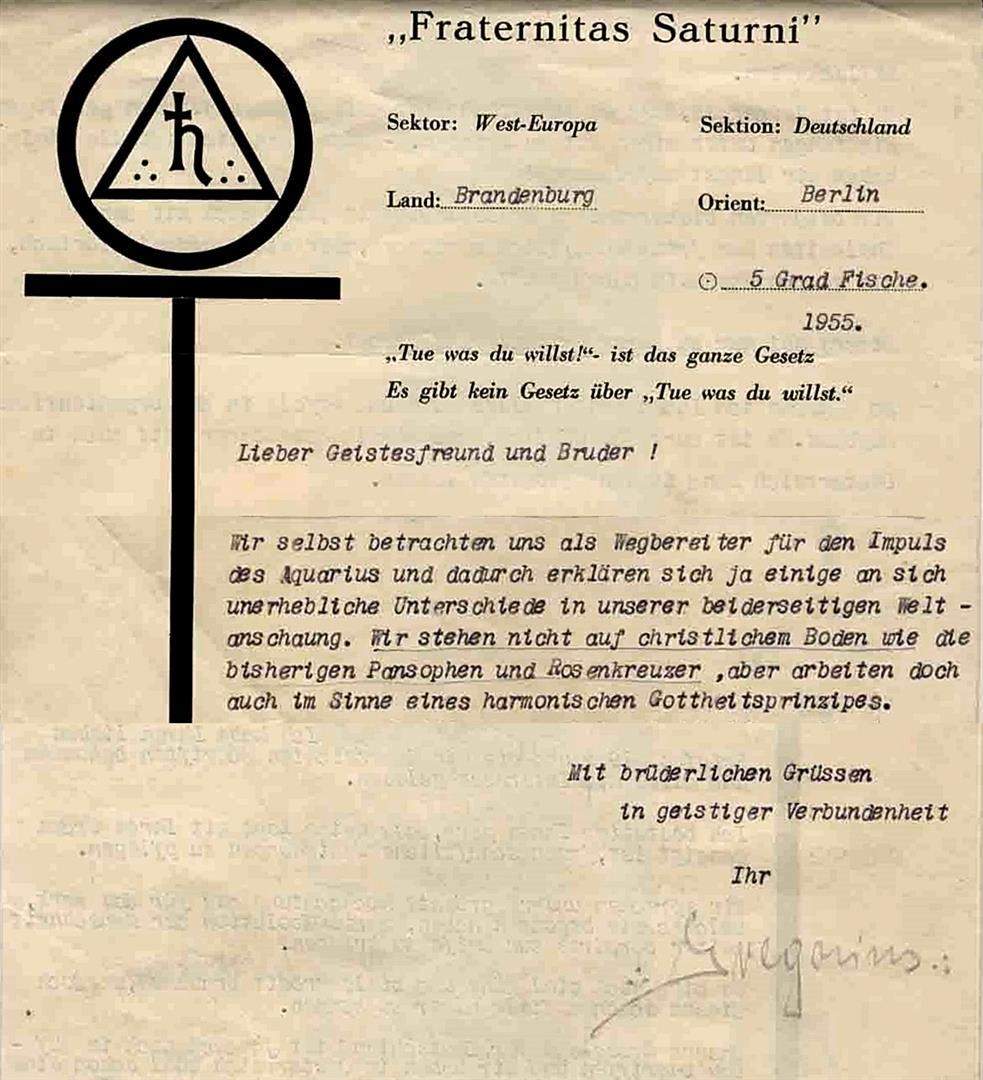
[Collage]
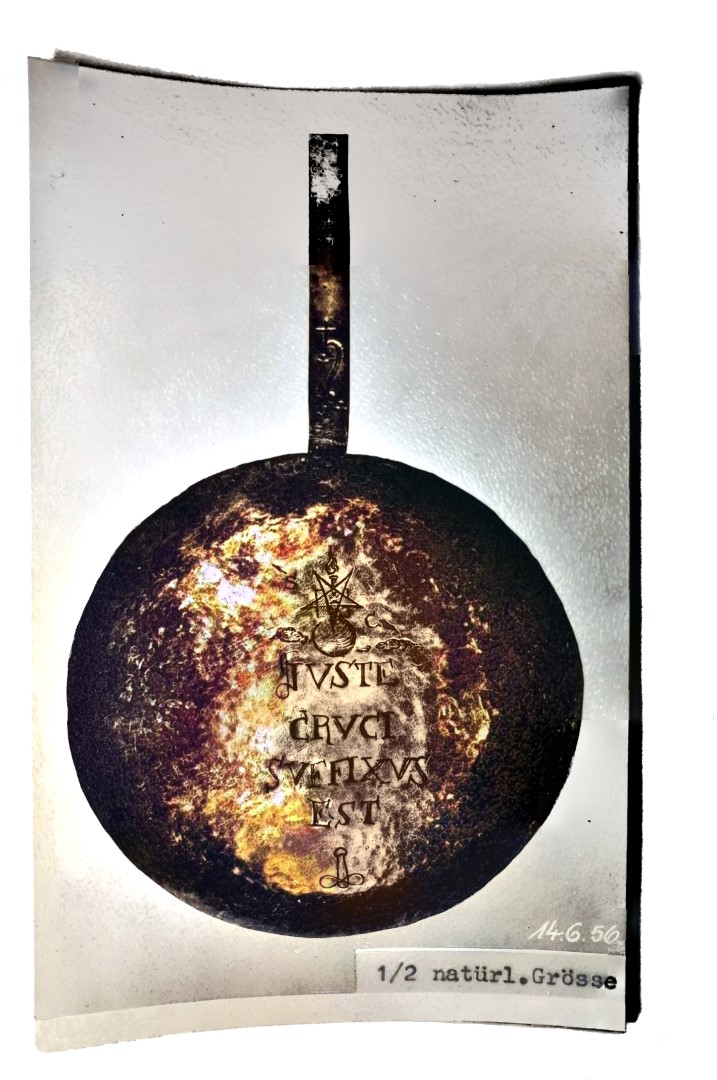
"juste cruci suffixus est"
Censer of the Fraternitas Saturni
[Colored with AI]
Selbst- und Außenwahrnehmung im Rückblick
The GOTOS Bust: an object with competing accounts of its origin, function, and subsequent interpretation.
The essay follows different assignments of meaning to images and objects. Adolf Hemberger interprets the GOTOS bust through an egregoric framework; Maikowski recalls a profane gift. These positions are sources with their own interests and histories. Grosche’s account of mirror magic, the literary Exorial narrative, and later claims about images as operative forces belong to different genres. Their comparison shows how an object, a story, or a described experience could acquire magical significance. It does not establish a collective lodge practice merely by placing them alongside one another.
Nosferatu's Baby — Too Hot To Handle.
Keywords: Hostility Towards Women in Religion and Occultism, Nosferatu's Baby, People Out of Stone, Baphomet and the O.T.O., Knights of the Neurosy-Cross, Fraternitas Rosicruciana Antiqua, Gnosis in Appenzell, defect in the oedipal phase of the New Aeon.
Saturn-Gnosis: a portrait of the real Fraternitas Saturni.
The essay examines selected teachings and claims to saturnian knowledge. Its title frames that inquiry; the texts discussed do not by themselves establish how all members thought or what their lodges regularly performed.
The essay examines claims about artificial beings, egregores, sexual magic, and grades through selected O.T.O. and F.S. writings. Such constructions could support personal ambitions as well as institutional authority. The comparison concerns particular authors and documents; it does not divide the O.T.O. and F.S. into two uniform worlds of individual liberation and collective dependence. A theory about sustaining an egregore is evidence of that theory and its uses, rather than an immediate description of what every lodge did.
Keywords: Homunculi and Crowleyan Practices, Jack Parsons and the ‘Moonchild’ Experiment, The Fraternitas Saturni and the Égrégore, Sex Magic and Ritualistic Hierarchies, Cultural and Mythological Underpinnings, The Occult as a System of Power, The Moonchild as Legacy and Burden.
- English: SATURN GNOSIS: The Real Fraternitas Saturni.
- Česká verze : SATURNSKÁ GNÓZE: SKUTEČNÍ FRATERNITAS SATURNI.
- Versiune română: SATURN GNOSIS: Adevaratul Fraternitas Saturni.
- En Français : GNOSE DE SATURNE : l'Authentique Fraternitas Saturni
Saturn's Art of Living and Loving.
Keywords: Founders and Influence (Eugen Grosche, Johannes Göggelmann); Artistic and Occult Practices (Göggelmann, Guido Wolther); Organizational Dynamics (Walter Jantschik). Grosche’s instructions on rooms, conduct, and sexuality connect claims to occult efficacy with domestic organisation and gendered authority. The writings and images of other members show different personal constructions. Hemberger’s compilations are examined as acts of selection and interpretation that helped shape the public image of the F.S.; their collective framing must be distinguished from the provenance and status of the documents they reproduce.
- Saturn: Raumkunst, Lebenskunst, Liebeskunst Kunst als Gedächtnis der Okkultur?
- Tradução portuguesa: Saturno–Gnose: A Arte de Amar e Viver.
![Eugen Grosche [Gregor A. Gregorius] Fraternitas Saturni In Nomine Demiurgi Homunculi](https://www.parareligion.ch/2010/homunc/2.jpg)
Eugen Grosche [Gregor A. Gregorius]
Photographiert von Johannes Maikowski
Weitere Photos:
Eugen Grosche
More Key Figures
Hermann Joseph Metzger, a Swiss baker and former communist, was initiated into the Reuss O.T.O. in 1943 by Alice Sprengel and Genja Jantzen, apparently in Davos. His permit to travel through the Allied occupation zones later made him a useful messenger between several orders and Thelemic contacts. After Eugen Grosche’s death in 1964, Metzger attempted to absorb the Fraternitas Saturni into his system and presented his own lodge complex as the “mother lodge” of organisations following the Law of Thelema.
Felix Lazerus Pinkus founded the section "Psychische Forschung" of the Swiss Cultural Society and, in 1945, also established a "Psychosophische Gesellschaft" with the aim to "communicate esoteric values and provide psychological help". In his esoteric group were notable figures such as Karl Brodbeck, Hans Rudolf Hilfiker, and many others. Soon, Pinkus' "Psychosophische Gesellschaft" evolved into the umbrella organization for H.J. Metzger's compilation of Orders. Metzger regarded Pinkus as his spiritual father and Grandmaster of the O.T.O. in Switzerland.
Thelema in Appenzell ?
This dossier sketches the people who helped Hermann Joseph Metzger assemble his collection of Thelemic and non–Thelemic orders in Stein, Appenzell Ausserrhoden: Annemarie Äschbach, Anita Elisabeth Borgert, and Metzger’s wife Rosalie Metzger–Strickler. It also includes interviews with Hansruedi Giger and Ulla von Bernus.
By the documentary measure used here, Metzger’s group was during the 1950s the only O.T.O. that combined a functioning lodge with regular publication of Crowley. Its later public activities attracted the tabloid press; after the scandal of the 1970s, the organisation largely withdrew behind new names and closed doors.
The Psychosophical Publishing Company.
The terms "Psychosophic" or "Psychosophical" have their origins in a lecture delivered by Rudolf Steiner in 1910, entitled 'Anthroposophy — Psychosophy — Pneumatosophy'. Hermann Joseph Metzger adopted the term "Psychosophie" to describe various undertakings, including his publishing enterprise, as well as an umbrella term for his collection of orders.
This article explores Metzger's associations with a number of notable figures, including Franz Bardon, Lanz Liebenfels, the Ordo Militiae Crucis Templi, Memphis Misraim, and the Argenteum Astrum. Additionally, the article delves into Metzger's views on Thelema.
What is the A.·.A.·.? Is it an official organization in the mundane world? There have been attempts to control the Argenteum Astrum, and certain individuals claim links to it, such as in the continuum of all XI° variations. Can we identify independent lineages of the A.·. A.·.? Here is a lineage that is seldom mentioned: that of Charles Waldemar. He maintained correspondence with Metzger's group, featured in their publications, and appeared to serve primarily as an ornamental presence given that Friedrich Mellinger was their primary contact for matters concerning the A.·.A.·..
Waldemar was a Swiss author with interests spanning esoteric practices, and alternative health technologies. He engaged in occult correspondence, particularly regarding rare Aleister Crowley manuscripts, and presented himself as a high–ranking initiate of the A.·. A.·.. His work combined mystical, psychological, and practical self–improvement themes, reflected in his publications on erotic energy, self–confidence, and magic, as well as in his commercial ventures selling electro–acupuncture devices and other alternative health products. Despite the grand claims of literary endorsements from figures such as Thomas Mann and Hermann Hesse, Waldemar’s reputation appears entangled with a blend of genuine esoteric enthusiasm, entrepreneurial opportunism, and the self–mythologizing tendencies characteristic of alternative spiritual figures.

The Ordo Militiae Crucis Templi experienced a turbulent turn in 1962 when Marcel Claude, an irregular hierophant of the Memphis–Misraim rite, proposed Metzger as a member. Metzger's induction caused uproar among prominent members, such as Baron E.B. Pflüger, who resigned in protest, citing Metzger’s financial dependence on his wife and lack of a stable home. The OMCT subsequently restructured itself in 1966, formally severing ties with Metzger. Despite his removal, Metzger persisted in claiming the title.
By 1969, Metzger and his network transformed their ventures into eclectic spiritual enterprises, including hosting seminars at the “Abbey of Thelema” in Switzerland, merging esotericism with practical pursuits like ballet training. This bizarre saga encapsulates the O.T.O.’s oscillation between esoteric gravitas and mundane absurdity, ultimately blending high ritual with small–town tourism in Appenzellerland.
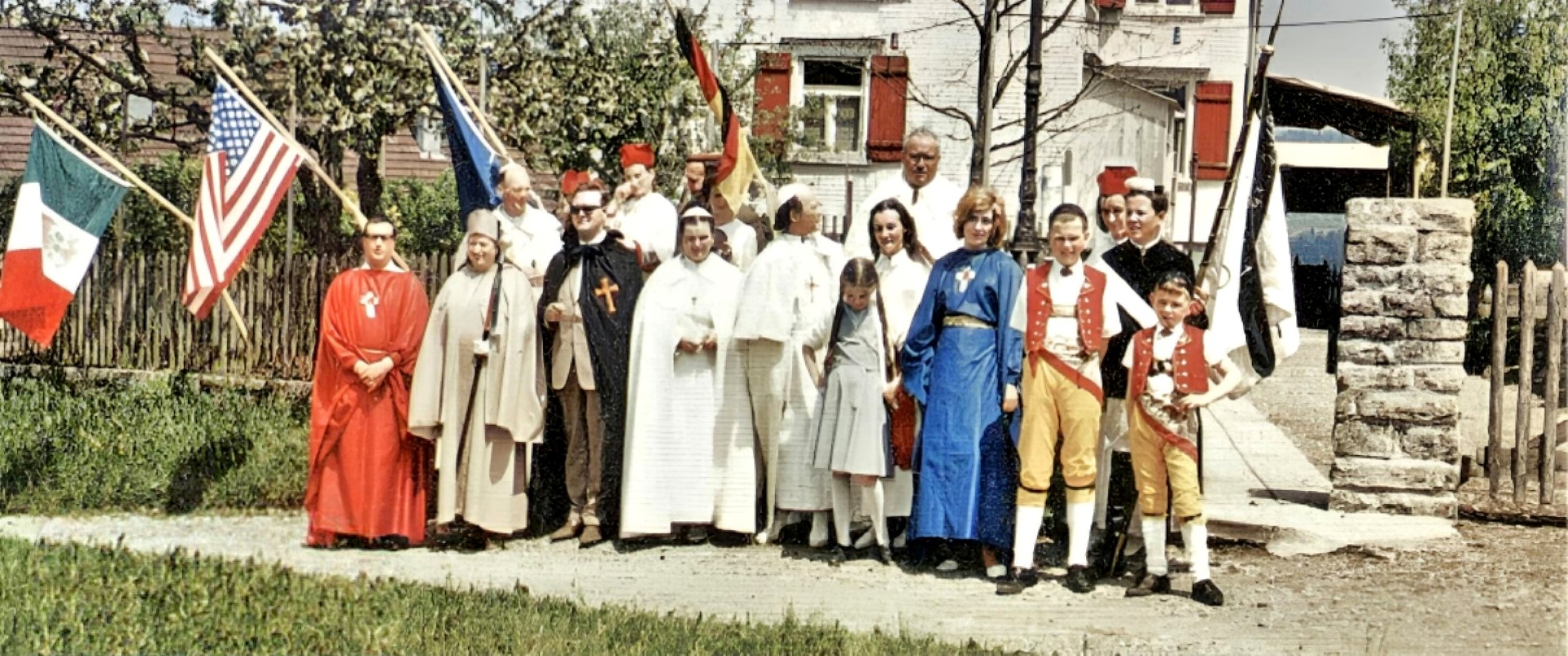
Karl Germer: Never the OHO of Crowley's O.T.O.
Germer’s life was marked by political persecution, financial dependency and patronage, and an uneasy relationship with Crowley’s legacy. A veteran of the First World War, he was imprisoned by the Gestapo and held in Nazi concentration camps; these experiences shaped his memoir Protective Prisoner No. 303. His marriage to Cora Eaton gave him the means to support Crowley, though the relationship between the two men was frequently contentious. The FBI file adds another, carefully qualified layer: an unidentified informant alleged that Germer voiced Master Race opinions and violent Nazi propaganda. The allegation belongs to the surveillance record; it is not, by itself, a verdict. Germer accepted Crowley’s succession but repeatedly admitted that his real interest lay in the A∴A∴, not in administering the O.T.O. When he died in 1962 without appointing a successor, the unresolved claims multiplied.
Karl Germer about himself.
Germer’s autobiography recounts a life of persecution and survival during the mid–20th century. As a member of the Ordo Templi Orientis, he faced harassment from the Nazi regime and indifference from Allied authorities. Imprisoned in Nazi concentration camps like Esterwegen and later in French internment camps, he endured brutal conditions marked by starvation, disease, and neglect. His account highlights the moral and administrative failures of the French, whose inefficiency worsened the suffering of thousands of refugees.
Despite obtaining a visa through his wife’s efforts, bureaucratic delays kept him trapped in inhumane conditions for months. Germer describes the camps as “hell”, emphasizing the systemic cruelty inflicted on detainees, many of whom were Jewish refugees willing to fight against the Nazis. His eventual release came only after significant diplomatic intervention.
Documents and photographies re: Karl and Sascha Germer.
The FBI files of Karl Johannes Germer reveal that many pages and entries contain repetitive information. But of particular interest is file 100–18329, dated November 2, 1942, which details allegations that Germer made statements regarding the concept of a Master Race.
Some of Karl Germer's Personal Letters.
Sascha Germer's Diary about Karl Germer's death.
H.J. Metzger's Manifesto 1963 — With biographical notes on Karl Germer.
The 1963 Sonderausgabe "Oriflamme" serves as both an obituary and a manifesto, marking the death of Germer and the transition of leadership within the O.T.O. The text exhibits hagiographic tendencies, portraying Germer as a martyr–like figure whose suffering and perseverance exemplified Thelemic ideals.
Notably absent from this narrative, however, is the fact that the Swiss group had expressed interest in December 1950 in the virulent anti–Semite Lanz von Liebenfels (1874–1954), founder of the Ordo Novi Templi (ONT). Liebenfels, often described as the man who gave Hitler his ideas, was posthumously honored by Metzger, who, in his 1954 obituary, praised him as the "last Grand Master of the Templars" and a man of "unbending conviction and the highest virtue" — and in 1956 even published on his racial theory of "hereditary hygiene". Metzger’s hypocrisy was certainly not lost on the Jewish men and women in his circle — for example, Friedrich Mellinger — and would soon have consequences.
The 1963 Sonderausgabe "Oriflamme" functions as a document of transition, sanctification, and consolidation — but also of opportunism — reflecting the Swiss O.T.O.’s ongoing efforts to maintain legitimacy and cohesion in the wake of a leadership change.
Factually speaking, at this time, the Swiss O.T.O. was the only O.T.O. worldwide — with lodges, rituals, and all the bells and whistles. For once, there was even an Order.
Legal dispute after Karl Germer's death.
Following Germer’s death, Hermann Joseph Metzger demanded that Sascha Germer transfer all O.T.O. properties to Switzerland, asserting his claim as Germer’s successor. Sascha acknowledged Metzger’s rights but emphasized that Friedrich Mellinger was co–executor, though she had lost contact with him. When Mellinger was located, he denounced Metzger’s leadership as illegitimate, accusing him of self–appointment and violating Germer’s will. Despite Metzger’s legal efforts and claims based on Swiss O.T.O. practices, the ‘Caliphate’ faction later rejected his authority, citing Mellinger’s objections. Ultimately, legal experts deemed further action pointless, leaving Metzger’s claim unresolved.
- The Official Receiver. Karl Johannes Germer, Louis Umfreville Wilkinson, John Symonds.
- Karl Germer, Frieda Harris and the Official Receiver.
Gnosis on Stage: Friedrich Mellinger.
Mellinger played a nuanced rôle in the postwar leadership struggles within the O.T.O. Initially favored by Karl Germer as a key figure in European Thelemic circles, Mellinger’s intellectual rigor positioned him as a mediator in the contested succession of O.T.O. leadership. However, tensions emerged, particularly with Hermann Joseph Metzger, who sought recognition as Outer Head of the Order (O.H.O.) after Germer's death in 1962. While Mellinger translated Crowley’s works and supported Metzger’s initiatives to some extent, he distanced himself from Metzger’s self–proclaimed authority, criticizing what he saw as egotism and opportunism.
Mellinger’s stance complicated the leadership debate, as he was named co–executor of O.T.O. matters in Germer’s will but refrained from fully endorsing Metzger. His critical perspective undermined Metzger’s claims while highlighting deeper divisions within the organization. Mellinger ultimately shifted focus to Theosophy, leaving the fragmented O.T.O. to grapple with its succession disputes. His rôle in these events underscores his intellectual independence and his discomfort with the factionalism that marked the post–Crowley era of the O.T.O.
- ГНОЗИС НА СЦЕНЕ — ФРИДРИХ МЕЛЛИНГЕР.
Karl Germer's correspondence with Friedrich Mellinger about H.J. Metzger, Pinkus, Grosche and Traenker.
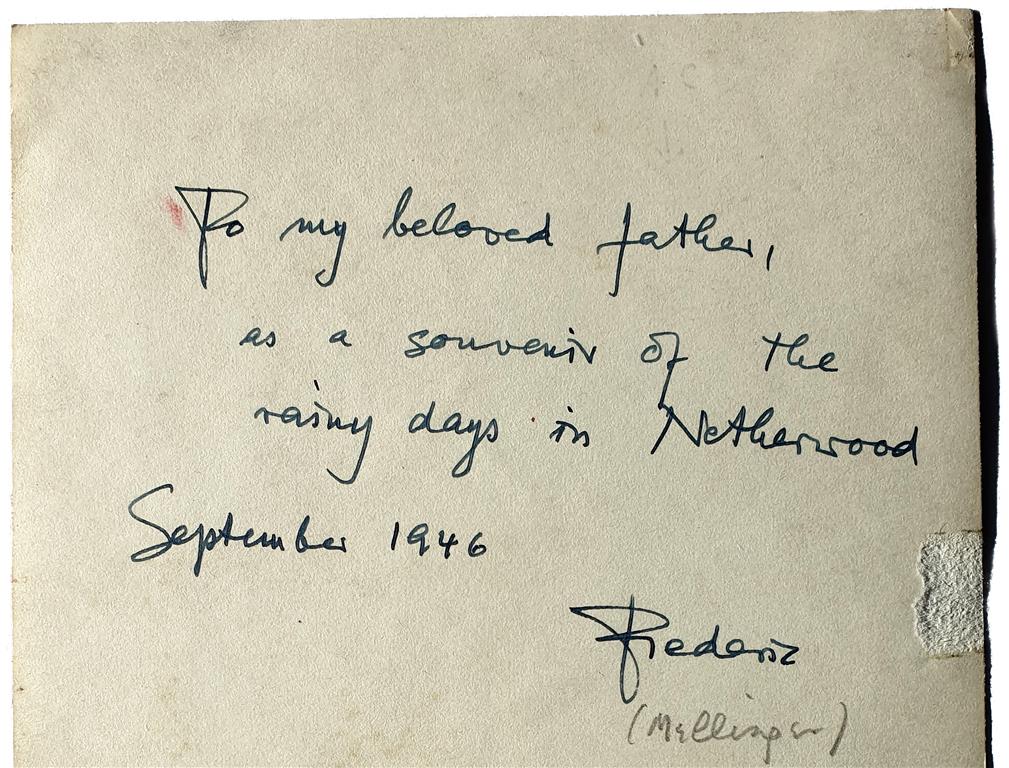
Gabriel Montenegro y Vargas (1907–1969) was a Mexican–American physician and esotericist who moved through the Thelemic world with deliberate detachment. Though closely connected to figures like Karl Germer, Jane Wolfe, and Helen Parsons Smith, he never formally joined the O.T.O. During the 'Caliphate' succession crisis, he challenged Grady Louis McMurtry’s claims and declined Hermann Joseph Metzger’s offer of leadership after visiting his Swiss stronghold in Stein. For a brief time, he became entangled in the convoluted politics surrounding Walter Englert’s Frankfurt-based Illuminaten-Orden. He left behind a final request: that all his documents be destroyed. Fortunately, not everyone obeyed.
Henry Birven.
Henri Clemens Birven, born in 1883 in Aachen, earned a doctorate in philosophy in 1913 and later became an electrical engineering lecturer in Berlin after surviving Russian captivity during World War I. His esoteric pursuits, influenced by Eliphas Lévi, led him to found 'Hain der Isis' in 1927, publishing works by Aleister Crowley and others. While initially collaborative, Birven criticized Crowley and Theodor Reuss as frauds, leading to strained relationships. Birven and associates delved into esoteric myths, including Anna Sprengel’s alleged rôle in the Golden Dawn. By the 1930s, conflicts with Crowley and Heinrich Tränker diminished Birven’s influence, and he was accused of aiding the Gestapo against Karl Germer. In the 1950s, he opposed Crowley’s legacy, labeling his works immoral and drug–influenced. Birven died in 1969.
Martha Küntzel. Friedrich Lekve. — Dreamland Thelem Chassidim.
Küntzel and Lekve were key figures in the evolution of Aleister Crowley’s Thelema in 20th–century Europe. Küntzel, originally aligned with Theosophy, became a fervent Thelemite after meeting Crowley in 1925, but her uncritical admiration for Adolf Hitler estranged her from Crowley and the broader movement. Her translations of Thelemic texts, particularly Liber AL, were criticized for their naivety, and her later belief that Hitler embodied Thelemic principles tarnished her legacy. Lekve, by contrast, sought to synthesize Thelema with Hasidic mysticism, coining the term "Thelem Chassidim" and creating his own esoteric order. While devoted to Crowley, Lekve diverged from orthodoxy, focusing on personal mystical experiences and Qabalistic practices. His civic contributions as mayor of Hildesheim highlight his ability to balance spiritual pursuits with practical leadership. Both figures struggled with financial and organizational challenges, facing criticism from other Thelemites like Eugen Grosche and Karl Germer. Küntzel’s work was overshadowed by her political entanglements, while Lekve’s innovations remained peripheral to the mainstream Thelemic movement. Their legacies reflect the tension between adapting esotericism to contemporary contexts and maintaining doctrinal cohesion. Together, they illustrate the complexities of Thelema’s expansion in an era of social and political upheaval.
Friedrich Lekves „Thelemische Exercitien Klasse D6“, Die Schwarze und die Weisse Messe, stellen eine pseudo-liturgische Messe dar, die christliche Hochmess-Elemente, jüdisch-mystische Begriffe und thelemische Formeln zu einem synkretistischen Ritualtext verschmilzt. Zentrale Figur ist ein „Fürstpriester“, der als Repräsentant eines eigens konstruierten „ELOHIM THERION“ auftritt und ein reales Tieropfer vollzieht – ein Bruch mit Crowleys Praxis wie mit der Symbolik von Nuit. Die Messe missversteht thelemische Prinzipien wie Nuit, Hadit und Ra-Hoor-Khuit als trinitarische Gottheiten und ersetzt Crowleys subversive Ritualsprache durch affirmativ-christliche Sentimentalität. Insgesamt erscheint Lekves Messe weniger als thelemisches Ritual denn als ästhetisch überfrachtetes Regressionsphänomen im Gewand einer sakralen Inszenierung.
C.H. Petersen — Abramelin in the Abbey of Thelema.
Carl Heinz Petersen, born January 14, 1912, in Bendestorf near Hamburg, established an Abbey Thelema in Hamburg and maintained ties with European Thelemites through Karl Germer and Gerald Yorke. He was regarded by Germer as a promising figure within the A∴A∴ and visited Yorke in London in 1952, as well as H.J. Metzger's Abbey of Thelema in the village of Stein, located in the canton of Appenzell, Switzerland, in 1953. Petersen’s translations, including Crowley’s Gnostic Mass and Liber AL vel Legis, were published through both Metzger and Eugen Grosche, leading to disputes over rights and accusations of theft by Metzger. His relationships with key figures like Friedrich Mellinger and Friedrich Lekve remained ambiguous, contributing to ongoing tensions within the O.T.O. hierarchy. After his cousin and sexual–magical partner Frau Pingwill committed suicide in 1956, Petersen died on April 4, 1957, with rumors suggesting complications from the Abramelin operations. Metzger later claimed control over Petersen’s legacy, asserting himself as a central figure in the Thelemic community.
- Karl Germer to Carl Heinz Petersen.
Keywords: Hermann Joseph Metzger, Henry Heinrich Birven, Theodor Reuss and Succession, Nazis, Martha Kuentzel, Friedrich Lekve, Heinrich Traenker.
Carl William Hansen — Denmark.
Carl William Hansen (Ben Kadosh), born on October 11, 1872, in Copenhagen, was a key figure in early 20th–century esotericism, blending multiple traditions under his leadership. Initiated into the Order of the Martinists in 1898 and rising to Danish Delegate by 1917, he received various charters in 1921 from Theodor Reuss, including those for the O.T.O., Memphis–Misraim, and Hermetic Brotherhood of Light. Hansen founded and dissolved several esoteric lodges, often facing challenges such as irregular masonic practices and internal disputes, before resigning from larger orders in 1931. After his death in 1936, his successor, Grunddal Sjallung, continued his work, establishing a distinct, non–Crowleyan O.T.O. branch and later founding the Sovereign Saint John of Jerusalem Order, which focused on humanitarian efforts. Sjallung’s successors, including Johannsen and Pelle Bull, maintained and evolved Hansen’s legacy, often interacting with other esoteric groups but facing challenges in gaining broader recognition.
- Tradução portuguesa: Carl Willian Hansen — Dinamarca.
The New Illuminati
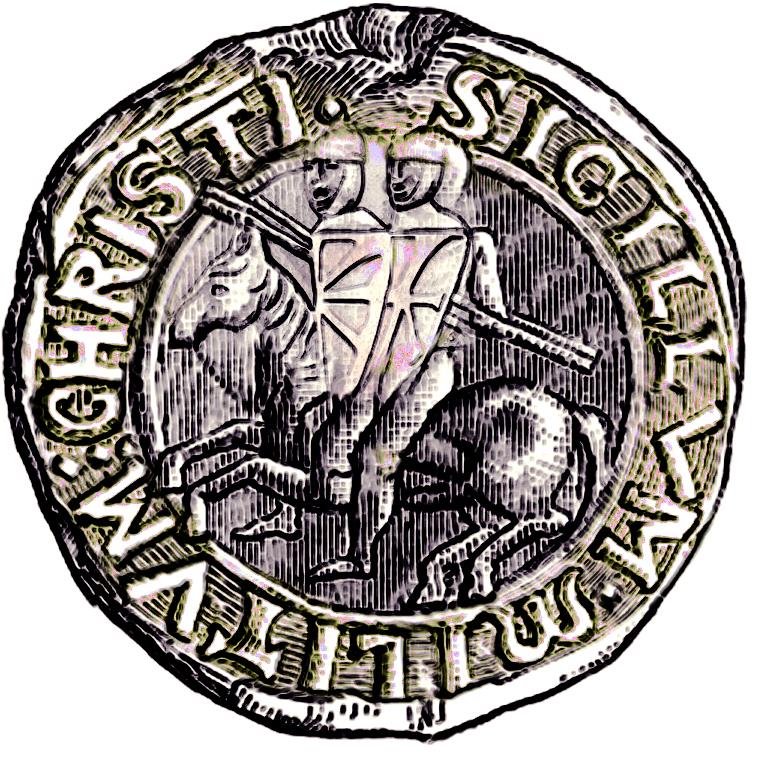
Illuminati and Templars — From Leopold Engel to Walter Englert, a 18° of the Fraternitas Saturni.
The term Illuminati refers to several historical secret societies that purportedly sought to promote enlightenment and knowledge. Today, the term is often used to refer to various alleged modern–day secret societies or conspiracies.
Around the turn of the century, Reuss and Leopold Engel attempted to revive the Order of Illuminati (OI), originally founded by Adam Weishaupt in the eighteenth century. However, their efforts were largely unsuccessful. Despite this, several groups affiliated with Engel persisted through both World Wars and eventually came under the presidency of Metzger in 1963. Metzger viewed the OI as a structure that could be utilized in his consolidation of various orders, including the Ordo Templi Orientis and the Fraternitas Rosicruciana Antiqua. He swiftly incorporated the Ecclesia Gnostica Catholica into the upper echelons of his OI.
Paul Ruediger Audehm: Co–founder of the New Illuminati in Frankfurt.
Audehm emerges as a central yet paradoxical figure in the labyrinthine developments surrounding Walter Englert and the Frankfurt–based Illuminati Order (I.O.). Introduced by Englert in 1964 to the Swiss O.T.O. in Stein, a village in the canton of Appenzell, Audehm’s trajectory reflects the broader conflicts and ideological fissures of the time. Although ostensibly subordinate to Englert as a "Chancellor" within the Freiherr Adolf von Knigge Lodge, Audehm’s dissatisfaction with Metzger’s leadership — and eventually with Englert’s provincial worldview — marks him as a catalyst for disruption. His ironic admission, "We have none; we’ll create one," regarding the I.O.'s gradation system, underscores his pragmatic, if chaotic, approach to occult hierarchy. By 1967, Audehm critiques Metzger’s inflated titles and alleged moral shortcomings, cementing his rôle as a whistleblower and disrupter within the order. His eventual split from Englert further emphasizes his inability to reconcile with the narrow constraints of the Frankfurt group, leaving behind a legacy of unorthodox reinvention and fragmentation. Audehm’s participation is both a reflection of the I.O.’s ambitions and a sharp critique of its insular practices.
H.J. Metzger vs W. Englert: Court Case.
Walter Englert joined the Fraternitas Saturni in 1962. He was a druggist by trade and provided practical materials for the rituals. His rapid ascent within the F.S. hierarchy culminated in his attainment of the 18th degree in 1963.
The death of F.S. leader Eugen Grosche (Gregorius) in 1964 marked a turning point for Englert and the F.S. Englert left the F.S. in the wake of Gregorius’s passing, seeking to establish new frameworks for esoteric work.
In 1964, Metzger initiated Englert into the Ordo Illuminatorum, granting him the title of X° for Germany. Englert’s most prominent post–F.S. endeavor was the establishment of the Frankfurt Illuminatenorden.
The legal battles between Metzger and Englert from 1971 to 1974 illustrate the interplay of personal ambition and institutional politics within esoteric movements. Central to the dispute was the use of the name “Illuminatenorden” and competing claims to legitimacy and authority within the esoteric community. Englert’s eventual legal victory, won on a technicality, allowed him to retain the title and naming rights of the Illuminatenorden.
Karl Brodbeck: Der Illuminatenorden.
Texts by Leopold Engel:
Texts by Hermann Medinger:
- Notes on Astral Traveling.
- Rituals of the Order of the Illuminati.
The New Templars
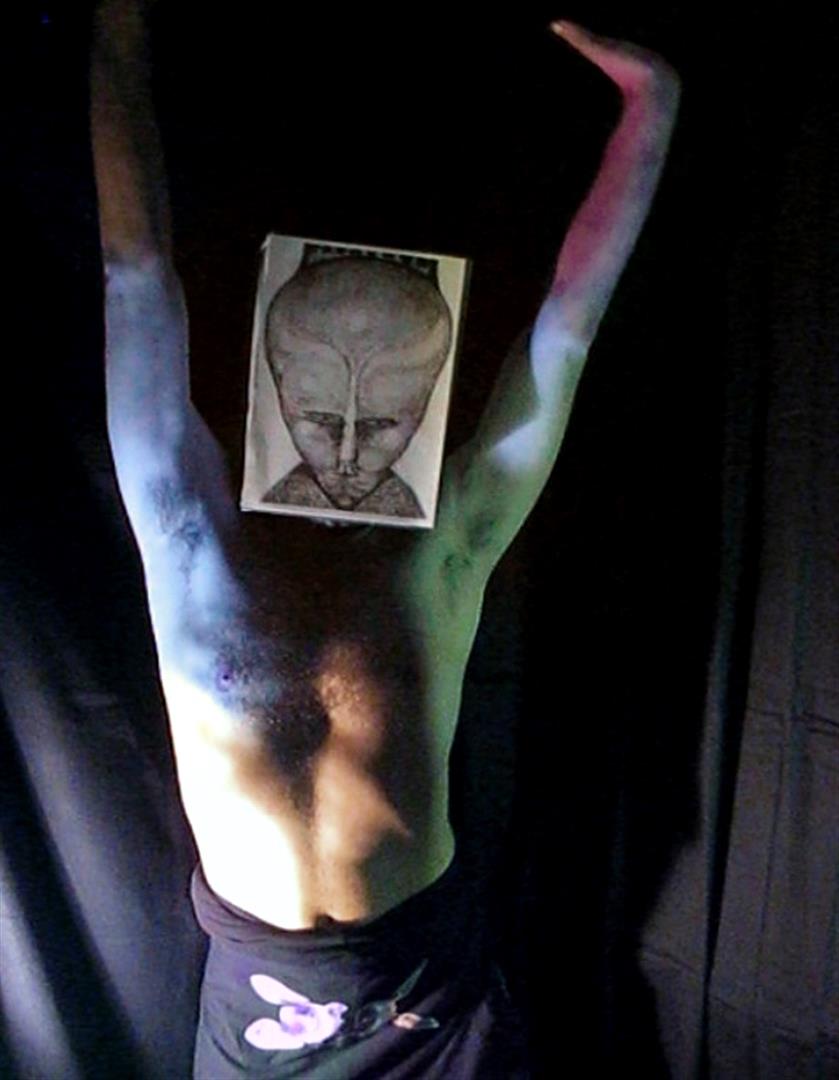
Material on and from the Typhonian O.T.O. — Keywords: Kenneth Grant, Shaitan–Aiwass, New Isis Lodge, Michael Staley, Starfire, LAM, Maat and the New Aeon, Maggie Ingalls, Nema, Linda Falorio.
Kenneth Grant, who was Crowley's secretary, has rejected the Masonic structure of the Crowley–O.T.O. Crowley spoke highly of Grant, stating in his diary in March 1946 that "there must be a trained man to take care of the English O.T.O." in case he were to die or go to the United States. Unlike other versions of the O.T.O., the Typhonian Order does not have group rituals or ceremonies of initiation at any stage of the degree structure. Instead, initiation is based on the individual's direct magical and mystical workings. As a result, all initiations are effectively self–initiations.
Documents: Karl Germer to Kenneth Grant.
Eugen Grosches Eindeutschung von Kenneth Grants O.T.O.–Manifest von 1955.
Kenneth Grant and the Plan 93 From Outer Space.
Grant's Typhonian Order expanded Crowleyan Thelema by integrating esotericism, Lovecraftian mythos, and an emphasis on contact with extra–dimensional beings like Lam. Lam, depicted as an egg–like figure, became central to meditative and magical practices, representing both an entity and a state of gnosis. Grant’s innovations included dream–control and sex–magic techniques, such as eroto–comatose lucidity, drawing from earlier occult traditions but sparking controversy for their rigorous and sometimes exclusionary application. His reimagining of the Holy Guardian Angel (HGA) as a bridge between terrestrial and transcendent realities exemplifies his effort to merge esoteric, psychological, and metaphysical models.
Grant’s eclectic approach incorporated influences like Advaita philosophy, the Aeon of Ma'at, and extraterrestrial gnosis, modernizing and globalizing occultism. Conflicts with the 'Caliphate' O.T.O. underscored factional tensions within Thelemic circles, where questions of legitimacy and authority often overshadowed spiritual practice. His work challenged traditional boundaries, positioning occultism as a multidimensional and experimental discipline. Ultimately, Grant’s contributions remain both innovative and divisive, raising critical questions about the rôle of personal interpretation in advancing esoteric traditions.
- Tradução portuguesa: Plano 93 do Espaço Exterior.
Behind the T.O.T.O.
After being initiated by Crowley and later endorsed as a potential leader, he was expelled in 1955 by Germer, Crowley’s successor in the US. Despite this, Grant pursued his own interpretation of Thelema, establishing the New Isis Lodge in 1955. Grant maintained correspondence and relationships with several key figures in the occult community, including Hermann Metzger, Eugen Grosche and Gerald Gardner, though these were often contentious. His authority and leadership claims were supported by some, including John Symonds, and contested by others, such as Germer.
History of a Hoax. Aleister Crowley appointing Kenneth Grant as his successor as Outer Head of the Order of the Templi Orientis in 1947?
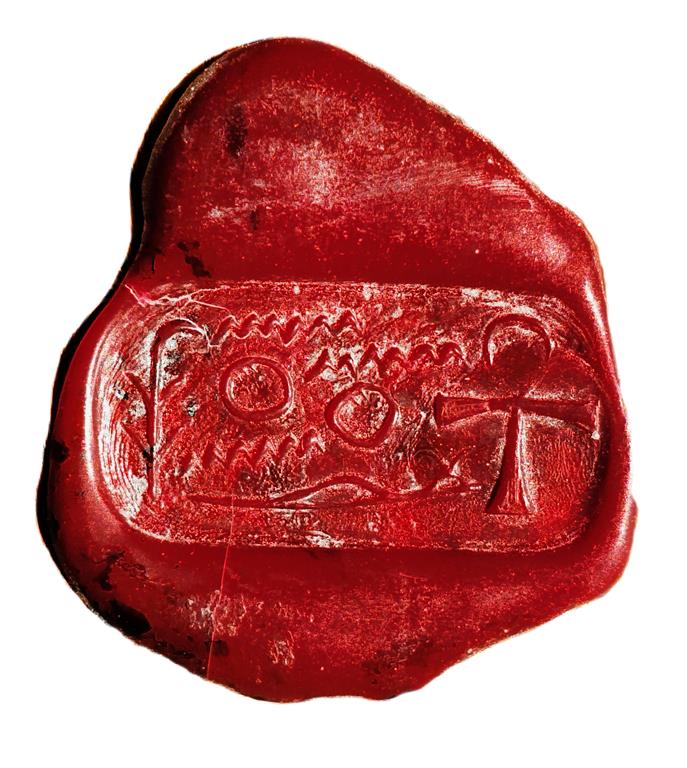
The Solar Lodge of the O.T.O., a controversial offshoot of Crowley's organization, operated in the 1960s with a peculiar mix of mysticism, communal living, and scandal. Led by Jean Brayton, it began as an attempt to revive O.T.O. practices but soon gained infamy through the 'Boy in the Box' scandal, where child abuse charges revealed authoritarian control and troubling moral lapses. Meanwhile, a potentially imagined connection to Charles Manson and tabloid sensationalism further tarnished its reputation, highlighting a zeitgeist steeped in countercultural experimentation gone awry. The Lodge's internal dysfunctions underscored the perils of unchecked charisma. Ironically, its notoriety catalyzed the emergence of the 'Caliphate' O.T.O., which distanced itself from Brayton's group while grappling with its own legitimacy as a successor.
- Charles Manson and the Solar Lodge of the O.T.O. — Reports by witnesses and the FBI.
- Solar Lodge and the 'Caliphate': Documents from the Early Struggles.
Background of the Emergence of the New American O.T.O., the 'Caliphate'.
Here, once more, is the link to the general overview of this 'Caliphate' — lest anyone should lose their way in the administrative fog.
The evolution of the American O.T.O. reflects a confluence of ideological, organizational, and personal influences, with various figures and movements contributing to its formation. The establishment of the 'Caliphate' underscores the factional nature of its development. External influences, such as the Swiss O.T.O. and the Solar Lodge, reflect the broader interplay of competing interpretations and authorities.
Key individuals shaped this evolving landscape, from Reuss and Crowley to later figures such as Karl Germer, Phyllis Seckler, Grady Louis McMurtry, and William Breeze. Others, including Kenneth Grant, Marcelo Ramos Motta, and John Symonds, left their mark through their writings and rival claims. The rôle of European counterparts further illustrates the transnational and often contested nature of the O.T.O.’s historical development.
Four letters from Gerald Yorke.
Keywords: Charles S. Jones, Grady Louis McMurtry, H. Spencer Lewis, Heinrich Traenker, Hermann Joseph Metzger, Jerry Kaye, John Symonds, Karl Germer, Kenneth Anger, Kenneth Grant, Thoth Tarot Teck.
- Gerald Yorke to Karl Germer.
- Gerald Yorke to Reuben Swinburne Clymer.
- Gerald Yorke to Grady Louis McMurtry.
- Gerald Yorke to Helen Parsons–Smith.
About Jack Parsons in Nikolas and Zeena Schreck: Demons of the Flesh.
Jack Parsons’ involvement with the O.T.O. Agape Lodge exemplifies the challenges inherent in left–hand path sex–magical groups, particularly regarding power struggles, interpersonal conflicts, and the tension between individual liberation and organizational hierarchy. Initially recognized by Crowley and other Lodge members as a promising successor, Parsons’ scientific acumen and deep commitment to Thelemic magic distinguished him, yet his independent streak clashed with the rigid structures of the O.T.O. His personal life, including his complex relationships with Wilfred Smith and his wife’s sister, intertwined with his magical pursuits, reflecting both his radical sexual philosophy and his vulnerability to exploitation. Crowley’s disapproval of the Lodge’s increasingly scandalous reputation, culminating in Parsons’ resignation and later return, underscores the broader issue of authority and legitimacy within esoteric orders. Ultimately, Parsons' devotion to Babalon led him beyond the confines of the O.T.O., embodying the trajectory of the left–hand path magician who, through personal transgression, emerges as a self–sovereign figure rather than a disciple.
In 1946, Crowley referred to his student Grady McMurtry as 'Caliph' in a handful of letters sent from England to California. This designation, derived from the contemporary postal abbreviation for California ("Calif"), was not employed in any official O.T.O. context, nor does it appear in the writings of either Reuss or Crowley himself. More than two decades after Crowley’s death, McMurtry reinterpreted this title as conferring upon him the rôle of Outer Head of the Order (OHO) and Patriarch of Crowley’s ecclesiastical body. However, his resulting 'Caliphate' O.T.O. group did not inherit any legitimate ecclesiastical or organizational succession within the O.T.O. framework. In 1987, following McMurtry’s death, the group revised its constitution. Under the leadership of William Breeze, the 'Caliphate' has pursued institutionalization, securing legal recognition by registering and incorporating both the U.S. Grand Lodge and O.T.O. International as tax–exempt nonprofit religious entities in the United States.
Several articles address the entity commonly referred to as the ‘Caliphate’, an organization established in 1977 that operates either as a formal institution or a private association, as well as its interpretation and implementation of the concept of “apostolic succession.” Although the ‘Caliphate’ has increasingly presented itself — particularly as it has expanded globally and secured certain legal victories — as the sole and authentic “O.T.O.”, this website consistently employs the term ‘Caliphate’ to underscore the complexity of its appropriation of the name O.T.O.
William Breeze, McMurtry’s successor, quietly buried the original construct — the once–trumpeted ‘Caliphate’ — out of sight in the bureaucratic undergrowth of the organization’s bylaws, where it survives only as Section 3.10, “Removal of Acting O.H.O. or Caliph.”
Consecration In Transit.
How, why, and where was the 'Caliphate' Ecclesia Gnostica Catholica constructed — not inherited?
In the backseat of a car, as William Heidrick described it: a pragmatic act performed en route to a notary. Not a rite of transmission, but a bureaucratic sleight of hand — sacral authority improvised to meet tax–exempt requirements. Grady McMurtry, facing collapse and solitude, later confessed to having activated the ‘Caliphate’ in “an afternoon of despair,” armed only with Crowley’s ambiguous paperwork.
The article traces the key mechanisms by which legal recognition was secured — not through apostolic lineage, but via incorporation documents and strategic improvisation. A textbook case of how modern esotericism manufactures legitimacy through administrative ritual and retrospective meaning.

[AI–generated image]
The email exchange in 1996 between William Heidrick (Grand Treasurer General of the 'Caliphate' O.T.O.), Tyagi Nagasiva, and Peter-Robert Koenig, provides an in–depth discourse on the legitimacy of the 'Caliphate', the nature of its initiatory and ecclesiastical authority, and the claims of succession from Crowley. The discussion focuses on several key issues, including the withdrawal of the preview of initiation rites, the various iterations of the O.T.O. constitution, and the ecclesiastical legitimacy of the E.G.C. within the 'Caliphate' structure. Notably, Koenig challenges Heidrick’s assertions on the transmission of authority, particularly regarding McMurtry's rôle and the historical accuracy of the supposed Crowleyan lineage. The correspondence also delves into the controversial 'Caliphate letters', the nature of the title 'Caliph', and whether Crowley intended it as a legitimate succession mechanism or merely as a pun. Ultimately, the debate underscores the broader conflict between different O.T.O. factions, revealing the extent to which competing narratives of authority and legitimacy shape contemporary Thelemic organizations.

[AI–generated image]
In an email exchange in 1996, Peter-R. Koenig and David Scriven, U.S. Grand Master of the 'Caliphate', debate the legitimacy of McMurtry’s authority, with critics arguing his leadership was self–declared and inconsistent with earlier O.T.O. structures. Allegations of manipulation by figures like Seckler and Smith further complicate the validity of his succession. The rôle of IX° members in elections remains contentious, particularly as some who were barred from voting later helped elect Breeze. Broader questions about Crowley’s own succession cast doubt on all subsequent leadership claims, while McMurtry’s health and contradictory documents add further uncertainty. The controversy highlights the instability of O.T.O. leadership transitions, where personal alliances and shifting narratives often outweigh clear historical continuity.
All we want is a 'Caliph': 'Minutes of the Special Ninth Degree 'Caliphate' Election' Held September 20/21, 1985.
The 'Caliphate' era of the O.T.O. reveals a tangled web of bureaucratic ambition and occult pretensions, epitomized by Grady McMurtry's and William Breeze's commercialization of the Order. The 1985 election of Breeze as 'Caliph', held in a Holiday Inn conference room, marked the transformation of this O.T.O. into a corporate–style entity marketed to Thelemites, with contested degrees and legal maneuvering taking center stage. The "provisional IX°s", ostensibly a stabilizing measure, were elevated upon McMurtry's death, exposing the political opportunism beneath the Order's spiritual façade. Breeze’s reforms, from ritual innovations to ceremonial franchising, have been criticized for reducing Crowley’s vision to what can be called the McDonaldisation of Occulture. The fragmented legacy of rival factions, disputed authority, and court battles underscores the dissonance between this O.T.O.'s claims of sacred continuity and its mundane operations.
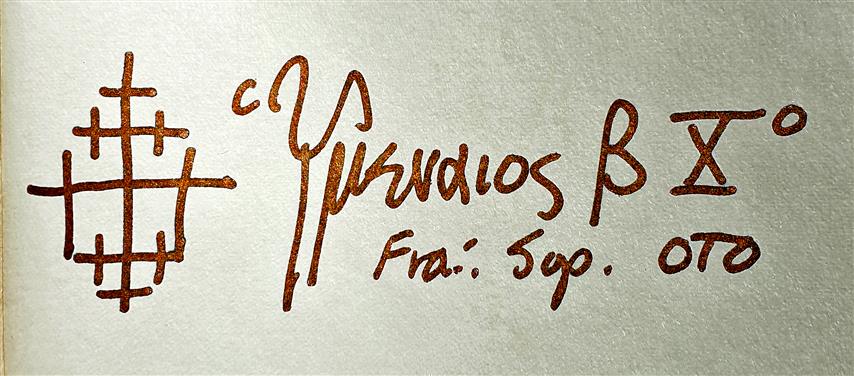
Some Spicy Smacks in Russia.
The post–Soviet sociopolitical landscape — marked by spiritual disorientation and exploitation by new religious movements — provided fertile ground for groups like the O.T.O. to emerge. However, the O.T.O.’s impact remained minimal compared to larger spiritual phenomena and charismatic movements in Russia during the 1990s. The contemporary political environment under Putin further limits transparency and necessitates protecting members’ identities, obstructing deeper exploration of this topic.
Christian Bouchet, a controversial figure whose political entanglements blurred lines between occultism and far–right nationalism, indirectly contributed to the O.T.O.’s local emergence in Russia. His initiatives, however, alienated him from various factions, including the 'Caliphate' O.T.O. The Russian O.T.O. was plagued by fragmentation and leadership disputes, which deepened skepticism about its authenticity.
"Ljuben je zakon" or "ljubav pod voljom"? — The O.T.O. in ex–'Yugoslavia'. An example of member activities.
The history of the O.T.O. in former Yugoslavia begins with figures such as Zivorad Mihajlovic–Slavinski, who worked with Thelemic ideas in the 1970s, and with the arrival of the 'Caliphate' faction in 1982. The Abrahadabra Camp and later Lodge performed the Gnostic Mass, conducted initiations, and translated Crowley, but disputes over leadership, money, and alleged abuse soon fractured the milieu. The wars of the 1990s scattered members and archives alike. What remains is not a continuous regional organisation but a documentary trail of translations, experiments, quarrels, exiles, and successor claims.
Moosebump.
The Canadian 'Caliphate' O.T.O. began with promise but quickly descended into chaos, embodying the pitfalls of esoteric collectivism. From a 1973 bookstore–turned–teahouse in Montréal to the rise of the Phoenix Lodge in the 1980s, its history is marked by fleeting successes and mounting disarray. Leadership under William Breeze initially signaled hope but soon faltered amid expulsions, scandals, and logistical instability. Physical spaces like the Café Thélème became temporary sanctuaries, but their transience mirrored the group’s lack of cohesion.
Public controversies eroded the 'Caliphate’s reputation and footing in Canada. Internal power struggles, particularly involving figures like Robert Deumié and Alan Stewart, alienated members and fractured the organization. By the 1990s, the once–promising movement had devolved into a scattered network of disillusioned practitioners and inactive groups. Ultimately, the Canadian 'Caliphate' stands as a cautionary tale of ambition undermined by ego, infighting, and the inability to sustain its lofty Thelemic ideals.
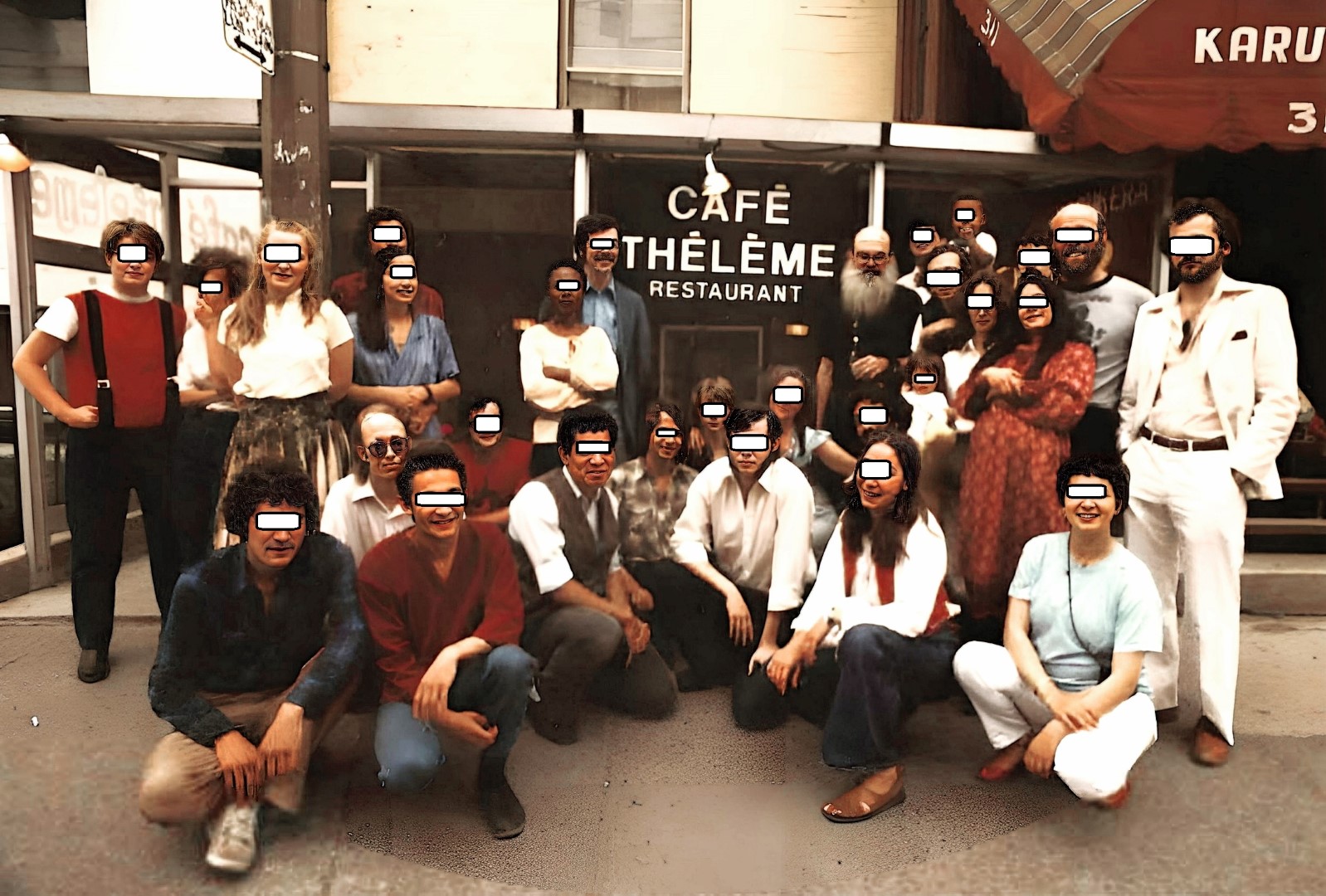
In Canada: With face uncovered: William Breeze, Grady Louis McMurtry
The O.T.O.–Foundation: Censorship and Inquisition in England.
The 'Caliphate' O.T.O. (COTO) "Inquisition" of 1996 was a farcical spectacle of bureaucratic zealotry, with anonymous accusations, no due process, and a hapless "Grand Inquisitor General". David and Irene Fraenkl–Rietti skillfully outmaneuvered the process, turning their expulsion into a strategic victory by founding the Ordo Templi Orientis Foundation (OTOF). The proceedings were less justice and more medieval witch–hunt, riddled with hearsay and personal vendettas. The Riettis emerged as Machiavellian tacticians, exploiting COTO’s dysfunction to enhance their influence and legitimacy in the occult community.
Oscar Schlag’s multifaceted career bridged psychoanalysis, parapsychology, and esotericism, blending scientific inquiry with mysticism. Trained under graphologist Max Pulver and psychoanalyst Oskar Pfister, he interacted with figures like Carl Gustav Jung and Albert Schrenck–Notzing, gaining notoriety for his paranormal experiments, though their scientific validity remains debated. Fleeing Nazi Germany, Schlag dramatically renounced his German citizenship.
A critic of formalized occult groups like the O.T.O., Schlag avoided allegiance while engaging with figures such as Karl Germer, Jane Wolfe, Phyllis Seckler, Marcelo Ramos Motta and Hermann Joseph Metzger, Friedrich Lekve, Friedrich Mellinger, Eugen Grosche, Heinrich Birven, Eduard Munninger ... You name them — he knew them personally. His Hermetische Gesellschaft embodied his vision of independent spiritual inquiry but faced criticism for its exclusivity. Schlag’s extensive esoteric library and contributions to graphology, including exposing the Golden Dawn’s foundational forgeries, highlight his intellectual rigor.
Despite his scholarly achievements, Schlag’s life was marked by controversy, distrust, and conflicting narratives from contemporaries, reflecting his enigmatic and polarizing legacy in the realms of psychology and the occult.
Oscar R. Schlag: self–styled last grey eminence.
- Documents on Oscar R. Schag in the context of Jane Wolfe, Marcelo Ramos Motta, Karl Germer, Hermann Joseph Metzger.
- Marcelo Motta palavras com Euclydes Lacerda de Almeida, 18 de dezembro de 1973.
- Translation of Marcelo Motta's tape to Euclydes Lacerda, dated 1973.
- Marcelo R. Motta: Lettre à un maçon brãsilien.
- Marcelo R. Motta: Letter to a Brazilian Mason UNEXPURGATED.
- Claudia Canuto de Menezes: I met Marcelo Ramos Motta in the 70’s.
- Traduction française: Les Évêques Errants.
- English translation: The Gnostics. — About the Gnostic Catholic Church, Androgyn + Gynandria, E.C.H. Peithmann, Peryt Shou, and the immissio membri virilis in vaginam in avoidance of the ejaculatio seminis.
Kurtzahn explores the esoteric concept of the light–seed as central to Gnostic salvation and spiritual transformation. The light–seed, composed of spirit and matter (water), is seen as the divine essence retained by men, which must not be wasted or misused, and its proper use is integral to achieving a higher spiritual state. Gnostic marriage involves a profound spiritual unity where both partners undergo breathing exercises to form new nerve centers, facilitating the elevation of the light–seed and mutual spiritual androgyny. This process aligns the couple with cosmic energies (M–rays) and the divine Pleroma, while emphasizing the man's rôle as the spiritual redeemer of the woman. The text advocates strict control over sexual energy, framing it as a path to enlightenment for the Pneumatikoi, while warning against misuse by the uninitiated. Practical guides and texts are suggested for those embarking on this rigorous path, with the ultimate goal of transcending the material realm and returning to the divine light. - Gnosis als Hype. Short German variation with outlines of an interview with Angie Bowie. First published in DU, November 2003.
- Traduction française : Steele Savage : David Bowie — Outside, Aleister Crowley et le Saint Graal.
- The full English online version of this book: The O.T.O. Phenomenon.
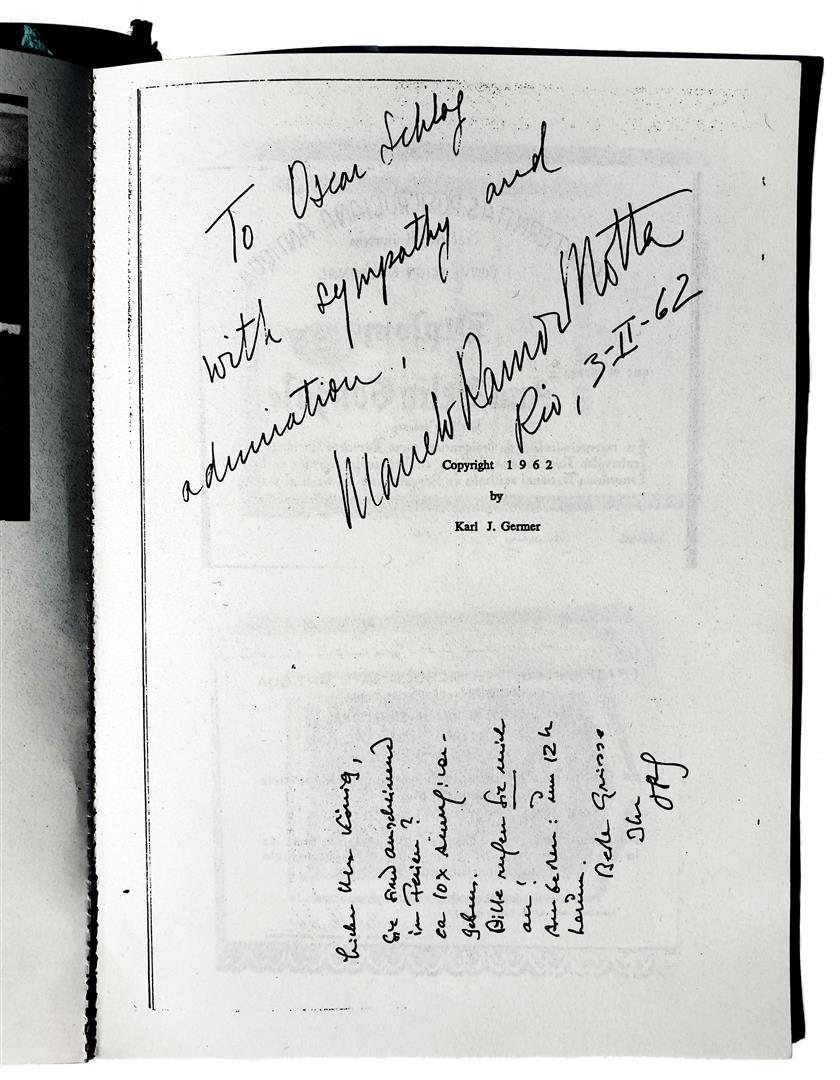
Dedication from Marcelo Ramos Motta to Oscar Schlag.
+ Schlag's short letter to P.R. Koenig.
[From: 'Ein Leben Für Die Rose']
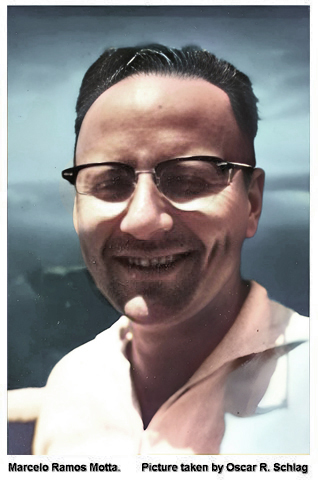
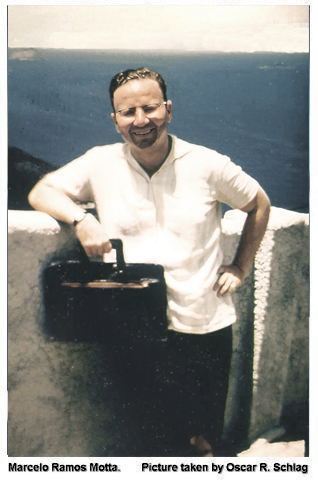
After Karl Germer died in 1962, several men attempted to become the sole head of his Crowley–O.T.O. Germer’s will directed his widow Sascha and Friedrich Mellinger to transfer O.T.O. property to the heads of the Order; it did not name a successor. Sascha Germer first encouraged the Brazilian Marcelo Ramos Motta (1931–1987), then concluded from her husband’s files that H.J. Metzger had been his preferred candidate. The later American litigation between claims advanced through Motta and Grady Louis McMurtry settled particular questions of standing, name, and copyright in that jurisdiction; it did not magically resolve the entire history of succession.
None of the parties placed H.J. Metzger’s competing claim before the American court. The dispute was framed as an American one, and an absent Swiss claimant would only have complicated the desired genealogy. A judgment can decide a case; it cannot retroactively simplify the archive.
Uma O.T.O. no Brasil.
Motta played a crucial rôle in shaping Thelemic groups in Brazil, navigating a complex landscape of esoteric orders, legal battles, and factional disputes. His involvement with the O.T.O., the A∴A∴, and various other organizations led to numerous schisms, some fueled by personal and ideological conflicts. Motta's early association with the F.R.A. influenced his later establishment of the Sociedade Novo Aeon and other Thelemic groups, particularly in response to the military dictatorship in Brazil. Motta’s disputes with figures such as Euclydes Lacerda de Almeida and Kenneth Grant underscore the instability of O.T.O. leadership claims and the divergent ideological interpretations of Thelema. The legal conflicts with Grady Louis McMurtry over succession within the O.T.O. ultimately led to Motta’s estrangement from the dominant American O.T.O. lineage. His death in 1987 triggered further disputes over his estate and legacy, with figures like Claudia Canuto de Menezes, William Robert Barden, and Daniel Ben Stone engaging in bitter conflicts. Allegations of grave desecration and financial improprieties further complicated the posthumous struggle for control over Motta's intellectual and organizational heritage. Former associates such as David L. Bersson and Ray Eales continued Thelemic activities, though often distancing themselves from official O.T.O. claims. Meanwhile, Lacerda formally renounced all O.T.O. affiliations in 1996, emphasizing the fractious and evolving nature of Thelemic organizations.
The sheer volume of documents produced by figures involved in these disputes underscores the complexity and contentiousness of Thelemic history in Brazil.
Euclydes Lacerda de Almeida — Marcelo Ramos Motta — Kenneth Grant: Documentos 1966–1997.
Euclydes Lacerda de Almeida: Marcelo Ramos Motta — Um Enigma.
Motta was central to the transmission of Thelema in Brazil and attempted to establish both A∴A∴ and O.T.O. structures there. In later years he concentrated several leadership functions in his own person, alienated students, and generated further schisms. Contemporaries interpreted his escalating conflicts through psychology, personal hostility, or the esoteric language of the “Oath of the Abyss”; the documents establish the conflicts, not a diagnosis. His importance and his destructiveness therefore belong to the same dossier.
Euclydes Lacerda de Almeida: Emails to P.R. Koenig.
Almeida's emails chronicle his affiliations with various factions, including his discipleship under Motta, his interactions with Grant, and his eventual disillusionment with the multiple claimants to O.T.O. authority. He critiques the 'Caliphate' and expresses frustration over the commercialization and bureaucratization of Thelema, which he views as a departure from its initiatory purpose. Over time, he grows increasingly skeptical of all O.T.O. branches, perceiving them as driven by power struggles rather than spiritual integrity. His later letters suggest a complete break with the O.T.O., as he declares himself independent and dismisses the legitimacy of any existing leadership. Ultimately, his writings reflect a broader concern that Thelema’s ideals have been diluted by institutionalized authority and internal rivalries.
Marcelo A.C. Santos: A Verdadeira História do "Califado" no Brasil.
Santos' article presents a critical account of the 'Caliphate' O.T.O. in Brazil, exposing internal conflicts, historical manipulations, and power struggles. The text argues that the organization's leadership prioritized personal ambition over the pursuit of Thelemic principles, leading to factionalism and betrayals. The author traces his involvement from initial curiosity to eventual disillusionment, revealing discrepancies between the 'Caliphate’s' professed legitimacy and its actual practices. The narrative highlights the rôle of figures like Euclydes Lacerda de Almeida, whose authority was initially recognized but later dismissed when he distanced himself from the 'Caliphate'. Internal disputes, such as those involving Carlos Raposo and Marisol Seabra, illustrate the cycle of ambition and treachery that undermined the organization's cohesion. The text underscores how secrecy, deception, and a lack of substantive teachings led to widespread dissatisfaction among members. Santos ultimately portrays the Brazilian 'Caliphate' as a vehicle for personal aggrandizement rather than an authentic spiritual order. His departure, prompted by ideological and ethical disillusionment, reflects broader concerns about the organization's legitimacy. The work concludes that the 'Caliphate' operates more as a hierarchical power structure than as a true Thelemic fraternity, reinforcing the notion that its leadership is driven by vanity and control rather than genuine esoteric pursuit.
In this correspondence, Marcelo A. C. Santos recounts his passage from Brazilian Thelemic idealism to disenchantment, sharpened by a sobering stay at the Texan headquarters of the 'Caliphate'. The result is a lucid document of ceremonial self-importance, fraternity without warmth, and the moment when the robe slips and the organisation reveals itself as "but a firm or club."
Marcelo Ramos Motta speaks about the O.T.O. rituals, about the A.·. A.·. and Kenneth Grant; in Portuguese, approx. 1973 (circa 620 KB).
Marcelo Ramos Motta: Ritual de Iniciação do Grau I O.T.O.
Marcelo R. Motta: Carta A Um Maçon.
Bibliographic Note and Addendum to "Letter to a Brazilian Mason by Marcelo Ramos Motta".
Marcelo Ramos Motta to Karl Germer, July 2, 1954.
Marcelo Ramos Motta about Paulo Coelho and others.
Marcelo Ramos Motta: The Development of a Secret Society in America in the Years 1957–2000.
Claudia Canuto de Menezes: Conheci Marcelo Ramos Motta nos idos anos 70.
Background information by one Goat of Mendes and others.
This correspondence documents, with remarkable depth and complexity, the fragmented landscape of Thelemic succession claims in the 1990s — particularly within the orbit of Marcelo Ramos Motta, his circle of disciples, and the competing O.T.O. structures (most notably the 'Caliphate,' HOOR, SOTO, and TOTO). The exchange repeatedly reflects upon itself, oscillating between high-stakes institutional politics and a grotesque sense of theatricality. What is at stake is not merely organizational structure, but personal vanity, prophetic ambition, escalation, and irony.
The correspondence repeatedly turns back upon itself, offering a reflexive commentary on its own absurdities. Among its recurring themes are structural fragmentation and personal feuds, shifting terminologies and ideological skirmishes, as well as the ever-performative politics of symbols, membership, and exclusion.
Palace of Secretes — Anal Intercourse and the O.T.O. — the XIth degree.
The XI°, Crowley’s so–called Palace of Secrets, is followed here through its changing theory, practice, and scandal history. The dossier moves from Crowley and Victor B. Neuburg through William C. Conway, Roland Merritt Shreves, Cecil Frederic Russell and the Choronzon Club, Louis T. Culling, William Wallace Webb, Michael Paul Bertiaux, Marc–Antoine Lullyanov, Llee Heflin, Patrick King, James Graeb, and William Breeze. It also compares the shifting position of the 'Caliphate' with the quite different interpretations of Marcelo Ramos Motta and Hermann Joseph Metzger. The result is not a single secret handed down intact, but a succession of reinterpretations, denials, improvisations, and retrospective orthodoxies.
Patrick King — Herald of the 'Caliph' and early XI° of the 'Caliphate'.
King, born in 1955, was deeply involved in martial arts and occult studies from a young age, excelling in Kenpo Karate before immersing himself in Thelema and the O.T.O. His introduction to Grady McMurtry’s O.T.O. came through the Kaaba Clerk House in San Francisco, where he was quickly recognized for his scholarship and leadership, particularly in the Salt Lake City occult scene. He co–founded the "Church of the 4 Sided Triangle", a group that blended intellectual engagement with strategic legal maneuvering, before becoming a key figure in the American O.T.O., where his XI° status made him a controversial presence. King’s later years were marked by a falling out with the organization, leading to self–imposed exile in Prague, where he lived in poverty with his lover and magical partner, Laura Deerfield. His death in 1997, following a police beating, underscores the tragic trajectory of his life — one shaped by intellectual rigor, spiritual ambition, and eventual alienation from the order he had helped shape.
Documents: William C. Conway: A con artist rumoured to be a XI°.
Conway exemplifies the archetypal con artist who blurred the boundaries between fraud and mysticism, using grandiose titles and fictitious organizations to maintain his persona. His trajectory from early fraudulent ventures, such as the “Good Roads Commission” and the “Optimist Society”, to esoteric and religious enterprises suggests a calculated evolution in his schemes, adapting to new audiences and cultural trends. His alleged involvement with the XI° O.T.O. and his attempts to merge Mormon fundamentalism with occult traditions illustrate his penchant for constructing elaborate spiritual and mystical identities. The proliferation of his self–styled orders and lodges — ranging from the Restored Apostolic Catholic Church to the Ancient Order of Atlantean Adepts — underscores his method of legitimizing himself through sheer volume of invented affiliations. Ultimately, Conway’s legacy is one of elaborate deception, where the line between self–delusion and calculated manipulation remains provocatively unclear.
The New Gnostics
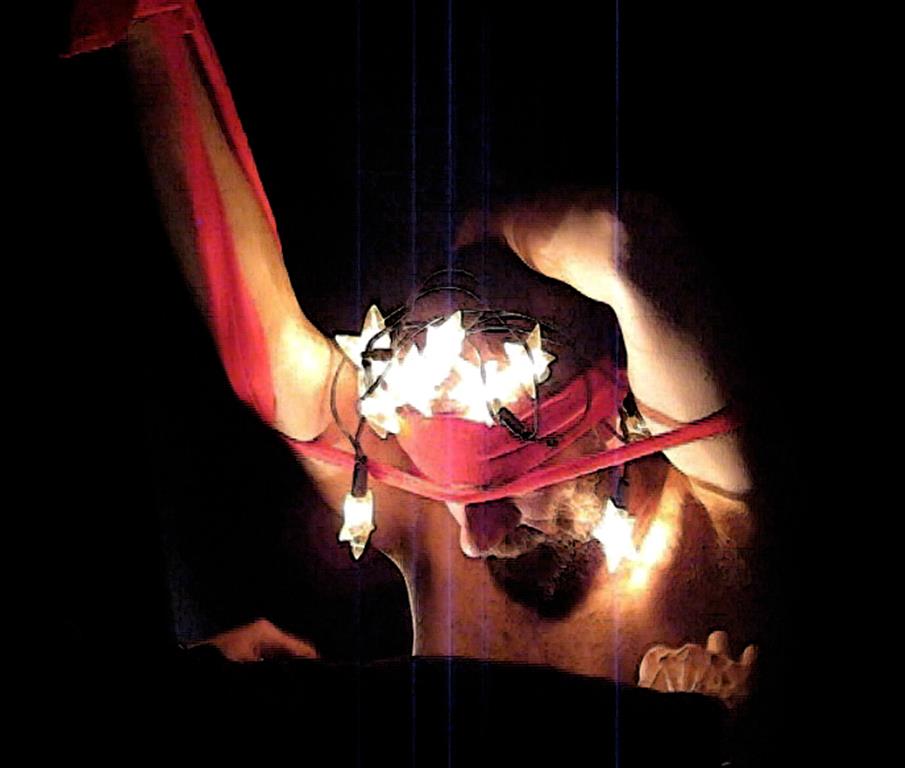
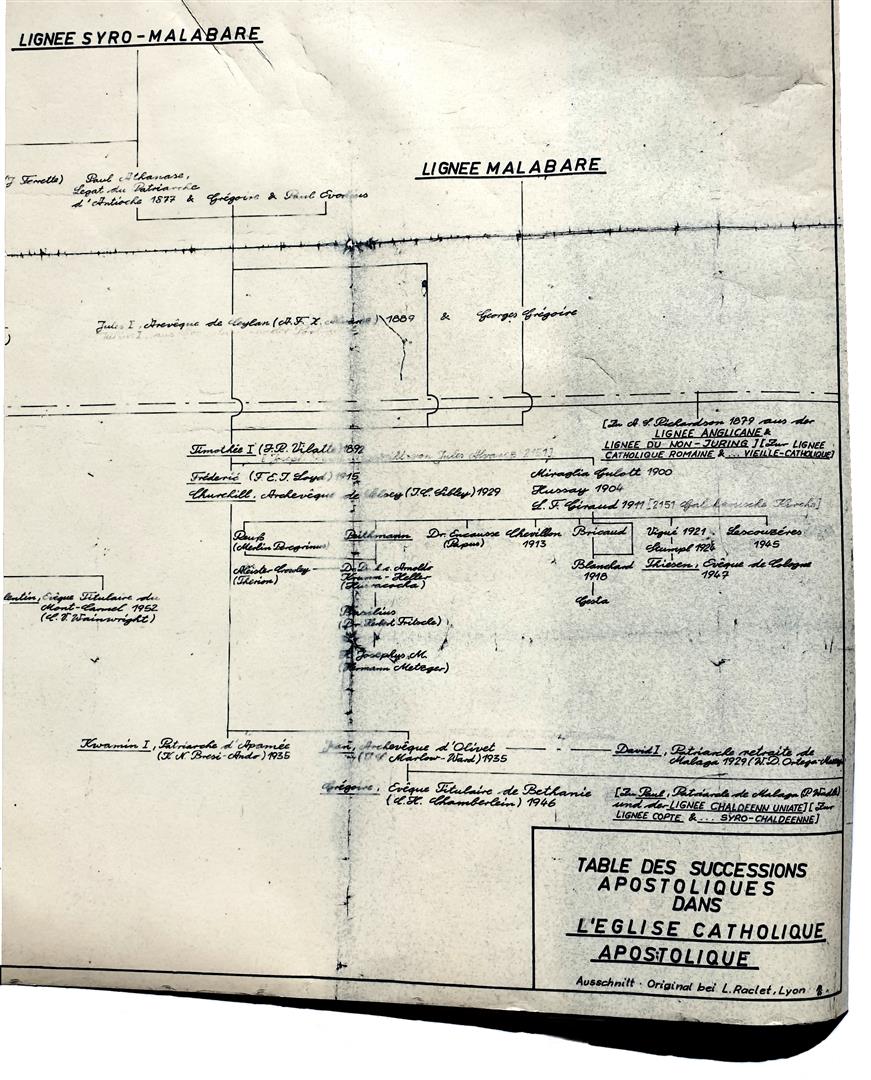
Lignée malabare: René Vilatte, Jules Doinel, Theodor Reuss, E.C.H. Peithmann, Arnoldo Krumm–Heller, Herbert Fritsche, Hermann Joseph Metzger.
The French Gnostic Churches, established in 1890, have experienced numerous divisions over their history. Although they aimed to follow the traditional path of apostolic succession, figures like Theodor Reuss and Aleister Crowley were never properly consecrated within canonical frameworks. In 1920, Reuss and Jean Bricaud attempted to promote Crowley’s Gnostic Mass as the official religion for Freemasons, but this initiative was short–lived. Crowley’s claim to leadership of the O.T.O. was later used in 1944 to appoint William Bernard Crow, an English Theosophist, as head of Crowley’s Gnostic Church and Memphis–Misraim. However, the position of "Outer Head of the Order" (OHO), central to the O.T.O.’s constitution, remained separate from the leadership of any specific church.
The history of the Wandering Bishops (Episcopi Vagantes) highlights their strategic fusion of mystical practices, legal maneuvers, and cultural adaptation to assert identity and institutional relevance. These bishops, lacking canonical legitimacy and traditional apostolic succession, exemplify the broader theological and organizational challenges faced by the Ecclesia Gnostica Catholica (EGC) and related movements. Their improvisational approach to spiritual lineage reflects the fluidity of authority within the O.T.O. and its affiliated entities.
A key critique lies in the reinterpretation of apostolic succession after Vatican II, which reframed ecclesiastical legitimacy as a collective rather than individual authority. This shift undermines the claims of Gnostic bishops to traditional succession and exposes the O.T.O.'s reliance on apostolic lineage as a pragmatic strategy to assert authority and protect intellectual property, emphasizing institutional survival over purely spiritual motivations.
Stranded Bishops — An exploration and historical account of Gnostic Churches and their Wandering Bishops.
The text underscores the necessity of critically engaging with historical claims regarding the rôles of secret societies in religion, particularly in the context of Significant E.G.C. Sequences, the development of Creeds, and the contributions of figures such as E.C.H. Peithmann and Ernst Tristan Kurtzahn. It also examines the influence of Herbert Fritsche and H.J. Metzger's Ordo Templi Orientis and delves into the activities of the Jean–Maines and Michael Paul Bertiaux. The discussion highlights the contested narratives surrounding Stranded O.T.O. Bishops and modern Gnostics in both domestic and ritual settings. Furthermore, it critically evaluates the Great Gnostic Catholic Church Scandal within the 'Caliphate' and the ecclesiastical legacy of William Bernard Crow, considering the biases and agendas inherent in documenting these complex intersections of esoteric traditions and religious institutions.
Some documents are preserved here; a second heap of ecclesiastical paperwork waits on this companion page.
Siehe auch die deutsche Seite Ecclesia Gnostica Catholica, die auf das gleichnamige Buch verweist. Dieses rekonstruiert durch Faksimiles und historische Dokumente die Entwicklung gnostischer Strömungen innerhalb des O.T.O.–Phänomens. Neben der Analyse der gnostischen Messe und des Einflusses französischer gnostischer Kirchen auf Reuss und Crowley wird die institutionelle Transformation des O.T.O., insbesondere unter McMurtry, kritisch beleuchtet, wobei eine zunehmende Kommerzialisierung und Abkehr von Crowleys ursprünglichem Konzept festgestellt wird. Die Legitimität apostolischer Sukzessionen innerhalb des 'caliphatischen' O.T.O. wird ebenso hinterfragt wie die Fragmentierung des O.T.O.–Phänomens und die Rolle konkurrierender gnostischer und esoterischer Gruppen. Das Buch dient dabei nicht nur der historischen Einordnung, sondern auch der kritischen Reflexion über moderne Adaptionen und Umdeutungen dieser Traditionen.
Ernst Tristan Kurtzahn, Mitglied von Reuss' O.T.O.: Die Gnostiker und die Unsichtbare Kirche [1925].
Aleister Crowley appointing W.B. Crow Patriarch of the thelemic Gnostic Catholic Church.
William Bernard Crow: OHO of the O.T.O., Grand Administrator General of Memphis and Mizraim and Patriarch of the Gnostic Catholic Church: The Ancient and Universal Rite of Cosmic Architecture.
In 1944, Crowley corresponded with independent Catholic bishops, including Hugh George de Willmott Newman, who suggested granting William Bernard Crow documentary authority to link the Gnostic Catholic Mass with the Memphis–Misraim Rite, thereby attracting financial supporters unsuitable for the O.T.O. Crowley found Crow charming and intelligent, appointing him "Sovereign Patriarch of the Gnostic Catholic Church and Vicar of Salomon" in August 1944, but later dismissed his grandiose claims, including the establishment of multiple universities, as delusional. After August 1944, Crow consecrated only twice: on September 3, 1944, he consecrated Henry George Brook, who later exchanged consecrations with several other bishops in May 1945. On August 16, 1948, Crow had himself declared Grand Hierophant of the Memphis–Misraim Rite, expanding his Ancient and Universal Rite of Cosmic Architecture to include the 33°, 90°, 97°, and XII° O.T.O., aligning with Crowley’s proposed 12–degree O.T.O. system, which William Breeze later incorporated into his 'Caliphate'. On April 11, 1972, Crow consecrated Kermit William Poling, Patriarch of the Orthodox Catholic Church of America. He passed away on June 28, 1976, and soon after, his esoteric legacy was taken up in Australia by Gregory Tillett, who became Deputy Grand Master of the Order of the Holy Wisdom in 1979.
Stephan A. Hoeller: "Position Paper Concerning the Thelemite or Crowleyan Gnostic Churches".
Hoeller’s essay examines the distinctions between classical Gnosticism, represented by the Ecclesia Gnostica, and modern revivalist movements associated with Crowley and the O.T.O. He contextualizes the Gnostic revival of the 1960s and 1970s, noting confusion caused by groups adopting the term “Gnostic” while lacking connections to classical scripture and sacraments. Hoeller critiques the O.T.O.’s claims of apostolic succession as invalid, arguing they fail to meet ecclesiastical standards of continuity and intent. Crowley’s "Gnostic Catholic Mass" (Liber XV) is dismissed as a magical ritual disconnected from both classical Gnostic and Catholic traditions, with Hoeller clarifying that one Mass no Church doth make.
While acknowledging Gnosticism’s pluralism, he argues that indiscriminate use of the term risks diluting its coherence and misleading the public. Hoeller critiques the Thelemic movement’s rejection of the Christian mythos central to Gnosticism, emphasizing the incompatibility of Thelemic and Gnostic traditions. Ultimately, he advocates for clarity and discernment to preserve Gnostic integrity and urges the Ecclesia Gnostica to uphold its classical traditions amidst modern esoteric trends.
William Wallace Webb. Frater Damon.
Born on May 11, 1919, in Seattle, Washington, Webb joined the Navy in 1941, serving as a forward observer during World War II. After leaving the Navy in 1945, he began a mystical life in 1950, becoming an astrologer and painter. In 1963, he co–founded the Philosophic Gnostic Hermetic Society (PHGS) in Joshua Tree, later establishing the QBL Alchemist Church, which drew on Masonic and Rosicrucian traditions. Webb engaged with figures like Meade Layne to explore esoteric codes and teachings and maintained leadership rôles in the Qabalistic Alchemist Church and the Ordo Argenteum Astrum. Despite hosting many Thelemites, he criticized Helen Parsons–Smith and was honored by Kenneth Grant as an Honorary VII° in 1973. Webb continued his spiritual and esoteric activities until his death on October 15, 1997.


The Ordo Templi Orientis Antiqua (O.T.O.A.) is a syncretic esoteric order blending Gnosticism, Voodoo, and sexual magic, claiming origins in Haiti through Lucien–François Jean–Maine. Although Jean–Maine is said to have been consecrated as a Gnostic bishop and associated with figures such as Papus, no historical records support these assertions, and his rôle within Western esoteric traditions remains disputed. Purportedly founded in 1921, the O.T.O.A. diverged from Crowley’s and Reuss‘ O.T.O. variations by developing a system of 16 grades that integrated Voodoo practices, Afro–Caribbean spiritual elements, and later absorbed multiple Gnostic successions, a Memphis–Misraim lineage, episcopal consecrations, and an Eleventh Degree.
In the mid–20th century, Michael Paul Bertiaux emerged as the order’s ideological and spiritual successor. A former Theosophist associated with Henry Smith’s spiritualist movement, Bertiaux was trained in both Voodoo and Western occultism and established the Monastery of the Seven Rays, which expanded the O.T.O.A. into a transnational network. Under his influence, the order fused Afro–Caribbean magical traditions with Gnostic Christianity and Enochian magic while affiliating with groups such as the Fraternitas Lucis Hermetica and the Ecclesia Gnostica Spiritualis. During this period, the Haitian magical order La Couleuvre Noire became closely tied to the O.T.O.A., reinforcing its syncretic nature.
Operating entirely on a magical level, the O.T.O.A. places a strong emphasis on magic, particularly sexual magic, which remains central to its practices. Its influence extended beyond its own circles, with Kenneth Grant drawing inspiration from Bertiaux's teachings. By the late 20th century, the O.T.O.A. had distanced itself from Thelema, embracing an increasingly Afro–Caribbean and Gnostic orientation while influencing esoteric movements in the United States and Europe.
History of the O.T.O.A.: Inflation of Gnosis — Ordo Templi Orientis Antiqua, Michael Bertiaux, Manuel Lamparter, La Couleuvre Noire, Monastery of the Seven Rays, Choronzon Club.
How William Breeze lost an Apostolic Succession.
In 1989, the 'Caliphate' published its claim to apostolic succession. First, two competing genealogical lines were presented, both straining credulity with their reliance on unverified or outright fantastical consecrations. The first lineage, rooted in figures like Aleister Crowley and William Breeze, hinges on tenuous assertions, including a supposed postal consecration by Crowley (the so–called 'Caliphate' letters) — a claim refuted by Crowley’s own disdain for apostolic tradition. The second lineage is a web of obscure consecrations involving figures such as Michael Bertiaux and William Wallace Webb, whose legitimacy falters under scrutiny. Webb himself dismisses the claims of his own bishopric as legalistic formalities rather than genuine spiritual transmissions.
Critical interventions in the 1990s led to a shift in the O.T.O.'s stance, effectively discarding apostolic succession as a meaningful tenet. This volte–face, prompted by the exposure of inconsistencies, underscores the organization’s pragmatic opportunism rather than spiritual integrity. Breeze’s defensive reaction — both dismissive and vitriolic — betrays the fragility of these claims. The ensuing intellectual gymnastics, such as equating leadership positions with ecclesiastical legitimacy, reveal a desperate attempt to salvage credibility.
My Own O.T.O.A.
Selling out O.T.O. groups in Italy.
The text delves into the complex and fragmented landscape of esoteric and occult organizations in Italy, particularly those linked to the O.T.O. and its various splinter groups. It highlights the influence of figures such as Roberto Negrini and Nevio Viola, demonstrating how internal disputes, power struggles, and ideological divergences led to a proliferation of competing factions. The interactions between these groups involve elements of esotericism, legal conflicts, and, in some cases, political extremism, reflecting the volatile and often performative nature of such organizations. Furthermore, the involvement of figures like Paolo Fogagnolo, with his blend of esoteric and leftist revolutionary politics, adds another layer of ideological complexity to the milieu. Ultimately, the text underscores the unstable and fractious character of the Italian occult scene, where claims of legitimacy, authority, and succession are frequently contested.
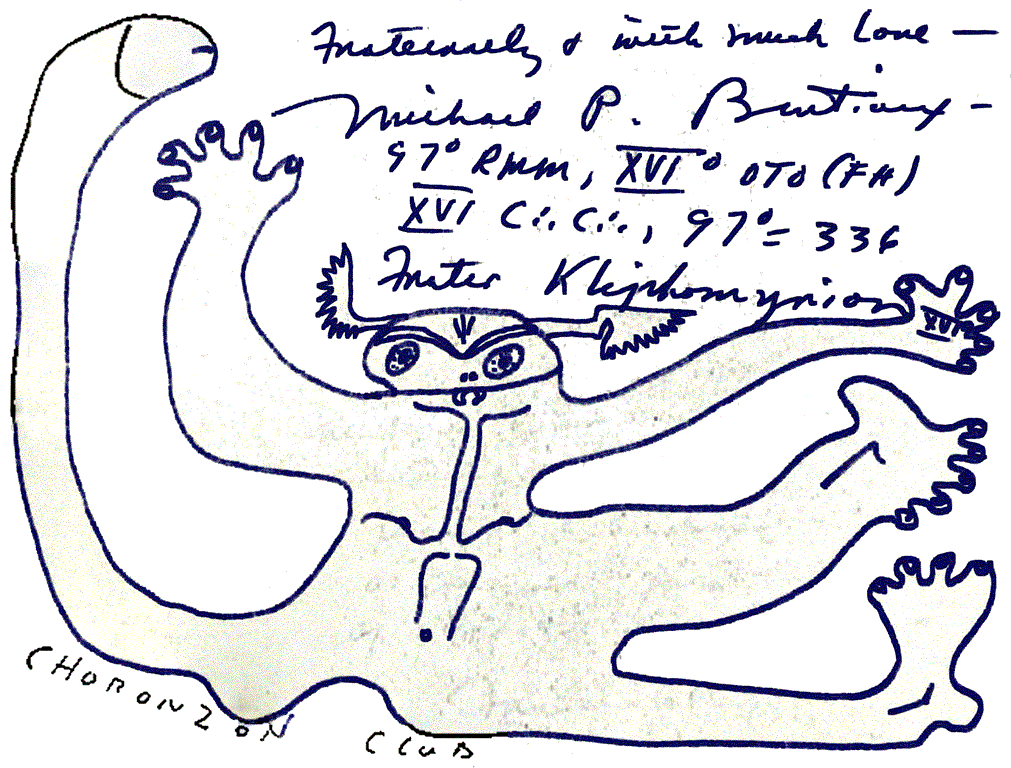

David Bowie and the Occult [Version 2024].
These articles delve into Bowie's spiritual inclinations and their profound influence on his music, performances, and lifestyle. His fascination with both Western and Eastern religious traditions, alongside his engagement with occult practices, shaped his ever–evolving artistic expression. Through masks, transformations, and symbolic gestures, he wove these esoteric themes into his work, crafting lyrics and a public persona that serve as a case study in the shifting dynamics of contemporary belief systems.
Bowie’s work unfolds as a labyrinth of cultural references woven together like an exquisite corpse, where meaning remains fluid, shifting, and often elusive. In this sea of intertextuality, words dissolve into flickering islands of in/significance, and creativity itself oscillates between revelation and an unsettling void.
Keywords: Golden Dawn, science fiction, Friedrich Nietzsche’s Übermensch, homo superior, flirtation with Nazism, Aleister Crowley, from Kether to Malkuth, Arthur E. Waite, Dion Fortune, Andy Warhol, William S. Burroughs, art brut, the first human who sold his persona to the stock market, Angie Bowie.
Steele Savage: David Bowie — Outside, Aleister Crowley, And the Holy Grail.
Bowie's 1995 concept album '1. Outside' reinterprets the Hermetic Grail Quest, drawing connections to his earlier work. The investigation into the murder of Baby Grace Blue alludes to the death of Love in occult philosophy, while the Philosopher's Stone symbolizes divine grace and the Holy Guardian Angel. Bowie deliberately links the murder to the archetype of the Dying God–Man and associates the suspects with contemporary societal malaise. Baby Grace’s mother is connected to mirrors and nature, while the diamond–encrusted umbilical cord represents the regenerated self. The album functions as a form of art therapy, confronting the darkest elements of the unconscious and underscoring the necessity of facing them in the quest for the Grail.
Bowie's song "I Can't Give Everything Away" suggests that the doctrine of crossing the Abyss is accessible only to those who have already reached a higher state of being, while the Blackstar symbolizes his realization of karma.
Encores
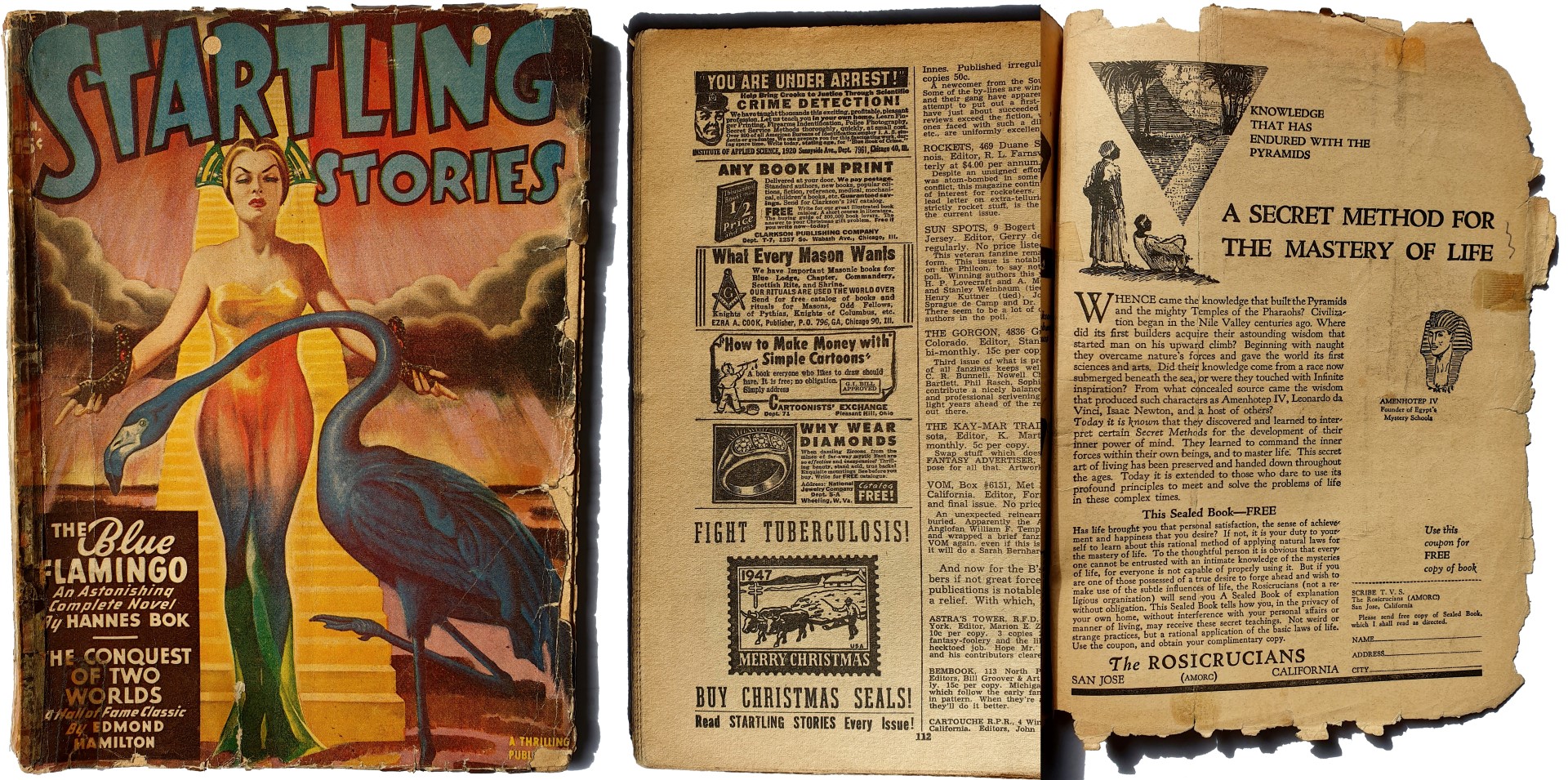
"What Every Mason Wants"
'Startling Stories", January 1948.
An objective researcher will benefit from these Court conclusions
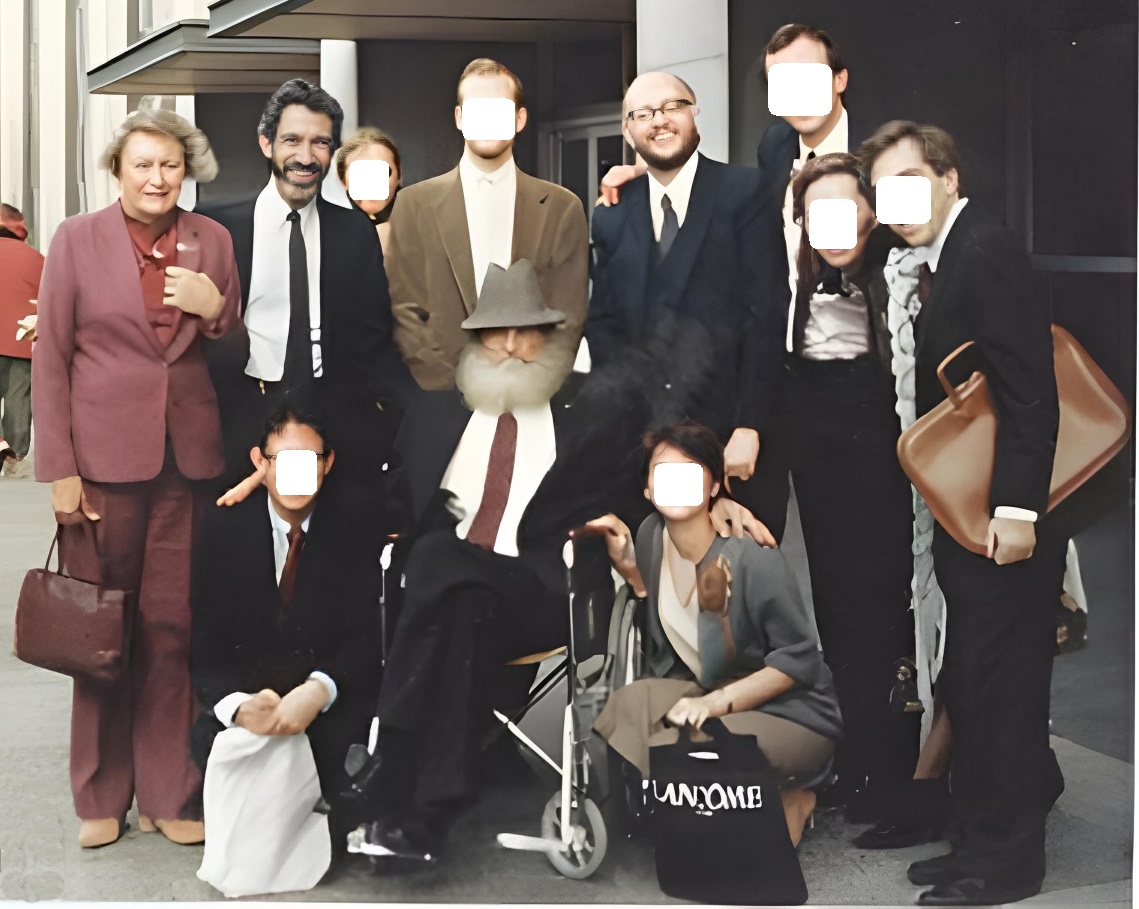
The American Ordo Templi Orientis, 'Caliphate', with Grady Louis McMurtry,
1985, in front of a court building.
The American Ordo Templi Orientis, 'Caliphate', with Grady Louis McMurtry,
1985, in front of a court building.
The Maine Decision, the California decision, The New Court of Last Resort Contents, Austrian rulings on Copyrights, German rulings on Copyrights, the International Copyright Situation, X versus the 'Caliphate', Anthony Naylor, Phaenomen Verlag, Starfire Ltd, Peter–Robert Koenig ...
Selection of Comments – Joscelyn Godwin, Ellic Howe, Albrecht Goetz von Olenhusen, H.T. Hakl, Wolfram Frietsch, Thomas Lueckewerth, Otto Buchinger, John Patrick Deveney, Oscar/Oskar R. Schlag, Erik Davis, Richard Metzger, Jean-François Mayer, Michael D. Eschner, Bill Heidrick, William Breeze, Christian Bouchet, Kenneth Anger, Ben Fernee, Michael Staley, Michael Aquino, G.M. Kelly aka Martin, Jerry Cornelius, James Graeb, Richard T. Cole, George Elliott, Genesis P-Orridge, Gion Cavelty, Bradford Verter, Angela / Angie Bowie, Christopher Hyatt, Ingo Heinemann, Manfred Ach, Dominik Tischleder, Harald Szeemann, Phyllis Seckler, Helen Parsons Smith, Gerald Suster, Timothy d'Arch Smith, Mark Parry-Maddocks, Johannes Maikowski, Daniela Siepe, ChatGPT, Boris Polonski, Colin Wilson, David Bersson and others.

["Thélèma, Bulletin du Mouvement de Thélème en France (Ordo Templi Orientis et Astrum Argentinum)", VIII;26, Château Thébaud, 1991]

In My Own Words
What Will I Give For An Encore? (2005)
This essay sets out the method behind the archive. I collect what the orders prefer to keep apart: ritual and bookkeeping, revelation and copyright, private correspondence and public doctrine, grand titles and very ordinary quarrels. The documents are not arranged to disclose a hidden metaphysical truth, but to show how authority is manufactured, defended, and sold. Irony is not an ornamental sneer; it is one means of restoring proportion when solemnity has become part of the evidence. The O.T.O. phenomenon appears accordingly as ethnographic material, historical paper trail, and recurring tragicomedy.
1998:
Nein, Von Diesem Lichte Ess Ich Nicht !
In diesem Interview werden verschiedene Aspekte meiner ethnologischen Feldforschung im Kontext des Okkultismus behandelt. Ein zentrales Thema, das betont wird, ist die Entfremdung und Ausgrenzung innerhalb der Gesellschaft. Es wird diskutiert, wie verschiedene Diskurse wie Popkultur, Wissenschaft und Esoterik sich gegenseitig beeinflussen. Ich verwende die Figur des Alien als Beispiel für Codierungen und Ausgrenzungsgeschichten im Okkultismus. Dabei wird deutlich gemacht, dass die Erforschung der Beziehungen zwischen Ich und Anderem grundlegende Fragen aufwirft.
Weitere Stichworte: Biographie, Cefalù, Postmoderne, Cover Art.
No, I Shan't Eat This Light !
This interview explores various aspects of my ethnological field research within the context of occultism. Emphasized as a central theme is the phenomenon of alienation and exclusion within society. The interplay between different discourses such as popular culture, science, and esotericism highlights their mutual influence. The figure of the alien exemplifies coded narratives and exclusionary stories within occultism, revealing how exploring the relationships between self and other raises fundamental questions.
Additional keywords: Biography, Cefalù, Postmodernism, Cover Art.
2008: Honesty is the Best Policy: An account of how the 'Caliphate' O.T.O. and William Breeze were unsuccessful in a legal case.
My research on the O.T.O. led me to document its public perception and legal disputes, particularly the allegations of ritual abuse. In search of reliable sources, I contacted the website gaiaguys.net, known for its conspiracy–related content, to obtain court documents and provided its operators with a heavily redacted internal membership list for verification — never intended for publication. When they misused the information, I unexpectedly found myself entangled in a legal battle with the so–called 'Caliphate' O.T.O., which sued me under the fabricated pretext of a data protection violation — apparently with the real aim of punishing me for my critical publications. My acquittal and the O.T.O.’s legal failure underscored the organization’s struggles with public scrutiny. Particularly perplexing was their choice of a lawyer with a peculiar past in child protection matters. This case made it clear to me how risky it is to engage with conspiracy theorists and how quickly research can cross into legal gray areas.
Deutsche Version: Ehrlich währt am längsten: Eine Darstellung, warum der 'Caliphate' O.T.O. gegen Peter–R. König unterlag.
Meine Forschung zum O.T.O. führte mich dazu, seine öffentliche Wahrnehmung sowie seine juristischen Auseinandersetzungen, insbesondere die Vorwürfe des Ritualmissbrauchs, zu dokumentieren. Auf der Suche nach belastbaren Quellen kontaktierte ich die für ihre verschwörungstheoretischen Inhalte bekannte Website gaiaguys.net, um Gerichtsunterlagen zu erhalten, und stellte den Betreibern eine stark gekürzte interne Mitgliederliste zur Überprüfung ihrer Behauptungen zur Verfügung — keinesfalls zur Veröffentlichung bestimmt. Nachdem sie die Informationen missbräuchlich verwendeten, geriet ich unerwartet in einen Rechtsstreit mit dem sogenannten 'Caliphate' O.T.O., der mich unter dem konstruierten Vorwurf eines Datenschutzverstoßes verklagte — offenbar mit dem eigentlichen Ziel, mich für meine Publikationen abzustrafen. Mein Freispruch und das juristische Scheitern des O.T.O. verdeutlichten, wie schwer sich diese Organisation mit öffentlicher Kritik tut. Besonders befremdlich war deren Wahl eines Anwalts mit eigenartiger Vergangenheit im Bereich des Jugendschutzes. Dieser Fall machte mir deutlich, wie riskant es ist, an Verschwörungstheoretiker zu geraten, und wie schnell Recherchen in rechtliche Grauzonen geraten können.
Interview 2024: In The Bermuda Triangle.
I approach occultism as a cultural artifact, focusing on its historical and social context rather than its content. Esoteric themes are regarded similarly to art brut or pulp fiction: apart from their entertainment value, meaningless on their own yet insightful in their origins and cultural significance. My work rejects rigid methodologies, embracing the chaotic, self–referential nature of the occult world while questioning why people immerse themselves in such fringe pursuits. Personally, I remain detached, treating my research as that of an archivist and collector rather than a believer. I refer to the grotesque finale of The Monk as an example of humanity’s obsession with extremes — decadence, decay, and the macabre — reflecting my bemused approach to such narratives and how they lay bare responses to existential absurdity.

AI–crafted Dadaist self–portrait based on keywords from this interview
Secrets of the Rosicrucians, Templars and the Illuminati

Books Online
Der Kleine Theodor Reuss Reader (featuring statutes, the 'Oriflamme', rituals, and writings on sex magic) — presented in the original German version. 1993.
Das O.T.O.–Phänomen (a comprehensive history of the O.T.O. groups). 1994.
Ein Leben für die Rose (This text provides a biography of Arnoldo Krumm–Heller, an examination of the sex magic practices of Reuss, Crowley, and Krumm–Heller, and an analysis of the belief system of the Fraternitas Saturni). 1995.
ABRAMELIN & Co. 1995.
(This work investigates the concept of Holy Guardian Angels, other UFO phenomena, and their connections to Thelema and the Argenteum Astrum (Silver Star), as embodied by Aleister Crowley. The text also explores Crowley's practices related to sex magic, including coprophagy and algolagnia).
Selected sections of this book have been translated into English:
Part One of Smoke Gets In Your Aiwass.
Angels as divine messengers predate Christianity and appear in Ugaritic, Assyro–Babylonian, and biblical traditions within differentiated celestial hierarchies. The Abramelin material belongs to a late–medieval or early–modern manuscript tradition rather than to a securely dated 14th–century book. It describes an operation for attaining knowledge and conversation of the Holy Guardian Angel and authority over demons, later absorbed into Crowley’s Thelemic system, especially the A∴A∴. Comparisons with modern UFO encounters are used here phenomenologically: they point to recurring structures of experience without declaring angels, demons, and extraterrestrials identical.
Part Two: More on The chajoth, the ‘living creations’ or ‘flying things’.
Ezekiel’s visions of the chajoth and later traditions of archons and celestial courts supplied occultism with hierarchies, seals, permissions, and dangers. Crowley’s adaptation of Abramelin became central to his magical system, although his operation at Boleskine remained unfinished and was later mythologised as both achievement and warning. The Adonists, briefly allied with the Fraternitas Saturni, form another strand in which sexual magic, angels, demons, and claims of transcendence meet.
Die vollständige Version (mit einem dritten Teil) ist jedoch nur auf Deutsch erhältlich: Abramelin & Co.:
Karl Germers Erfahrungen mit seinem Heiligen Schutzengel (HGA) zeigen eine Verschmelzung von spiritueller Identität und okkulten Praktiken, die traditionelle Geschlechtszuschreibungen auflösen. Der HGA wird dabei nicht nur als göttlicher Vermittler, sondern auch als Projektionsfläche homoerotischer und geschlechtsübergreifender Rollen interpretiert. Crowley beschreibt diese Vereinigung als ekstatisch, jedoch unfruchtbar, und sieht im Ritual die Annahme einer weiblichen Rolle als Voraussetzung. Germers Haft in Nazi–Deutschland wird zur Initiation, in der er durch Meditation und Rekonstruktion heiliger Texte einen transzendenten Kontakt erfährt, der seine Identität transformiert. Marcelo Ramos Motta erweitert diese Konzepte und interpretiert den HGA als Verkörperung des Kundalini–Prinzips, dessen Aktivierung zum spirituellen Erwachen führt. Motta postuliert, dass die Verbindung mit dem HGA einen Prozess der Selbstvergöttlichung in Gang setzt, wobei spirituelle Hierarchien und magische Rituale als Vehikel dienen. Der Text verknüpft diese Ideen mit modernen Interpretationen, in denen der HGA als Schnittstelle zwischen irdischem Bewusstsein und kosmischer Intelligenz fungiert, was durch Science–Fiction–Metaphern und außerirdische Symbole gestützt wird. Kenneth Grants Weiterentwicklungen führen zu visionären Konzepten des Übermenschlichen, die Sexualmagie und außerzeitliche Realitäten kombinieren, während andere zeitgenössische Strömungen den HGA als Spiegel von DNA–Mutation und Bewusstseinserweiterung deuten. Schließlich reflektiert die Analyse, wie diese Vorstellungen die Grenzen zwischen psychologischem Archetyp und metaphysischer Realität verwischen und den HGA als zentrales Symbol der Selbsttranszendenz etablieren.
Walter Jantschik: Die Schutzengelbeschwörung durch ABRAMELIN.
Claas Hoffmann: Besessenheit, Mister Spock & Abramelin.

Address to buy some
books about the O.T.O. Phenomenon:
A.R.W.
Manfred Ach
Gunta–Stölzl–Str. 9
D – 80807 München
Deutschland / Germany
Online ordering via email
The majority of these books are no longer available for purchase.
books about the O.T.O. Phenomenon:
A.R.W.
Manfred Ach
Gunta–Stölzl–Str. 9
D – 80807 München
Deutschland / Germany
Online ordering via email
The majority of these books are no longer available for purchase.
See them
Scattered On The Floor while
Browsing Through The Rituals

Data
As of October 2026, this website comprises 961 webpages: articles, translations, comments, source editions, galleries, and contributions by others. Many pages contain documents, photographs, audio, or video. Some images have been AI–treated or AI–generated; these interventions are identified as such.
This introductory page exposes only a fraction of the archive. The real route runs through the links inside the individual dossiers, where documents lead to other documents and footnotes acquire offspring.
The labyrinth is not ornamental. It reflects both the fragmented subject and the way the research accumulated over four decades.
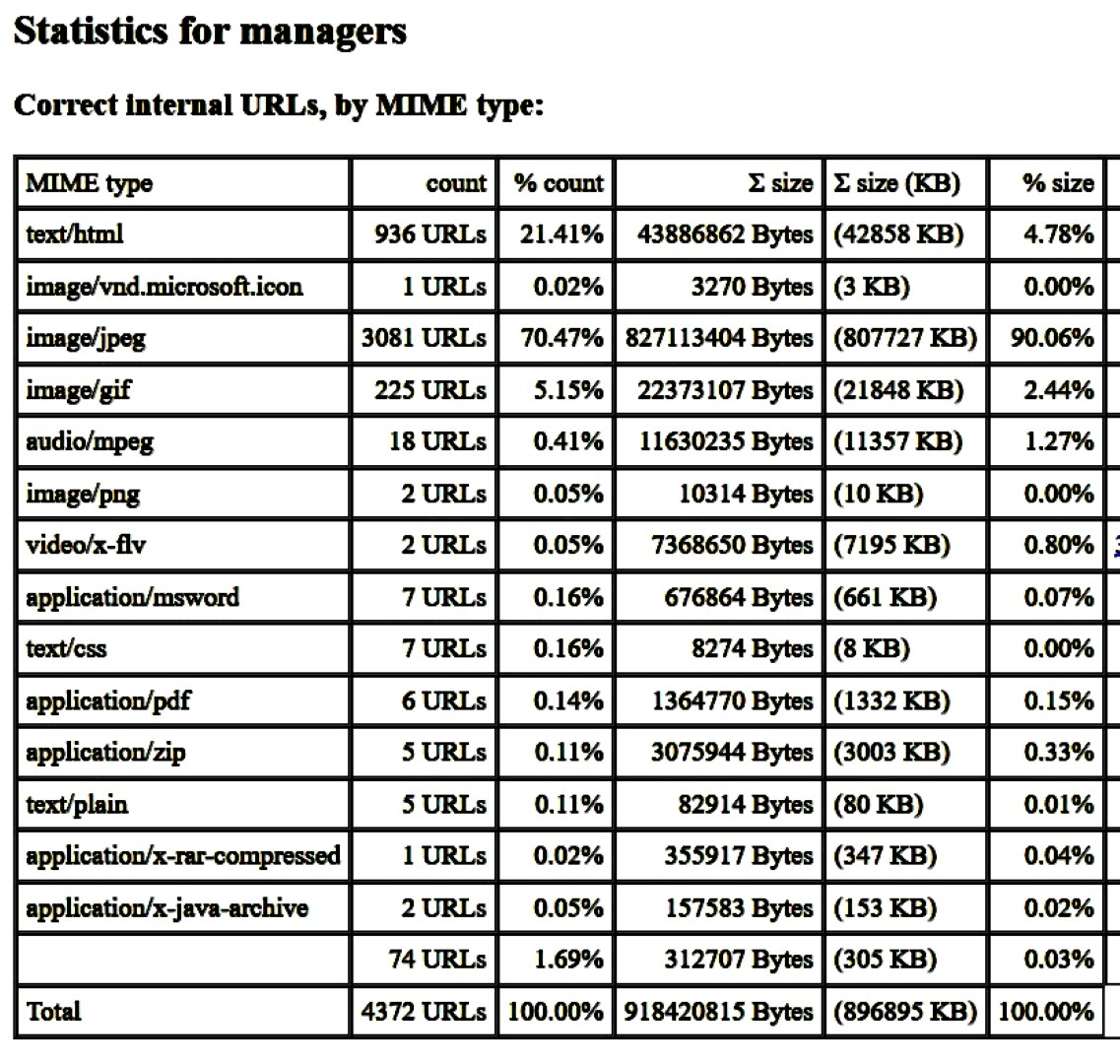
As of October 2026
These days, debates on the internet often resemble a collective downhill race. Participants vie with each other to rush towards the abyss on their ideologically primed steep slopes. The crash seems inevitable, and the end near — however, the specific end in question varies depending on the faction. Is it the domain of the self–righteous and know–it–alls, those voices that express opinions on absolutely everything and prefer to preach their truths in the form of slogans?
And how was the internet perceived and used in its early days?
Use of the Internet — A questionnaire for occultists, March and April 1997.

This section presents a selection of emails received during my research into the O.T.O. phenomenon, including correspondence from 1996 to 2000 and comparable accounts.
They show, in the correspondents’ own language, why people wished to join, declined to join, or remained suspended between attraction and distrust. The value lies less in a representative sample than in the motives, projections, and expectations that become audible.


Paper correspondence, 1985–1996.

Archive of documents, manuscripts, and internal records, 2000.


Archive of documents, manuscripts, and internal records, 2024.
Navigation


MP3 / YouTube recordings:
The recordings include Marcelo Ramos Motta, Oscar Schlag, W.W. Webb, Michael P. Bertiaux, Annemarie Äschbach — who assumed interim leadership of Metzger’s Swiss group after his death — and a grandson of Carl Kellner recalling his grandfather.
Photographs and Documents:
A compilation of photographs and documents highlighted through the Bing search engine, showcasing notable figures such as Carl Kellner, Theodor Reuss, Arnoldo Krumm–Heller, Marcelo R. Motta, and Oscar Schlag, alongside charters, letters, manuscripts, and other archival materials.
What's New?
A comprehensive list of new content, revisions, and corrections, updated regularly since March 2000.

My intent is to present fragments of the O.T.O. phenomenon. Comments, corrections, suggestions, and complaints are welcome.
 Click / tap to enter
Avoid the fate of Gregor Samsa — regular visits to this site will keep unsightly metamorphoses at bay.