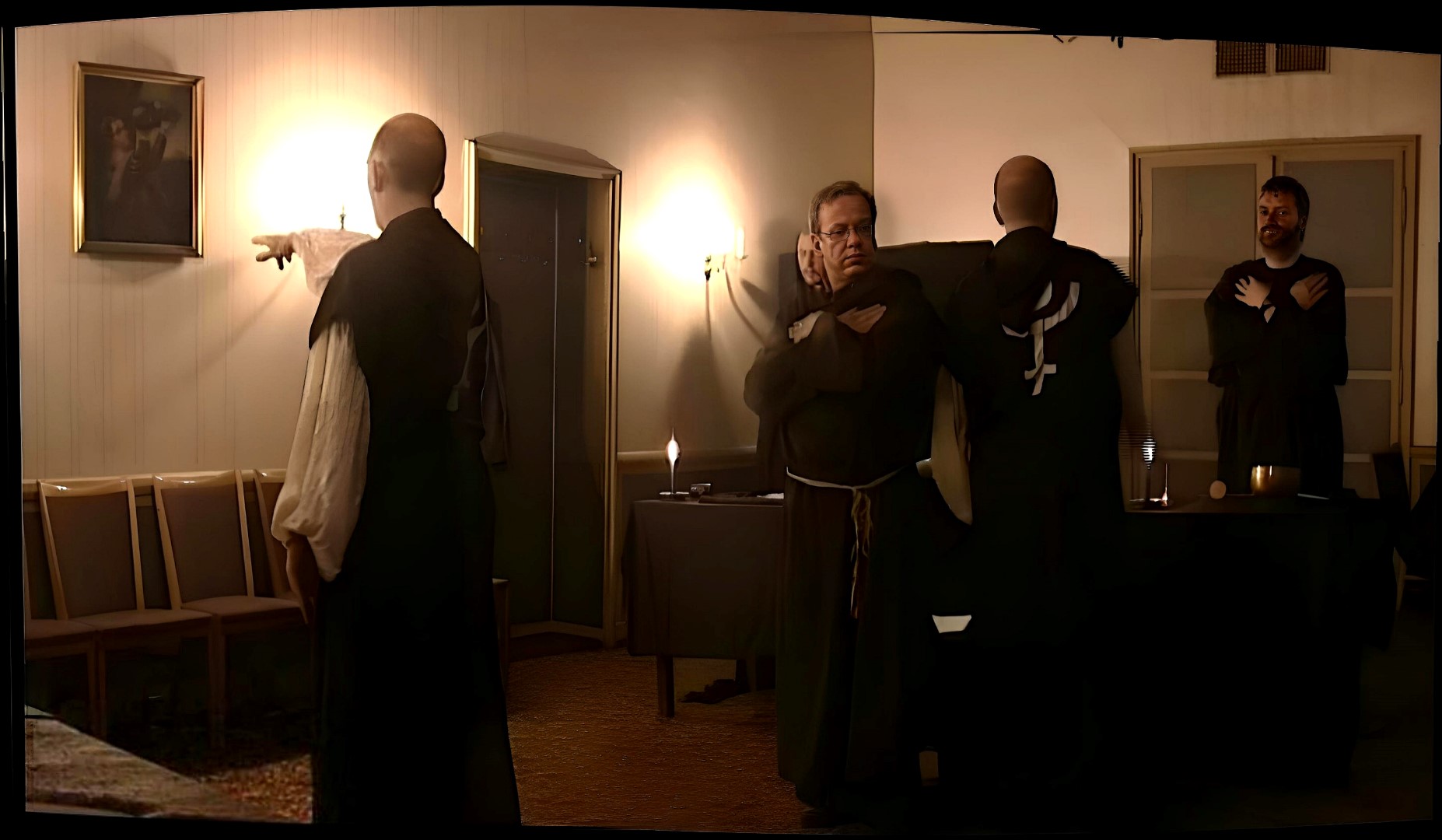
Grandmaster of the Fraternitas Saturni: chemistry, sex, demons, domestic trouble, popular culture and the persistent wish to run an occult organisation — all under Saturn.
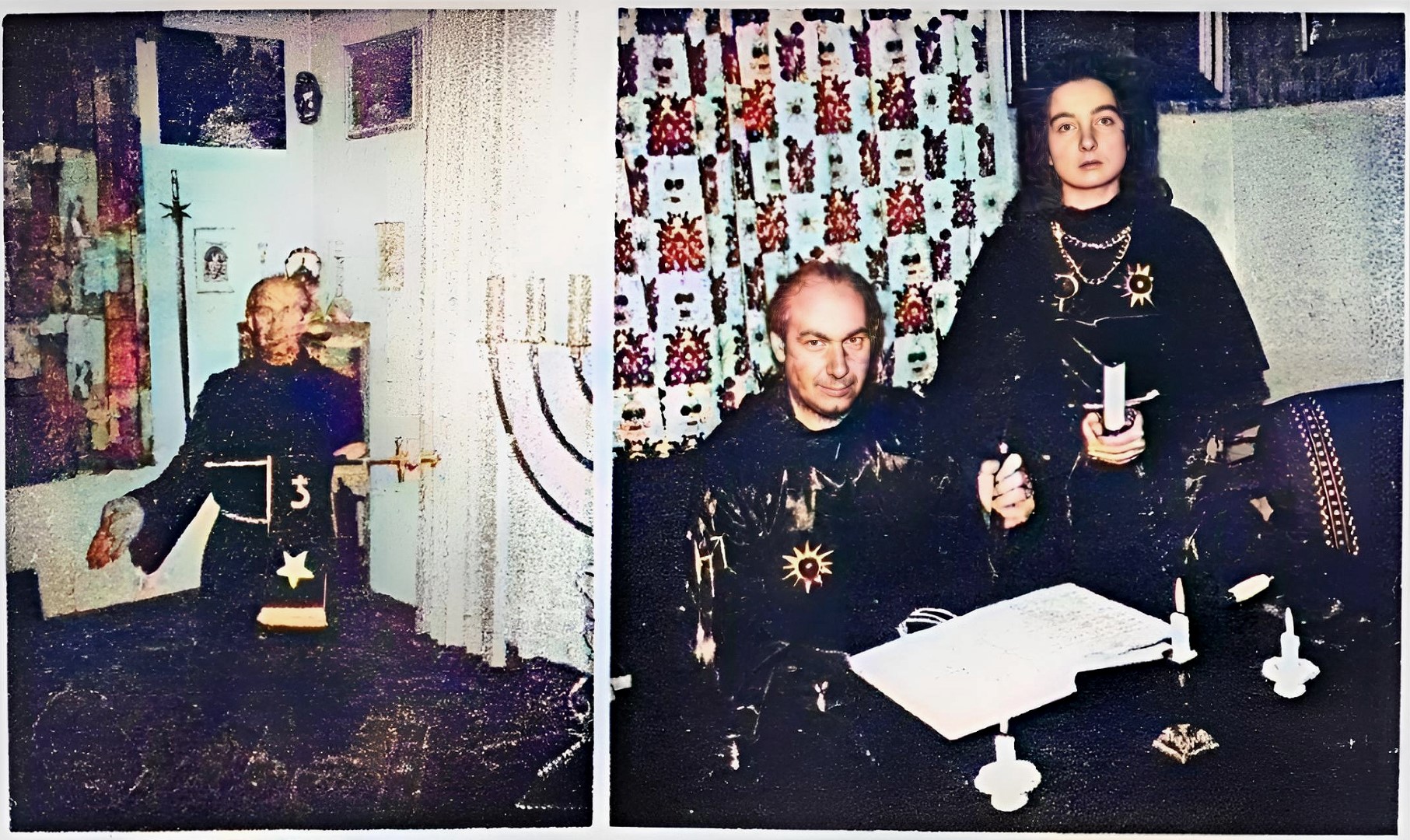
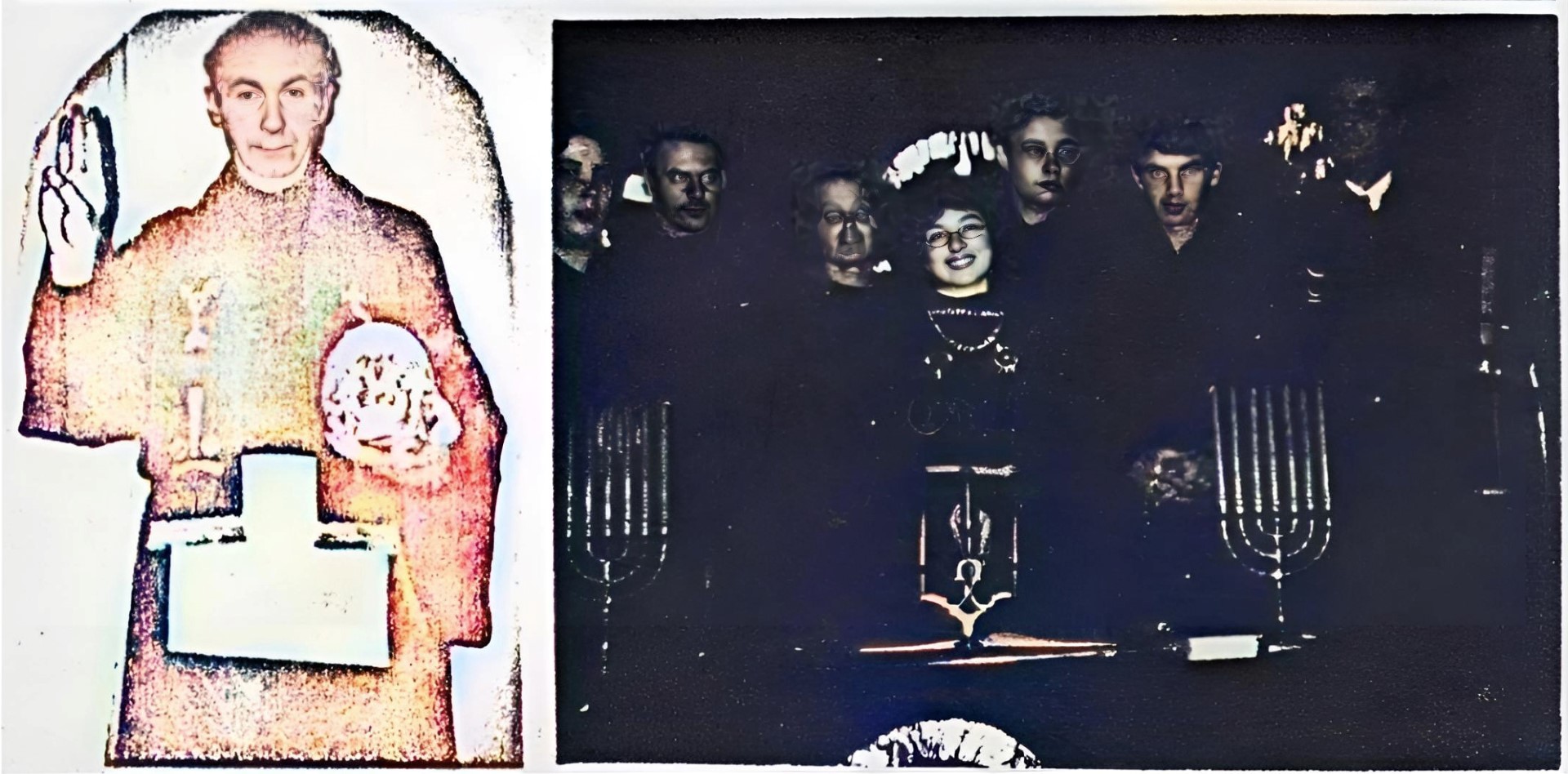
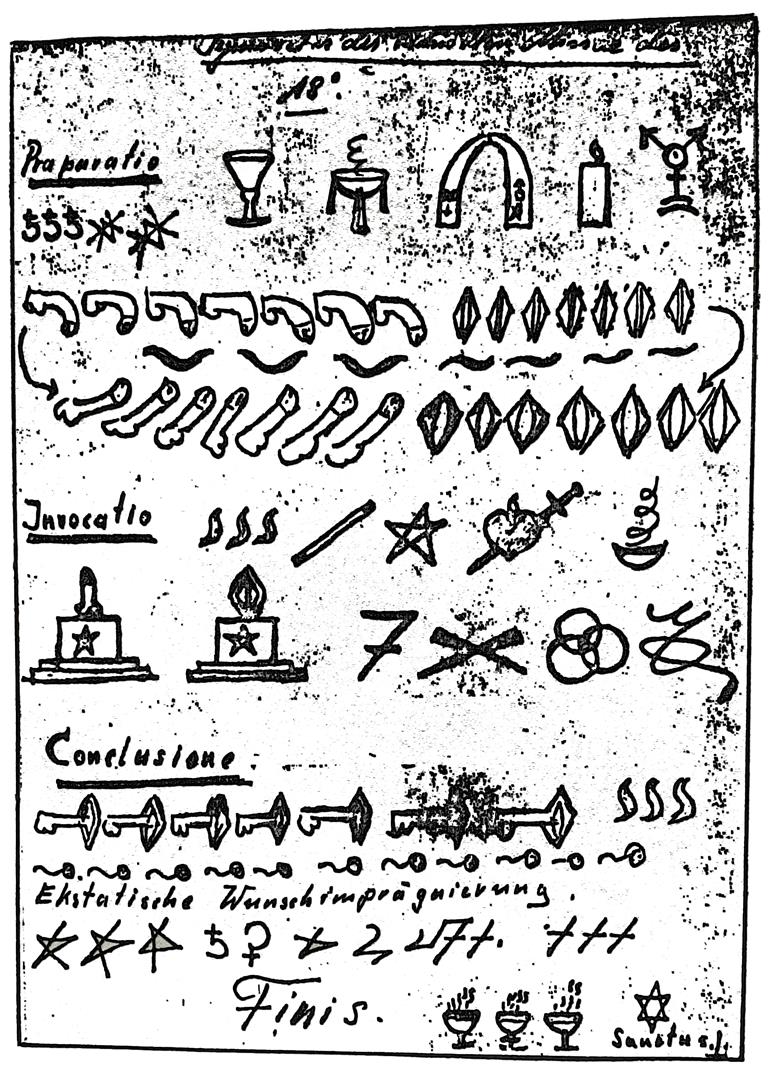
Guido Wolther, Frater Daniel (18°, 33°), joined the Fraternitas Saturni in March 1964, became Grandmaster at Easter 1966 and reached the 33° in 1967. Within remarkably little time, he produced rituals, sex-magical drawings, symbolic systems, inner orders, blood, semen and administrative trouble. His notorious 18° ritual travelled beyond the lodge; the rest helped give the postwar F.S. some of its more memorable scenery.
Taken together, the material is less a coherent magical system than a remarkably busy household on Saturn: chemistry, sex, demons, popular entertainment, marriage and lodge politics keep wandering into one another. The broader chronology and documentary setting are treated in the history of the Fraternitas Saturni.
Dossier
Routes through Wolther, his rituals, drawings and neighbouring Saturnian scenery.
Chronology in brief
March 1964
Wolther joins the Fraternitas Saturni.
Undated
In the Pluto ritual, probably written before or around 1966, Wolther asks for "the power to reign over people" and to become "master of an organisation, of an occult society" — a power he wishes to share with his wife. Her part is already written into the drama: partner in power, future betrayer. Pluto supplies both the job description and the marital foreshadowing.
9 April 1966
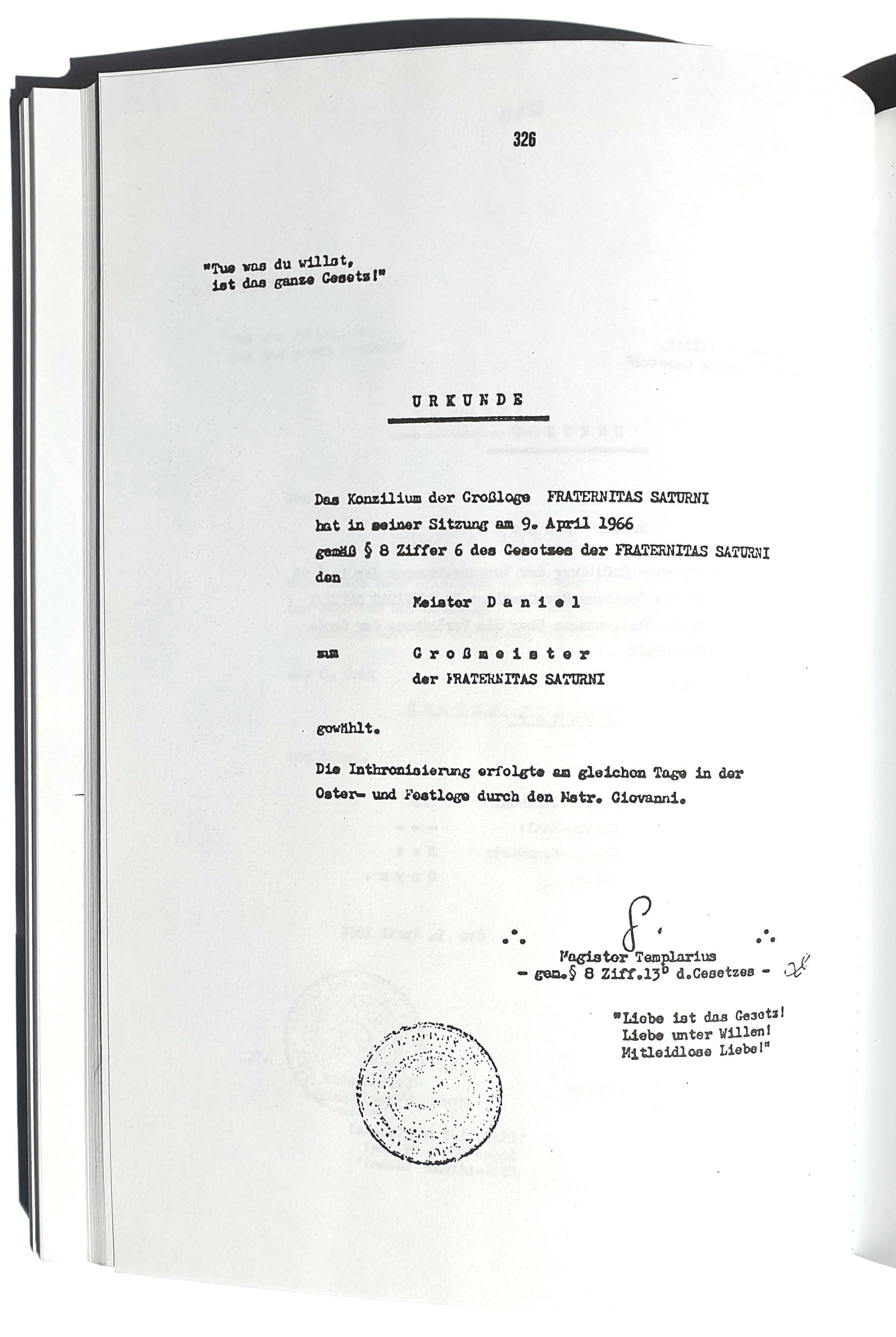
At the Easter Lodge, Wolther is elected Grandmaster of the F.S.; the surviving certificate records his enthronement by Karl Wedler (Giovanni) on the same day.
1966
Miriam Wolther writes Amor Ex Nihil, a literary construction of the same domestic, sexual and occult milieu in which Guido's ritual work was taking shape.
Easter 1967
Wolther is elevated to the 33°.
April 1968
He establishes the Ancient and Mystical Order of the Saturn Brotherhood, AMOS / OMS, within the F.S., allegedly on the "higher command of the Great Demiurge Saturn".
28 Aug. 1968
Miriam leaves Wolther together with Hans Bühler / Heliobas; the marital crisis soon enters Wolther's correspondence, magical requests and organisational life.
Late 1968
An Abschlussbericht from Wolther's camp recasts the marital and lodge crisis surrounding Miriam (Soror Rahel) and Heliobas as an attempted overthrow. It is evidence for that interpretation, not neutral proof of the alleged coup.
10 Feb. 1969
Wolther contests annual Grandmaster elections and equal voting rights, considers withdrawing, and quarrels over lodge property. Pluto had promised dominion; occult power had come down to ballots, ritual books and who owned the gong.
Easter 1969
Wolther's period as Grandmaster is effectively over; Walter Jantschik is installed as Grandmaster of the United Lodge.
18 Feb. 1971
Wolther declares his final break with the lodge leadership, disputes claims surrounding Adolf Hemberger and ritual material, and closes the Orient Frankfurt.
1971
The Gradus Pentalphae material is in circulation in documented form.
1973
Wolther's symbolism of the 18° and related drawings are documented.
1974
FOGC ritual material attributed to Wolther appears in Adolf Hemberger's compilations. No later drawings or writings by Wolther are presently known here.
The chronology mixes contemporary lodge papers and correspondence with later recollections. The Pluto ritual is undated; its placement before or around 1966 is provisional. Where the sources disagree, the quarrel continues in the linked F.S. dossier.
Primary documents, 1966–1971
Nine facsimile pages, one brief career: one page for the ascent, eight for the trouble afterwards. They cover election, accusation, constitutional quarrel and final rupture. They are not equal as evidence.
9 April 1966
Election and enthronement
The high point comes with unusually tidy paperwork. On 9 April 1966 Wolther, Frater Daniel, was elected Grandmaster of the Fraternitas Saturni; Giovanni enthroned him the same day. For once, the document records an office rather than a quarrel.
Election and enthronement of Guido Wolther / Frater Daniel as Grandmaster, 9 April 1966.
Late 1968
The Abschlussbericht: crisis becomes narrative
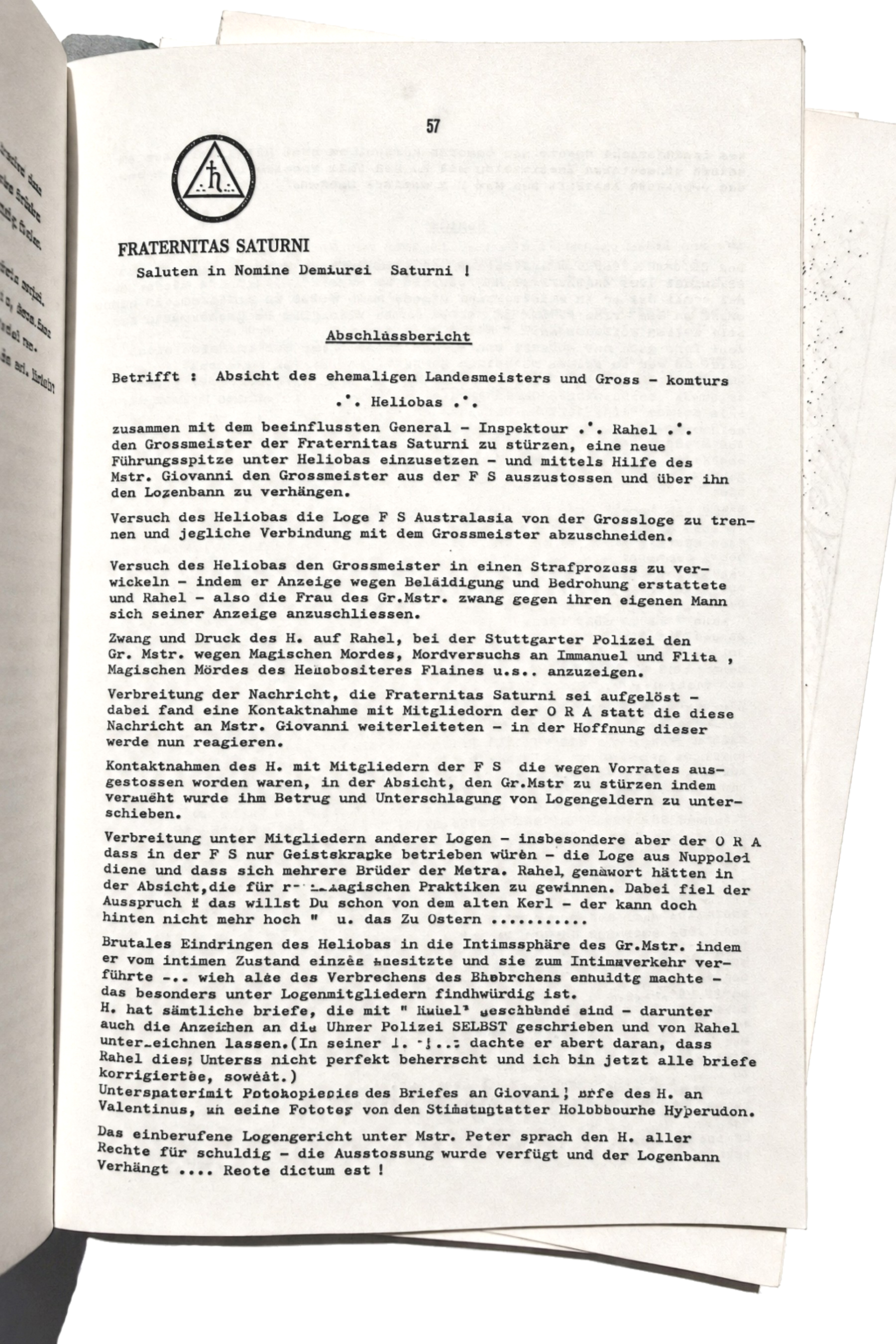
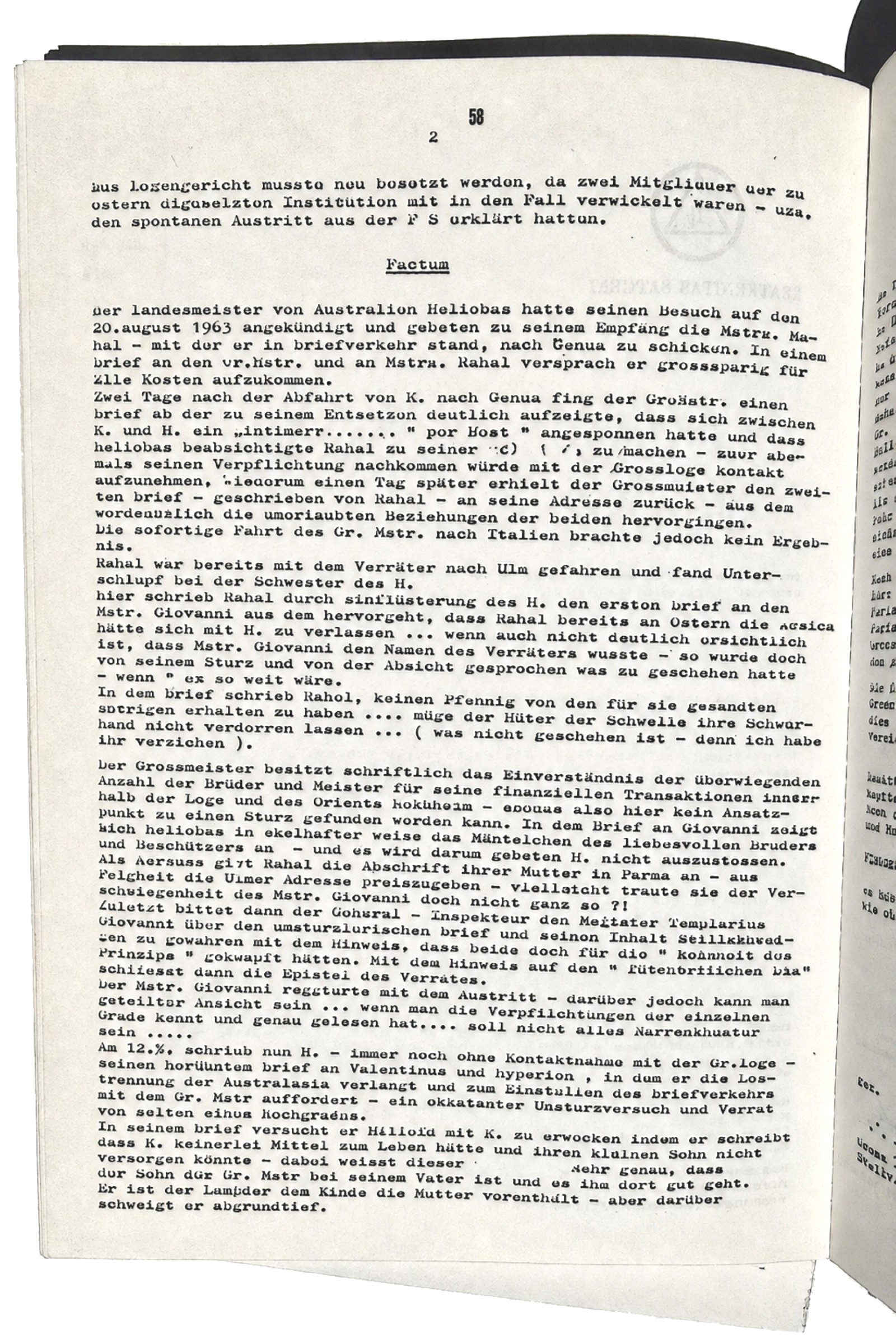
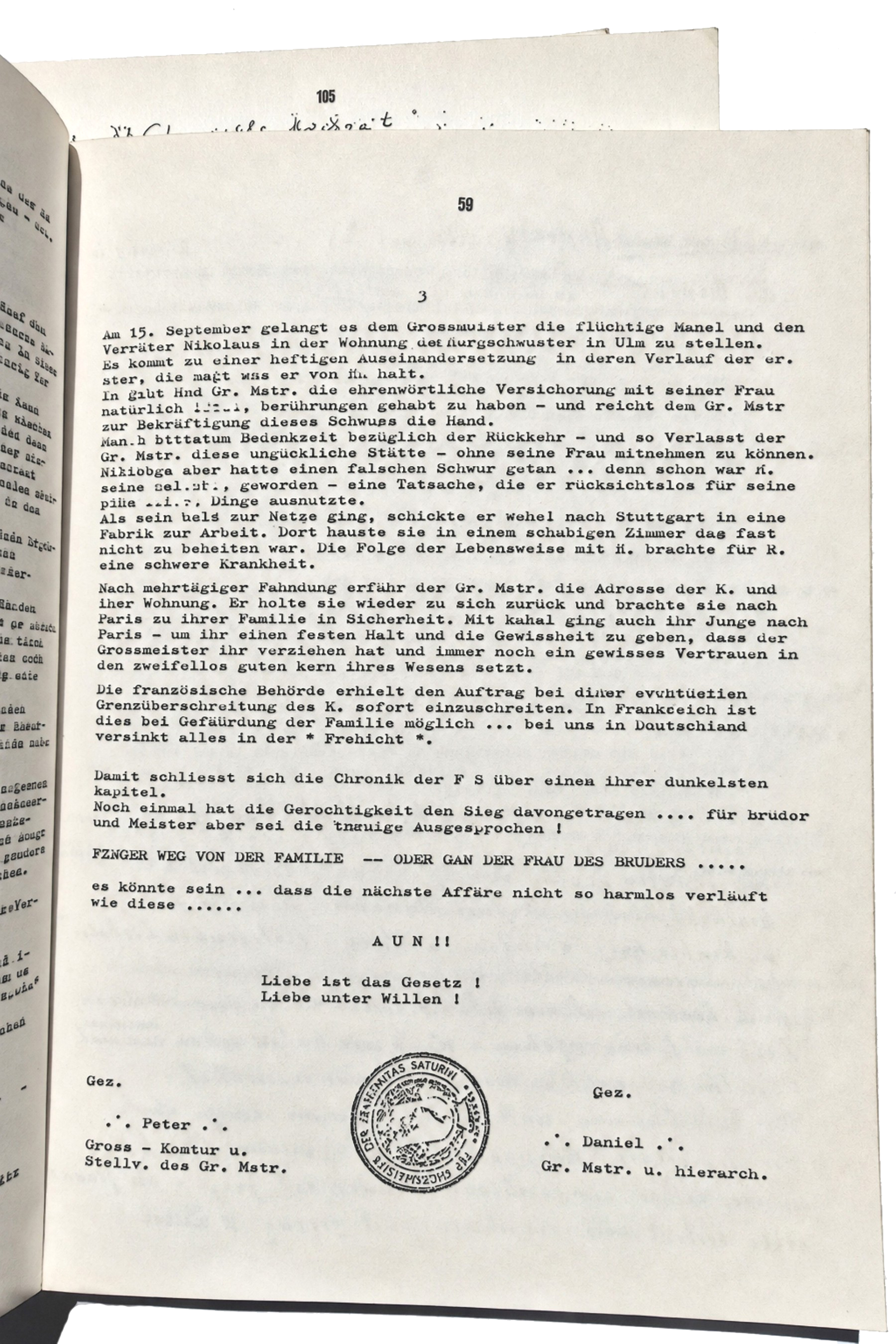
After Miriam / Rahel left Wolther with Hans Bühler / Heliobas on 28 August 1968, marriage and lodge politics stopped pretending to be separate subjects. This three-page Abschlussbericht, signed only by Guido Wolther (Frater Daniel) and a certain Peter, casts Heliobas and Rahel in a tale of influence, disloyalty and an attempted overthrow of the Grandmaster.
It tells us very clearly what Wolther's camp thought had happened. It does not, by itself, prove that the coup happened that way — or that there was a coup at all.
Abschlussbericht, late 1968 — page 1 of 3.Page 2 of 3.Page 3 of 3.
The barely legible original was gently restored with AI. It helped, but only just.
10 February 1969
Authority, withdrawal and lodge property
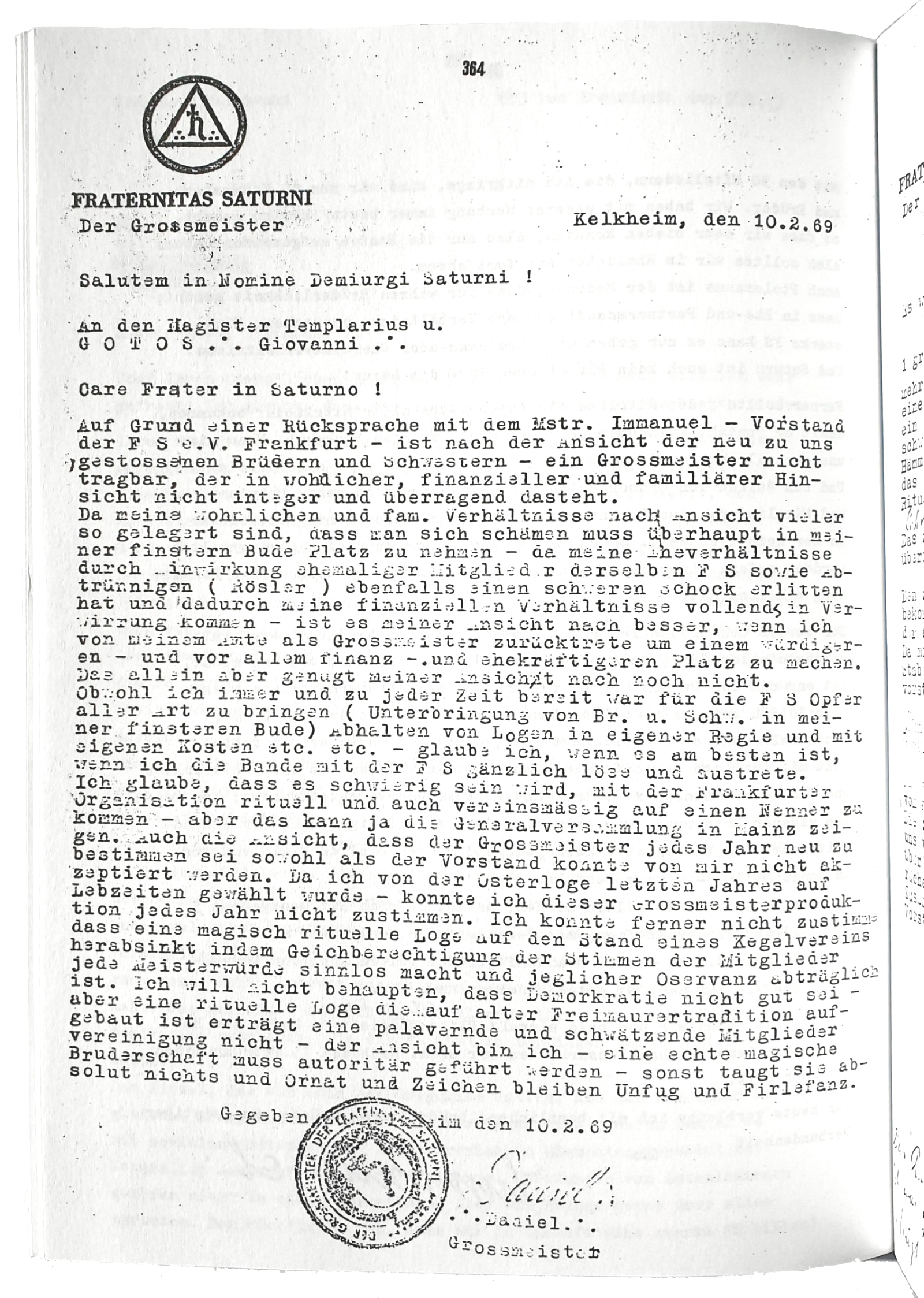
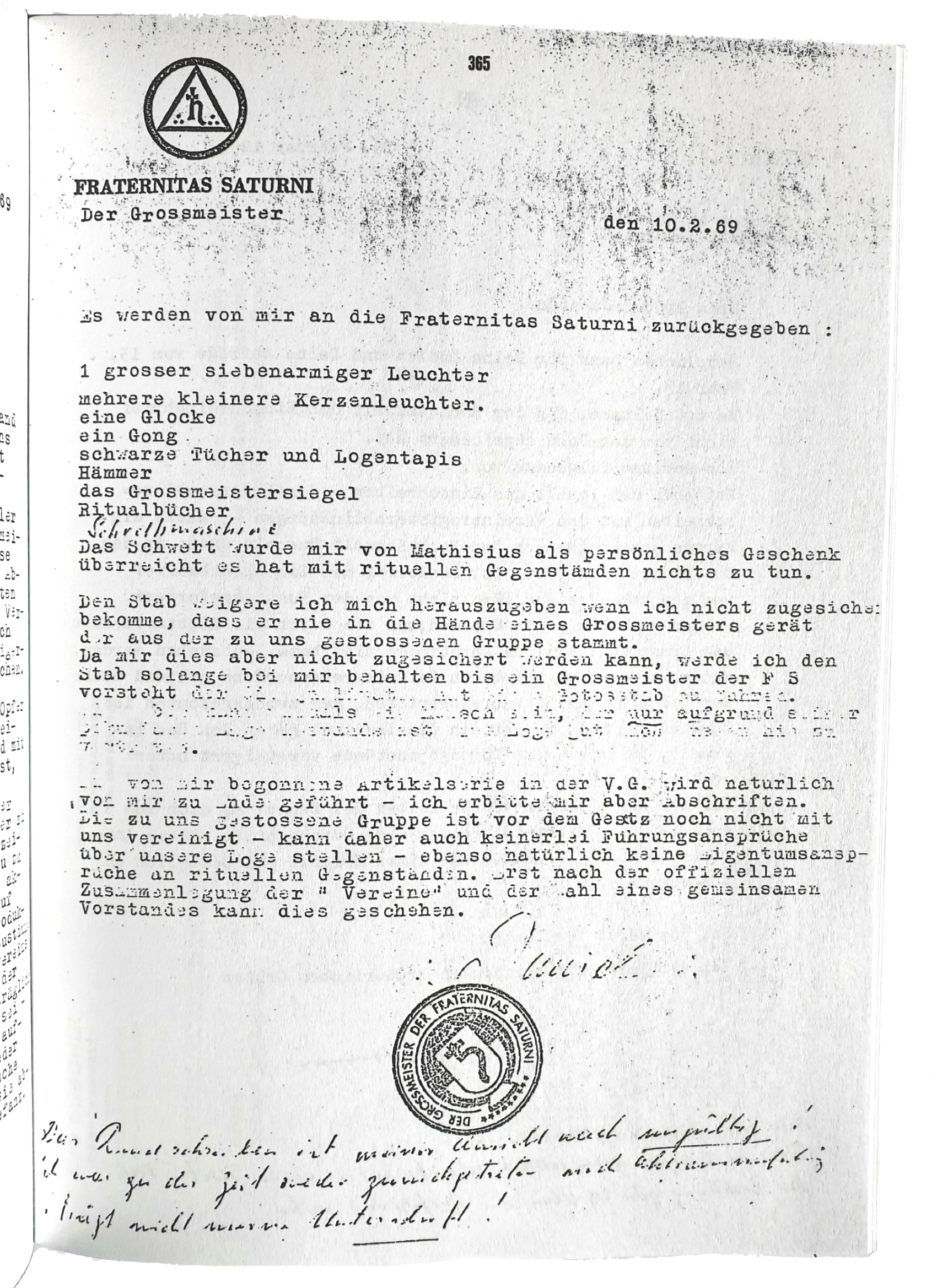
By February 1969 the demons had yielded to bylaws. Wolther objects to annual Grandmaster elections and to equal votes: a magical lodge, in his view, should not become an ordinary club with ballots. He considers withdrawal while discussing ritual books, seals and other paraphernalia to be returned, retained or accounted for.
The letter is useful precisely because metaphysics and housekeeping share the same paragraph. Magical authority now means something very practical: who decides, who owns the objects, and who gets to speak for the lodge.
Guido Wolther, 10 February 1969 — page 1 of 2.Page 2 of 2.
18 February 1971
Final break — without a quiet exit
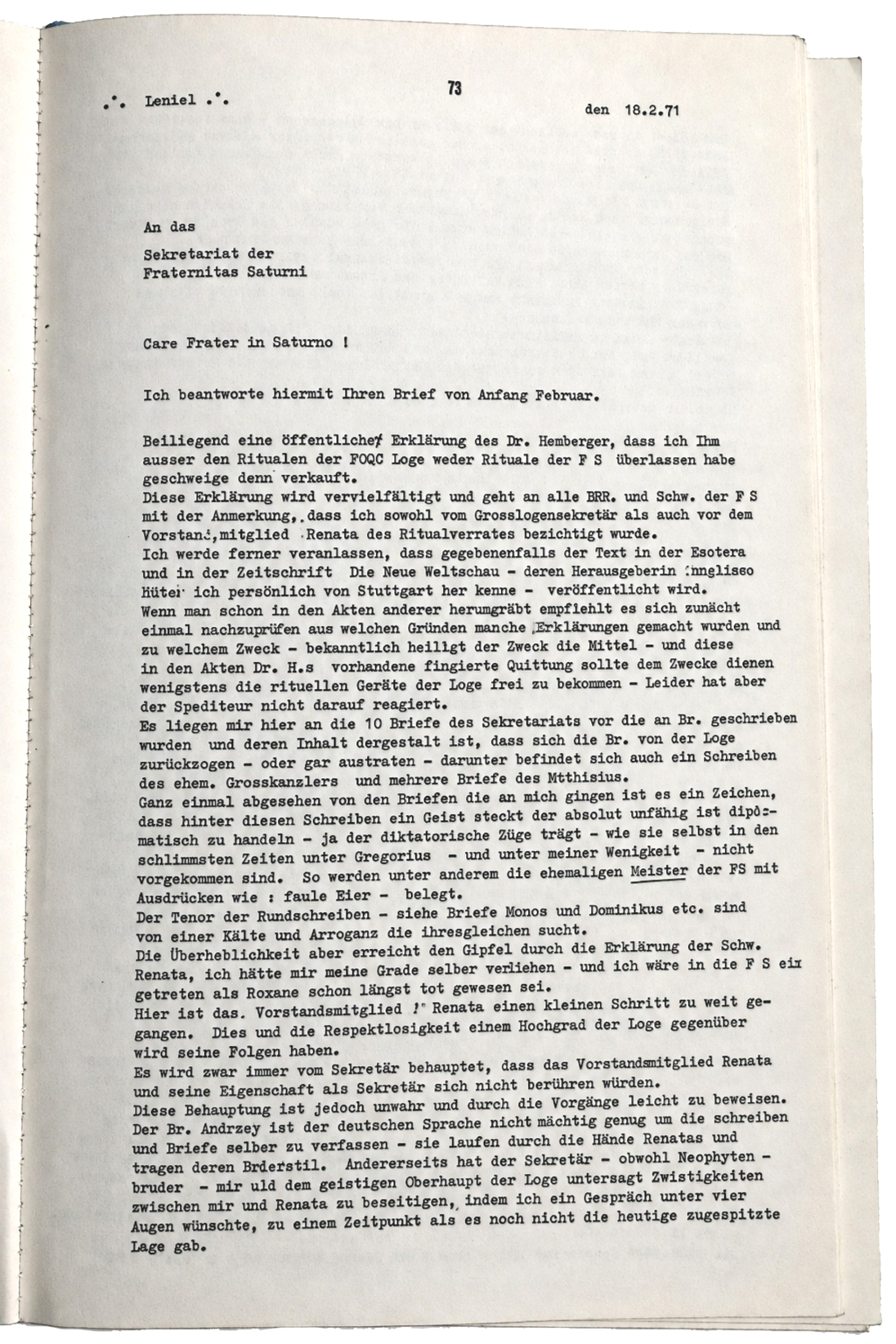
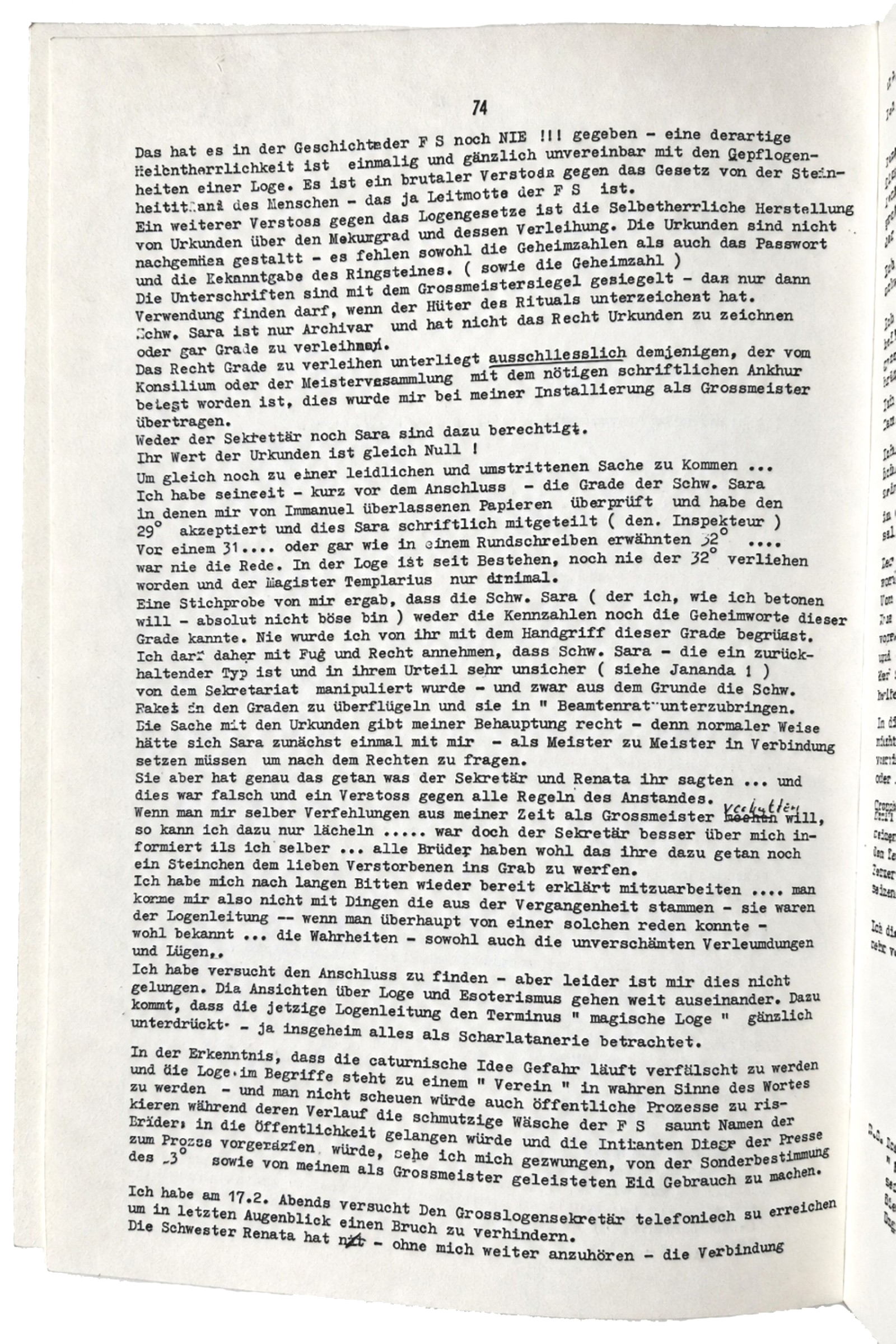
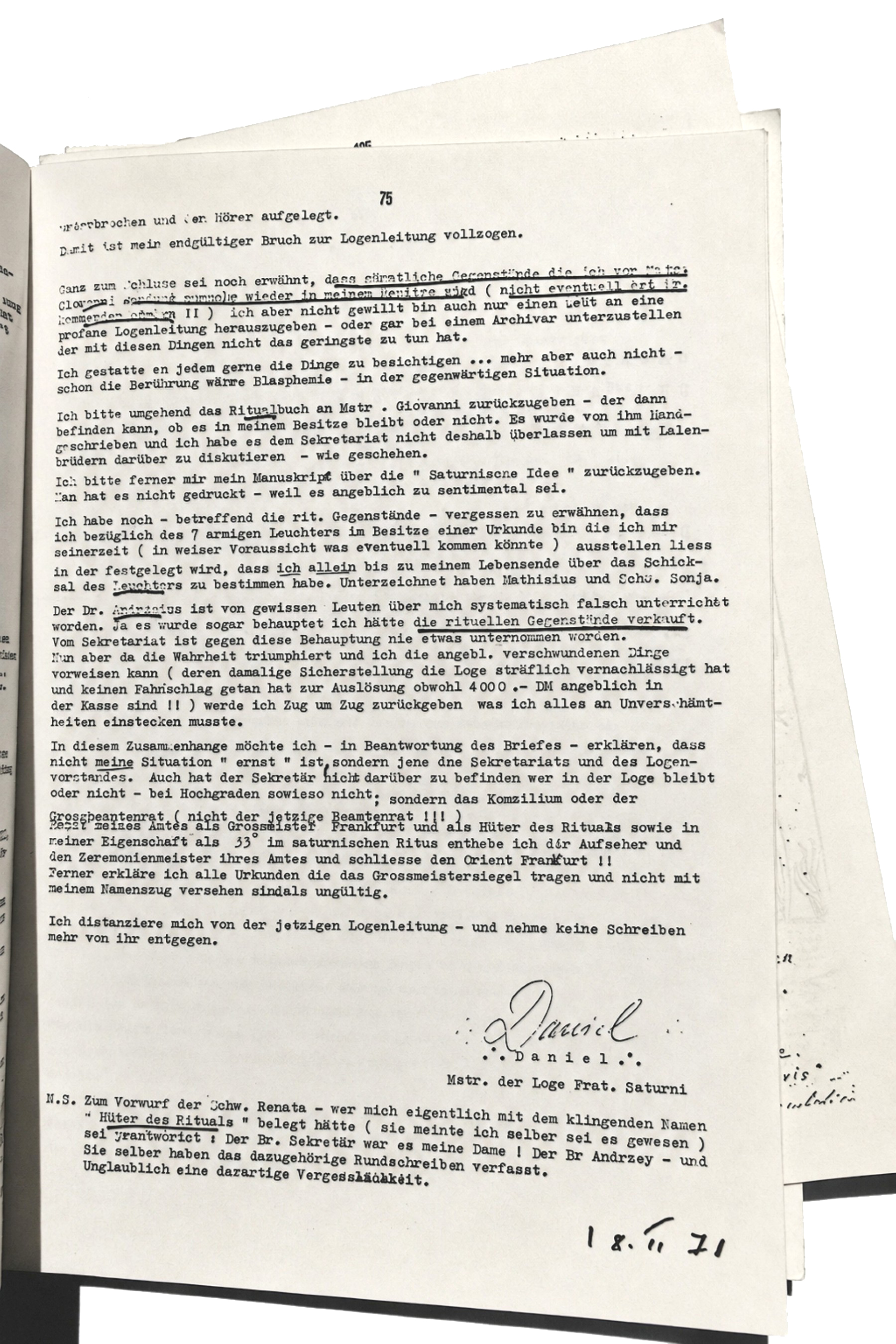
Two years later comes the exit, though not much of a departure. Wolther breaks with the lodge leadership, answers Adolf Hemberger's public statement, disputes the alleged transfer of F.S. ritual material and mentions a "fingierte Quittung". He still argues through grades, certificates, seals and ritual authority, then closes the Orient Frankfurt.
This is not a tidy resignation. Wolther leaves the leadership, but not the language of jurisdiction. The door closes; the claim to authority remains in the room.
Guido Wolther, 18 February 1971 — page 1 of 3.Page 2 of 3.Page 3 of 3.
The barely legible original was gently restored with AI. It helped, but only just.
Read together, the papers show less a clean succession of offices than a slow conversion of occult authority into paperwork: election, accusations, voting rules, seals, ritual books, receipts and finally closure. The magic did not disappear. It acquired administration.
"Nahema! Nahema! Uuu! Ole-Ona-Uüä-Uuu! Aie, Aonie, Lilith, Lilith! Lilith! Oron chite haloja aroen latistén. Ka eron maggo holler ka nono ka hel. Maguth ka craim he! Yaro… Sat! Elohim! Marazoth!! Hoo…!! Hu!!!"
Guido Wolther
Hallo! Hier spricht die Skorpionfrau!
Hallo! Hier spricht die Skorpionfrau! places Guido and Miriam Wolther's Pluto complex beside the visual junkyard of the early 1960s: Edgar Wallace, science fiction, horror magazines, cave-magic and demons. The resemblance is not merely decorative. Behind the scenery sits a very earthly subject: authority inside the lodge.
The demons provide the scenery. The request is quite prosaic: power over people and command of an occult organisation. Sexual magic, evocation symbols and a Luciferic hierarchy end, rather efficiently, in management.
Miriam Wolther deserves her own billing. Her 1966 manuscript Amor Ex Nihil turns domestic tension, sex, lodge life, violence, demons and romantic melodrama into an occult diary novel. Guido later helped transmit the manuscript; the voice and construction are Miriam's.
In the novel, overheated love prose and erotic demon-kitsch eventually produce the inevitable catastrophe: „Mein Körper windet sich unter der Brunst des Wesens, dessen heißes Glied wie eine Naturkatastrophe in mir wütet.“ Literal report or not is the least interesting question. Everyday misery and occult fiction plainly knew each other's address.
Wolther had trained and worked as a chemist; by the 1960s he was trying to survive as a freelance bookseller. In Kelkheim he lived with the Frenchwoman Andrée Mériam Wolther (order name: Rahel), born in Bayonne, and their son Patrick. Miriam wrote and painted and took part in the couple's occult work. The result was not a sealed "private reality" but a household in which money, marriage, lodge politics and magic had very thin walls.
In August 1962 and September 1963, according to the Wolthers, they tried to "bring forth the devil from Hell" in a "magnificent stalactite cave 250 metres below the earth", with burnt antimony, uranium salt, thorium oxide, strontium and petroleum. Miriam was said to have received the recipe in trance from "high Saturnian intelligences". Chemistry supplied the ingredients; the cave supplied the décor; Saturn supplied the instructions.
The pattern survives the cave. Trans-Saturnian powers soon share the stage with rank, secrecy, obedience and office. Ritual and administration were never very far apart.
"We are attracted by the unreal and mysterious — we just 'have to' ... We are driven to discover and to work — work magickally. Those who have met us know that we are no 'esoterical fanatics,' but that we know how to conduct our operations skillfully and with scientific thoroughness."
Scorpion Woman, demon, organisation
The Scorpion Woman is evoked with "barbaric sounds". "Onia ... Heva!! Onia ... Chavah! Chavah! Heva!! Ino ... Rea! Ria! Rua! Oia! Uuu ... Nahema! Nahema! Uuu! Oie-Ona- Uuea-Uuu! Aie, Aonie, Lilith, Lilith! Lilith! Jahou! Juhooe! Jaaaaheluu! From the deepest depth cometh forth you forces of Pluto! Heareth my call in the depth, rise forth from the transuranos — transuranos — rise forth. Plutonian powers, I enforce you to show yourself. Agiel be the mediator, Arratron be the mediator! I call Saturnus, guardian of the threshold, Saturnus, Saturnus, Saturnus — open the door to transuranos. Open the door to transuranos. Uuuu Jiiii."
A female demon with the body of a scorpion and the face of a woman appears. Miriam faints. The demon's body becomes human and "raises his hand against my wife". Wolther then states his wish with unusual directness: "Therefore I beg you for the power to reign over people — the power to be master of an organisation, of an occult society which represents power on three levels — and this power I wish to share with my wife." The demon answers with a prophecy of betrayal: "the woman ... is going to betray you, little man".
The supernatural part is almost a distraction. Wolther states the practical wish himself: he wants to rule people and an occult organisation. In 1968 he founded further inner structures such as AMOS / OMS; ritual texts, secret grades and possession of archival material became credentials. Pluto had already supplied the job description.
The demon also predicts that the woman will betray him. Miriam left in August 1968. This does not make the ritual prophetic; it shows how conveniently later domestic disaster could move into a mythology that already had betrayal, dangerous women and Pluto waiting on stage.
Drawings after the threshold
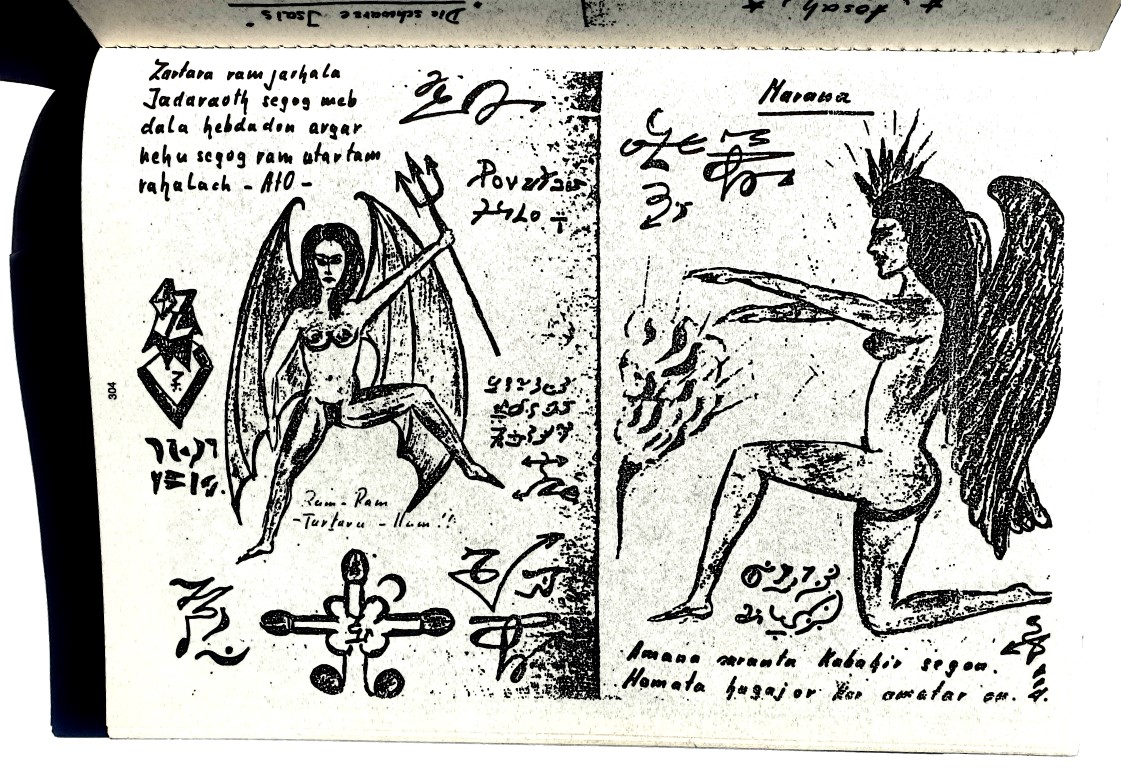
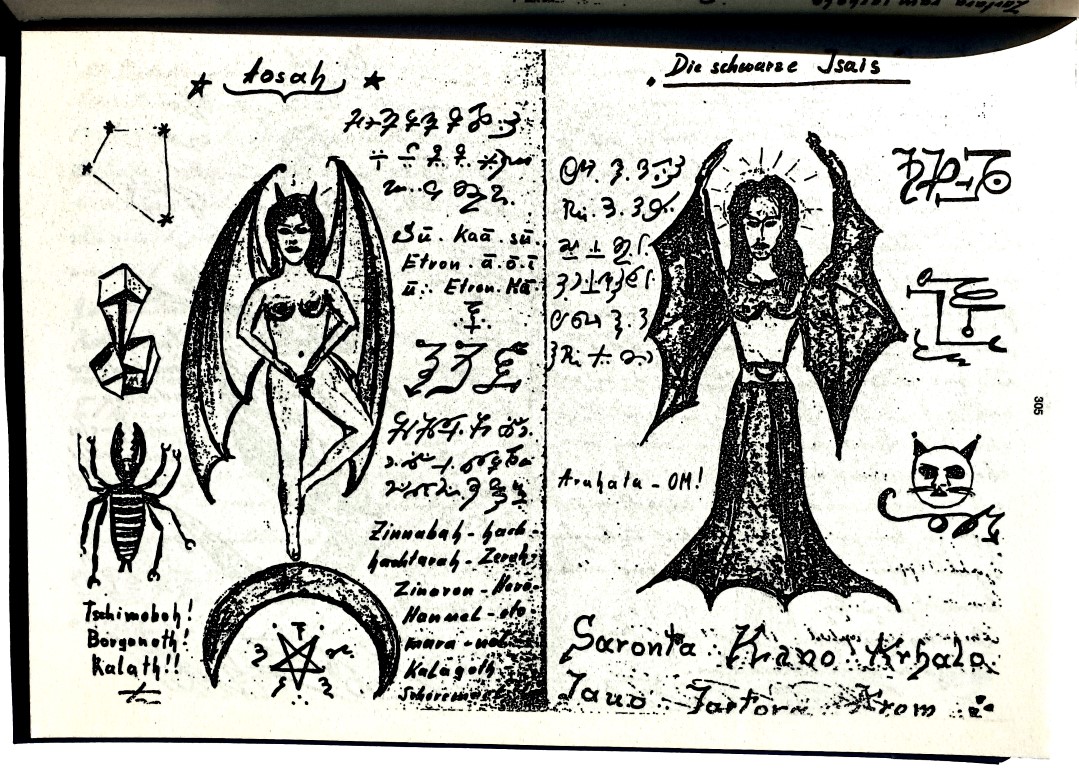
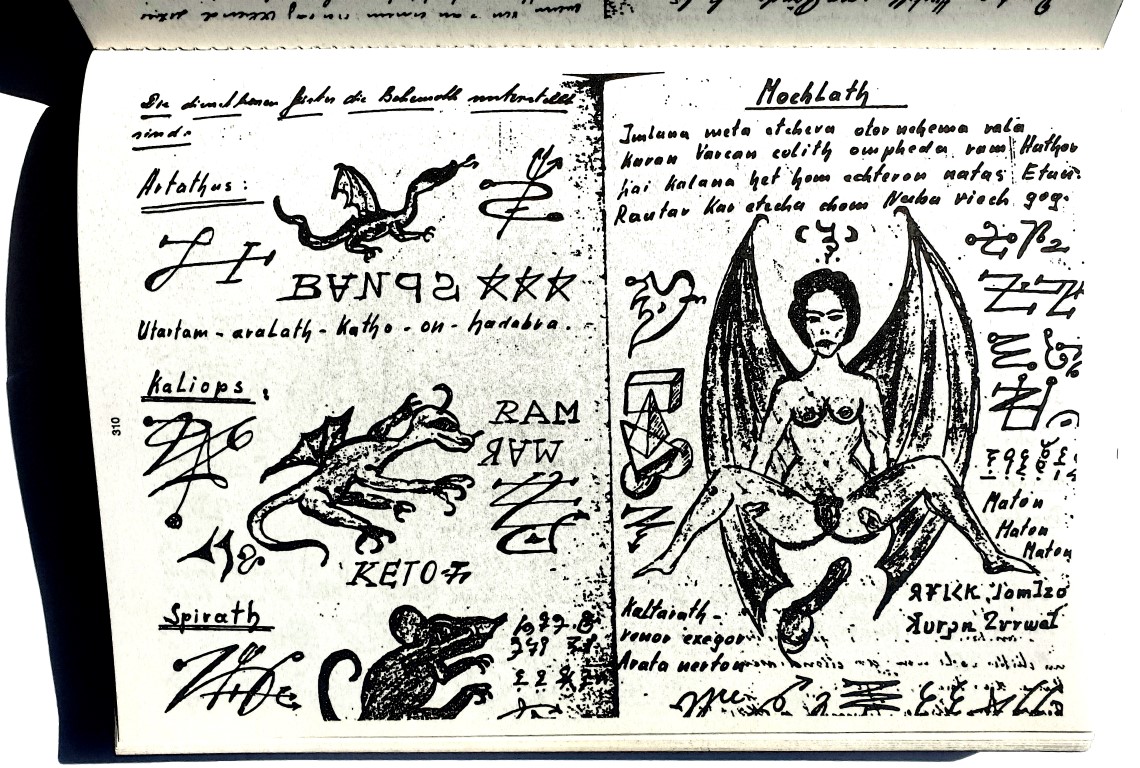
Wolther's sex-magical drawings of the early 1970s mix Egyptian and Hebrew occult motifs with emphatic penises, vaginas, diagrams, hierarchies and technical-looking notation. The art is not the point. The system is. Sex receives labels, arrows and the reassuring appearance of occult engineering.
Wolther and Johannes Göggelmann / Saturnius shared a fondness for putting the fantastic in a laboratory coat. Research, experiment, specialised knowledge: the vocabulary is scientific; the scenery rather less so. The drawings belong with the grades, letters, ritual instructions and quarrels over who possessed the real knowledge. A diagram can do wonders for authority.
After 1974
After 1974 the paper trail, at least here, goes quiet. There is no need to diagnose the silence. The documented scenery is sufficient: marriage gone, health damaged, money scarce, lodge politics sour, Grandmastership finished. Then the drawings stop.
The newer documents make one thing difficult to maintain: a neat border between occultism and ordinary life. With Guido and Miriam, marriage becomes demonology, ambition becomes evocation, sex becomes cosmology and a domestic crisis can acquire a full ritual cast. Occultism was not an escape hatch from everyday life. It was everyday life with better props.
Female demons recur in Wolther and Saturnius, and the temptation to diagnose them is best resisted. More useful is their employment: sex, danger, knowledge, betrayal and power arrive in the same costume. Miriam's Amor Ex Nihil shows the arrangement from the other side of the marriage.
"Daniel and Saturnius achieved tremendous things with their magical research. It is to be assumed that their creative work represented a kind of ritual escape from the unbearable existence in a bourgeois and boring society. Of course, they did not identify with that society: they constantly lamented that there were no suitable individuals for genuine magical work — no one who could continue the MAGICAL WORK."
Walter Jantschik, 24 August 1998
Hammer shadows
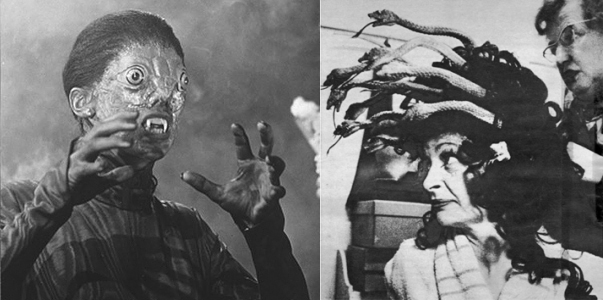
Wolther's painted women occasionally look as though Hammer Films had lent the lodge a costume department: compare The Reptile, directed by John Gilling (1965), and The Gorgon, directed by Terence Fisher (1964). The resemblance is vague, but pleasantly so.
For the Pluto material and its relation to popular culture, occult authority and Wolther's organisational ambitions, see Hallo! Hier spricht die Skorpionfrau!. For Miriam Wolther's 1966 manuscript, its transmission and its relation to marriage, lodge life and literary construction, see the transcription of Amor Ex Nihil and the analysis Die Himmel weinen Blut.
Of similar nature: Die GOTOS-Büste, a dossier of advice, suggestions and cartoons for the brothers and sisters of the Fraternitas Saturni.
The third volume on the Fraternitas Saturni: Johannes Maikowski as Foreign Legionnaire, prisoner in the Stasi prison Berlin-Rummelsburg and twice Grandmaster; Communitas Saturni, Communitas Solis and the Grossloge Gregor A. Gregorius/GAG; Eugen Grosche's difficult postwar years, the Stasi files and former Nazis in the lodge; Karl Wedler, the chalice, the palace revolt and the copying machine; sexual-magical disputes surrounding the 18°; experiments with Johannes Göggelmann and Horst Kropp; Dieter Heikaus and the Ordo Saturni; Grandmasters, stagnation and the merger of the GAG with the F.S.; GOTOS, Egregor and Exorial.
Also included: Wolf Rösler, Wilhelm Uhlhart, Richard Tschudi, the Elixiere des Teufels, the stalactite cave in France, Walter Englert, the Ipf mountain, Horst Knaut, Adolf Hemberger, the Saturn monastery, Michael Gebauer, Martin S., Federico Tolli and Calix Borealis.