Johannes Göggelmann, Walter Jantschik, Guido and Miriam Wolther, Adolf Hemberger — and the manufacture, circulation and afterlife of Saturnian documents.
Preface to the two volumesIn Nomine Demiurgi Saturni and In Nomine Demiurgi Nosferati, containing approximately 800 pages of facsimiles on the Saturn Orders.
[See also the review of the second volume In Nomine Demiurgi Nosferati]
The title of this chapter is programmatic: it approaches this German secret society from the deliberately generous angle of its "creative" production.
For the history and documentary background, see the following books by P.R. Koenig.
Ein Leben für die Rose (referring to the magically significant degrees 18° and 33° which seem to feed an astral vampire. See also "Falling In Sperm Again" in the book "In Nomine Demiurgi Nosferati" by Marlene Leander/Zarah Dietrich, that is Barbara Weisz, Ottmar Domainko and P.R. König)
Abramelin & Co (containing several sexmagickal drawings, plus Golden Dawn material)
Why does the Fraternitas Saturni attract a kind of curiosity quite different from that surrounding most O.T.O. groups? The answer lies only partly in doctrine. Its public image was formed by a comparatively small number of unusually productive protagonists — and by the people who copied, annotated, published and sensationalised their papers. Eugen Grosche supplied the institutional centre; Johannes Göggelmann supplied a mountain of visions, diagrams and letters; Guido and Miriam Wolther supplied ritual theatre, sexuality and domestic drama; Walter Jantschik supplied an almost inexhaustible Baphometic continuation; Adolf Hemberger turned archival fragments into publications that often looked more authoritative than their provenance allowed.
Revision 2026. The first version of this essay, written in 1998, asked whether the drawings and writings revealed the personalities of their makers. The surviving documents now permit a more useful question: what happens to a text while it travels? A private report becomes a lodge document; a lodge document becomes a photocopy; a photocopy acquires annotations; the annotation becomes an alleged fact; the alleged fact reaches a journalist; and the journalistic version returns to the occult milieu as proof of its own notoriety.
This distinction matters. A document is not automatically an event, a self-description is not a diagnosis, and a later publication is not automatically a faithful edition of its source.
ProductionWho wrote or drew the material, when, and for whom?
TransmissionWho copied it, removed it from an archive, abbreviated it or supplied it to outsiders?
FramingWhich captions, dates, diagrams and explanations were added later?
ReceptionHow did occult publishers, sect observers and the boulevard transform it yet again?
This is also why the word creative remains useful here, but only with quotation marks nearby. The interest is not whether Saturnius, Wolther or Jantschik qualify as artists. It is how they constructed worlds from available materials — lodge jargon, popular occultism, sexuality, diagrams, pulp imagery, private experience — and how those worlds were subsequently edited by others.
Johannes Göggelmann / Saturnius
Johannes Göggelmann (Saturnius, born 10 July 1905) is the clearest example of why diagnosis from handwriting, drawing style or sheer quantity of correspondence is a poor historical instrument. He sent his Grand Masters close to a thousand pages of letters, manuscripts and drawings. Eugen Grosche did not treat this simply as rubbish; portions were preserved as potentially useful or inspiring lodge material. What later looked to outsiders like an autonomous "Saturnius system" was therefore already the result of selection inside the lodge.
His manuscripts move restlessly between esoteric commonplaces, visions, evocation reports, war and post-war memories, biological speculation, diagrams, "vibrations", sexuality and specialist vocabulary of his own manufacture. The schemes and geometric drawings do not need to be explained as displaced sexuality or symptoms of loneliness. More demonstrably, they perform authority: subjective experiences are converted into tables, technical terms and experimental procedures so that they can circulate as knowledge.
The cat is a useful test case. Göggelmann's manuscript describes the notorious ritual scene in the context of his fiftieth year, hence 1955. Adolf Hemberger published a transcription in Experimental-Magie in 1967 and supplied the year 1952 — incorrectly. Hemberger also surrounded Göggelmann material with his own notes, interpretations and images whose provenance is not always recoverable. The story did not become a mass-media emblem of the F.S. until later.
By 1973 the chain had reached the weekly QUICK. Under the label "Die Satansmörder", Göggelmann was reduced to the man with the tortured cat, the skull and the satanic ritual. The transformation is instructive: private manuscript → lodge archive → occult compilation → tabloid exhibit. Each station sharpens the scene and weakens the context. The notoriety of Saturnius therefore tells us as much about the circulation of documents as it does about Göggelmann himself.
Later recollections do not solve the problem. Johannes Maikowski could remember Göggelmann with reverence in one context and dismiss him as insignificant or fraudulent in another. Such contradictions are not a reason to choose whichever recollection is more picturesque; they are evidence that memory inside a disputed lodge is itself a source with a history.
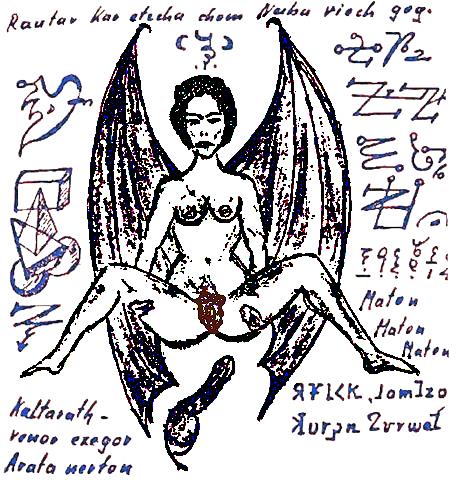
This leaves the drawings where they belong: not as psychiatric Rorschach tests, but as part of a material archive. Little devils, mermaids, vampires, female demons, skulls, graphs and "scientific" notation show how mass-cultural motifs and occult vocabulary were repeatedly recoded as Saturnian research. The result could be clumsy, obsessive, comic or unexpectedly effective. It was certainly reproducible — and reproducibility is what gave it a second life.
The wider comparison remains useful. Austin Osman Spare, Aleister Crowley, Phyllis Seckler, Linda Falorio, Maggie Ingalls, Kenneth and Steffi Grant worked with very different artistic and occult strategies. Wilhelm Friedrich Quintscher and his pupil Josef Anton Schuster (Silias) belong to another neighbouring genealogy. Their presence should not, however, be used to turn every diagram, demon or sexual symbol into evidence of one coherent "occulture". Similar symbols travelled through very different social arrangements.
Guido Wolther later produced texts associated with the FOGC milieu. Here, too, provenance matters more than retrospective prestige: a ritual that occultists later regard as ancient or important may in fact be a comparatively recent compilation, adaptation or attribution.
The Templar's Reich - The Slaves Shall Serve. Aleister Crowley - Ordo Templi Orientis - Fraternitas Saturni - Theodor Reuss - Hanns Heinz Ewers - Lanz von Liebenfels - Karl Germer, Arnoldo Krumm-Heller - Martha Kuentzel - Friedrich Lekve - Hermann Joseph Metzger - Christian Bouchet - Paolo Fogagnolo - James Wasserman.
Other F.S. protagonists: the lodge as circulation system
The F.S. after Grosche was not one seamless magical worldview. Its everyday life consisted to a considerable degree of magazines, circulars, statutes, degrees, correspondence, meetings and quarrels over competence. From 1965, specialised study circles could compartmentalise subjects such as sex magic, drugs, evocation, spiritism, Gnosis, Satanism and even animal sacrifice without making every member a participant in every experiment. That distinction is essential whenever spectacular documents are treated as representative of "the Fraternitas Saturni" as a whole.
The same mundane infrastructure made scandal possible. A photocopier, an archive, a borrowed letter or an annotated transcript could have more historical consequence than a ritual. Documents escaped the lodge, returned in altered form, provoked denials, generated new correspondence and eventually became part of the mythology they claimed merely to describe.
This is the context in which the conflicts around Wolther and Hemberger, and the killing in Jantschik's family environment, are presented here. The criminal event of 1970 must not be fused with the occult interpretation manufactured around it four years later. Nor should the lurid material be suppressed merely because the boulevard abused it. The task is simpler and harder: separate event, document, attribution and later framing.
Walter Jantschik (born 9 November 1939)
Walter Jantschik — Jananda, later Aythos, Levum, CIT and finally Baphometor — is less useful as a psychological "type" than as a junction through which an extraordinary number of organisations, documents and interpretations passed. He had been a member of the F.S. since April 1964. At the Easter assembly of 5–6 April 1969 Karl Wedler enthroned him Grand Master of the reunited lodge. The tenure lasted roughly half a year; Jantschik later attributed his resignation chiefly to intrigues from all sides.
1964
Entry into the Fraternitas Saturni; parallel interests soon extend well beyond a single lodge.
1969
Brief Grand Master episode in the "United Grand Lodge"; the title proves less stable than the surrounding paperwork suggests.
6 May 1970
F.S. member Paul-Günther Diefenthal shoots Jantschik's brother-in-law Josef Göttler. This is the criminal event. Its occult interpretation has a separate history.
22–27 March 1974
Horst Knaut and Friedrich-Wilhelm Haack visit Jantschik. Shortly afterwards the document Mein Bekenntnis is dated; it supplies a spectacular magical reading of the 1970 killing.
1979–1980
As Aythos he publishes F.S. material in Haack's A.R.W. series; in 1980 he helps found the German branch of the "Caliphate" O.T.O.
late 1980s
The accumulated Baphomet material crystallises in the Ordo Baphometis. Jantschik no longer merely comments on systems; he becomes the authority of one.
The four-year gap between the killing and the great journalistic reconstruction is crucial. In 1974 QUICK presented the affair as if occult causality had at last been discovered at the crime scene. Yet the sequence runs the other way round: first the killing, then years later the visit, the interviews, the confession-text and the mass-media synthesis. Jantschik himself later declared the "Bekenntnis" to be forged by Knaut. Whether one accepts that late repudiation or not, the document cannot simply be projected backwards as a police record from 1970.
Jantschik was also a collector and transmitter. During the 1974 visit Haack obtained three letters by Saturnius; later, under the name Aythos, Jantschik himself published F.S. internals in the A.R.W. documentary series. He moved through or alongside AMORC, Metzger's Illuminaten-Orden, the Golden Order, Stephanios/Kether, AMOOKOS, the O.T.O.A., the Ordo Saturni, the Temple of Set and the German "Caliphate". The list is not valuable as a trophy cabinet. It explains why Jantschik became a node at which otherwise separate occult genealogies could be made to touch.
His Baphometism is the late consequence of the same operation. Sexual magic, Kundalini, trans-Saturnian planets, sperm, menstrual symbolism and a proliferating pseudo-technical vocabulary are repeatedly reorganised until the system can account for almost anything. In 1998 Jantschik called his project a "descriptive art" of philosophical-hermetic Baphometism. That phrase is more revealing than a comparison with Adolf Wölfli: the diagrams and neologisms do not merely fill space; they turn private synthesis into a claim of total competence.
The resulting language can be magnificent in its solemn overproduction. But its historical function is precise. Once every objection can be classified as ignorance of the proper initiation, the system becomes difficult to falsify from the outside. The diagram replaces the dogma, and the technical term replaces the proof.
Guido Wolther entered the F.S. in March 1964 and was elected Grand Master at the Easter lodge of 8–10 April 1966. The surviving material is easier to understand when it is read chronologically rather than as a gallery of sexual curiosities. His earlier Pluto texts, his later Grand Master ambitions, the AMOS/OMS experiment of 1968, the crisis of his marriage and his sex-magical drawings of the early 1970s belong to one changing social field.
Wolther had trained as a chemist but lived precariously in the early 1960s, trying at times to make a living as a freelance bookseller. His wife Andrée Mériam Wolther — Rahel in the order — was not merely "Frau Wolther" standing beside the magician. She appears as medium, writer and co-producer of the couple's mythology. Their son Patrick and the pressures of ordinary domestic life remain in the same frame as demons, lodge offices and occult experiments.
The Pluto evocations are dated August 1962 and September 1963 in the surviving account. Whether this chronology is contemporary or partly retrospective cannot simply be assumed. What can be analysed is the text that survives: chemistry, cave imagery, popular horror, sexual symbolism and organisational ambition are fused into a first-person authenticity performance.
The most revealing request in the ritual is not a chemical recipe but Wolther's wish for "the power to reign over people" and to become master of an occult organisation, a power he says he wants to share with his wife. The later lodge history gives this line an obvious social resonance. Ritual and ordinary ambition do not inhabit separate worlds; one translates the other into cosmic language.
Hallo! Hier spricht die Skorpionfrau! follows this machinery in detail. The visual and verbal repertoire of Edgar-Wallace cinema, science fiction, horror booklets and contemporary occult scandal literature sits alongside antimony, uranium salts, thorium oxide, petroleum and "high Saturnian intelligences". The result is not evidence of an unresolved parental conflict. It is a cultural construction with identifiable materials.
The same correction applies to Wolther's drawings. Their Egyptian and Hebrew motifs, genital diagrams and claims of scientific exactitude do not need to be read as a sealed "private reality". They belong to an economy of occult documentation in which drawings could be commissioned, copied, removed from archives and republished as evidence. Adolf Hemberger was an important amplifier of this material, but he cannot plausibly be its origin: the Wolthers' ritual and symbolic world predates Hemberger's intervention.
Miriam's 1966 novel makes the connection with everyday life even clearer. In Amor Ex Nihil, marital tension, erotic melodrama, demons, lodge personnel, violence and cosmic claims continually pass into one another. The accompanying analysis, Die Himmel weinen Blut, therefore changes the reading of Guido as well: the occult counter-world is not detached from normality; it dramatizes normality.
After the collapse of his position in the F.S. around 1969, Wolther continued to produce or circulate ritual and symbolic material into the early 1970s; on 18 February 1971 he formally resigned his office as Gotos of the Frankfurt secessionist faction. No secure body of later drawings or writings comparable to the early-1970s material is presently known after about 1974. That is an archival boundary, not a psychological diagnosis.
Adolf Hemberger is indispensable to the history of the F.S. precisely because he is such a difficult source. A Dipl.-Volkswirt and Dr. phil., later associated with the Justus-Liebig University in Giessen, he approached secret societies with the vocabulary of scholarship while at the same time becoming entangled in the occult networks he described. The older temptation is to explain this by family frustration or academic rejection. The documents permit a firmer conclusion: Hemberger's editorial practice itself blurred the line between collecting, interpreting and manufacturing authority.
He contacted the Fraternitas Saturni in June 1966. Surviving correspondence shows that in September he did not yet know the lodge publications; the lodge offered him a sample while explicitly withholding internal circulars from outsiders. Nevertheless, in 1967 he published, as Klingsor, Experimental-Magie, the one Hemberger work that reached the regular book trade. Its rapid appearance and its mixture of orders, rituals and attributions make provenance a central problem from the outset.
A factual correction to the older version of this page: Hemberger's 1971 F.S. volume was not financed by the Deutsche Forschungsgemeinschaft. After the claim appeared in public, DFG press officer Hilke Stamatiadis-Smidt explicitly corrected it in a letter published on 19 July 1973. Hemberger had received a three-month research grant of DM 4,490 in 1968; the self-published F.S. book itself received no DFG funding.
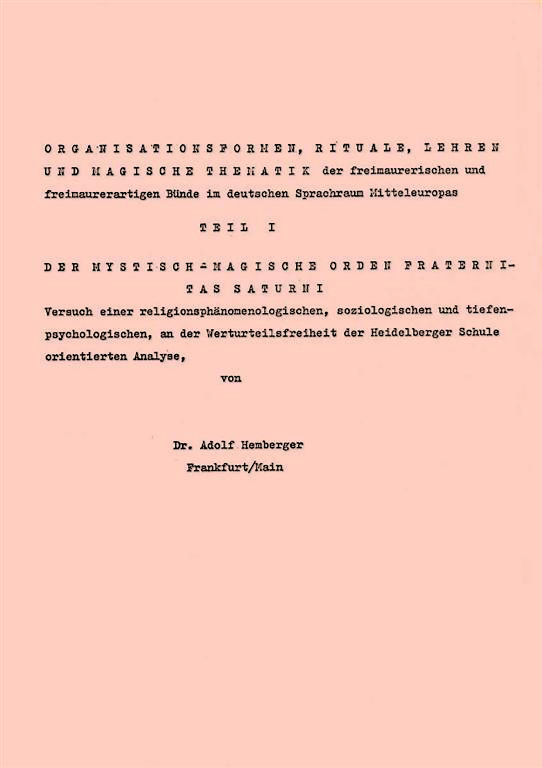
The title nevertheless displayed maximum academic armature: Organisationsformen, Rituale, Lehren und magische Thematik der freimaurerischen und freimaurerartigen Bünde im deutschen Sprachraum Mitteleuropas, Teil I: Der mystisch-magische Orden Fraternitas Saturni — Versuch einer religionsphänomenologischen, soziologischen und tiefenpsychologischen, an der Werturteilsfreiheit der Heidelberger Schule orientierten Analyse (1971). The title promises methodological separation. The archive often delivers the opposite.
Hemberger produced more than thirty occult publications or compilations, nearly twenty of them concerned with the F.S., alongside material on Freemasonry, Pansophy, Rosicrucianism, Adonism and related organisations. Many were small photocopied editions of roughly 50–100 copies. The rarity of these objects later helped confer an aura of secret authority on material whose editorial status was often uncertain.
The method can be watched in miniature in the Saturnius cat episode. Göggelmann's manuscript belongs to 1955; Hemberger's 1967 transcription inserts 1952. He adds commentary and contextual claims, and elsewhere assigns material to traditions such as Abramelin without an adequately demonstrated chain of provenance. By the time later authors and journalists quote Hemberger, his editorial additions can become indistinguishable from the source he is supposedly reproducing.
The same caution is required with Guido Wolther. Hemberger was crucial in bringing Wolther's sex-magical drawings, writings and the notorious 18° material into circulation. An older account on this page repeated the story that Hemberger telephoned Wolther in the mornings, whereupon Wolther hurriedly produced material for sale. Such recollections may illuminate the atmosphere of the exchange, but they are not a sufficient basis for declaring the resulting objects "false" or psychologically inauthentic. Better to ask separately: what existed before Hemberger, what was copied for him, what he annotated, and what later circulated under Wolther's name.
Hemberger's habit of writing into, around and over his documents is therefore not a cosmetic defect. It is the historical problem. Annotation can silently become authorship. Caption becomes attribution. Compilation becomes genealogy. This is one reason his works are extremely difficult to use as straightforward reference books.
The criticism was not confined to later historians. In 1972 the Masonic research lodge Quatuor Coronati distanced itself sharply from Hemberger's writings and even considered the accusation of "malicious defamation". At the same time Hemberger cultivated an impressive range of occult legitimations of his own: he was active in structures connected with Adonism and Memphis-Misraim, issued or supported charters, acted as an expert in disputes around the Illuminaten-Orden and later signed documents with a collection of Masonic and Martinist titles. The researcher of secret societies was therefore also a participant in the economy of titles he was documenting.
This double role does not make the archive worthless. On the contrary: without Hemberger, much material might not have survived or circulated at all. But it means that his compilations must be disassembled before they can be used. Original document, copy, handwriting, caption, added diagram, later interpretation and publication history have to be kept apart. Hemberger is most informative when read not as the final authority on the F.S., but as one of the principal mechanisms by which the modern image of the F.S. was manufactured.
Appendix regarding volume two: "In Nomine Demiurgi Nosferati"
The reproduction of two antisemitic Ariosophical texts from the 1930s documents one of the ideological environments in which the Fraternitas Saturni was received. Ariosophical writers could treat Eugen Grosche's works as a "reliable guide" while objecting mainly to the lodge's alleged Masonic structure.
The contents of the two tomes on the Saturnian Orders:
Johannes Maikowski, GOTOS and the Saturnian archive
The third volume on the Fraternitas Saturni.
Johannes Maikowski: Fremdenlegionär, Gefangener im Stasi-Gefängnis Berlin Rummelsburg, Zweimal Grossmeister, Communitas Saturni und Communitas Solis, Grossloge Gregor A. Gregorius/GAG. Eugen Grosche: Bittere Nachkriegszeit, Die Stasi-Akten, Alt-Nazis in der Loge. Karl Wedler: Der Kelch, Die Palastrevolution, Die Kopiermaschine. Sexualmagische Unruhen um den 18°. Experimente mit Johannes Göggelmann und Horst Kropp. Der Ordo Saturni von Dieter Heikaus. Grossmeister und Stagnation: Guido Wolther, Walter Jantschik, Stanislaus Wicha, Joachim Müller, Heinz Conrad, Hartmut B., Ralph-Peter T. Zusammenschluss der GAG mit der F.S. Die Logendämonen: Der Meister GOTOS — Egregor? Exorial.
Und: Wolf Rösler, Wilhelm Uhlhart, Richard Tschudi, die Elixiere des Teufels, die Tropfsteinhöhle in Frankreich, Walter Englert, der Berg Ipf, Horst Knaut, Adolf Hemberger, das Saturn-Kloster, Michael Gebauer, Martin S., Federico Tolli, Calix Borealis.
Myth: The central concept in F.S. lodges is that of the lodge Egregore (group spirit), called GOTOS and represented as a bust. GOTOS is also said to be the highest rank in the F.S. (from “Gradus Ordo Templi Orientis Saturni”).
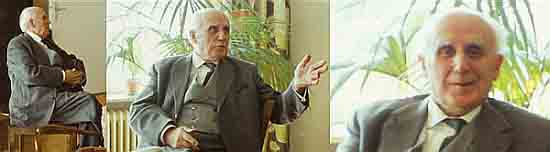
Documented context: Johannes Maikowski, Grandmaster of the Fraternitas Saturni and appointed by Eugen Grosche as his successor in December 1963, speaks with Peter-R. Koenig in August 2011.
Johannes Maikowski reports on the GOTOS bust. What happened to it after Eugen Grosche’s death? What interested the members? Why the name Saturn?
On 23 December 1963 Eugen Grosche appoints Johannes Maikowski as his successor as Grandmaster of the Fraternitas Saturni. How was elevation to the 18° carried out? What about Walter Englert’s 18°?
Johannes Maikowski recalls Walter Englert, Margarete Berndt, Karl Spiesberger, Herman Wagner, Walter Jantschik, Horst Kropp, Guido Wolther, and the 1962 putsch initiated by Karl Wedler and Wolf Rösler.
Until shortly before his death Eugen Grosche (1888–1964), founder of the Fraternitas Saturni, was in good health. There was no lodge room. Wilhelm Reich’s ORGONE box. What interested Grosche most? What did Johannes Maikowski / Immanuel know about Grosche? Ria Grosche was always alone. Gregorius was the “Über-Papa”. Eugen Grosche was a member of the Protestant Church.
Eugen Grosche never spoke about his emigration to Switzerland and Italy. He also never spoke about his political views. Grosche lived from his bookshop and membership fees. Why did Grosche tolerate Nazis in the Fraternitas Saturni? No antisemitic remark was ever heard. Miriam Wolther, a Jewish former concentration-camp prisoner, likewise never spoke about it.
Johannes Maikowski, a member since 1950/1955, was appointed by Eugen Grosche as his successor and Grandmaster of the Fraternitas Saturni in December 1963. He was re-elected by his own adherents in 1964/65. In 1983 a competing F.S. elected a new Grandmaster, prompting him to abandon the lodge name that same year. In 1993 he founded several lodges, including the Communitas Saturni and the Grossloge Gregor A. Gregorius der FS in Kaiserslautern (GAG). Dual memberships existed with the Ordo Templi Orientis and regular Freemasonry. Maikowski soon declared his own lodge foundations null and void, although some continued to exist. In 2003 the GAG united with the formerly competing Fraternitas Saturni in Berlin. Maikowski continued to regard himself as the only legitimate Grandmaster.
Autogenic training · Yoga for the West · Johannes Heinrich Schultz · reconnection with the deity · connection to God · spirit-soul · hypnosis · Fraternitas Saturni · dream exercises by Gregorius / Eugen Grosche.
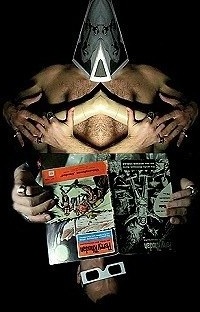
Perry Rhodan · saviour and heir of the universe · science fiction · SOS from Outer Space · Enterprise Stardust · Johannes Maikowski · Thora · Overhead · Moon landing · comic book · pulp novel · popular literature · fan fiction · Fraternitas Saturni · Saturnus · Saturnius · hollow-Earth theory · hollow globe · worldview · Johannes Lang · Rolf Keppler · Moon-landing conspiracy · World Trade Center conspiracy · conspiracy culture · Jules Verne · Paul Lincke · Man in the Moon.