The Masonic Grand Lodge of the Order of Illuminati for Germany
The Rite of Swedenborg in Germany
The Scottish, Memphis & Misraim Rites in Germany
All the above orders were established in Germany after their introduction by Theodor Reuss in Berlin.
Reuss was born in Augsburg, originally a pharmacist and later an opera singer – as such he came into close contact with Richard Wagner and King Ludwig II – then became a journalist and author after the sudden loss of his voice. He was also active as an agent of the political police and a war reporter for English newspapers during the earlier Balkan wars. In about 1890 he “reactivated” the Illuminati Order and nominated his friend Leopold Engel, who had tired of his stage career, as the Order’s custodian. This enabled him to succeed, around 1896, with a re-organisation of Adam Weishaupt’s order, giving it a definite structure and infusing it with a new spirit.
The objects of this order were philosophical research, improvement of human character and mutual support in idealistic endeavours; it had no political or religious concerns. It is international, having its headquarters initially at Berlin, then at Dresden, and since 1904 back in Berlin. The order is divided into five grades; the first three being the three Craft, or “Blue Lodge”, degrees of the English ritual, the fourth grade is the ‘St. Andrew’ degree containing the English Royal Arch degrees, while the fifth is a ‘Rosicrucian’ degree.
Within the Illuminati Order both Lodges of St. John and St. Andrew could be founded. The right to found Lodges according to the Scottish Rite is supported by a warrant which had been transferred to Weishaupt during his residence in Regensburg, on 19th November 1786, by the ‘Prince of the Rosy Cross’ Louis Gabriel Lebauche from Bazeille near Sedan.
On the basis of this warrant, the German Masonic Grand Lodge of the Illuminati Order was established at Berlin in 1900; the Berlin lodge was called ‘St. Johannisloge Ludwig’ [Ludwig Craft Lodge] in the Orient of Berlin, which was later joined by the ‘Phoenix’ Craft Lodge in the Orient of Hamburg.
The general statutes of this Grand Lodge for Germany were modelled after those of the English Grand Lodge. Besides these statutes, each Craft lodge had its own laws.
Sooner than one might have thought, an era of storm and stress arrived for the new organization. From outside came accusations that the Masonic Grand Lodge for Germany had been “smuggled” into the Illuminati Order as an illicit and defective lodge; that the Grand Lodge was, in point of fact, still under the rulership of the Illuminati Order. Inside the group suspicions arose against the genuineness of Prince Lebauche of Bazeille’s warrant, which had been entrusted to the safekeeping of the Ludwig Craft Lodge. Reuss relieved his friend Engel of his offices there, explaining that the Grand Lodge for Germany was independent; this took place on 3 July 1901.
The division between Reuss and Engel soon had a paralysing effect on the activities of the lodge members. Reuss appeared there with a new Masonic patent — a Swedenborg Rite charter from John Yarker of Manchester — and used it to constitute ‘Zum heiligen Gral’ [Holy Grail] Lodge and Temple No. 15 in Berlin. The members of the Grand Lodge for Germany soon joined this new institution, with which the Grand Lodge ceased operations — with some reluctance — as this previously unknown Swedenborg Rite seemed to be little more than a fantasy to its members.
The Sanctuary and Grand Lodge of the Swedenborg Rite for Great Britain and Ireland was founded according to the constituting document of the “Sovereign Sanctuary of Ancient and Primitive Masonry in and for the Continent of America”, by its Grand Master-General Harry J. Seymour on 3 June 1872, and was established in London on 8 October 1872 with John Yarker as its Grand Master-General. The American sanctuary derived its own foundation from the French Grand Orient, being entry number 28911 of 2nd September 1862 in that body’s register.
Any Mason in good standing who had gained his Master’s degree was permitted to affiliate to ‘Zum heilgen Gral’ Lodge and Temple to receive the higher degrees, without demitting from his own lodge; thus the Swedenborg Rite was, or so it was claimed, an augmentation of the German Masonic system as it had hitherto existed. It provided knowledge of the complete degrees of Egyptian Masonry, dividing into three grades the degree of Enlightened, Exalted and Perfect Masonic Master, which comprised degrees 4-18 and 80 of the Ancient and Accepted Scottish Rite. The Rosicrucian grade and the degree of Elect of the Grail formed the conclusion of the entire system.
Since the Swedenborg Rite had, as became known, no jurisdiction over the Craft degrees, and had no exact relationship to Craft Masonry in either England or America, its members could never depend on being accepted by other German Masons. the members — especially the well-known Viennese occultist and Mason Dr. Kellner — therefore pressed Reuss to bring them the patent of a recognised body.
Subsequently on 24 September 1902 the Sovereign Sanctuary of the Ancient and Primitive Rite for Great Britain furnished Reuss with a charter granting him the right in Germany to found Lodges, Chapters, etc., up to the 33rd degree of the Scottish Rite, the 90th degree of the Misraim Rite, the 95th degree of Memphis, and to confer all grades from 1 to 95.
In the ‘Oriflamme’, the “organ of the Grand Orient of the Scottish 33° Masons and the Sovereign Sanctuary 95° in and for the German Empire, organ of Swedenborg Masons and the Order of Rosicrucians”, a ‘Manifesto addressed these matters to “all exalted and enlightened Br. Freemasons of all systems in Germany”:
“Our greetings on all points of the triangle.”
“At the request of a number of Bro. Freemasons, our Most Illuminated and Most Worshipful Bro. John Yarker, 33°, 90°, 96°, Sovereign Grand Master-General in and for the United Kingdom of Great Britain and Ireland, in the name of the Grand Orient of the Scottish 33° Rite of the Ancient and Accepted Freemasons (Cerneau – New York 1807) and of the Sovereign Sanctuary of the Ancient and Primitive Rite of Memphis and the Egyptian Rite of Misraim, has resolved to introduce these systems, which had not previously existed in Germany, and has granted to Bros. Dr. Franz Hartmann 33°, 95° (formerly of Washington No. 12, Georgetown, America), Heinrich Klein 33°, 95° (formerly of Pilgrim No. 238, London), and Theodor Reuss 33°, 96° (formerly of ‘Pilgrim’ Lodge No. 238, London) and their fellow Bros., a charter for the constitution of a Grand Orient and Sovereign Sanctuary of the Rite for the German Empire.”
According to this charter, the Sovereign Sanctuary for the German Empire and the German Grand Orient was empowered to found, accept and consecrate Masonic Lodges throughout Germany, to work the entirety of degrees from the first or Apprentice Grade (1°) to the last, that of Grand Inspector-General and Grand Conservator (33°-95°), and to initiate and advance candidates.
On 11th November 1902, at the Lodge rooms of the ‘Zum heiligen Gral’ Swedenborg Lodge, the swearing-in to the Sovereign Sanctuary and Grand Orient in and for the United Kingdom of Great Britain and Ireland, of the Grand Master-General in and for the German Empire, took place in the presence of many brothers from Berlin and elsewhere. After the festive assembly had been opened, Reuss first gave a review of the events of the previous days and years, and particularly of the results which had led to what was now being confirmed and celebrated. Reuss explained that the ‘Ludwig’ Grand Mother Lodge and all the Craft Lodges founded through it had been dissolved, and that all its associated and established rights were now void. As a sign of this dissolution and their break with the past, all the Grand Officers and other officers removed the symbols of their particular offices. Hereupon Reuss presented the English constituting Warrant and a message from the Sovereign Grand Master-General for Great Britain and Ireland, Br. John Yarker 33°, 90°, 96°, for which the assembly expressed its warmest thanks in Masonic fashion.
Having taken his oath, the new Grand Master-General proclaimed that the Grand Orient and Sovereign Sanctuary in and for the German Empire had already been recognised and signed treaties of mutual friendship with the following Masonic bodies: the Sovereign Grand Orient 33° of Italy in Naples and Palermo; Sovereign Symbolic Grand Lodge of Spain and Sovereign Grand Council-General 33° of Iberia in Madrid; Sovereign Sanctuary and Grand Orient 33° of Romania in Bucharest; and the Grand Orient and Symbolic Grand Lodge of Argentina in Buenos Aires.
In closing it was announced that the Sovereign Sanctuary for the German Empire had approved the establishment of three Symbolic Lodges, two Chapters, and one Grand Council under its jurisdiction, and issued warrants for the Symbolic Lodges in Berlin, Hamburg and Kattowitz.
The regulations of this body mostly resembled those of the other German groups it recognised, except in four aspects. The first concerned the form and constitution of the Grand Orient, the second the constituting of a Scottish Chapter, the third the constitution of the Symbolic Lodges, and the fourth the death benefits (a sum of 300 marks). An appendix contained a list of information and a questionnaire for candidates, the declaration of a 1° candidate, a table of Masonic laws, as well as the modus operandi of a Symbolic Lodge and a Chapter.
On January 1st 1903 there appeared the “Historical Issue” of the ‘Oriflamme’ for the Scottish, Memphis and Misraim Ritess of Masonry. In this an attempt was made to present the Grand Orient of United Rites of Scottish, Misraim and Memphis Masonry (33°, 90°, 95°) of Great Britain and Ireland etc., and of the German Empire, as a regular Masonic body.
At this time the group had one Grand Orient in Berlin, one Chapter in Berlin, one Chapter in Hamburg, and four Symbolic Lodges, namely: ‘Licht von Osten’ [Light from the East] No. 1 in Berlin, ‘Zur siegenden Sonne’ [The Sun Triumphant] No. 2 in Berlin (this was the former ‘Ludwig’ Illuminati Masonic Lodge). ‘Phoenix’ No. 3 in Hamburg, (the former ‘Phoenix’ Illuminati Lodge) and ‘Morgenröte’ [Bright Dawn] No. 4 in Kattowitz (whose members had previously been in the General Citizens’ Lodge in Berlin and the Union of Reformed Craft Lodges in Hamburg).
At the end of this year the Order had expanded itself into the ‘Ludwig’ Chapter in “the Valley of Munich”, the ‘Ludwig’ Symbolic Lodge of Eternal Union in “the Orient of Munich”, and the country lodges ‘Katharina zum stehenden Löwen’ [Catherine of the Lions Gardant] in Rudolstat and ‘Zur Aufblühenden Rose der Beständigkeit’ [Blooming Rose of Constancy] in Zittau (formerly the ‘Zum rauhen Stein’ [Rough Ashlar] General Citizens’ Lodge); there was also an unnamed country lodge in Hanover, and another projected in Nuremberg; a Scottish Chapter was also to be founded there.
In 1904 the Master of the German Masonic Grand Lodge applied in the name of seven hundred of his brethren to join the Order of Ancient Freemasons of the Scottish, Memphis and Misraim Ritess in Germany.
On May 12th 1904 in Leipzig the ‘Eiche’ [Oak] Temple of the Sovereign Sanctuary of the German Grand Lodge was reconstituted under the name of the “Scottish Lodge of Perfection called Masonic Grand Lodge of Germany” and was issued a charter under that name at a price of 800 marks.
On August 14th the same year the Order founded the ‘Carl Theodor’ Chapter and the ‘Carl Theodor zum Guten Rate’ [Carl Theodor of Good Counsel] Symbolic Lodge in Augsburg; shortly thereafter, on August 25th, another Symbolic Lodge named ‘Germania’ No. 7 was opened at Alexandria in Egypt under the jurisdiction of the German Grand Orient, at which the first three degrees of the Ancient Scottish Rite were worked in German.
The following year on June 24th 1905, the Scottish Lodge of Perfection, called the “Grand Lodge of Germany” acquired from the Grand Orient a warrant for a “Symbolic Grand Lodge of the Scottish Rite in Germany” which stated explicitly that it remained an independent organisation, wholly separate from the Grand Orient, and that this warrant could never be revoked; 600 marks was paid for it.
Then on 27th August the Berlin Sanctuary established a “Grand Orient of Masons of the Ancient and Accepted Scottish Rite 33° for Germany” in Hamburg; or, more precisely, Reuss moved the Grand Orient there. But since Reuss had reportedly been up to some highly unpleasant things under the cover of occultism at the Hotel Metropol in Munich, and the lodges could not understand such teachings from their Grand Master-General, they split away from him, commenting that his Rite did not have the remotest right to work Craft degrees in Germany; they wished to part from him despite his group being recognised as a regular Masonic body. Thus the Symbolic Lodges in Munich, Augsburg, Hanover and Hamburg entered into relations with Grand Lodges of the German Grand Lodge Union.
Some members of the ‘Ludwig zum Ewige Bund’ [Ludwig of the Eternal Bond] Lodge in Munich moved to the ‘Treue fest’ [Ever Faithful] Lodge in the same city (it was a regular German provincial lodge); nine Master Masons in the ‘Carl Theodor zum guten Rate’ Chapter in Augsburg also transferred to ‘Treue fest’ in Munich. Their initiations and raisings all took place within two days, and the brethren’s transfer-fees cost just 50 marks. On May 27th 1906 they were consecrated as the ‘Zur Sonnenrose’ [Sun-Rose] Lodge in the Orient of Augsburg, and then re-initiated their former members in accord with the laws of a regular lodge. The ‘Phoenix zur Wahrheit’ [Phoenix of Truth] Lodge in Hamburg permitted the Hamburg ‘Gudrun’ Lodge to receive nineteen of its brethren on January 29th 1906, and these then became a new ‘Phoenix zur Wahrheit’ Lodge on June 9th 1906. This Lodge could likewise now re-initiate its former brethren.
The ‘Archimedes zu dem drei Zirkeln’ [Archimedes of the Three Circles] Lodge in Hanover allowed members to go through the ‘Phoenix zur Wahrheit’ in Hamburg, and they were then consecrated as the ‘Baldur’ Lodge back in Hanover on December 2nd 1906.
Berlin’s ‘Zur siegenden Sonne’ [Triumphant Sun] Lodge, which had already renounced Reuss in 1904, entered into communication with the Hamburg Grand Lodge in 1907, and was consecrated on July 6th 1907; it kept its former name.
The country lodges in Kattowitz, Zittau, and Rudolstat, which had not proved viable due to low membership-numbers, had already long since forsaken the Grand Orient.
Reuss, who had meanwhile suddenly moved to London, protected his Masonic concerns from desertions by appointing P. Eberhardt of Leipzig, Grand Master of the Symbolic Grand Lodge of the Scottish Rite in Germany, as independent Grand Master-General of the Superior Council of the Scottish (A & A) Ancient and Accepted Rite for Germany.
Reuss placed the working and expansion of Memphis 90° and Misraim 95° in Germany in the hands of Dr. Steiner in Berlin, since Eberhardt rejected the Memphis and Misraim Rites in every form.
In November 1909 Reuss became convinced that the new independent Grand Master-General in Leipzig was definitely not working the higher degrees, and therefore revoked all the supposed powers he had conferred on November 15th 1906.
But the real reason was that about this time Reuss had received intelligence from his friend and brother Carl (who had earlier allied himself as a loyal follower and been rewarded by nomination to the Sovereign Sanctuary, getting the necessary grades per communicatio) that the Grand Master of the Scottish Rite Symbolic Grand Lodge in Germany was moving his lodges into the German Grand Lodge fold, and it irritated Reuss that the Scottish Rite in Germany would thereby be further obscured. He had even tried to cancel the Grand Master of the Scottish Rite in Germany’s charter for the Symbolic Grand Lodge, although Reuss had sold the right to cancellation, which meant that the charter could never be rescinded.
Nevertheless the German Grand Orient failed, even after Reuss appointed Dr. Carl Lauer — formerly of Ludwigshafen, now in Leipzig — as its Grand Master-General; Masons from regular German lodges never entered the new Grand Orient to gain the higher degrees.
“All roads lead to Rome”
The growth of the Grand Orient and of the Sovereign Sanctuary of the Scottish, Memphis and Misraim Ritess for the German Empire may be tabulated as follows:
‘Licht vom Osten’ [Light from the East] in Berlin, constituted 1902; defunct.
‘Zur siegenden Sonne’ [The Sun Triumphant] in Berlin, taken over as Illuminati Lodge ‘Ludwig’ formed in April 1904; entered Hamburg Grand Lodge July 6th 1907.
‘Zur hellen Morgenröte’ [Bright Dawn] in Kattowitz, constituted 1902; defunct (see also tables on pp. 40 & 53).
‘Katharina zum stehenden Löwen’ [Catherine of the Lions Gardant] in Rudolstat, constituted 1902; defunct.
‘Zur aufblühenden Rose der Beständigkeit’ [Blooming Rose of Constancy] in Zittau, constituted 1902; defunct (see also tables on pp. 40 & 53).
‘Archimedes zu den 3 Zirkeln’ [Archimedes of the Three Circles] in Hanover, constituted 1902; since December 1906 ‘Baldur’ Lodge (Hamburg).
‘Phoenix zur Wahrheit’ [Phoenix of Truth] in Hamburg, taken over as Illuminati Lodge 1902; since May 19th 1905 affiliated to Hamburg Grand Lodge.
‘Ludwig zum ewigen Bunde’ [Ludwig of the Eternal Bond] in Munich, constituted in 1902; members migrated to ‘Treue fest’ [Ever Faithful] lodge, affiliated to the German National Grand Masonic Lodge.
‘Carl Theodor zum guten Rat’ [Carl Theodor of Good Counsel] in Augsburg, constituted August 14th 1904; on May 27th 1906 transferred as ‘Sonnenrose’ [Sun-Rose] lodge to the National Grand Masonic Lodge, (see also table on p. 81).
‘Germania’ in Alexandria, constituted on August 25th 1904; went over to Egyptian Grand Lodge.
(Since the membership of the Symbolic Lodges forms part of this chapter, they are omitted from the list).
On the Oriental Templar Order (O.T.O.) in Germany
Founded in 1912 by Theodor Reuss in London.
The working of this order lay in the hands of Dr. Carl Lauer, formerly in Ludwigshafen and now in Leipzig, and of Paul Kirmiss in Berlin and Andreas Ullmer in Munich.
Dr. Carl Lauer 33°, 90°, 95°, IX° was Grand Master-Commander of the Supreme Council 33° of the Scottish Rite, Grand Orient of Germany; Grand Administrator-General of the Sovereign Sanctuary for the German Empire; and Acting Master of ‘Pythagoras’ Lodge in the Orient of Mannheim.
Paul Kirmiss 33°, 90°, 95°, IX° was Grand Chancellor-General of the Order of Ancient Freemasons of the Memphis and Misraim Ritess in Germany; and Acting Master of the lodge ‘Renata zum Licht vom Osten’ [Renata of Light from the East] in the Orient of Berlin.
Andreas Ulmer, 33°, 90°, 95°, was Secretary, Grand Expert-General of the Order of Ancient Freemasons of the Memphis and Misraim Rites in Germany; and Acting Master of ‘Zum heiligen Gral’ [Holy Grail] Lodge in Munich.
The Munich and Berlin lodges had at most twenty or thirty members, while the Mannheim lodge attracted 50-60 members at the start. Those Scottish Rite brethren who did not want to be affiliated to the German Grand Lodge invited these members to join their lodges; latterly the membership was in constant decline.
The organisation of the Oriental Templar Order was as follows:
I° Candidatee, II° Minerval, III° Craft (Blue) Mason, IV° Scottish (St. Andrew) Mason, V° Rose Croix Mason, VI° Templar Rosicrucian, VII° Mystical Templar, VIII° Oriental Templar, IX° Perfect Illuminatus, X° Supreme King.
The federal journal bore the title: “I.N.R.I. Official Organ of the Order of Oriental Templars and of the Sovereign Sanctuary of Ancient Freemasons in Germany.” Therefore, the Oriental Templar Order was organically organically connected with the Sovereign Sanctuary of Ancient Freemasons for the German Empire.
The O.T.O. initiated men and women and conferred all degrees of Masonry equally upon both sexes. Still, nobody could be an ‘initiate’ of the O.T.O. who had not previously received the three degrees of Craft Masonry. Just who was and was not an ‘initiate’ was supposedly clarified by the following passage: “The Rosicrucian, esoteric teachings of the ‘Hermetic Brotherhood of Light’ are reserved for the few initiates of the inner occult circle. The grade-knowledge of this inner initiated circle runs parallel with the highest degrees of the Memphis and Misraim Rite, and these ‘initiates’ form the secret stock or trunk of the Oriental Templar Order.”
This description comes from the 1912 “Jubilee edition” of the ‘Oriflamme’. The Order was not going to have a future in Germany, where the woman blessed with husband and children would have violated her dignity as housewife and forfeited her devotional hours at home had she directed her steps towards the O.T.O.; but the woman of the present day is no more attracted by the teachings of the O.T.O. than the man, for we Germans have become too earnest and too modern for such romance.
“Es hilft nicht, gegen Wind und Flut sich schlagen.“
(“It does not help to rail against wind and flood.”)
The development of the Oriental Templar Order is described in the following list:
Berlin: ‘Renate zum Licht vom Osten’ [Renate of the Light from the East] Lodge had 33 male members, and 9 female members in a side-Lodge,
Mannheim: ‘Pythagoras’ Lodge.
Munich: ‘Zum heiligen Gral’ [Holy Grail] Lodge.
On the Symbolic Grand Lodge of the Scottish Rite in Germany
formerly the Masonic Grand Lodge of Germany.
The General Citizens’ Lodge constituted on June 12th in Berlin transferred its meeting-place to Leipzig at the start of 1899; it adopted the title of ‘Matthäus Lodge Union’ [St. Matthew Lodge Union] in 1900, but by 1903 had changed this into the ‘Grosse Freimaurerloge von Deutschland’ [Masonic Grand Lodge of Germany].
The first task embarked on by the Masonic Grand Lodge of Germany’s leadership was the elaboration of new statutes with the aim of making the body an officially registered society, replacing its former 412-clause constitution with a much simpler one of just 57 clauses. Based on these statutes, the body was duly registered with the Royal District Court at Leipzig on June 28th 1904, and these statutes became legally binding for the group. Besides this, the Grand Master issued a ‘Vademecum’ and ‘Briefe für Lichtsuchende’ [Letters for Light-Seekers]. The first was a guide for gentlemen wishing to join a Masonic body, and tried to advise candidates on both the “recognised” lodges and the Masonic lodges of more recent date. Also a new identity card valid for three years, modelled on that of the German United Grand Lodge, was introduced.
There was a strong demand for the ‘Vademecum’, as it published a new edition every year. Later in 1904 there came a “Fraternal Compact” between the Masonic Grand Lodge of Germany and a group of independent German Craft Lodges in Berlin. These two lodge-associations opened their temples to one another, and undertook never to admit or accept former members of friendly lodges if they were not holders of a genuine certificate of resignation.
But the most important event of 1904 was the acquisition of a warrant for a Scottish Lodge of Perfection through the Scottish Memphis and Misraim Rite.
The Grand Mastership was driven to this step partly by the frequent resignations justified by the claim that the Union was not patented, and partly by the favourable assessments in the masonic press by the Grand Orient and the Sovereign Sanctuary of the Scottish, Memphis and Misraim Ritess in Berlin. These were also highly reminiscent of earlier claims by the Accepted Masons of the Scottish Rite in Germany, about how they had obtained their constituting warrant from regular English Masons.
Even so, the Grand Master-General himself managed to get into a second-degree working at a regular Berlin Lodge and was received as a Mason; they had made the assumption that their Grand Lodge recognised his rite.
The members of the Union therefore willingly submitted to the conditions imposed upon them. Thus, while observing what were taken to be all Masonic forms, the 702 brethren of the Grand Masonic Lodge of Germany were rectified by the Sovereign Sanctuary and Grand Orient, and the Grand Masonic Lodge of Germany was reconstituted as the “Scottish Lodge of Perfection, called the Grand Masonic Lodge of Germany.”
The procedure was as follows: three brethren of the Grand Officers’ Council entered the Grand Orient of the Scottish Rite. They constituted the Scottish Lodge of Perfection; into it the Masters of the Chairs of the Grand Masonic Lodge of Germany were admitted by the Grand Master-General in Leipzig on 12 May 1904. These in turn admitted their previous brethren into their lodge. The majority of the Altona-based ‘Zur Treue und Einigkeit’ [Truth and Unity] Lodge’s 71 brothers and the nine members of the ‘Zur blühenden Heide’ [Heather Blossom] Masonic club in Lüneburg had, unfortunately, already left the Union beforehand.
But since on the other hand various parties regarded the Grand Master-General of the Scottish Rite in Germany [Reuss] as far from faultless, they endeavoured to become an institution that was a body equal in status to the Grand Orient as soon as possible. This was achieved by the Scottish Lodge of Perfection, called the Grand Masonic Lodge of Germany obtaining the warrant of a Symbolic Grand Lodge of the Scottish Rite in Germany dated June 24th 1905.
The constituting warrant stated:
Z.R.D.A.B.A.W.!
[Zum Ruhme des allmächtigen Baumeisters aller Welten!]
“Deal with your neighbour as you would wish that he might deal with you. In the name of the Grand Orient of the Scottish Rite and of the Rite of Misraim and Memphis. Our greetings on all points of the triangle. Peace, Tolerance, Truth.
“To all enlightened and honourable Bro. Freemasons of the world!
“Herewith it is attested that the Most Enlightened and Most Worshipful Brother John Yarker, 33°, 90°, 96°, Sovereign Grand Master-General ad vitam of the Antient and Primitive [sic] Rite of Masonry of the Scottish Rite, Ancien et Accepté 33° (Cerneau – New York 1807), and of the Oriental (Egyptian) Rite of Misraim, in and for the United Kingdom of Great Britain and Ireland, by the power of his office, and by rights granted to him on the basis of a Warrant of the Sovereign Grand Orient of France of the 21st of July 1862 from the M[ost] Ill[ustrious] Sovereign Grand Master-General of America, Brother Harry J. Seymour, to the V[ery] W[orthy] Brethren Theodor Reuss, 33°, 96°, Dr. Franz Hartmann, 33°, 95°, Heinrich Klein, 33°, 95°, and those brethren associated with the same, a Warrant has been granted to constitute a Sovereign Sanctuary for the German Empire with the rights to work the complete degrees of the Ancient and Accepted Scottish Rite 33°, of the Oriental Rite of Misraim 90°, and of the Rite of Memphis 95° from the first to the 33° (90°-95°) and final grade, and to found and consecrate Symbolic Lodges, Chapters, Senates, Councils and Grand Councils in Germany.
“The Sovereign Sanctuary for the German Empire, by power of the rights conferred upon it, herewith grants on application to a lawful number of brethren, the W[orshipful] Brethren Paul Eberhardt, Arno Hoefer LLD., Emil Boehme, Ernst Gierschick, Louis Gaschä &c., in Leipzig etc. permission to found a Symbolic Grand Lodge of the Scottish 33° A & A Rite under the name ‘Symbolic Grand Lodge of the Scottish Rite in Germany’ in the Orient of Leipzig, and to work the three symbolic (Craft) degrees, i.e. Apprentice, Fellow, and Master of the Rite of Ancient and Accepted Freemasons of the Scottish Rite 33°, according to the established and accepted rituals of the Sovereign Sanctuary for the German Empire. This charter was granted on the condition that the new Grand Lodge accepts the Sovereign Sanctuary as its Mother Lodge and generally preserves the common bond to one Rite and one Order.
“This permission and present charter cannot be rescinded by the Sovereign Grand Master-General.
“As authentication of which this present charter is signed, sealed and delivered.
“Done in our Sanctuary where reign Peace, Knowledge, and Plenitude of all that is good, this 24th day of the Egyptian month Chocac answering to the 24th day of June 1905 E. V.
“John Yarker, 33°, 90°, 96°, G[rand] M[aster] G[eneral] of Gt. Britain and Ireland.
L.S.
“Given in our sanctuary on the 24th day of the Egyptian month Chocac in the year of True Light 1,000,000,000, answering to the 24th day of June 1905 E. V.
“Theodor Reuss 33°, 29°, 96°, Grand Master-General ad vitam for the German Empire.”
1905 saw the holding of a Grand Lodge Conference at Frankfurt-am-Main, which took place on Saturday 15th July in the premises of the ‘Zum ewigen Bund’ [Eternal Bond] Lodge, and on Sunday 16th in the local Stock Exchange hall; it was attended by 31 voting members and about 60-70 brothers from the Frankfurt area. At this time there were almost 800 brethren in 37 Orients belonging to the organisation, which had recently gained more than 150 brothers with the addition of six new Lodges. In the previous two years the following Lodges had joined:
Berlin: ‘Zur Kaiserkrone’ [Emperor’s Crown]; constituted 27 March 1904.
Glauchau: ‘Zur Brudertreue’ [True Brother]; constituted 7 December 1904 (‘Bonifazius’ Lodge in the Reformed Masonic Order)
Dresden: ‘Zum flammenden Stern’ [Flaming Star] Craft Lodge; constituted 6th January 1905; earlier part of the Reformed Masonic Order under the name of ‘Kaiser Friedrich zur Treue und Liebe’ [Kaiser Friedrich Loyalty and Love] Lodge.
Halle: ‘Baldur zu dem 3 Flammen’ [Baldur of the Three Flames]; constituted 10 March 1905, earlier affiliated to the Second Prussian Grand Lodge.
Magdeburg: ‘Treue und Recht’ [Loyal and Just]; constituted 21 March 1905.
Bautzen: ‘Ortenburg’; constituted 1 April 1905.
Lodges already covered:
‘Zur Burg über dem Thale’ [Mountain over the Valley] in Orient Halle (1904), the previously mentioned Lodge in Altona, and the side-Lodge in Luneburg.
In Hamburg immediately after the Grand Lodge Conference the ‘Zur deutschen Treue’ [Loyal German] Lodge left the association. Some brethren from ‘Zur deutschen Treue’ had already left it to join together with brothers from ‘Bruderkette’ [Fraternal Links] Lodge under the name of ‘Friedrich zur Bruderkette’ [Friedrich of the Fraternal Links] Lodge.
Also soon after the conference the ‘Isarfels’ Lodge from Munich, previously part of the Union of German Lodges, joined the association; likewise the ‘Victoria of Prussia’ Lodge in Berlin, that had previously been the ’Victoria II of Prussia’ Lodge of the Independent Masonic Order. Further, on October 4th 1905 the ‘Zur treuen Bruderhand’ [True Hand of Brotherhood] Lodge in Bernburg was consecrated. Before the year was out the projected ceremonial reworkings were published by the Grand Master as four ritual booklets, based on old English ceremonies.
In 1906 Lodges were constituted in Kassel, Leipzig, Karlsruhe, Stuttgart and Tönning; also the ‘Faust zur Wahrhaftigkeit’ [Grip of Truthfulness] Lodge in Berlin became part of the group. However, the ‘Bauhütte Zur Leuchte’ [Lodge of Light] in Munich and its associated ‘In Treue fest’ [In Faith Fast] lodge broke off links.
In November there appeared a printed list of ‘Questions on the Candidatee’s Catechism’ published by the ‘Zum ewigen Bunde’ Lodge in Frankfurt, which became a required purchase for admission to the group. By the end of the year, the group numbered 44 Lodges with about 1100 brothers.
In 1907 members attended the Grand Lodge Conference on the 13th and 14th of July in Dresden at the ‘Johannis zum flammenden Stern’ [St. John of the Flaming Star] Lodge there, to promote the group and defend it from attacks. In this connection, the Mainz Lodge had been asked by various Grand Orients whether the Warrant of the Symbolic Lodges of the Scottish Rite in Germany was valid; when they had not been able to provide a satisfactory answer, the Mainz members had themselves expressed doubts about the Warrant’s genuineness. However, by the end of its debates on the subject, the conference concluded unanimously that the Mainz Lodge had not adduced sufficient reasons for its claims that the Warrant was invalid. The Mainz Lodge soon departed from both the conference and the Grand Lodge.
Now there were 43 Lodges with 1150 brethren; on 30th June 1906 the group’s assets totalled 19,500 marks. The minimum annual subscription for each member was still just 100 marks; the maximum contribution was fixed at 1,000 marks.
There was lively debate over whether loans should be given to newly-established Lodges, and whether it was advisable to seek recognition for the group from the German United Grand Lodge. The question of recognition precipitated events, and the lodges in Dortmund, Bernburg, Stuttgart, Karlsruhe, Mannheim. Schwerin, Kassel, Frankfurt, and ‘Faust zur Wahrhaftigkeit’ in Berlin all left the association. Later the lodges in Breslau and Kattowitz were to join the exodus. The question of seeking recognition was raised again at the 1909 Grand Lodge Conference in Hamburg on the 31st of July and 1st of August; indeed the debate was so intense that the Grand Master came up with a slogan: “If you want peace and quiet in the Lodge, join the German United Grand Lodge.”
Why? Because it had become obvious to Reuss that, as a rule, it was always the same kind of brethren who actively wanted to secede from the group. So before the flames of rebellion could be damped down, the group would have to undergo another large series of defections. Thus the Grand Master was re-elected at Hamburg only on the condition that he should transfer the group to Germany’s United Grand Lodge.
At the extraordinary Grand Lodge conference at Leipzig in September 1910, he presented his first conclusions to the lodges, upon which it was resolved to liquidate the union on March 31st 1911. The official accounts revealed that the remaining lodges in the union had funds of 26,000 marks. Some five lodges which felt that negotiations with the Grand Lodge of Saxony were proceeding too slowly, had already left the union and allied themselves with with the Hamburg Grand Lodge.
The first lodge from the union to be absorbed by the Saxony Grand Lodge was the ‘Tripitser’ Lodge, which was amalgamated via the ‘Goethe’ Lodge in Pössneck.
In June 1911 the lodge formed from the combination of the four Leipzig lodges initiated some 60 Scottish Rite brethren, with which the establishment of Saxon lodges became possible in Leipzig, Altenburg, Apolda and Tönning; curiously enough, during their probationary period some of the Apolda Scottish Rite brethren withdrew their petition; they believed that a lodge based on an eclectic system would be more quickly accepted in Apolda.
During its existence the union paid out over 80,000 marks to the surviving dependents of deceased brethren, and thus saved many families from want and distress. Nevertheless, the union did not survive more than fifteen years, which was probably all to the good.
The development of the Symbolic Grand Lodge of the Scottish Rite in Germany (1896 General Citizens’ Lodge, 1900 St. Matthew Lodge Union, 1903 Grand Masonic Lodge of Germany, 1904 Scottish Lodge of Perfection called Grand Masonic Lodge of Germany, 1905 Symbolic Grand Lodge of the Scottish Rite in Germany) is given in the following list:
Altenburg, ‘Osterland’ Lodge, founded March 3rd 1904; after the liquidation of the union (March 31st 1911) transferred to Grand Provincial Lodge of Saxony as the ‘Baldur zu dem 3 Sternen’ [Baldur of the Three Stars] Lodge on 10th December 1911.
Altona: ‘Zur Treue und Einigkeit’ [Loyalty and Unity] Lodge, constituted 29th August 1898, joined the union 20th May 1904; allied to the Union of Independent Craft Lodges; after 9th January 1910 ‘Armin zur Treue und Einigkeit’ [Armin of Loyalty and Unity] Lodge in Altona.
Apolda: ‘Zum Apfelstamm’ [Apple Tree], constituted 13th February 1899; after liquidation of union (March 31st 1911) 5 members joined ‘Goethe’ Lodge in Pössneck (Saxony), the remainder went to the ‘Zur Treue und Einigkeit’ Lodge in Kassel (Frankfurt) in the immediate expectation of being able to form an independent Lodge.
Arnstadt: ‘Zum Doppeladler’ [Double Eagle], constituted 23rd April 1896, after liquidation of the union about 10 members moved to ‘Zur festen Burg’ [Sure Foundation] Lodge, Triptis (Saxony).
Bautzen: ‘Ortenburg’ constituted 28th April 1905, joined 2 September 1910; approx. 10 original members belonged to ‘Carl Wiebe zum ewige Licht’ [Carl Wiebe of the Eternal Light] in Görlitz (Hamburg) and another 5 or so to the ‘Zur goldenen Mauer’ [Golden Wall] Lodge (Saxony).
Berlin: ‘Zur Kaiserkrone’ [Emperor’s Crown], constituted 27th March 1904; amalgamated 27th March 1906 with the ‘Victoria of Prussia’ United Lodge.
Berlin: ‘Victoria of Prussia’, constituted in October 1905; dissolved after the liquidation.
Berlin: ‘Faust zur Wahrhaftigkeit’ [Grip of Truthfulness] inaugurated as a lodge on 25th June 1906, joined the union 3 September 1907; merged with ‘Bayreuth’ Lodge in Berlin.
Bernburg: ‘Zur treuen Bruderhand’ [True Hand of Brotherhood], constituted on 4th October 1905, joined end of 1907.
Breslau: ‘Eberhardt zu Liebe und Vertrauen’ [Eberhardt of Trust and Love], constituted on 25th January 1908, joined the union 1910; of its 8 members a few joined the ‘Settegast zur deutschen Treue’ [Settegast Loyal German] Lodge in Breslau (Hamburg).
Kassel: ‘Licht und Wahrheit’ [Light and Truth] constituted and joined 18th April 1906; after 27th November 1908 ‘Zur Einigkeit und Treue’ [Unity and Loyalty] Lodge in Kassel (Frankfurt).
Chemnitz: ‘Archimedes zu den drei Zirkeln’ [Archimedes of the Three Circles], constituted 22nd August 1899 under the name ‘Concordia’; adopted name ‘Zum wahren Weg’ [True Way] in 1901, and in 1909 its present name; dissolved after the liquidation of the union.
Cologne: ‘Zur festen Burg’ [Safe Fortress], constituted on 11th April 1904; after the dissolution of the union the remaining two members move to ‘grünenden Eiche’ [Green Oak] Lodge in Leipzig (Saxony).
Cuxhaven: ‘Zur siegenden wahrheit’ [Truth Triumphant], constituted 9th July 1898; after the union’s liquidation moved to Grand Provincial Lodge of Saxony as ‘In Treue fest’ [True Faith].
Danzig: ‘Eintracht’ [Harmony], constituted 12th January 1902 under the name ‘Wacht im Osten’ [Watch in the East]; dissolved itself after the liquidation of the union.
Dessau: ‘Ascania zur sprossenden Eiche’ [Ascania of the Sprouting Oak] constituted 8th February 1901 under the name of ‘Zur sprossenden Eiche’; after the liquidation of the union transferred to Grand Provincial Lodge of Saxony under the name ‘Drei Säulen [Three Pillars] on 7th July 1912.
Dortmund: ‘Zum Freistuhl’ [Master’s Chair] formerly part of the General Citizens’ Lodge; transformed into a lodge on 28th July 1902; joined end of 1907.
Dresden: ‘Zur wahren Freundschaft’ [True Friendship] constituted under the name ‘Zur Rautenkrone’ [Diamond Crown], took on later name 5th January 1904; joined the union in September 1909; 15 members moved to ‘Zu den ehernen Säulen’ [Adamantine Pillars] Lodge (Saxony).
Dresden: ‘Johannes zum flammenden Stern’ [St. john of the Flaming Star] Craft Lodge, formerly part of the Reformed Masonic Order as ‘Kaiser Friedrich zur Treue und Liebe’ [Emperor Friedrich of Truth and Love] Lodge, entered the union on 6th January 1905 under its later name; after 17th December 1911 belonged to Saxony Provincial Grand Lodge under the name of ‘Zum flammenden Stern’.
Eckernförde: ‘Ykernborg’, constituted on 15th July 1901; after the dissolution of the union transferred to Grand Provincial Lodge of Saxony on 10th September 1911.
Eisenach: ‘Zur Warte auf dem Berge’ [Mountain Guard], constituted 1st June 1901; closed down after the dissolution of the union.
Elbingerode: ‘Glückauf!’ [Good Luck], constituted on 10th April 1901; in 1906 a few members moved to the United Lodge in Wernigerode (Harz).
Erfurt: ‘Zur deutschen Treue’ [Loyal German], constituted on 8th August 1897; closed down after liquidation of the union; five members joined ‘Goethe’ Lodge in Pössneck (Saxony).
Frankfurt-am-Main: ‘(Rudolf) zum ewigen Bunde’ [Rudolf of the Eternal Bond], constituted on 28th November 1899, part of the union; after 31st October 1909 ‘Zur Eintracht und Freimutigkeit’ [Harmony and Honesty] in Frankfurt (affiliated with Bayreuth).
Glauchau: ‘Zur Brudertreue’ [Loyal Brother], formerly allied with ‘Bonfazius’ Lodge of the Reformed Masonic Order, entered union on 7th December 1904; closed down after the dissolution of the union.
Gotha: ‘Wachsenburg’, constituted on 14th August 1907, entered union September 1910.
Görlitz: ‘Zur aufgehende Sonne’ [Rising Sun], constituted on 6th October 1906, part of the union; after 29th January 1911 became ‘Weibe zum ewigen Lichte’ [Weibe of the Eternal Light] Lodge in Görlitz (Hamburg).
Güsten: ‘Zur Morgenröte’ [Dawn], constituted 18th August 1899; a few members transferred to United Lodge in Dessau in 1905.
Halle: ‘Baldur zu den drei Flammen’ [Baldur of the Three Flames], formerly allied to Independent Masonic Order and the Second Prussian Grand Lodge, entered union as a lodge in July 1904; in 1910 a small number of members moved to union lodge in Dessau and after the dissolution of the union to a lodge of Odd Fellows in Halle.
Hamburg: ‘Zur deutschen Treue’ [Loyal German], constituted on 20th March 1899; on 20th March 1905 divided itself into two lodges (see next entry for Hamburg) later joined the union of Independent Craft Lodges; after 11th March 1911 known as ‘Konrad Eckhof’ Lodge (Hamburg).
Hamburg: ‘Friedrich zur Bruderkette’ [Friedrich of Fraternal Links] constituted 20th March 1899, taking name after split from ‘Zur deutschen Treue’ (see previous entry); has continued since dissolution of the union as an independent lodge.
Hamburg; ‘Zur Bruderkette’ [Fraternal Links], founded as ‘Zur goldenen Weltkugel’ [Golden Globe] Lodge of the Reformed Citizen’s Masonic Order; then part of German Lodge Union in Munich as Grand Lodge, entering union under later name on 17th January 1904, the remaining members transferring to ‘Friedrich zur Bruderkette’ union lodge at Hamburg in 1904.
Karlsruhe: ‘Zu den drei Säulen am Oberrhein’ [Three Pillars on the Upper Rhein] constituted on 3rd October 1906; closed at end of 1909.
Kattowitz: ‘Fels im Osten’ [Rock in the East], formerly allied as ‘Goethe’ Lodge No. 3 with the Independent Order of the Brothers of Truth, entering union under later name on 25th January 1908, amalgamating with it in 1910; after February 4th 1911 renamed ‘Zur wacht an der Grenze’ [Border Guard] Lodge (Hamburg).
Kiel: ‘Tom Kyle’ constituted on 17th May 1898, joined the union 1909; since 12th November 1910 ‘Fritjof zum Nesselblatt’ [Fritjof Nettle-Leaf] Lodge (Hamburg).
Leipzig: ‘Zur Eiche’ [Oak], constituted on 24th March 1898; after union’s liquidation transferred to Grand Provincial Lodge of Saxony under the name of ‘Zur grünenden Eiche’ [Green Oak] on 24th September 1911.
Leipzig: ‘Astraea’, formerly a lodge of chivalry; entered union as a lodge on 16th November 1906; after union’s liquidation merged with ‘Zur grünenden Eiche’ Lodge (Saxony).
Lübeck: ‘Zur Birke’ [Birch], constituted 15th December 1901; closed end of 1908.
Lüneburg: ‘Maurerklub Zur Blühenden Heide’ [Blue Heather Masonic Club], constituted 28th February 1904, joined the union around end of May 1904.
Magdeburg: ‘Treue und Recht’ [True and Just], constituted and joined 21st March 1905; since 14th November 1908 ‘Gustav Adolph zur Gerechtigkeit’ [Gustav Adolph of Justice] Lodge (Hamburg).
Mainz: ‘Zum rauhen Stein’ [Rough Ashlar], constituted 10th February 1901, affiliated 1907; closed down.
Mannheim: ‘Pythagoras’, constituted 30th June 1907, affiliated 1910; now Lodge of Oriental Templar Order.
Meerane: ‘Zu dem drei Sternen’ [Three Stars], constituted 12th August 1899, joined the union 1910; reconstituted 7th January 1912 for collaboration with ‘Concordia’ Lodge in Meerane (Saxony).
Munich: ‘Zur Leuchte’ [Lantern], constituted 16th June 1899, affiliated in October 1905; some members moved to ‘In Treue fest’ [Loyal and Just] Lodge (Provincial Masonic Grand Lodge of Germany).
Munich: ‘Isarfels’ formerly part of Reformed Citizen’s Masonic Order and the German Lodge Union, entered union as lodge on 26th July 1905; after the dissolution affiliated to Grand Provincial Lodge of Saxony under name of ‘Mozart’; consecrated as a lodge 1st March 1913.
Plauen: ‘Zu den zwei Türmen’ [Two Towers], constituted 26th September 1903, affiliated October 1910; since 9th March 1911 ‘Renata zur Treue’ [Loyal Renata] Lodge (Hamburg).
Schwerin-an-der-Warthe: ‘Zum gekrönten Löwen’ [Crowned Lions], constituted 1st April 1900, then again on 1st October 1905; closed down in 1909.
Stuttgart: ‘Furchtlos und Treu’ [Fearless and True], constituted 2nd October 1906; closed in October 1909.
Tönning: ‘Eidora zum Schwan’ [Eidora of the Swan], constituted 27th December 1906; after dissolution of union transferred to Grand Provincial Lodge of Saxony on 23rd July 1911.
Wernigerode (Harz): ‘‘Zu dem zwei Türmen’ [Two Towers], constituted 16th February 1901; after the dissolution of the union moved to Hamburg Grand Lodge under the name ‘Zur Eiche am Scharfenstein’ [Oak at Whetstone] on 24th September 1911.
Wittstock (Dosse); ‘Barbarossa’, constituted 24th January 1898; closed down after dissolution of union.
Zeitz: ‘Zitza’, constituted 27th March 1903; after the dissolution of the union members moved to ‘Orlagau’ Craft Lodge at Neustadt-am-Orla (Saxony).
Zwickau: ‘Für Licht und Recht’ [For Light and Right], constituted 19th January 1902; after union dissolved moved to Saxony’s Provincial Grand Lodge under name of ‘Zu den drei Türmen’ [Three Towers] on 3rd September 1911.
The Union of Free Working Craft Lodges in Berlin
Founded by the pharmacist Paul Brandes on June 3rd 1912.
Was it purely fortuitous that Brandes, Master of the ‘Firmament’ Lodge, came together with Engel, the leader of the Illuminati Order? The ‘Union of Free Working Craft Lodges’ (Bund frei arbeitender Johannislogen) undoubtedly owed its existence to this acquaintance.
The ‘Firmament’ Lodge in Berlin, which was the derivative or heir to the ‘Kreuzbruder’ (Brothers of the Cross) Lodge, founded in Berlin in 1870, earlier had the intention to join the Grand Lodge of the Scottish Rite in Germany, as the latter’s acquaintance with ‘Firmament’ had already meant it had taken steps towards its entry into the Union of German Grand Lodges; so the matter of union was “awaited” by both sides.
Therefore the thought inside ‘Firmament’ was that it could expand by its own authority into a Grand Lodge, an independent Union. The idea’s begetter was Lodge Master Paul Brandes, and it proved a sympathetic concept to the Illuminati Order’s custodian: the Illuminati lodges could be revived by it.
Thus it was on June 3rd 1912 that the ‘Union of Independent Craft Lodges’ first saw the light of day. The Union worked to the Marbach agendas and the Bunge catechisms; but my belief is that Bunge, past Master of the ‘Alexius zur Bestandigkeit’ [Alexius Steadfast] Lodge in Bernburg, had worked only the first and second degrees.
To serve as propaganda, they used a ‘General Principles of Freemasonry, for use in free Craft Lodges. With a Preamble addressed to free men of good repute, issued in Leipzig 1913 by Eduard Volkening, Publisher.’ This pamphlet’s preamble dealt with free men, good repute, working towards personal perfection and the good of mankind. The principles themselves spoke of God, religion and the state, of neighbours and the family, of the lodge and brother Freemasons, as well as of the Masonic store of knowledge and its so-called secrets. The conclusion instructed readers as to what they should understand by “Free Craft Lodges”.
The term “Free Lodge” is distinguished from “Lodge” in the same way as Masonry distinguished “Free Man” from “Man”, i.e. the lodge must be truly independent, led by Craft Masons elected by the vote of their fellows. Scottish and other high-grade Masons had not earned such voting-rights within Craft Lodges.
The lodge must be inwardly free, it should also honour and obey the laws of the land. We should specially note the requirement for free and cheerful obedience of the Union’s rules, which Article 8 of the ‘General Principles’ mentions.
Such straightforward behaviour would undoubtedly have contributed to a Lodge’s good repute, a repute which was increased by not undermining the reputation of another Lodge. It was also strongly recommended that the expression “snob lodge” should not be used for certain other lodges. Although some lodges might be conceited in particular respects, turning that into a general term of abuse could not be squared with a good Masonic conscience. A lodge’s good repute depended thirdly on not taking its founding lightly; Articles 18 and 19 of the ‘General Principles’ were meant to discourage this. “Free Bauhütte” No 1 being described as a Free lodge made this clear, as did page 5 of the pamphlet: “I consider as free Lodges all those that do not submit to the Grand Lodge Union… the editor.”
Even so, section 2 clause 8 of these ‘Principles’ seems doubtful to me, as it claims: “Therefore in the German Empire any citizen may found Lodges as of right.” The Union’s basic law will be found printed in issue number 7 of the magazine ‘Das Wort’ [The Word]. It consists of nineteen paragraphs and begins:
“Federal Law for the Union of Independent Craft Lodges, Berlin Headquarters.
“§ 1. Foundation and Basis. The Union of Independent Craft Lodges (Berlin Headquarters) was founded on the 3rd of June 1912. The basis of the Union takes as its norm the recognised “General Principles of Freemasonry”, which include the Old Charges as well as the essential portions of the anciently accepted Masonic symbolism and ritual ceremonies, such as are contained in the catechisms of the three Craft degrees.
Ҥ 2. Aims. The aims of the Union are:
- the protection and promotion
of the common interests and particularly the further building of independent Craft Lodges, both internally and externally.
- the inauguration of
mutual contact through permitting visits to corresponding Lodges.
“§ 3. Federal Council. The legislative body of the Union is its Federal Council. In this every allied Lodge of 20 or more brothers is represented by a Master Mason. At least one of these must be a Master of the Chair. Their length of service on the Council is fixed at three years. Each of these brothers has the title of ‘Federal Representative’ and promotes communication between the Union’s centre and his lodge. Similarly every associated lodge has a representative of the Union’s central body.
“§ 4. The conduct of the Union’s business lies in the hands of its officials, who are elected to enact its resolutions. Their number is presently divided into four:
- the chairman,
with the title Federal Chairman,
- the
secretary, with the title Federal Secretary,
- the
treasurer, with the title Federal Treasurer,
- the
Editor of the journal ‘The Word – Building block for Freemasonry’, with the title Federal Editor.
“The election of the Federal Officers is held every three years, on the 1st of July. Re-election of Officers 1 to 3 is permissible. In the interests of the Federal organ the election of a new editor shall only take place when urgent circumstances require it.
“The central office of the Union is located in the Lodge to which the Federal chairman belongs. In cases of delay the Federal chairman nominates his deputy from the ranks of the Federal Council.”
The following paragraphs deal with the federal officers, the federal organ, ritual, etc.
To date there have been two meetings of the Federal Council, both being held in August at Leipzig, in the rooms of the unaffiliated ‘Lessing’ Lodge. The Union hoped that this Lodge would also join its ranks, but the union has failed to occur so far because of the opposition of a majority of the ‘Lessing’ brethren, who will only agree to affiliation with a recognised Lodge or Grand Lodge.
On August 17th 1913 it was agreed that the statutes should be completely revised, after which the assembly voted to accept a report on the ‘Freie Bauhütte’ [Free Lodge] magazine plan of Brother Bauerfeld. The general principles on which it would be run were approved. While it was resolved that the Union and magazine should remain independent of each other, the ‘Freie Bauhütte’ was selected as the Union’s organ; provisionally, for six months. Lodges were encouraged to obtain a copy for every brother.
Since its first number of September 1913, in the “First year of construction” at the “First Quire”, there has appeared the ‘Freie Bauhütte’, a monthly publication for independently working Craft lodges, published by the brethren of the ‘Lessing’ Freemasons’ Lodge of Leipzig. Its “responsible printer and publisher” was given as August Bauerfeld of Eutritzsch in Leipzig.
Thus they dropped ‘Das Wort’ [The Word] — already primarily the organ of the Illuminati Order — as the federal journal, largely because of the differences that had arisen with the Illuminati brethren. This meant that Federal Secretary Brandes had to preside over the Union assembly for 1913, at where he lamented that the first and second Federal Chairmen had resigned their offices because of differences of opinion with one of the Union lodges over the Illuminati degrees. That disagreements built up with the Illuminati lodges in the Union is hardly surprising, when one realises that the Union recognised only the three Craft degrees, while the Illuminati lodges also worked higher degrees. Likewise, it was apparently all too easy for differences to arise between the Union’s leaders and the non-Union ‘Freie Bauhütte’ editorial team.
The Union, which could look back on two years’ existence and elects its Federal Chairman every three years, is still in the charge of its third Federal Chairman. For the affiliation of a lodge he demands 25 marks from the lodge treasury, and 2 marks annual subscription from each brother.
Lodges which have joined the Union are: ‘Zum Firmament’ in Berlin, Adam Weishaupt zur Pyramide’ in Schöneberg-Berlin, ‘Empor zum Licht’ [Upwards to Light] in Chemnitz, ‘Zu den drei Schritten’ [Three Steps] in Leipzig, ‘Lessing zur Eintracht’ [Lessing of Harmony] in Frankfurt, ‘Comenius zur Wahrheit’ [Comenius of Truth] in Hohen-Neudorf, ‘Wotan zu den drei Welten’ [Wotan of the Three Worlds] in Bremen, ‘Kaiser Friedrich zur Gerechtigkeit’ [Kaiser Friedrich of Justice] in Königsberg, ‘Concordia zum aufgehenden Licht’ [Concordia of the Rising Light] in Düsseldorf, and the ‘Maurer Kränzchen’ [Mason’s Wreath] in Steglitz-Berlin; also the ‘Holtei zu dem drei Welten’ Lodge in Breslau belonged for a short time.
It is commendable that the Union’s leaders did not fetch in members by advertising; rather they held explanatory lectures about the Union in their lodges, and then invited everyone to join. Even so, they should not permit the Union-affiliated ‘Adam Weishaupt zur Pyramide’ lodge did recruit members by advertisements.
What the Chairman required of his members was that they bring him regular news of “unaffiliated” or “independent” lodges, which were the life-blood of the Union. He was extremely active in enlarging the Union and leading it towards bright heights; but I hardly think that he got his wish, because easy though it was for lodges to join the Union, it was just as easy for them to leave it through any disagreements. At all events, at the present moment the Union is on an upward trend.
And what predictions shall we make for the Union’s Chairman? Ever and again at Delphi, both young and old asked the priestess of the oracle: “Shall we ever really be granted the object of our wishes?” What will the next Federal Assembly in Berlin bring?
“Wie schwer ein Werk,
Erst später wird sich’s zeigen;
Wie hoch ein Berg,
Erkennt man erst beim Steigen”
(“However hard a labour,
Sooner or later it will work out;
However high a peak,
We know it first by climbing.”)
The development of the Union of Free Working Craft Lodges in Berlin is indicated in the following table:
‘Zum Firmament’ Craft Lodge (registered society) in Berlin, Mittelstrasse 16/17, presently about 40 members; constituted in 1870 as a “Kreuzbruderloge”[2]
‘Adam Weishaupt zur Pyramide’ Craft (and Illuminati) Lodge (registered society) in Schöneberg-Berlin, Hauptstrasse 139, presently about 40 members; began in 1880 as an Illuminati Lodge in Munich, 1896 in Berlin, 1902 in Dresden, 1905 back in Berlin.
‘Empor zum Licht’ [Upwards to Light] Craft Lodge (registered society) in Chemnitz, Waisenhausstrasse 20, presently 30 members; constituted in 1901, after approximately 10 years became defunct, re-formed in 1912.
‘Zu den drei Schritten’ [Three Steps — birth, life, death] Craft Lodge (registered society) in Leipzig, Burgstrasse 7, presently 20 members; established as ‘König Albert’ Lodge in the Reformed Civic Masonic Order of Berlin; on 18th August 1912 split in two, with the lodge led by former Worshipful Master Albert taking the name ‘Zu den Lichtstrahlen’ [Rays of Light]; in 1910 renamed ‘Lessing’ Lodge on certain grounds. But Albert founded another lodge in October 1910 with his followers, namely ‘Zu den drei Schritten’.
‘Lessing zur Eintracht’ [Lessing of Harmony] Craft Lodge (registered society) in Frankfurt-am-Main, Junghoferstrasse 19, with its own Temple, has presently 20 members; constituted in 1900. (In late 1913 approximately ten brothers left with the former Master; these entered the Grand Lodge of Saxony via the ‘Apollo’ lodge, with the purpose of opening a Saxon lodge in Frankfurt in 1914).
‘Comenius zur Wahrheit’ [Comenius of Truth] Craft Lodge in Hohen-Neudorf, presently 15 members; constituted by the Altona Union of Independent Craft Lodges on 14th October 1908.
‘Kaiser Friedrich zur Gerechtigkeit’ [Kaiser Friedrich of Justice] Craft Lodge in Königsberg (East Prussia), presently 15 members; constituted in 1913. It owed its existence to Bro. Jaschinski, earlier the first Secretary of ‘Zum Firmament’ Lodge in Berlin, now resident in Preussisch-Eylau.
‘Wotan zu den drei Welten’ [Wotan of the Three Worlds] Craft Lodge in Bremen, presently 20 members; constituted on 2nd January 1910 as a federated lodge of the ‘Kaiser Friedrich zur Duldsamkeit’ [Kaiser Friedrich of Tolerance] Grand Masonic Lodge in Berlin.
‘Concordia zum aufgehenden Licht’ [Concordia of the Rising Light] Craft Lodge in Düsseldorf, presently 30 members; constituted 13th March 1911 as a federated lodge of the ‘Kaiser Friedrich zur Duldsamkeit’ Grand Masonic Lodge in Berlin.
‘Holtei zu den drei Welten’ [Holtei of the Three Worlds] Craft Lodge in Breslau, constituted in 1912; entered the Union in 1912; approved 1914.
The Masonic Club at Steglitz-Berlin was inaugurated as a lodge in October 1914.
Endnotes and editorial notes
[1] Comment by Mark Parry-Maddocks: I know that this can also be rendered as ‘On Clandestine German Lodges’, but in that case, why didn’t Eberhardt just use ‘geheim’ or even ‘heimlich’? To me “Winkelloge” implies a lodge that might well be “Winklig” or in a “Plätzchen”, which fits in nicely with Theodor Reuss’s dubious activities.
Comment by P.R.K.: "Winkelmaurerei" also can be translated as "fringe Masonry".
[2] Comment by Mark Parry-Maddocks: Absolutely no idea what this is. Red Cross of Constantine? But that’s a “higher Degree”.
Translation by Mark Parry-Maddocks.
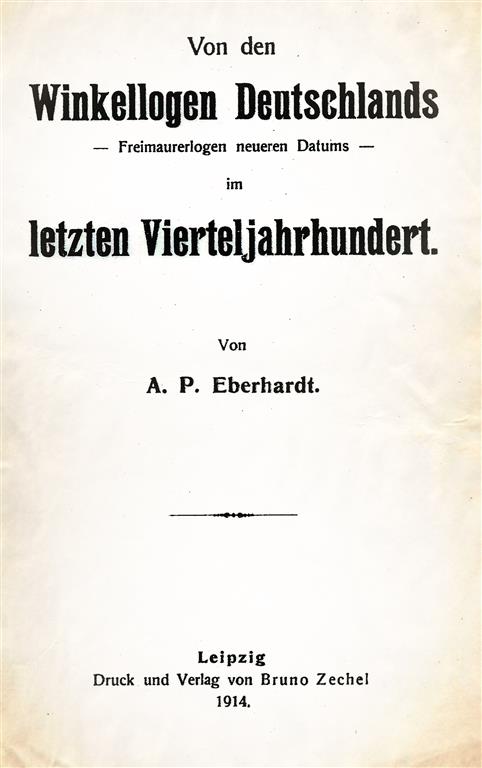
German original: A.P. Eberhardt: Von den Winkellogen Deutschlands. Freimaurerlogen Neueren Datums — im letzten Vierteljahrhundert.
Theodor Reuss' reaction in the Oriflamme 1914.