The Inquisition
Sometimes inquisitors identify plotters and settle their own scores. They point the finger at the lost sheep and draw up little institutional narratives on the basis of rumours, gossip and hearsay, without subjecting them to the process of analysis that is elementary for any kind of judgement. They overestimate here, underestimate there, and are perfectly happy to act as judge and jury.
The defendants publicly have to apologise or risk expulsion.
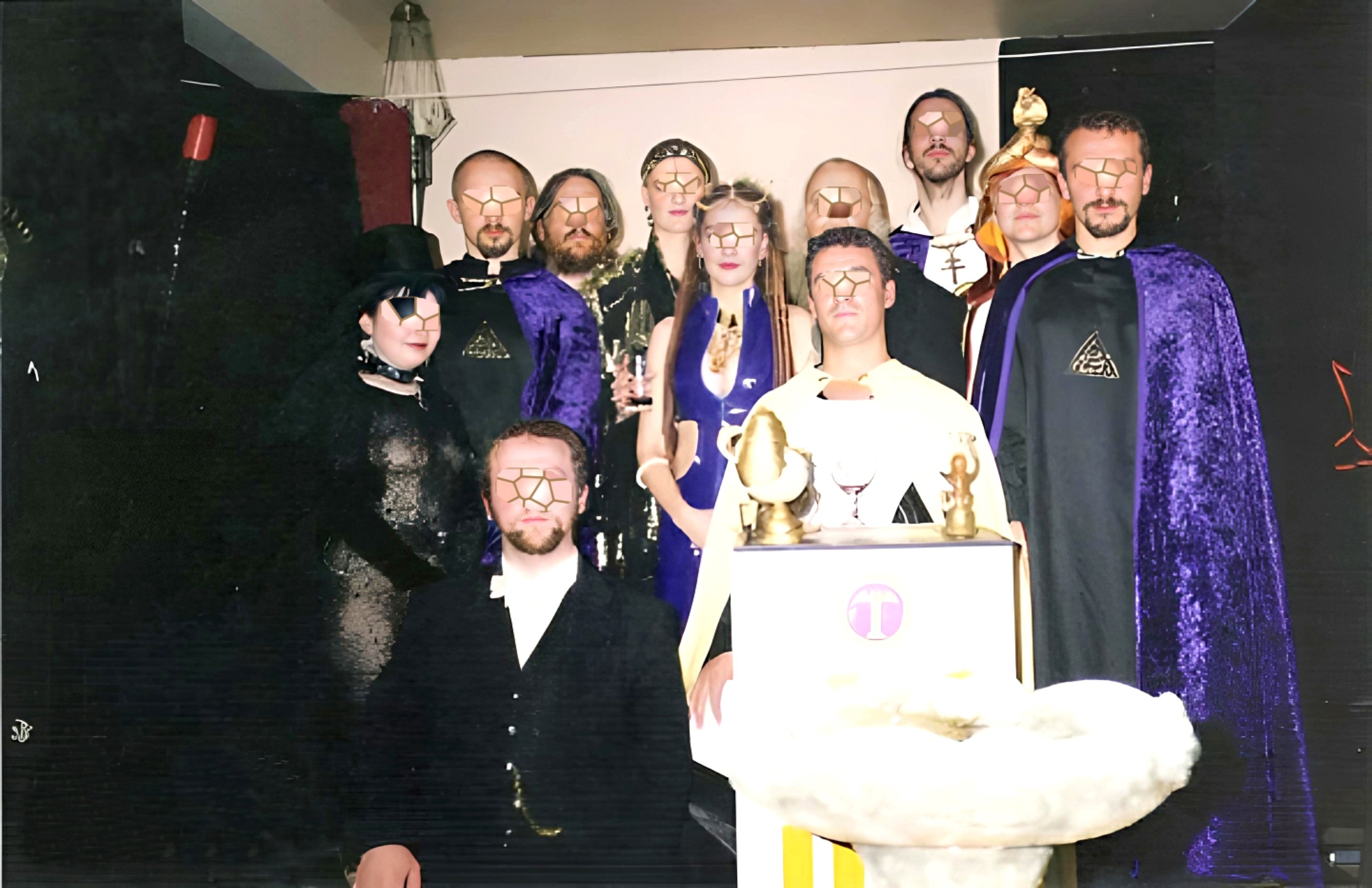
In 1996, David and Irene Fraenkl-Rietti were expelled by the Supreme Council of the 'Caliphate'. Eventually they founded the Ordo Templi Orientis Foundation, O.T.O.F.
[AI-generated image]
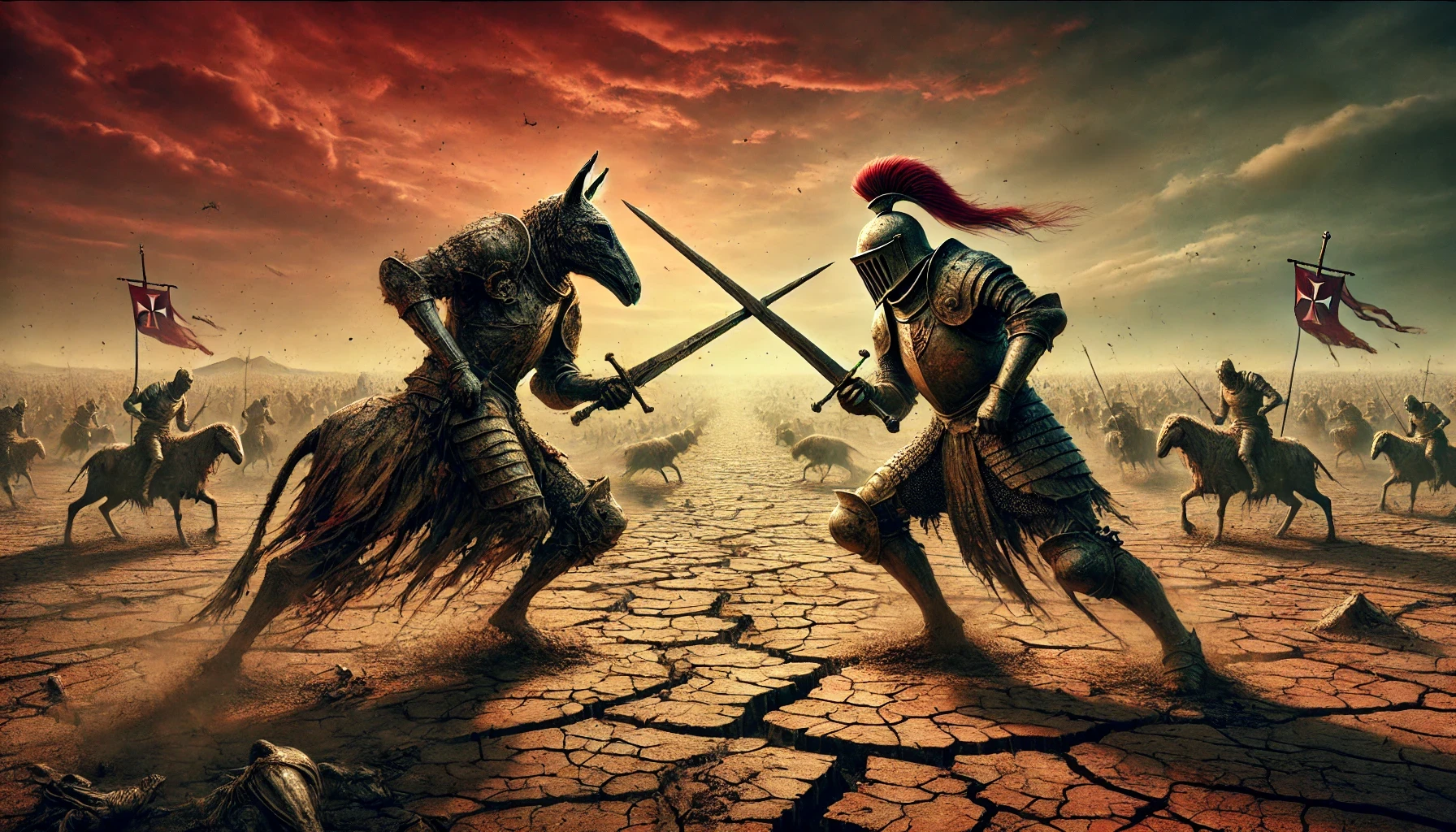
“Nobody Expects the Caliphate Inquisition!”
1. Introduction: Schism as Ritual Form
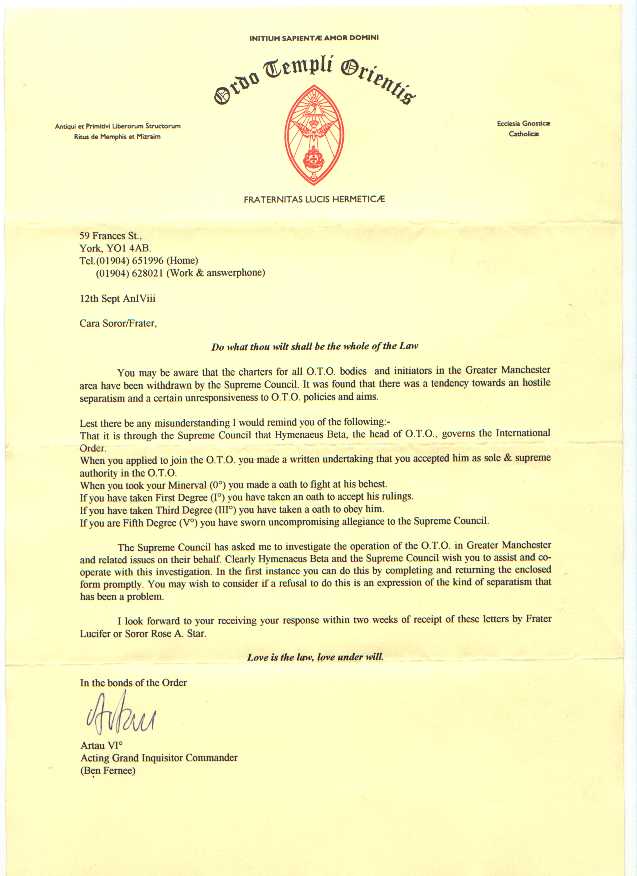
The year 1996 marks a curious chapter in the history of the 'Caliphate' O.T.O. — either a nadir or a climax, depending on one’s preferred tragic register. David and Irene Fraenkl-Rietti, once loyal members in London, became the subject of an internal inquisition led by Grand Inquisitor Ben Fernee.
This pseudo-judicial process was far more than administrative housekeeping. It became a symbolic drama about legitimacy, authority, and the ownership of lines, initiations, and the Caliph’s Word.
2. Tribunal and Transcript: The Rietti Affair
The main document chronicles the encounter. The Riettis demanded transparency and fairness; what they received was a rigid apparatus of enforcement. Joe Collins summarized:
“They chose the battlefield, they set the time, date, and manner of the visit […] It was a good old-fashioned mediæval witch-hunt!”
Ben Fernee, for his part, later withdrew in humility:
“I am wiser now. That is not to say that I am wise, just that I was very unwise.”
3. The O.T.O. Foundation: Counter-Myth as Counter-History
The Riettis responded by founding the O.T.O. Foundation, complete with their own IX° system, clear initiatic policy, and a rejection of remote rituals:
“Remote initiation […] is absurd, impossible and invalid.”
4. Postscript of Parody: Bryony Murds and the Absurd
Independent of the internal disputes, Bryony Murds — a non-member observing from the sidelines — later offered an ironically stylized reflection on the affair. Framed as a theatrical grotesque in the spirit of Monty Python, her piece transforms the drama into parody rather than polemic. Her imaginary “Cardinal Benjamino Feendish” intones:
“Our weapons are three in number: surprise, coffee, a tape recorder, and staying up till two in the morning!”
Far from mocking individuals, Murds’ pastiche highlights the inherent theatricality of power rituals within esoteric institutions — especially when their sacral claims are wielded bureaucratically. Her contribution, penned well after the dust had settled, adds a strange kind of clarity: by laughing, one often sees more clearly.
5. Meta-Critique: Initiation, Lineage, Symbol
Internal critics reach beyond the theatre to articulate a deeper disillusionment. The mysteries, they argue, are known; what remains is hierarchical theatre and symbolic exhaustion. One comment cuts particularly deep:
“Leaving a thing does not fully sever the link to it, rather it must also leave you.”
The Riettis, Fernee, Collins — all become characters in a drama that simultaneously uplifts and undermines its own mythos.
6. Conclusion: The 'Caliphate' Inquisition as Ritual Mirror
Whether revenge, exorcism, satire, or bureaucratic pageantry, the 1996 inquisition against the Riettis reveals a structural tension within Thelemic culture: between esoteric seriousness and institutional absurdity.
7. Epilogue: A Letter from the Ashes
Not every witness to the drama of 1996 parted ways with gratitude or reverence. Marcelo Santos, a former initiate of the broader Thelemic field, left behind a bitter and vividly worded account of his encounter with the O.T.O. Foundation. Writing in late 1999, he recounts his impressions with theatrical disgust:
“Ridiculous!!! ... After wasting three hours ... He ejaculates upon the cakes upon the altar and distributes the disgusting thing between the candidates, telling them to eat it. (Of course, I only pretended I was chewing, and threw that piece of cake under the chair...)”
Santos had expected distance from the 'Caliphate'. Instead, he encountered what he saw as a redundant echo:
“I was somehow upset when I saw that the OTO-F still used the same rituals as the Caliphate.”
For Santos, there was no saving grace in derivative solemnity. What he experienced was, in his words, “masturbating before the mirror” — a theatre of self-importance and recycled sacraments. His response was neither polemic nor parody, but disgusted exit:
“After that, I just said goodbye to the Order.”
All quotes and materials are drawn from internal correspondence, published testimonies, and archival collections curated by the author.
Source Material
The dossier is not a sermon. It is a filing cabinet with a theatrical cough: transcripts, letters, recollections, reactions and related pieces, arranged so that the institutional opera can be inspected without incense.
- Ben Fernee expelled in 1999.
- And for more — read also this one.
- Visit A visitor.
- Another One about the A.·. A.·.-aspect that maybe led to the expulsion.
- Marcelo A.C. Santos: ex-member of the O.T.O.F.
- Tales from the Café Thélème.
- More about all this in Andreas Huettl and Peter-R. Koenig: Satan - Jünger, Jäger und Justiz.
Images on this page are part of the Parareligion archive presentation and are handled by Peter-R. Koenig / Parareligion. Contact: koenig@parareligion.ch.