Parareligion archive · March and April 1997
Use of the Internet
A questionnaire for occultists, sent into the early web before social media turned every sectarian quarrel into a permanent weather report.
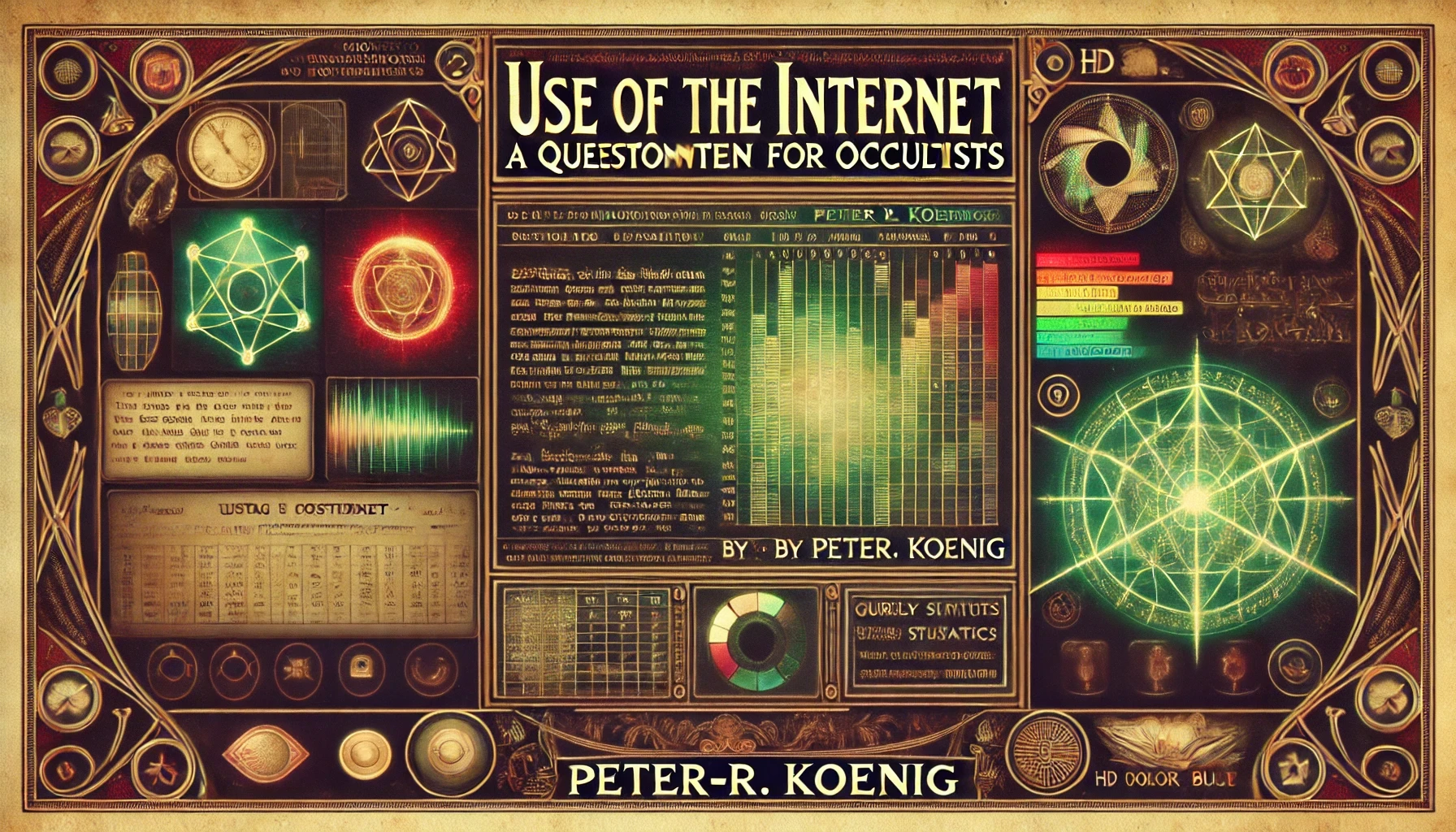
The small survey before the large noise
In March and April 1997, Peter-R. Koenig sent a questionnaire to 282 occult e-mail addresses: surfers, operators of larger and smaller websites, and people running their own mailing lists.
The questions deliberately contained word-shells and euphemisms into which the receivers could project their own concepts: “active”, “passive”, “consumption”, “occultism”, “inspiring”, and similar little semantic hooks. Some questions were more suggestive, especially in relation to Koenig’s essay on The McDonaldisation of Occulture.
Since Koenig’s reputation as an observer of the “Caliphate” may have prevented some members of that group from answering the questionnaire — with a bow to Heisenberg’s uncertainty principle — the responses should be read with that distortion in mind.
Method, sample, and its charming imperfections
Aggregated findings
83%
explicitly considered themselves “active” consumers of the Web; 11% and 7% respectively considered themselves more “passive” consumers.
42.4%
had a clearly positive opinion of occult net culture, usually framed around creativity; 30.5% had a rather negative one.
47.5%
complained about the self-referential character of occult websites; 13.6% found them useful.
37.3%
explicitly believed that occultists had a different approach to the Internet than the average user.
0–1
was the usual number of stimulating monthly responses reported by those maintaining their own web presence, with four exceptions reporting 20, 30, 50, and 600.
8.5%
sent queries about the questionnaire to the website; two participants asked when and where the results would be published.
What this is, and what it is not
This questionnaire is not presented as a comprehensive or scientific report. The aggregated data represents a subset of internet users and offers a snapshot of public sentiment in 1997, when occult cyberspace still had the odd innocence of a basement laboratory wired to a cosmic switchboard.
The value of the material lies less in statistical authority than in atmosphere, self-description, irritation, enthusiasm, and the early symptoms of occult net culture becoming conscious of itself.
Questionnaire and related material
The original questionnaire and a collection of the most impressive and significant answers are available in the Parareligion archive.
Open the questionnaire archive
The McDonaldisation of Occulture
Scattered On The Floor
Browsing Through The Rituals
I would like to express my sincere thanks.
Search and portals
Search Parareligion
O.T.O. Phenomenon
Return to the main navigation, the Parareligion entrance, or the peculiar aura of the whole machine.
Memphis MisraimEgyptian rites, irregular masonry, and O.T.O. prelude.
IntroductionEntrance into the O.T.O. Phenomenon archive.
The early O.T.O.Origins, documents, and contested beginnings.
Carl KellnerThe name before the later myth-machinery.
O.T.O. RitualsRitual texts, dossiers, and archival context.
Fraternitas SaturniSaturnian dossiers and German occult cross-currents.
Typhonian O.T.O.Kenneth Grant, Typhonian claims, and related material.
Gnostic ChurchesEcclesia Gnostica Catholica and surrounding bodies.
The “Caliphate”Documents, controversies, authority, and litigation shadows.
F.R.A.Fraternitas Rosicruciana Antiqua and related currents.
David BowieOcculture, Kabbalah, performance, and pop masks.
BooksPrinted matter on the O.T.O. and its orbit.