Society Ordo Templi Orientis
Marcelo Ramos Motta
Jeremy Charles Ellis · Richard Gernon / Gurney
S.O.T.O. as legal umbrella
Upon Marcelo Ramos Motta's behalf, one Michael G. Kaplan registered the Society Ordo Templi Orientis as a legal umbrella for the O.T.O. in Nashville on 3rd February 1978. Acts of payment for this Society Ordo Templi Orientis had been processed via a 'Troll Publishing Company'. On 16th May 1978, Motta nominated a certain Jeremy Charles Ellis as representative of the true O.T.O. in London, with orders to stop the Crowleyan publications of Kenneth Grant and John Symonds. Ellis would take his commission all too literally, and in 1982 tried to set fire to the offices of the publishers Routledge & Kegan Paul in an attempt to burn Grant's books.Ellis committed suicide in 1983.
"As I experienced it, the S.O.T.O. existed solely on paper as a collection agency to pay Motta's bills.” Martin Starr in his book 'The Unknown God', Chicago 2003, p. x.
Martin Starr was initiated under the auspices of Richard Gernon (see below) and rose to Director (and III°) of a mid–West O.T.O. branch on 1st November 1976.
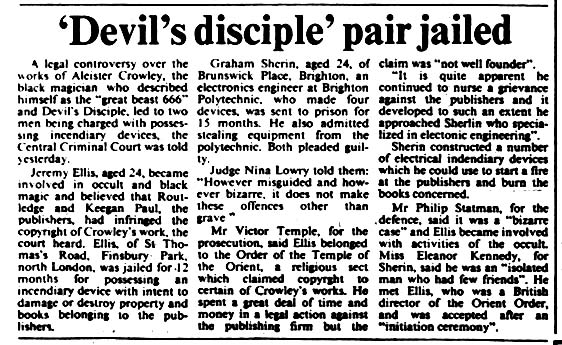
'Devil's disciple' pair jailed
A legal controversy over the works of Aleister Crowley, the black magician who described himself as the "great beast 666" and Devil's Disciple, led to two men being charged with possessing incendiary devices, the Central Criminal Court was told yesterday.
Jeremy Ellis, aged 24, became involved in occult and black magic and believed that Routledge and Keegan Paul, the publishers, had infringed the copyright of Crowley's work, the court heard. Ellis, of St Thomas's Road, Finsbury Park, north London, was jailed for 12 months for possessing an incendiary device with intent to damage or destroy property and books belonging to the publishers.
Graham Sherin, aged 24, of Brunswick Place, Brighton, an electronics engineer at Brighton Polytechnic, who made four devices, was sent to prison for 15 months. He also admitted stealing equipment from the polytechnic. Both pleaded guilty.
Judge Nina Lowry told them: "However misguided and however bizarre, it does not make these offences other than grave"
Mr Victor Temple, for the prosecution, said Ellis belonged to the Order of the Temple of the Orient, a religious sect which claimed copyright to certain of Crowley's works. He spent a great deal of time and money in a legal action against the publishing firm but the claim was "not well founded".
"It is quite apparent he continued to nurse a grievance against the publishers and it developed to such an extent he approached Sherlin who specialized in electronic engineering".
Sherin constructed a number of electrical indendiary devices which he could use to start a fire at the publishers and burn the books concerned.
Mr Philip Statman, for the defence, said it was a "bizarre case" and Ellis became involved with activities of the occult. Miss Eleanor Kennedy, for Sherin, said he was an "isolated man who had few friends". He met Ellis, who was a British director of the Orient Order, and waa accepted after an "initiation ceremony".
Times, October 22, 1982
Ellis documents
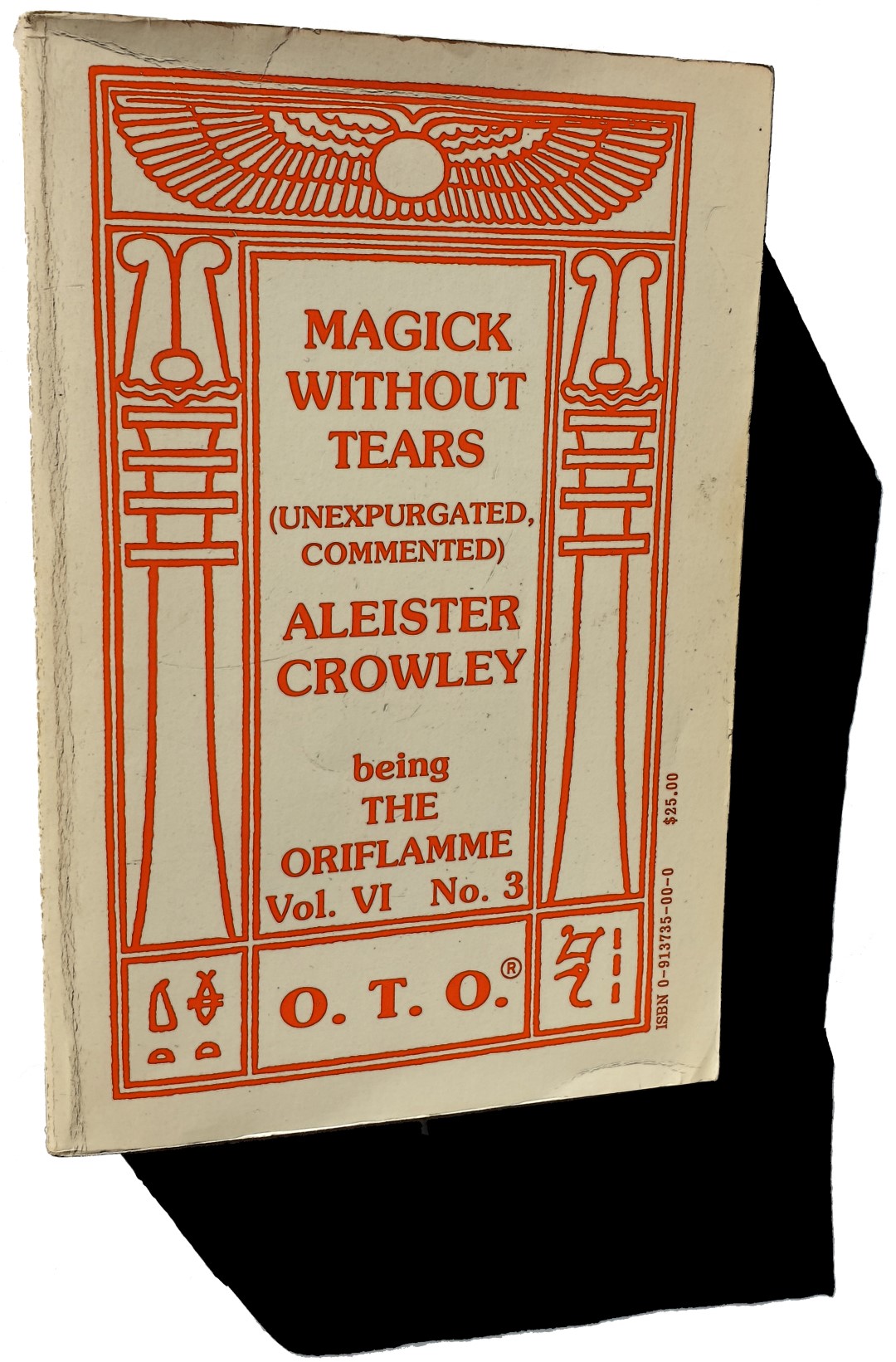
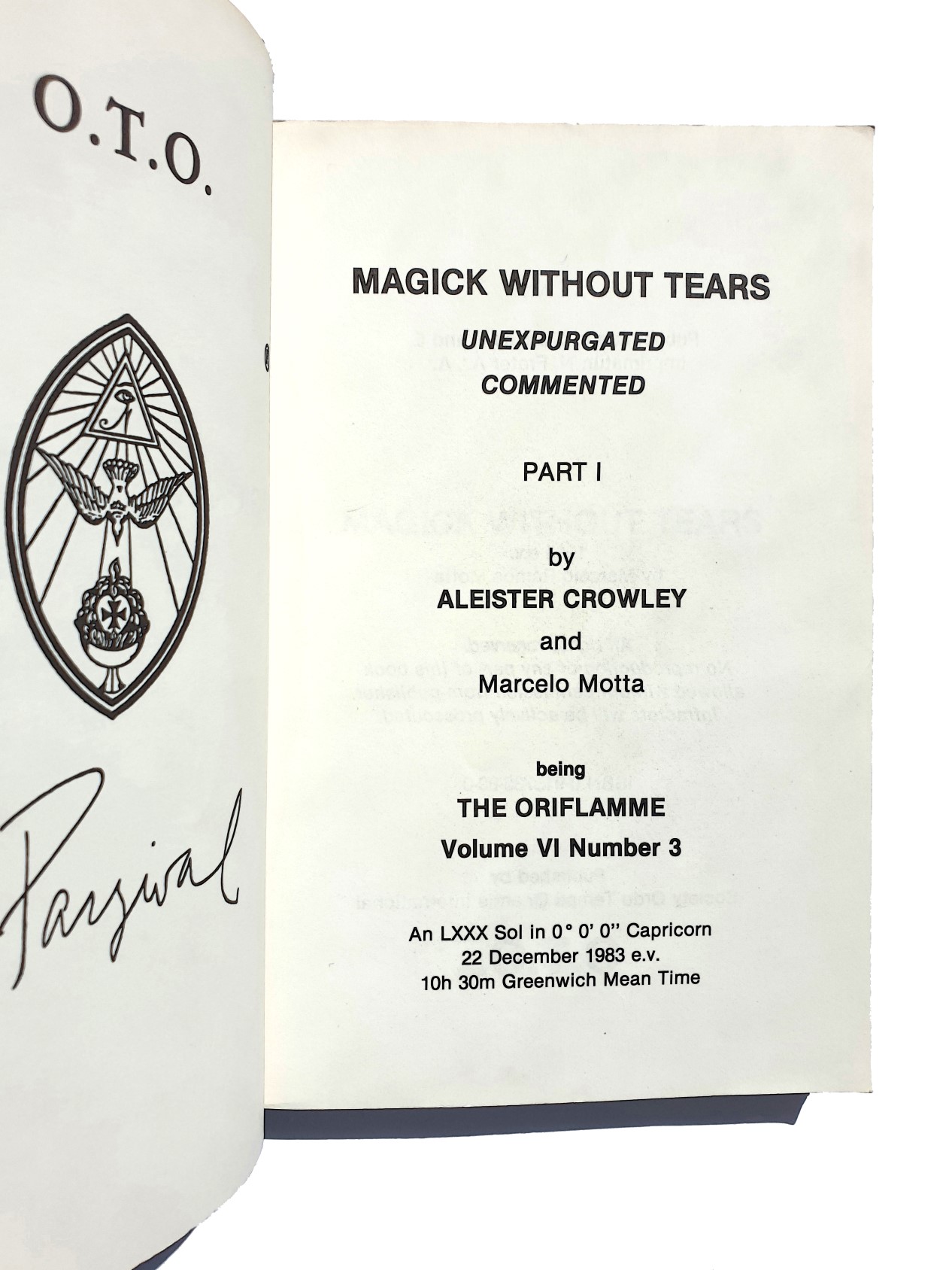
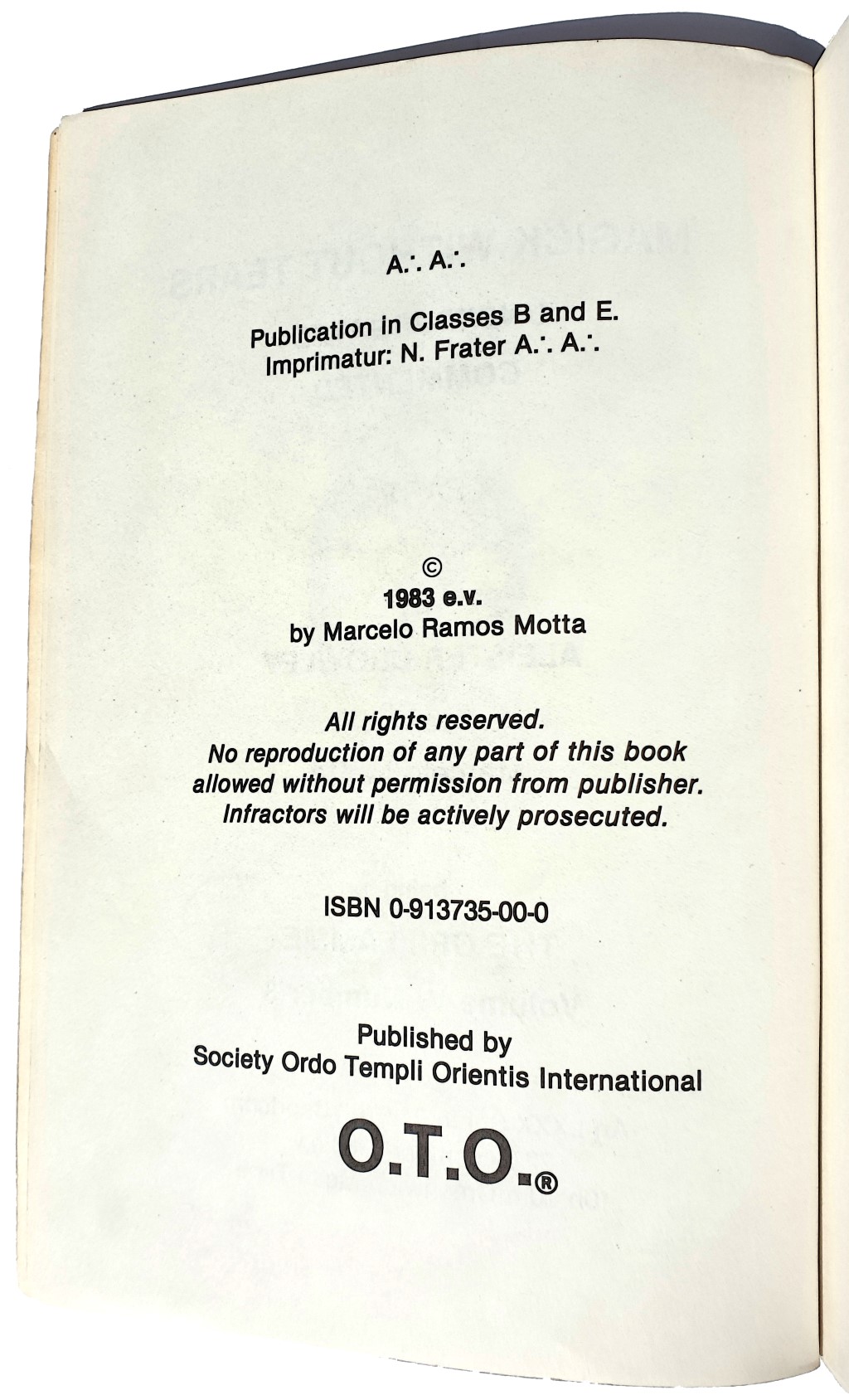
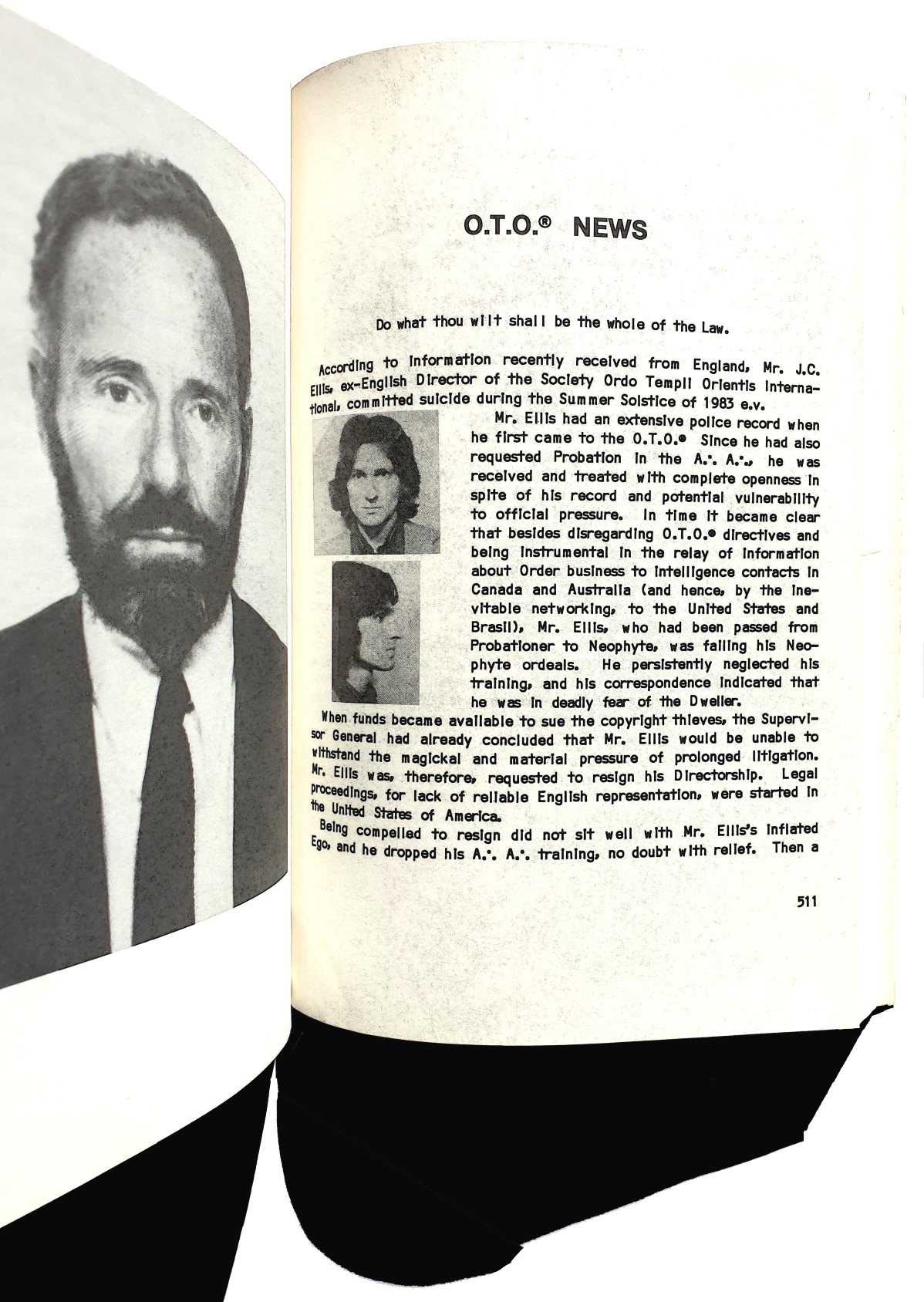
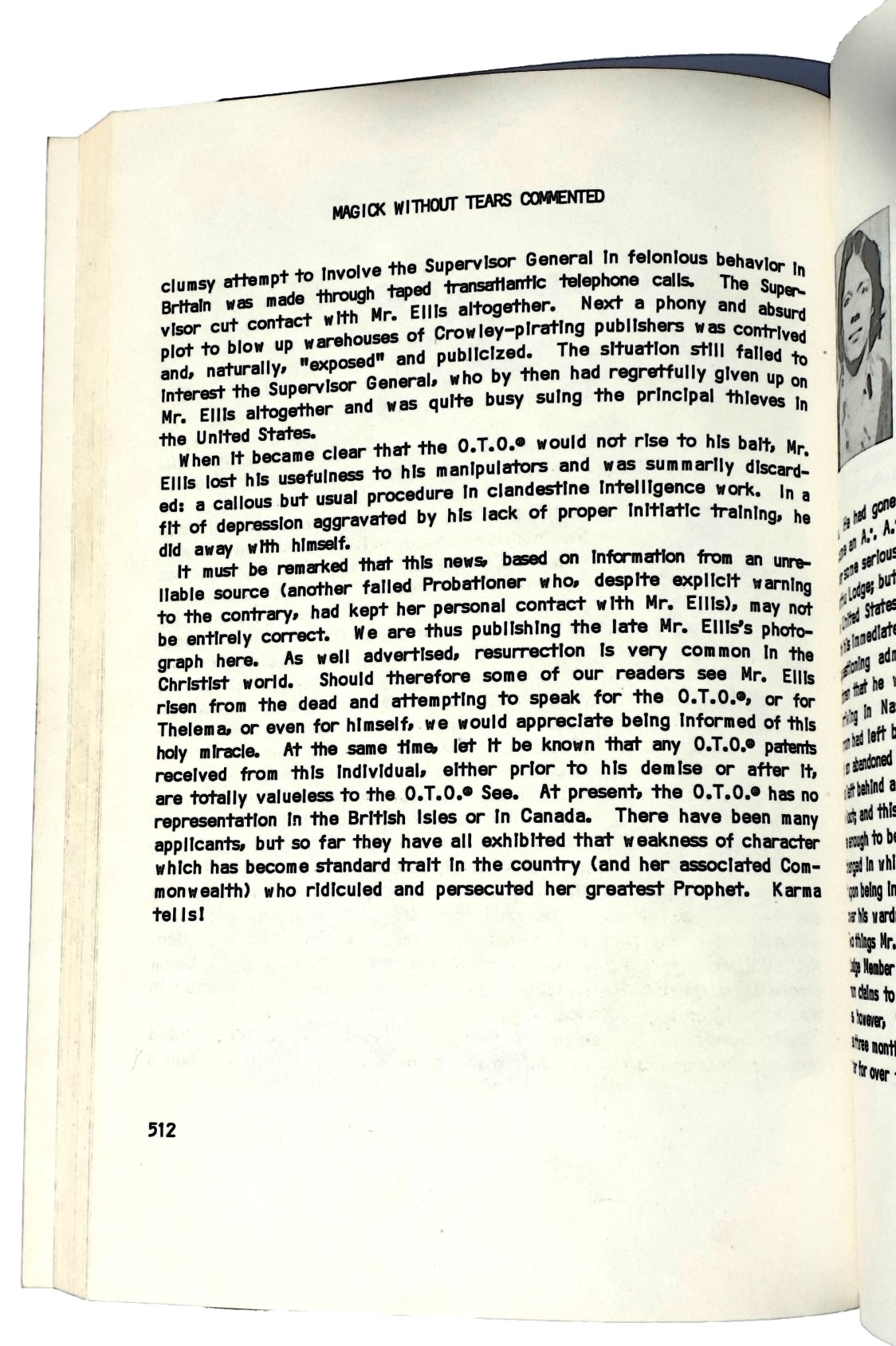
Motta on Ellis; 1985 court transcript
According to information recently received from England, Mr. J.C. Ellis, ex-English Director of the Society Ordo Templi Orientis International, committed suicide during the Summer Solstice of 1983 e.v.Mr. Ellis had an extensive police record when he first came to the O.T.O. Since he had also requested Probation in the A.·. A.·., he was received and treated with complete openness in spite of his record and potential vulnerability to official pressure. In time it became clear that besides disregarding O.T.O. directives and being instrumental in the relay of information about Order business to Intelligence contacts in Canada and Australia (and hence, by the inevitable networking, to the United States and Brasil), Mr. Ellis, who had been passed from Probationer to Neophyte, was failing his Neophyte ordeals. He persistently neglected his training, and his correspondence indicated that he was in deadly fear of the Dweller.
When funds became available to sue the copyright thieves, the Supervisor General had already concluded that Mr. Ellis would be unable to withstand the magickal and material pressure of prolonged litigation. Mr. Ellis was, therefore, requested to resign his Directorship. Legal proceedings, for lack of reliable English representation, were started in the United States of America.
Being compelled to resign did not sit well with Mr. Ellis's inflated Ego, and he dropped his A.·. A.·. training, no doubt with relief. Then a clumsy attempt to involve the Supervisor General in felonious behavior in Britain was made through taped transatlantic telephone calls. The Supervisor cut contact with Mr. Ellis altogether. Next a phony and absurd plot to blow up warehouses of Crowley-pirating publishers was contrived and, naturally, "exposed" and publicized. The situation still failed to interest the Supervisor General, who by then had regretfully given up on Mr. Ellis altogether and was quite busy suing the principal thieves in the United States.
When it became clear that the O.T.O. would not rise to his bait, Mr. Ellis lost his usefulness to his manipulators and was summarily discarded: a callous but usual procedure in clandestine intelligence work. In a fit of depression aggravated by his lack of proper initiatic training, he did away with himself.
It must be remarked that this news, based on information from an unreliable source (another failed Probationer who, despite explicit warning to the contrary, had kept her personal contact with Mr. Ellis), may not be entirely correct. We are thus publishing the late Mr. Ellis's photograph here. As well advertised, resurrection is very common in the Christist world. Should therefore some of our readers see Mr. Ellis risen from the dead and attempting to speak for the O.T.O. or for Thelema, or even for himself, we would appreciate being informed of this holy miracle. At the same time, let it be known that any O.T.O. patents received from this individual, either prior to his demise or after it, are totally valueless to the O.T.O. See. At present, the O.T.O. has no representation in the British Isles or in Canada. There have been many applicants, but so far they have all exhibited that weakness of character which has become standard trait in the country (and her associated Commonwealth) who ridiculed and persecuted her greatest Prophet. Karma tells!
Marcelo Ramos Motta: "Magick Without Tears Unexpurgated Commented Part I", "Oriflamme" VI;3, Nashville 1983, 511pp.
IN THE UNITED STATES DISTRICT COURT
FOR THE NORTHERN DISTRICT OF CALIFORNIA
BEFORE THE HONORABLE CHARLES A. LEGGE, JUDGE
Grady McMurtry, William E. Heidrick, Phyllis Seckler, Helen Parsons Smith, William Breeze, Francis I. Regardie, James Wasserman, and Kenneth Anger, individuals, Ordo Templi Orientis, a corporation, and Thelema Publications, a business entity,
Plaintiffs,
vs.
Society Ordo Templi Orientis, a corporation, Thelema Publishing Company, a corporation, Marcello Ramos Motta, an individual, and Does I through X, inclusive,
Defendants.
CIVIL NO. C-83-5434
REPORTER'S TRANSCRIPT OF PROCEEDINGS OF COURT TRIAL
Tuesday, May 14, 1985
450 Golden Gate Avenue
San Francisco, CAlifornia 94102
THE COURT: Well, who held the title of Director?
THE WITNESS: Very well. The title of Director was held by a Jeremy Charles Ellis of London, England, by a William Robert or Richard Barton of Melbourne Australia, by a Claudia Canuto of Nashville, Tennessee, and I believe that was all at that time.
BY MR. MacKENZIE:
Q. Is it your understanding that these people were members of the Board of Directors of the Tennessee corporation, SOTO?
A. Well, no, because none of them except me was an [page 467] American citizen. So I don't know if that's possible. The legal aspects of that I'm unaware of.
Q. Were there ever any Board of Directors' meetings?
A. Never.
Q. Have you seen corporate records?
A. Yes, I have. I examined Mr. Motta's files in December of 1983 when I spent a week at his house.
Q. Well, did Mr. Motta ever consult the Board of Directors regarding the SOTO action that he wanted?
A. Consult in what sense?
Q. Well, for their approval.
A. No. Our approval was not required and most often never sought for any action he took. And to ever go in opposition to any direction that he wanted to take put you in immediate peril of expulsion, as he took great pains to point out whenever such suggestions were made.
...
...
...
Q. Yes. What can you tell me about the Constitutions?
A. Well, in both Constitutions the absolute authority of Mr. Motta as supervisor, again, a title that he invented for himself is maintained.
In the firs Constitution there was a chapter on disciplinary norms which mentioned that if a member acted out of line that a request could be made to the Supervisor for the "elimination of the culprit."
Q. Do you know that that phrase "elimination" meant? [page 469]
A. Well, Mr. Motta uses it in a rather ambiguous sense. In one sense, the common sense acceptation of it I would think would mean the removal of a member from the SOTO.
However, I have seen him use it in letters and in a document he wrote in the '50s about the OTO where he was calling for the murder of people who acted out of line in the Order.
Q. What letter, if you remember, was that?
A. One letter I can think of was a letter to the late Jeremy Charles Ellis, a British Director whom he expelled.
MR. MITTEL: Objection; Best Evidence.
Move to strike the answer.
...
...
...
Q. Do you know about how many members there are, well, today or within the last six months, currently?
A. Within my knowledge i would say there are maybe four, perhaps three members internationally.
Q. Now, who is Jeremy Ellis, is he a member?
A. Mr. Ellis, now deceased, was a British Director of [page 472] the SOTO and was expelled by Mr. Motta.
...
...
...
BY MR. MacKENZIE:
Q. Was Jeremy Ellis ever a member of plaintiff, Ordo Templi Orientis?
A. Absolutely not. I keep track of those on the mailing list, and I have never seen that one go by, especially before we used the computer on those listings. It was awful.
MR. MITTEL: Your Honor, am I clear that Mr. MacKenzie's rendition of the article is not in [page 564] evidence but only a translation?
THE COURT: No, that's simply a translation.
MR. MITTEL: That document has not been offered and that's one of the documents to which we object.
THE COURT: On what basis?
MR. MITTEL: On the basis of authenticity and on the basis of hearsay and on the basis of relevance.
MR. MacKENZIE: Well, I think the relevance is quite clear. Mr. Ellis was a member of Mr. Motta's association, a member of his Board of Directors. And he's been confused with my client.
The authenticity, I don't have any way of authenticating other than when Mr. Heidrick received it.
THE COURT: I will admit it subject to motion to strike at the conclusion of plaintiffs' case.
...
...
...
Q. Can you tell me how that insignia differs from the one that the plaintiffs use.
A. By the addition of the word "Society," and by the fact that it is in color.
Q. And on the first page it states the date first used in California is dated as April 15th, 1980.
A. Yes.
Q. Okay. When did you say that you decided you wanted to reformulate the oTO rituals? When did you first make up your mind to do that?
A. When the Crowley rituals were published.
Q. Okay. I show you Plaintiffs' Exhibit 215.
Is that a membership application to the Society?
A. Yes, it is.
Q. And why do you inquire about the police record?
A. Because I have had pupils with criminal records, [page 926] and it's necessary to know about it.
Q. When id you start using this form?
A. It may have been some time between 1980 and 1983. I do not recollect the exact date.
Q. Are you familiar with the name Jeremy Ellis?
A. Yes.
Q. Was he a director of your Society?
A. Yes.
Q. And how long was he a director?
A. I do not recollect exact dates, but at least four years, I think.
Q. When did he stop being a director?
A. I asked him to resign. If he had not resigned, I would have expelled him.
I do not recollect the exact date.
Q. Was it -- can you guess which year it was?
A. I can tell you that it was six months before he had made his attempt on the records at Routledge & Kegan Paul. That much I know, because I went back in the records to look at the news.
Q. You mean the bombing of the publisher's house in London?
A. The attempted bombing.
Q. I show you Plaintiffs' No. 2190 and ask if this is a letter that you sent to Mr. Ellis? [page 927]
A. I -- I gave Mr. Starr permission to copy my entire correspondence with --
Q. Just answer the questions, Mr. Motta, please.
A. Yes, yes, yes.
Q. Was he a director of the SOTO at that time?
A. Mr. Ellis? Yes.
Q. Would you read the portions I've underlined, please?
THE COURT: Well, are you going to move for the admission of this into evidence?
MR. MacKENZIE: Yes, I am, Your Honor.
THE COURT: Well, then, it isn't necessary to take up time.
MR. MacKENZIE: All right.
THE COURT: You've marked my copies and so I can --
MR. MacKENZIE: That's fine.
THE COURT: -- read them. There is no sense the record to do that.
MR. MacKENZIE: All right.
BY MR. MacKENZIE:
Q. I show you Plaintiffs' No., 216 and ask you if you have written this letter?
A. Yes, un-huh.;
Q. I'm not going to embarrass the Court by reading this [page 928] extremely obscene letter.
A. Oh, really.
Q. But I wanted to know if you oftentimes write such vulgar letters?
MR. MITTEL: Objection to the form of the question.
THE COURT: Well, the letter can speak for itself.
You've moved for its admission into evidence. I can read it. Let's leave it at that.
BY MR. MacKENZIE:
Q. My question is this fundamental, I think, Mr. Motta: How do you in the form of writing such letters, in the form of dealing with people such as Ellis and discussion murder in that letter, how can you say that you carry on the spirit of the Ordo Templi Orientis, the spirit of Aleister Crowley?
A. I think, sir, that you should leave that for the Court to decide.
Q. Because I would like to hear your answer.
A. You just heard it.
Q. You don't have an answer?
A. Would you not consider that your question was rhetorical?
I am here. [page 929]
Q. Do you feel you carry on the spirit of Aleister Crowley?
A. Yes. We are not hypocrites.
...
...
...
Richard Gernon / Gurney
Gernon served as master of Motta's S.O.T.O. in Nashville, Tennessee where he had originally gone to at the instigation of James Wasserman. He later joined the 'Caliphate' and succeeded Wasserman as Lodge Master in New York City. Gernon was a Bishop of the 'Caliphate–Ecclesia Gnostica Catholica'. He committed suicide with a drug overdose in 1989.Gernon documents
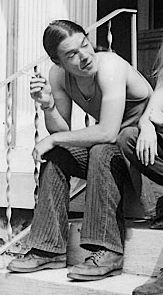
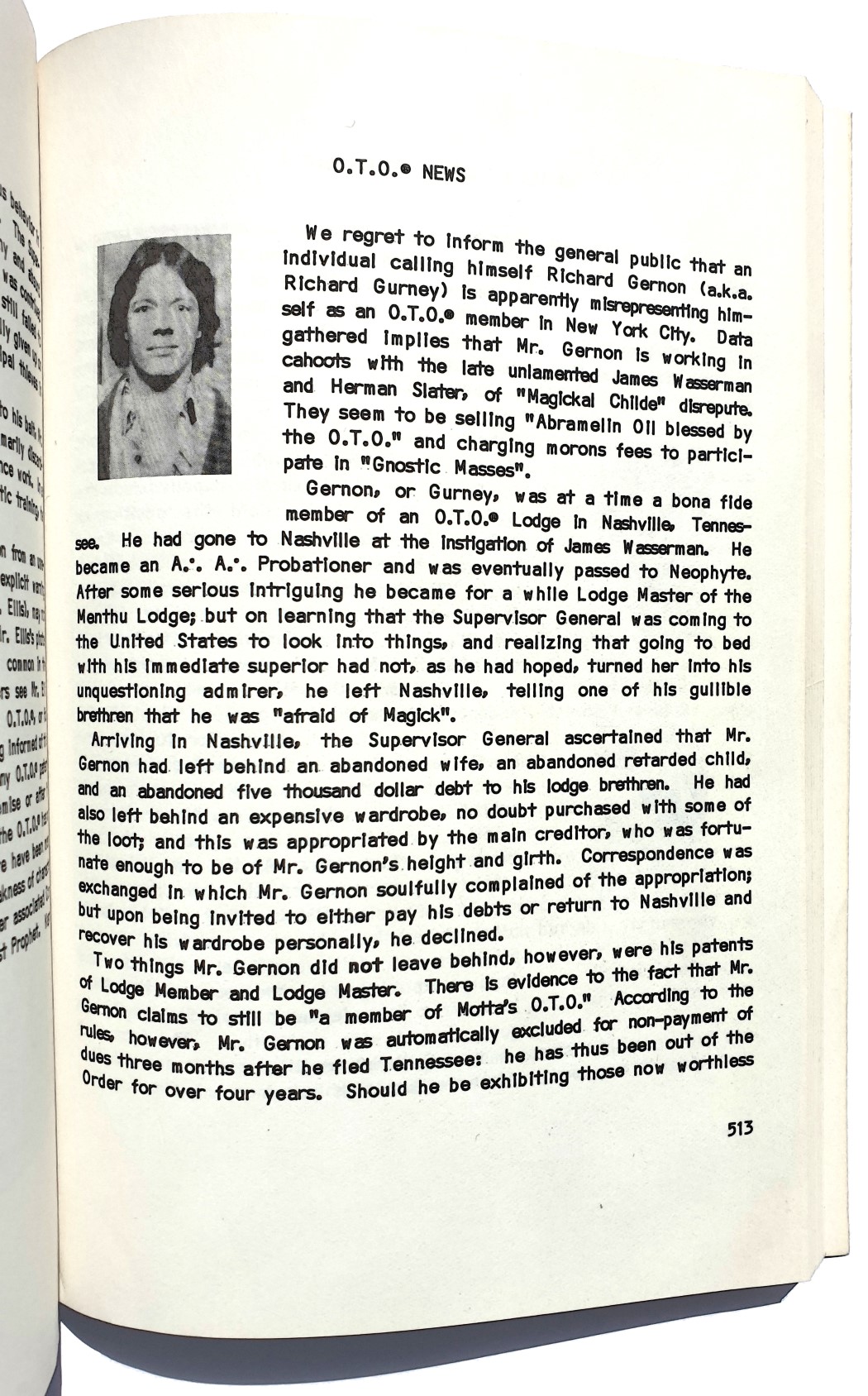
Motta on Gernon; 1985 court transcript
We regret to inform the general public that an individual calling himself Richard Gernon (a.k.a. Richard Gurney) is apparently misrepresenting himself as an O.T.O. member in New York City. Data gathered implies that Mr. Gernon is working in cahoots with the late unlamented James Wasserman and Herman Slater, of "Magickal Childe" disrepute. They seem to be selling "Abramelin Oil blessed by the O.T.O." and charging morons fees to participate in "Gnostic Masses".Gernon, or Gurney, was at a time a bona fide member of an O.T.O. Lodge in Nashville, Tennessee. He had gone to Nashville at the instigation of James Wasserman. He became an A.·. A.·. Probationer and was eventually passed to Neophyte. After some serious intriguing he became for a while Lodge Master of the Menthu Lodge; but on learning that the Supervisor General was coming to the United States to look into things, and realizing that going to bed with his immediate superior had not, as he had hoped, turned her into his unquestioning admirer, he left Nashville, telling one of his gullible brethren that he was "afraid of Magick".
Arriving in Nashville, the Supervisor General ascertained that Mr. Gernon had left behind an abandoned wife, an abandoned retarded child, and an abandoned five thousand dollar debt to his lodge brethren. He had also left behind an expensive wardrobe, no doubt purchased with some of the loot; and this was appropriated by the main creditor, who was fortunate enough to be of Mr. Gernon's height and girth. Correspondence was exchanged in which Mr. Gernon soulfully complained of the appropriation; but upon being invited to either pay his debts or return to Nashville and recover his wardrobe personally, he declined.
Two things Mr. Gernon did not leave behind, however, were his patents of Lodge Member and Lodge Master. There is evidence to the fact that Mr. Gernon claims to still be "a member of Motta's O.T.O." According to the rules however, Mr. Gernon was automatically excluded for non-payment of dues three months after he fled Tennessee: he has thus been out of the Order for over four years. Should he be exhibiting those now worthless documents as "evidence" of O.T.O. authority, we would welcome information to the effect. There is, furthermore, reason to believe that Mr. Gernon claims to "know and communicate the Rituals of Motta's O.T.O."; we would welcome information on this point too; and especially as to what kind of "rituals" Mr. Motta may be supposed to have provided Messrs. Gernon, Wasserman and (who knows?) Slater with. Should the information come in the form of affidavits it will be very well received.
Marcelo Ramos Motta: "Magick Without Tears Unexpurgated Commented Part I", "Oriflamme" VI;3, Nashville 1983, 513pp.
IN THE UNITED STATES DISTRICT COURT
FOR THE NORTHERN DISTRICT OF CALIFORNIA
BEFORE THE HONORABLE CHARLES A. LEGGE, JUDGE
Grady McMurtry, William E. Heidrick, Phyllis Seckler, Helen Parsons Smith, William Breeze, Francis I. Regardie, James Wasserman, and Kenneth Anger, individuals, Ordo Templi Orientis, a corporation, and Thelema Publications, a business entity,
Plaintiffs,
vs.
Society Ordo Templi Orientis, a corporation, Thelema Publishing Company, a corporation, Marcello Ramos Motta, an individual, and Does I through X, inclusive,
Defendants.
CIVIL NO. C-83-5434
REPORTER'S TRANSCRIPT OF PROCEEDINGS OF COURT TRIAL
Tuesday, May 14, 1985
450 Golden Gate Avenue
San Francisco, CAlifornia 94102
BY MR. MacKENZIE:
Q. Well, how much longer were you in California?
A. I traveled from Los Angeles to San Francisco on July 26th, where I met Daniel Gunther and Richard Gernon. Mr. Gernon was Mr. Gunther's student. He met Mr. Gunther through me. [page 410]
And I had requested them to come out to California to verify my judgments of Mrs. Smith, Miss Seckler and Mr. McMurtry.
I knew that Mr. Motta felt these people were capable of fascination and magical attack in a very subtle way, and I wanted to best discharge my responsibility to him by bringing in other witnesses that he would trust to either confirm or deny my opinions.
And thank god they came.
Q. Do you know what their reactions were?
A. Their relations were virtually identical to mine. I have a letter from Mr. Gunther --
MR. MITTEL: Objection; hearsay.
THE WITNESS: -- written July 30th in which be confirms my opinion verbatim.
MR. MITTEL: Motion to strike the answer.
THE COURT: Yes. Objection sustained.
BY MR. MacKENZIE:
Q. Let me ask you this: Do you know if Mr. Gunther and Mr. Gernon were initiated into the OTO?
A. Yes, they were. Along with myself.
Q. And who initiated them?
A. Mr. McMurtry. [page 411]
...
...
...
Q. Does the A.·. A.·. have any rights to the library?
A. No. The A.·. A.·. is not -- does not include a concept of legal rights.
Q. Do you know for a fact who took the library in 1979?
A. Who took the library in 1979?
Q. The theft of it?
A. I don't have the slightest idea.
Q. Where were you living in 1979?
A. In New York.
Q. How old were you in 1976 when all this was going on?
A. I believe I was 25, 26.
Q. Mr. Mittel asked you if you didn't have some kind of a loyalty towards Gernon, Richard Gernon. [page 450]
A. Richard Gernon? Yes.
MR. MITTEL: Objection. That's a misleading characterization of the question.
THE COURT: What was the question --
MR. MacKENZIE: Let me re --
THE COURT: Well, introduce it differently, then. You're just introducing the subject matter, I assume?
MR. MacKENZIE: Yes.
BY MR. MacKENZIE:
Q. Did you state that you had some loyalty towards Richard Gernon at this time --
A. My loyalty to Mr. Gernon is a personal friendship as well as Order loyalty. But I believe it is Mr. Gunther that we're referring to.
Q. I'm sorry. Mr. Gunther.
-- and that you had feelings of loyalty after the Calaveras Court decree, but during that time as well?
A. Certainly.
Q. Was Mr. Gunther a member of the A.·. A.·.?
A. Yes, he was.
Q. And was he a member of the OTO?
A. There was no OTO.
MR. MacKENZIE: No further questions. [page 451]
...
...
...
Q. Were there any other members in the A.·. A.·. at the [page 458] time you joined other than Mr. Gunther and Mr. Gernon?
A. Not to my knowledge, sir.
Q. Did you ever discuss at this time the OTO itself?
A. No. There was absolutely no discussion of the OTO. Our matters at the time were solely concerned with the A.·. A.·..
THE COURT: I've lost who he's talking to, Mr. Motta or Mr. Gernon?
MR. MacKENZIE: No. I'm sorry, Your Honor.
This is with Mr. Gunther and Mr. Gernon.
BY MR. MacKENZIE:
Q. Let me ask you a preliminary question:
Was Mr. Motta in the United States at this time?
A. No, he was not, sir.
Q. Do you know when he first came to the United States in the 1970s?
A. Mr. Motta did not come to the United States in the 1970s; he came to the United States in July 1980.
Q. He was never in the United States in the 1970s, to you knowledge?
A. No, sir.
Q. Are the A.·. A.·. and the OTO related?
A. No, sir.
Q. Do you know if Mr. Gernon became involved with the [page 459] OTO?
A. When I first talked with Mr. Gernon on the telephone in, I believe, May of 1977 he indicated that he had been in California in July of 1976 and was then initiated into the plaintiffs" OTO.
Q. When did the SOTO develop?
A in May of 1977 I was informed by Richard Gernon that Mr. Motta had chartered James Daniel Gunther to be his OTO representative -- SOTO representative in the United States.
Q. To your knowledge, was Mr. Gunther an American citizen?
A. Yes, he is, sir.
Q. Do you know if he went to Brazil to get chartered?
A. No, he did not. This all done through the mail.
Q. So, in other words, prior to this SOTO in May of 1977, there was no SOTO?
A. That is correct.
Q. Where were you living at this time?
A. In May of 1977 I was living in St. Louis, Missouri.
Q. Did you ever live in Nashville?
A. Yes, I did. I resided in the academic year of 1977 and 1978 when I attended Vanderbilt University.
Q. Were you familiar with the SOTO at that time? [page 460]
A. Yes, I was. I had visited there that spring and had talked with people.
Q. Do you know how many members there were in the SOTO at that time?
A. There were approximately five to seven members.
...
...
...
Background: The Song the of the Whitewash.