
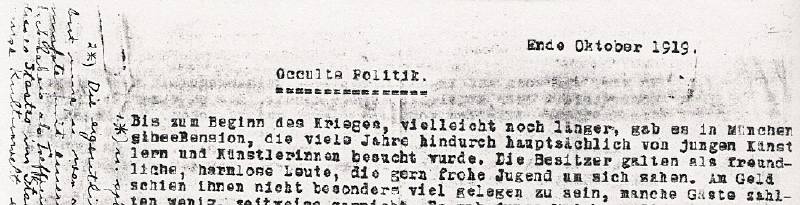
Until the beginning of the war, perhaps even longer, there was a boarding house in Munich which for many years had been frequented mainly by young male and female artists. The owners were regarded as friendly, harmless people who liked to have cheerful youth around them. Money did not seem to matter to them very much; some guests paid little, at times nothing at all. There were young girls who felt very well cared for there at little cost. Every evening there was dancing, but anyone who did not want to join in did not have to. From time to time festivities took place, arranged in such a way that, as an eyewitness related, by the end everyone was lying on the floor in pairs. One person sat in the middle and watched. Many a young couple, in this temple, brought its first sacrifice against its will.
This went on for many years and was so well known and acknowledged that the enterprise was completely secure. Woe to anyone who became indignant about it! All indignation turned back against him. Woe if one of the many who had innocently followed the invitations coming from every side wanted, in the torment of an unbearable memory and under the compulsion of an incomprehensible situation, to speak of what had happened! He found deaf ears and mocking, derisive hostility. Everywhere in the city this house was advertised: in the university, the academies and the studios. It was a base for a nameless gang of occultists who practised sexual magic on a grand scale, so to speak a joint-stock company for exploiting the psychic and physical forces of their fellow human beings. The real shareholders remained in the background. They held the roads to success in every field, and whoever at that time wished to achieve anything professionally or socially as an artist or scholar had to seek contact with a circle which, besides that boarding house, used the house of a wealthy Jewish art lover as a meeting place. No one could say who actually held the strings, who was the ruler of this state within the state, whose borders by no means lay in Munich, nor even in Germany. The net extended across the entire cultural world. Whoever joined in obediently did splendidly.
Much could be told about the activity of these people, especially things of a kind altogether different from anything else that goes on in the world. It is difficult to describe such matters, because one would have to acquire entirely new concepts. Many were thrown completely off course, fell into inextricable, incomprehensible difficulties, unwanted relationships and dependencies. A general mood of degradation and humiliation, an oppressive melancholy, a deep helplessness lay over the young people, while some showed an unpleasant wildness and coarsening. Whoever wanted to swim against the current felt tormented by states of anxiety, indeed by suggestions of suicide. What was the use of investigating the cause of a sudden outbreak of madness, a suicide, or even a crime?
It may have been fifteen years or more ago that a man from Mühlhausen (?) committed a mass murder, claiming many victims. He stated that he had wanted revenge because years earlier he had been seduced into an orgy and could not bear the memory.
Some found themselves surrounded by unfamiliar hostility, encountered incomprehensible mistrust, struggled in vain with misunderstandings. Such things could also suddenly change and turn into their opposite. For one could serve that gang in many ways, even quite unknowingly: with money, influence, position, name, or through personal qualities. There were also those who served with their good heart.
Particularly striking was the inversion of judgement, of valuation. Evidently they understood how to influence the mass psyche. Any given action could arouse indignation or enthusiasm, or appear ridiculous, according to person and occasion. A serious event could pass unnoticed; an insignificant incident could unleash a storm. Coincidences lying far apart suddenly appeared like pearls on a string, in an unsuspected connection.
It was as if attention could somehow be concentrated or diverted at will. The emotions covered over in one place tended to reappear somewhere else. The anger which, on one occasion, had for some reason been suppressed could be used in another case. The admiration which had not been allowed to arise the first time was available for a desired occasion.
Thus the indignation now flaring up against the O.T.O. and its representatives has, so to speak, been imported from Munich. The things of which the O.T.O. is accused were the order of the day there. And how were they judged? “If it is true, one should certainly not talk about it.”
Against what, fundamentally, is the indignation directed? By no means against the sexual act. The fiercest opponents of the O.T.O. are the people with so-called free views, the cynics and carefree pleasure-seekers. The rage directed against the O.T.O. has its true reason in the fact that the O.T.O. takes a different position on the matter from the other party. That party directs the mass orgies in such a way that power, money and many other things — unimaginable to the normal human being, but highly valuable to them — flow to the leaders, who possess a great, unpopular and carefully guarded knowledge. In part by entirely spiritual means they know how to prevent people from gaining insight who are not of their spirit, that is, people who would not use the acquired knowledge and forces for exploitation. To them this counts as betrayal. In an exceedingly ingenious manner they know how to test the human material.
The outrage against the O.T.O., allegedly because of immorality, is in truth directed against the O.T.O.’s tendency to regard sexual union in the natural and primordial spirit: namely as a holy act, as a sacrament. Every means is used to prevent this conception from gaining ground. For if it is understood and put into practice even by only a few, an incalculable loss results for those others. So much greater is this force when exercised in the sense of true humanity. For this reason natural abstinence is supported by ecclesiastical ordinance and philosophical explanations, and also by widespread prejudices and suggestions, so that as far as possible the creative force of the human being may be used only in the service of evil. This has always happened where it is not joined with love.
The tremendous extension of this principle and its systematic exploitation explain the enormous effect. The Munich boarding house mentioned above is not the only enterprise of this kind. Across the entire cultural world stretches the net of those who know — whoever in the previous century gained insight into what was taking shape there, invisibly and yet before everyone’s eyes, had to regard catastrophe as inevitable. What we experience as the causes of war and revolution has its deepest causes here. It could come to this because all were co-conspirators without knowing it. Everyone bore and still bears (!!) the traitor, the Judas, within himself. Everyone has something within himself that would like to make common cause with those vampires of humanity!
And now the decision is at stake: to be hammer or anvil!