Ecclesia Gnostica CatholicaThe Eucharistby Clément de Saint-Marcq (1906) | 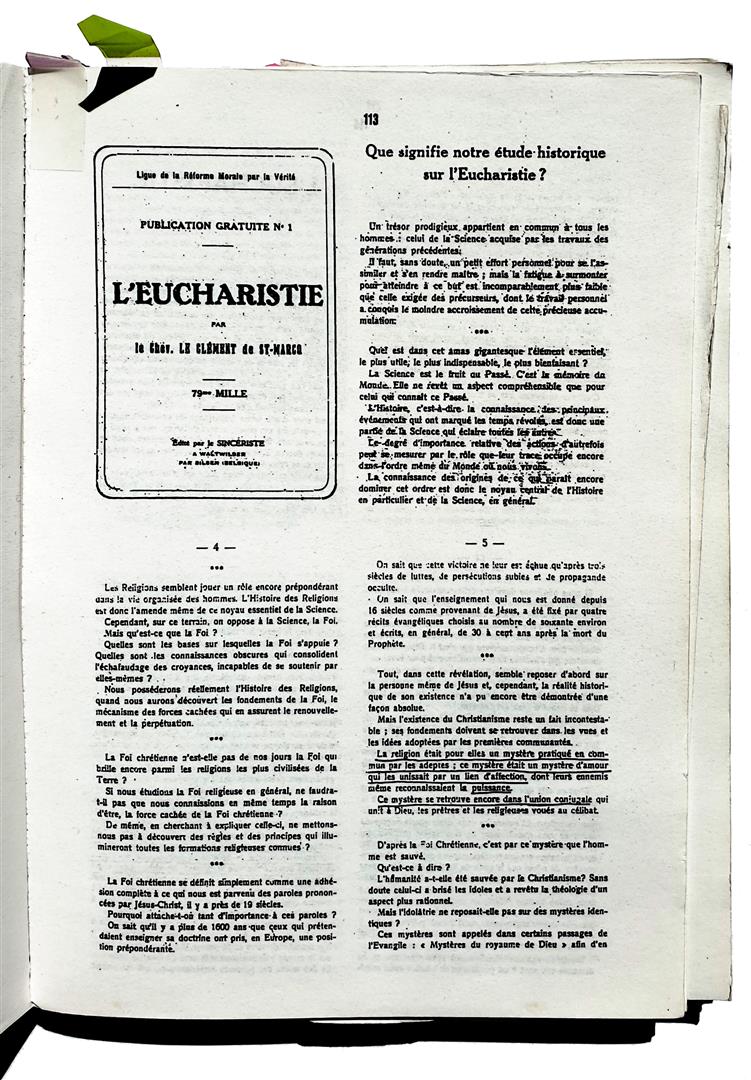
[From 'Der Grosse Theodor Reuss Reader'] |
|
A prodigious treasure is in the common possession of all men: that of
the knowledge acquired by the efforts of the preceding generations.
No doubt it requires a small personal effort to assimilate this and master it, but the fatigue to be surmounted in attaining this goal is incomparably more feeble than that demanded of our precursors, whose personal travails have conquered each tiny increment of this precious accumulation of knowledge. What in this gigantic gathering is the essential element, the most useful, the most indispensable, the most beneficial? ... Science is the fruit of the past. It is the memory of the world. It does not however reveal a comprehensible aspect of itself other than to those who know this past. History, which is to say comprehension of the principle events which have marked the times passed by, is therefore the part of knowledge which enlightens all others. The degree of importance here attached to the actions of yesteryear, can be measured by the unique role that their influence occupies, even now, in the order of the world in which we live. The knowledge of the origins of that which still appears to dominate this world order is therefore the central core of history in particular, and science in general. Religions seem to play a preponderant role in the organised life of man. The history of religions is itself therefore the key amendment of this central core of science. However in this arena we oppose science to faith ... But what is faith? What are the bases upon which faith applies itself? What are the obscure items of knowledge that consolidate the scaffold of beliefs, incapable of supporting themselves? We truly posses the history of religions when we have discovered the fundaments of faith, the mechanism of hidden forces which assure its renewal and perpetuation. Also is it not the Christian faith that in our time still shines forth amid the most civilised religions of this earth? If we study religious faith in general, must we not at the same time learn the hidden force behind the Christian faith. Similarly, in seeking to explain this, do we not engage ourselves in the discovery of the rules and principles which illuminate all known religious formations? The Christian faith defines itself simply as a complete adhesion to that which has come to us as the words pronounced by Jesus Christ almost nineteen centuries ago. Why is such importance attached to these words? We know that over 1600 years ago those who prepond to teach us his doctrine took a predominant position in Europe. We know that this victory came to them after three centuries of battle, suffering persecutions, and occult propaganda. We know that the teachings that have been presented to us for sixteen centuries as originating from Jesus, were fixed by four evangelists chosen from around sixty, and written, in general thirty to one hundred years after the death of the Prophet. Everything in this revelation, seems to rest predominantly upon the person of Jesus himself, and, yet, the historical reality of his existence has never been able to be demonstrated in an absolute manner. But the existence of Christianity is based on an incontestable fact; its foundations can be found in the views and ideas adopted by its first communities. The religion was for them a mystery practiced in common by the adepts; this mystery was a mystery of love which united them by a bond of affection, the power of which bond was recognised even by their enemies. This mystery is still to be found in the conjugal union which unites the priests and religious members vowed to celibacy with God. According to the Christian faith, it is by this mystery that man is saved. What does this mean? Is humanity saved by Christianity? Without doubt it was this that broke the idols and has redressed theology in a more rational aspect. But do not these same mysteries reside in idolatry? In certain passages of the Gospels these mysteries are called, "The Mysteries of the Kingdom of God", to remind the faithful of the worldly glories, but in other verses, the power of their adepts is qualified by the Father of Lies, and thereby is taught the funestre character of the hypocritical domination founded by them. The blinded believer supposes that it assures the salvation of his personal soul, but the enlightened Christian understands that Christianity was no more than a historical instrument destined to reform the world, overwhelming the traditional hierarchies. For more than a century the brilliance and the grandeur of the church has declined. This duplicity within the mysteries seems to have terminated its role. It remains to study the scientific aspects, the possible relations with the beyond, the spiritual properties of the human body and its various effluvia, and it is in this arena that the reader of our brochure concerning the Eucharist finds himself. The mystic union with Christ demands research into its supreme intentions, but these are expressly forbidden by the Gospel, as abutting on the reign of truth. For those who wish to regenerate themselves, one single avenue remains open, that of sincerity. IThe development of the Christian religion has played a role of exceptional importance in the history of the world in the last fifteen centuries; human thinking has been strongly influenced by the imprint of this faith. It is not difficult to discern in the principle aspirants, which battle at this moment in the spirit of terrestrial humanity to fix its future, on the one hand those sacerdotal pretensions attached to the past and to all forms of the dominating spirit, and on the other hand the renewing and revolutionary breath of the Gospel. One could say that the most powerful tendencies which are at play in the political world are nothing but manifestations opposed to the thinking of Christ. It is therefore of high importance to know exactly what this teaching of Jesus was, that has shaken the world with such a force, that even now, after two thousand years, we are still struck by violent ripples in the spirit of man. To realize this objective we are forced to examine with the greatest care that which is affirmed by those professing both to guard the secrets of the prophet of Nazareth, and to spread them around in the world. If we penetrate into a church consecrated to this cult, then at the moment of the divine sacrifice we see the officiator give the supreme honour to a white corpuscle, of circular form, formed of dough and dried, which replaces the sacrificial victim offered to the idols of paganism and carries for this purpose the name of "host". It is as if it is the very God of the temple himself who immolates Himself thus before all, and for all. The whole of the cult resides in the divinity of the host, the reward whereof to the faithful, purified by penitence, forms the pivot of the essential sacrament of the Eucharist, in which according to the faith, God gives Himself to those who adore Him. The host is not an image, nor symbol of divinity, according to the catholic faith, it is divinity itself, at the same time materially and spiritually present in the person of Jesus Christ, whose conscience and sensibility are entirely present and alive in the smallest particle of a consecrated host. It is in this that the affirmation resides which amongst all of those which are the foundation of the catholic religion, is both the most necessary to the existence of its cult, and the most inadmissible to reason. If then one also tells us that the thoughts of Christ, being the creator of the religious movement which bears His name, is present in the symbol of the host, the invention of which is a consequence of the teaching He pronounced, in the same way as the genius of an artist is present in the work which he has conceived and manifested, the thesis thus reduced has nothing reasonable or evident in itself; but no mindful man can admit that the personality of Christ can be simultaneously eternally present in each host, that He can be there, see there, hear there, find Himself there as profoundly real, as if He had been there living in His own body. If one attentively examines this situation, one asks oneself how it is possible that such a considerable number of priests have been able to affirm and sustain such an enormity for more than fifteen centuries; how immense masses of believers have let themselves be indoctrinated in this way, without ever universal common sense revolting and rejecting from the start theories so distant from sane reason. No one could conceive of such a collective aberration, if one did not discern that apart from what was said, there was that which was not said; that as well as what is exposed with a loud voice in the catechism, there are hidden explanations which circulate from cassock to cassock and in whispers to the ears of ecstatic devotees. If we penetrate into this mysterious domain, we discover a secret cult entirely parallel to the public cult. The second is only the external glorification of the first. It is a lie. But it envelopes and covers the first, which by its nature, does not seem to be able to be exposed to the eyes of the masses. He who is initiated into these mysteries understands how the preceding generations were brought to erect this edifice of lies in the bosom of which one is called to live, and finding himself with the same demands, will continue to defend, to spread, and to protect against counter-truths, that which to him appears as the necessary vehicle of the highest, most holy, most pure, most respectable tradition. Exactly this secret teaching, this occult doctrine, transmitted mouth to mouth in the bosom of the church since the time of the Apostles, is what this opuscle has as its objective to expose. To raise for the reader the discrete veil woven for centuries to cover these mysteries, we seek to bring to those who are ignorant of it, the true Christian tradition, for them to know it, and to understand it completely. They will have thereby a notion which is more exact, more conforming to the truth which touched the existence of the priests, their way of living and thinking, their real influences in the world; they will penetrate the sense of all the writings coming from the hands of ecclesiastic thinkers who have occupied a great place in the literature of all times, and of whom many, such as Fenelon and Bossuet, are still taken as models by our studious young. We also permit, by this revelation, the readers to better comprehend the historical reality, to find in the past the powerful and known effects of the ideas which have developed behind the exterior manifestations of the cult, and to discover that even today they are surrounded by the same customs, the same mysterious conspiracies of the woman and priests who were unifying their aspirations of lust and domination in one and the same ideal! For those who already know the mysteries that we will unveil, our present work will none the less be useful; they will find the opportunity to reflect on its truth and upon themselves, denuded of all trappings of the cult; they can ask themselves if it is not better to leave the old lies which surround the doctrine of their master, or whether that which Christ gave to the ears of His disciples should not be said purely and simply, without reservation or false shame, before the whole world, in order that th ere can be truth, goodness, and justice in this tradition which has become the common patrimony of humanity, and cease to be the privilege of an association of so called elect, who, as long as they live in idleness on that which they extract from the workers, can not also claim to be the true moral guide of the world. IILet us approach the principal subject which occupies us and open the Gospel of Saint John, chapter 6 verse 47 and following. Here we have the teachings upon which the Eucharist is founded. 47 In truth, in truth I say to you, those who believe in me have eternal life.Let us pose then this question: How does a man give of his flesh to eat and of his blood to drink without cutting himself or rending his limbs, without injuring himself, without damaging the integrity of his body? This problem brings a solution and brings only one solution. We have no choice. We are obliged to take that which science furnishes us with: the procreative semen is a comestible material, semi-solid, semi-liquid, which therefore can be eaten or drunk; it is at once the flesh and the blood of the man who provides it, because in it is found the germ of his possible descendance, which is the flesh of his flesh and the fruit of his blood. It is therefore under the auspices of sperm that the flesh of Jesus Christ was able truly to be a nourishment and his blood a beverage. We have seen that, according to the teachings of the Messiah, it is absolutely necessary to eat His flesh and drink His blood to achieve eternal life. Submitting to this injunction, certain faithful therefore approached their master and received from Him a portion of the sacred substance which immortalised them. But after them, once the master had departed, how could He continue His celestial generosity? Who could still invite the poor humans to the royal feast of God? The following verse responds to us on this point: 56 He who eats of my flesh and drinks of my blood lives in me and I in him.There is the basis of the indefinite extension of the person of Jesus; His universal presence amongst all the members of His church. Each one of those who took part in the holy communion, of the flesh and the blood, becoming by that action a new body of Christ, a prolongation of the personality of the Master; everyone of them in their turn is a sacred source to whom other faithful could come to draw forth the explanations given by the mouth of the Savior, and the living waters of spiritual regeneration in the substance which propagates His divinity. From transmission to transmission, it is always the same act repeated with the same words, and the same effects, which still brings to life among us, in thousands of different places, the figure of the founder of Christianity. The same promise of eternal life is found implicitly guaranteed in the thesis of verse 56. The faithful knows, by the particle of Christ, so intimately united with Him, that they are but one: and yet the tradition tells him that his master has traversed victoriously the trials of death, that living, He left the tomb and showed Himself by various miracles to those who had believed in Him: like the Master, he believes himself therefore assured of revival beyond trespass, and despite whatever he has done, whatever crime he has committed, he counts on an eternal future of beatitude. Is it not the Christ, according to his faith, who shall come to judge the living and the dead; and yet one can not be both judge and judged at once, and he, faithful Christian, is Christ Himself by the mystery of the holy communion, and will be therefore, in this formidable moment, upon the divine throne and not on the bench of the accused. Thus we see that this act, so simple in appearance, suffices to explain the enormous extension of Christianity and the most visible manifestations of its cult. IIIThis practice was not new. Jesus was not its inventor. It would not have been able to have such a profound effect on the spirits of those to whom it was revealed, if it did not have other live roots in the mysteries of theology. Probe into the Scriptures, says Christ, because it is via them that you will believe you have eternal life, and it is these that testify to me. (St John v39) And truly, if we probe the scriptures, that is to say, if we seek to realise the sense hidden under the allegories of the Old Testament, we see every page teeming with allusions to the sacred spermatophagia, the traditional mystery of the sacerdotal caste, the hidden mark of the divine ministry and of the superior intelligence of the priests. If we cite here but a few, leaving the reader the care to edify himself by his own proper researches for the rest ... The first image, known by all, and moreover recalled in the verses cites above, is found in the manna in the desert, the special food given miraculously by God to his beloved people. In the scriptures the desert frequently represents the solitude into which the priest must withdraw himself to excersize his supreme devotion, and gather in the divine substance. A second, more developed allegorical figure is offered by the sacrifice of Abraham, who consented to give up his son to satisfy the divine Will; in reality God does not demand of him the perfect accomplishment of this holocaust, it suffices that he makes the gesture to comply, and that is exactly what the priest does in offering to the most respected divinity, that which could have become his son if time and circumstances were different. Finally, we indicate the tree of life, of paradise on earth, in Genesis. The fruit of the tree of life is forbidden to man; if they eat of it they become alike to the Gods, that is to say, alike to the priests who know good and evil. These images and their explanations become very clear when one knows the practices and customs to which they allude. But the texts of the Old Testament themselves were inspired by previous religious traditions, which flowered in the Hindoustan peninsula, and which have left traces to be found easily under the guise of a sacred literature whereof several monuments are available to us, having recently been translated into the French language. We take as our guide the "Song of the Joyous" or Bhagavad-Gita, translated from the Sanskrit by Emile Burnouf, and here we find in a more explicit language, the same traditional practice of the sacred spermatophagia, glorified as being the sole method of seizing God, to unite with him, to live in a saintly perfection. God is the universal soul. II.17. Know this, he is indestructible, he who has developed this Universe; nothing can accomplish the destruction of the imperishable.The supreme joy resides in the union with God. VI. 27. The supreme pleasure penetrates into the soul of the Yogi; his passions are appeased; he has become an essence of God himself; he is without spot.This union with God is achieved by an act. V.5. The retreat attained by rational meditations, is also attained by the acts of mystical union, and he who sees but one thing in these two methods sees well.The priest must deliver himself in solitude. VI.10. Let the Yogi always exercise his devotion alone, apart, without company, master of his thoughts, unassuaged of hope.To find God, let him address himself to his masculine force, to his reproductive might. VII.8. "I am", so speaketh the God, "the masculine force in the man."Let him find the principle of immortality in his own seed. VIII.10. "Know ye", saith the God, "that I am the inexhaustible seed in all that lives."The act with which the priest unites himself with God constitutes the supreme sacrifice. IV.27. Some, inside the mystical fire of the countenance illuminated by science, offer all the functions of sense and of life.But the remnants of the sacrifice are to be eaten. IV.31. But those who consume the remnants of the sacrifice, they shall have immortality, ascending to the eternal God.In this act, the priest is beyond sin. V.7. Devoted to this practice, the soul purified, victorious over himself and his senses, living the life of all those that live, he is not soiled by his works.The most precious teachings of the tradition reside in the comprehension of these things. XVIII.63. I have exposed to you the science in these most secret mysteries. Examine this in its entirety and then act, according to thy will.How many millions of priests haven't there been, following the word of joy, believing always to unite with an invisible God, and consecrating all of their lives to a strange superstition which still appears, soaring above our contemporary societies like the senseless dream of a sick imagination, and yet at the same time as a solid institution which seems to defy the centuries. And it is not only in the sacred books where we find the traces of their bizarre and occult customs: if we interrogate the monuments raised by the diverse religions of India and Egypt, we can find there allusions evidencing these theophagic practices. The ithyphallic idols of Egypt themselves explain the ideas and customs of the priests; it is the same in the cult of the Lingam so universal in India. Jerome Baker cites to us a temple in High Egypt, dating to the Pharaohs, where, he noted, in the midst of divers ornaments on the decorative murals, a figure of Osiris, traced in profile, and on which the artist has figured a symbolic arc departing from the sources of generation to arrive at the mouth, and indicating thereby the ritual trajectory of the sacred seed. The same explorer, finding himself in Cairo towards the summer months, when the city is usually abandoned by foreigners, had occasion to assist in the exhuming of a procession in honour of Osiris, for whom the fellahs still hold this annual homage; the image of God carried that which the poets who speak of these mysteries have become accustomed to calling "the august gesture of the Sower"; during the course of this religious manifestation executed in the public street, this was achieved by means of a special mechanism activated by a porter concealed in the plinth. It is not, by the way, uniquely in the regions from which we have just quoted, that the traces of this theological usage are susceptible to gather; there is not one country in the world, not one race having had any tint of religious civilization, that has not known these mysteries, and where the habitual communion between the priests and the gods has not been consummated according to this rite, so carefully hidden from the profane. The triades of druids made numerous allusions to it. All the different religions of China and other countries of the Far-East have no other basis. When the conquerors of Mexico planted the Cross of Christ on the American soil, copiously sprinkled with the blood of the unfortunate indigenes, they found flourishing in the land a magnificent cult, with grandiose temples in the interior of which were celebrated mysteries of which the essential font resides in the same universal practices. Recently also, on the island of Madagascar, a new religion is flourishing among the Magaches and is spreading with the rapidity of an explosion; the centre of this new cult was always the secret union between the solitary priest and the all powerful divine, by the ministry of a mystical marriage between man and the infinite. The Negro fetishists teach no other thing to their young communicants, and to remind them of the importance of the new nutrition given to their body and their spirit at the beginning of their initiation, they are entirely coated with a white colour during the first year of their novitiate. This universal belief in the possibility of establishing a bond between man and God by spermatophagia is therefore anything but a local superstition, and he who knows and who perceives clearly the historical reality in this matter finds himself reduced to the inability to admit, to explain the situation of the world, except in a number of strongly reduced hypotheses: either there is a collective mental illness whereof the contagion has contaminated all the races of the world, or there is in the fundament of these practices a serious element, founded in the nature of things, that can be brought to light in a definitive and irrefutable manner. If one seeks the explanation of these facts by ascending to their origins, which is the sole method conforming to reason, one can ascertain that even before the birth of any organised religion, there appeared in all the countries of the world solitaries who lived apart, without carnal contact with the other sex. These men delivered themselves to meditation, and seemed in rapport, according to their views, with an other spiritual population of this world, whom our senses do not perceive, but whose existence seems to be proved by spiritual phenomena which are researched more and more these days. The special method applied by these isolated ones in their carnal lives, was its nature not to facilitate the rapports between men and these invisible entities? If an affirmative response could be given to this question and be valuably demonstrated, the natural history of religions would be considerably clarified. IVWe cannot linger over these considerations; we have but exposed them to allow the reader to comprehend the impact of the words of Christ and upon which bases his teachings are founded. From the beginning, this doctrine took the most diverse aspects according to the nature of the intelligences in which it germinated and grew; among the Christians of the first hour there were a great number of illiterates, for whom the considerations heard in the religious histories and their desirable evolution had to remain dead letters; for those, the new theology had to be summarised into a simple and strong thesis, following as closely as possible the predications that the church demanded of them. It was in this milieu of the confident and zealous worker, deprived of profound science, that the conception was formed that summarised the entire teaching of Christ into the requirement to love. To put this demand into practice, to realise this on earth, this heavenly Jerusalem where everyone lives animated by a sentiment of unlimited adoration for his fellow creatures, the premier method to follow, the straightest way, the shortest, consisted according to them in action, that is to say, in intimate embraces mixing all the faithful without distinction of age, nor sex, nor fortune nor beauty. That is the fundamental principle of the first communities of Christians, of their meetings that occurred every night at first, then dissolving to once every week, and which took, for reasons of their own object, the name Agape, from the Greek agapo, "I love." None of those who participated in these transports of the mystic faith, sensed and lived even in the very flesh, conceived of the slightest remorse, nothing came to trouble the calm of their conscience. The universal example of the whole of the com munity, where such virtues and religious zeal shone, and where the excellence of their true intentions turned exclusively towards the universal wellbeing of humanity and the hope of the celestial kingdom, sheltered them from any doubt, and exiled far from their thoughts the possibility of seeing a base side to their ritual actions, anything gross or reprehensible. But if it was thus for profound masses of Christianity, very different indeed must have been the attitude of the apostles, playing at the same t ime the role both of pastor to the troop of the faithful, as well as defender of the faith against other cultures, other religions, to whom Christianity would soon show itself the implacable adversary. The rapid evolution which changed attitudes to paganism from a more or less benign indifference to a declared hostility in the consideration of the new cult, finds itself marked in certain striking traits in relation to the actions of the apostles. In the beginning discourses exalting the ideas which slumbered in the fundament of the pagan mysteries were the subject of passionate enthusiasm on the part of their populations: XIV. 11. And the people, having seen what Paul had done, cried and spoke in the lycean language: "the gods have descended to us in a human form."But soon those who had any claim to an interest relating to the conservation and development of the ancient superstitions, sensed that there was in the new ideas a powerful breath which would shatter the ancient idols and change the world to a higher conscience. Each time what stirred them most vividly was to see the habitual benefits to which their existence was attached being menaced at the source; therefor they developed on their part a desperate opposition to the progress of the church. This special aspect in the beginning of Christianity is clearly brought to light in the following passage. XIX. 24. For a goldsmith named Demetrius, who made little gold temples of Diana and who earned much respect from the workers in his profession.This incident must have multiplied itself in a thousand different forms in all the locations where Christianity was preached, and so a war of interests, a war merciless and passionate, was fatally declared between the pre-existing religion and the proselytism of the faith which had just been born. This war, all in words and discourse to start, brought the apostles to reply as they could to the attacks of which they found themselves the target; strong in the knowledge of the hidden customs of the pagan priests they sought there a weapon against their adversaries, and Paul thus found himself brought to publicly decry these practices, to attract to them the despite of the masses, to represent them as an aberration of humanity, and a malediction of the divine justice. Thus we see him say, in his epistle to the Romans, speaking of the priesthood of the idols: I.25. This is why God has delivered them to infamous passions, for the women among them have perverted the natural practices to something other, which is against nature.But after having spoken a language so gross and so insulting regarding those who had committed no crime but that of whosoever gives Agape to eachother, how would the apostle still dare to present himself to those Christians of whom he had made himself chief, and what language would he speak to them? Ah, skillfulness in discourse did not desert him, and nothing was easier for him that to show two faces, the one of the hunter, the other pacifist, like the double mask of the god Janus; it was in the very words of Christ that he found the basis of his moral duplicity; the true Christian is united with Christ and by consequence benefits from the same liberation; not matter what he does, sin no longer acts upon him, he is covered by grace and moreover, the more he sins, the more he commits that which is a sin for another, the more he abounds in the grace of the innocent; in this way the apostle exhorts the faithful to offer their bodies as a living sacrifice, saintly and pleasing to God, which is their reasonable service. (Rom. XII, v1) Thus establishes itself the theological theory of sanctified grace, which erases all sins, and thus apparently benefits all those who have communion with the true Eucharist. VIn examining closely the historical situation which we have exposed, the reader understands how the Christian community, all the while believing themselves not to be sinning in the actions commanded by Jesus, none the less had to affirm that these actions were immoral and carefully hide their existence from the eyes of the outside world. Yet as the number of Christian communities was growing, a thousand reasons, made it difficult, if not impossible to conserve this secret. Amongst the innumerable neophytes of the Gospel, there were without doubt those, attracted above all by curiosity, who did not find in the Christian mysteries a satisfactory solution to the problems which tormented them. Fatigued by acts which their bodies no longer associated with anything but repugnance, without hope of seeing that complete illumination that certain believers spoke of, flowering within themselves, they left the communities and renounced their participation. Wanting to save others from the disillusions to which they had been exposed, they did not hesitate to tell their friends of what nature the ceremonies were, to which they had submitted. On the other hand, certain propagandists of Christianity uncovered these truths too early during the process of their conversations with strangers whom they would draw into their faith; for these reasons and others as well, such as the imprudent or easy words that the faithful, men or women, must have let escape in the circumstances, it soon happened that the Roman world was full of the noise of the strange things happening in the Christian mysteries, and this situation, which made the apostles mission diff icult and painful, often drew them to address remonstrations to their flock. In First Corinthians, saint Paul wrote: V.1. One hears speak in all parts that there is imprudence amongst you, and such an imprudence, that even amongst gentiles, one hears speak of nothing alike.The best way to avoid this bad reputation for Christians, resided, according to saint Paul, in a complete and absolute separation between the Christians and the world, and this is why he said to them: V.9. I wrote to you in my letter that you should have no communication with the shameless ones. 10. But not absolutely with the shameless of this world.But despite these objurgations and many others, repeated then by those who found themselves in a similar situation to Paul, the broadcast of the truth remained unremitting and the whole world continued to amuse themselves and scandalise themselves over the scenes of debauch to which the conventicule of the New Religion delivered themselves. In the presence of this continuous noise mounting ceaselessly even unto the depths of the popular masses, the priests of the Church, the ecclesiastical authorities, the successors of the apostles, did not cease to oppose it with the most formal, the most categorical denials: "None of it was true, it was all slanderous, invented from top to bottom without the least serious basis, and on the contrary, all the Christians lived in saintly abstinence!" But the confidence and perseverance in the lie did not suffice to keep ahead of all situations, and it did not take long for this to become evident to the chiefs of the Christian church, who understood that it was time to engage and to recognise at least a part of the truth, if they did not want to see their prestige and their authority crumble into nothing. And so we see certain religious writers recognising that such practices could have existed in certain Christian sects, and that these were disavowed by the great majority and proclaimed heretical. So Theoretet and Prodicus reported that certain sects called the act of Venus, practiced publicly in the temple, an act of mystic communion. Saint Epiphane gives a complete description of the ceremony of the Eucharist, but attributes it exclusively to the Gnostics and takes care to represent it as in aberration abhorred by true Christians; in their assemblies, he said, men and women reciprocally ate the reproductive seed of humans, turning to the altar, and saying (to the All Mighty) "Offerimus tibi donum corpus Christi" "We offer in sacrifice the body of Christ!" But on the one hand, while the scribes in the pay of the church tried to save its reputation by casting upon the heretical sects the bad renoun of the secret cult, on the other hand, the authorities directed this great social movement, forcing the disciplining of the agapes, to reestablish order therein, to render them less attractive to the faithful, so that they had more presence in their spirit of the idea of the sacrifice that they had offered to God. This is how the Concile of Laodicea started by prohibiting the kisses of peace between persons of the opposite sex. The same Concile went further and abolished the custom of laying out beds in the church to make Agape more conveniently. This was not about the beds used by the rich classes of the roman empire as a chair for their meals; in effect the Christians were all workers, in large part slaves, and if these beds were convenient for Agape, it was that one delivered oneself to those acts for which the bed has always been reserved ever since man has used it. But, despite these restrictive measures, the truth continued to be plastered, in all parts across the cracks in the doors that enclosed the Christian temples, and sheltered the mysteries from the curiosity of the profane. The clergy felt itself menaced by the explosion of public sentiment vis-à-vis which it was obliged to battle, having recourse to the violence of continual lies; this situation was intolerable; on the other hand the Church, enriched, supported by a tradition already several times secularised, glorified by the innumerable martyrs and possessing at last the support of imperial authority, felt so strong as to place itself entirely beyond the world and to expel the masses of the faithful from the sanctuary. The Concile of Carthage purely and simply abolished Agape, and replaced these fraternal assemblies by the Mass, that cold and symbolic ceremony, which we still see celebrated in our days in the edifices consecrated to the Christian cult. Ever since that moment, the real Eucharist was no longer accorded to the faithful; it was no longer permitted except to the priests and those who would voluntarily associate themselves with their practices; the body of Jesus Christ was no longer given to the Christian by the minister of the divine love, in the form of the sperm emanating from a saint figuring Christ himself. It is the host, this simple particle of flour, which now fulfilled this role. The mysteries no longer had a reason for being, and as of that day, the doors were thrown open when the mass was celebrated. In the times which followed this decree, the leaders of the various Christian parishes protested against the reform the Concile imposed upon them; they brought from their ordinary people missives complaining that the faithful seemed to take substantially less interest in the cult since it had been given this new form; they reported that the number of assistants had considerably diminished since Agape had yielded to the Mass. But the interests of the Church held sawy. The Concile had spoken; all the world had to conform and the reform remained in force. VIHowever, a seed of death had entered into the Church at the same time as this enormous lie transformed a morsel of bread into an all powerful God. Most of the texts relating to the true Eucharist had to be adapted to the doctrine of the host. It was no longer a part of the body of the priest, and it was therefore not possible to relate it to the body and the blood of Jesus-Christ by passing through the internal filiation of the true transmission. It had to be said that it was the words pronounced by the priest at the altar that had the magical power to transform in essence and in nature the poor host, which from this moment on, acquired substantially and in an invisible way, the virtue of being a particle of the substance of Christ, and this pitiable and clumsy invention was to become the pivot of the conscience of the world!! From the beginning, educated theologians protested against the inadmissible character of these affirmations imposed by the dogma of the Church upon all who those who entered into it to lead the comfortable and easy life of a priest. It was more than eight centuries before the Papacy dared to proclaim the dogma of Transubstantiation, which was voted in 1207 by the Concile of Latran. The Priests who were reunited in this assembly, declared that the Eucharist was the mystery of the love of Jesus-Christ for mankind; to remain among those who love him, to sacrifice himself for them, to unite himself with them, that this was the triple vow of all love. The vow is not completely realisable by Man, who is bounded both in power and longevity. But God, able to realise it, realised it. In one word, to know what love can do in the heart of God, one only has to think of what it can do in the heart of man, and add Infinity. But these solemn declarations did not impede each individual priest to recognise in himself, in a manner most startling, the falseness of what he been obligated to affirm daily. Several, taken by their conscience, tried hard to find a way to approach religious education of the true Christian tradition. It was from this school of thought, grown to the point of making itself heard to entire nations, that the Reformation appeared. It is in the subject of the Eucharist that for the most part religious innovators have introduced modifications to the doctrines taught by the catholic Church; Luther affirmed that the host is communicated as the body of Christ, and with the body, but that it is not that body; that it is communicated as the body because the priest gives the host to the faithful, just as he himself received the divine sperm of his ascendance in the mystical filiation; that it is communicated with the body because the priest who presents the host would not be able to act in this way, but that he had received a true part of Christ before being called to officially fulfill his sacerdotal functions; but that the host is not the body. This has no need of explanation. One sees that these theses follow very closely the hidden reality, distancing themselves from it in no way; but they do after all leave the faithful in an inferior situation to that of the catholic Church, in the sense that he does not have the advantage of the reality of communion, and he is relieved of the theophagic illusion. Zwingly restricted himself to say that the Last Supper is a symbol; which is true as much for the spermatic communion of the priest, as for the purely illusory one of the faithful. But if this affirmation is sincere, it is of little importance, and diminished considerably the importance of these acts. Calvin taught that the celestial body of Jesus acts in the Eucharist in a miraculous manner upon the souls of the believers. This formula conserves for the consumption of the seed, all of the prestige given to it by the catholic Church, and yet the affirmation of Calvin is much closer to the truth, as one can realise when one possesses the exact definition of the terms he employs. We have seen that in accordance with the text of the Gospel, (John VI, v56) he who eats of the flesh of Christ, and drinks his blood, incorporates Christ and is incorporated in Him. By this union, he becomes a part of the body of the Saviour of whom the form visible in the world comprehends therefore all those who have taken part in this carnal communion, the fundamental sacrament of the Church, that is to say the entire sacerdotal body; just as, on this earth, the priest is the sole representative of Heave n, the body of Christ thus formed by the ensemble of priests could be called by Calvin, the celestial body of Jesus. In the exoteric Eucharist, this body acts upon the soul of the believer in a miraculous manner, by making the faithful believe that the divinity is present in a material object, by the simple power of the affirmation, and in the esoteric Eucharist, by revealing to the communicant the mysteries of his personal assimilation with the Divine. One sees in which way, by which alembic evasions the protestant theologians have sought to correct, by way of an apparent sincerity, but not deprived of hypocrisy, the crude and fundamental lie of the catholic faith; one equally sees that they wanted, in a certain measure, to avoid the reproach of consciously saying the opposite of what is the case, and yet there remained in a thousand places, the startling frankness which consisted of affirming the truth, such as it was known to them, in a language as clear and simple as possible. Also, the movement of the Reformation perforce had to split and subdivide itself unto an infinity in an unlimited number of formulae of which not one could be definitive. VIILet us return to the present Úpoque; let us consider the priest with whom we rub shoulders daily on our streets and pavements, the neighbourhood convent whose doors we pass daily. What happens there? What do these religious people believe? What do they do with regard to the Eucharist and its mysteries that we have been occupying ourselves with? The work of the secret transmission of the person of Jesus always continues; it is always the centre of life, the predominant preoccupation. If we want to reassure ourselves of this, it suffices to cast an eye over the specialist literature that these gentlemen revise and in which they embroider upon this theme, attaching infinite variations. The space at my disposal here does not permit me to give to the reader a long series of examples of these special works; but it is easy to procure these books for oneself and to find there, under the flowerings of a conventional rhetoric, the precise facts which have been exposed in the preceding pages. Sometimes the language of the tonsured author takes on an undiscussable and amazing sharpness. Let us open "The World of the Eucharist", published by Monsieur the abbot Bion, with Victor Palmé, Paris, 1873. This work, perfectly orthodox, received the approbation of the public, conceived in flattering terms by Mr Augustin, Bishop of Nevers, and dated in Châtillion-en-Bazois, 10 Octobre 1872. This is what we read there, p.191: It is by the manducation of the fruit of the tree of life, that the Holy Spirit must come upon us. It makes us full of life, this wine which germinated the virgins.I think it is needless to say that one does not extend the belief in the transubstantiation very far by trying to germinate a virgin by means of some fragments of the host! It is very much a different substance, that which we have spoken of above, which monsignor the abbot targets with his words. Other works are no less probing, for example, the study of pakhomian cenobitism written by the Abbot of Ladeuze, currently the rector of the catholic university of Louvain, with the intent of refuting recent assertions by the learned French egyptologist, Mr Amelineau, who brought to light Coptic manuscripts depicting the customs of the monks of Thebaide under an aspect far removed from the notion that one generally makes of them, as being careful to guard their reputation of saintliness. We find, at the end of the work of Mr Ladeuze, a series of theses in Latin, with regard to the mysteries of the religion and where there is a notable affirmation (LIV) that the human generation is contaminated by the fact that it casts off as guilty the nature of the seed of Adam. As for the sincerity of the author who fights the conclusions of Mr Amelineau, we does not wish to cast doubt upon it, especially as he says: (LXI): "That the lie which defines the affirmation of a thing judged to be internally false, is an evil external and essential, it must be said that it can never be permitted, even to avoid greater worldly evils."We now know what the real mentality is of our priests and we have to understand that they draw from these ideas a great intellectual and moral force; an intellectual force resulting from their knowledge of an important historical truth which has played an enormous role in the events of the past, which still represents an enormous power in the present world; and they know that those who posses this truth which they know, are not numerous, that this science is therefore a prestigious privilege which gives them a real superiority, a considerable ascendancy over the rest of humanity. They also draw therefrom a great moral strength, as we have said, this results from the thought that, without a shadow of possible doubt, there exists between each of them and the martyr of Calvary a powerful bond — a direct bond — an intimate bond, by the very will of he whom a great number of people consider as their Saviour. The reader will also find, in the ideas that we have exposed, the explanation of the immense, invincible influence that the priest has on the spirit of the great generality of women. The rationalist who attempts to turn a catholic woman from the superstition in which she is embroiled, abuts on a polished indifference which no argument can reach; the conscience of this woman is entirely subjugated by the ideas which have been developed by her confessor; she is entirely overwhelmed by this mystical love to which she gives all her thought, all her intentions, and which makes up all the charm, all the poetry, all the grandeur of her life. It is good to know these things, since it is better to walk through the world with open eyes than with covered ones; yet the few pages which the reader has traversed cannot be for him but the beginning of more serious and more profound studies into this subject, which is perhaps the most important in History and contemporary Politics. He must first arrive at a personal certainty regarding these notions, and here, our experience proves that it is sufficient to touch upon these problems to see the proofs surge forth of their own accord. Every time we have spoken of it, we have received new information from those to whom we have addressed ourselves, and again recently, having exposed these theories in a rather large assembly, one of our audience joined us after the session, and told us: "Yes, everything that you have explained this evening is perfectly true, and I know this with scientific certainty, having been raised in a village and having in my youth been a part of a congregation (De broeders zonder zonden - The brothers without sins) where all this is currently practiced." Translated by Susanne Williams, Rose A Starr and Joe Collins, 1998. Re-print in O.T.O. Rituals and Sexmagick. Visit the Gallery for more photos. More about Clément de Saint-Marcq.
|
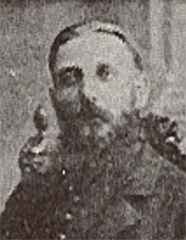
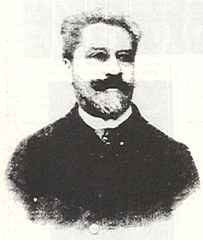
Main page about the Gnostic Churches
More about all this in: Andreas Huettl and Peter-R. Koenig: Satan — Jünger, Jäger und Justiz
O.T.O. Phenomenon navigation page | main page | Aura of the O.T.O. Phenomenon | mail
What's New on the O.T.O. Phenomenon site?