The Great Beast without its Master?
Andreas Huettl
Lawyer
In November 2007 a court trial ended with a settlement which left all questions regarding the copyrights to Aleister Crowley’s works unanswered.
The litigants before the District Court in Berlin were the Ordo Templi Orientis under the leadership of William Breeze, based in Artois, California, and the former owner of the “Phänomen Verlag” in Germany.
From 1995 to 2003 the editing house had published books of Aleister Crowley’s translated into German. In September 2003 they received a letter from the German lawyer of the Californian O.T.O demanding to refrain from further publication of books of Aleister Crowley’s.
Therein it was stated that the O.T.O was the owner of the copyrights to Crowley’s works and that therefore the publications of the “Phänomen Verlag” were illegal.
The letter contained a copy of the judgment of an English Court containing the following statement:
"The claimant is entitled to the absolute title in the copyrights (so far as subsisting) in all of the literary works written by Aleister Crowley."
Based upon that judgment the O.T.O. demanded that “Phänomen Verlag” sign a declaration of forbearance including the obligation to refrain from any further publication of Crowley's works. Attached to the lawyer's letter was a prefabricated declaration of forbearance, containing a passage stating that the signatory accepts the O.T.O.'s claim for damage compensation due to copyright infringement.
"I hope the O.T.O. is honest and we achieve an amicable settlement”
At that time the owner of the “Phänomen Verlag” was not represented by a lawyer and committed herself not to publish any more of Crowley’s works in the future. However, in respect to the claim of damage compensation also included in the declaration of forbearance she wrote to the O.T.O.'s lawyer: "I consider the claim for damage as a set phrase and therefore as meaningless."
"I will apply for the defendant to be sentenced to pay € 13.498,81 […] to the claimant"
The O.T.O. disagreed in regard to the liability for damages and submitted the matter to a court in Berlin at the beginning of 2005. The O.T.O. sued for payment of € 13.498,91 calculating this amount as a "reasonable royalty" of 10% of the total sales revenues of Crowley’s works published by the “Phänomen Verlag” from 1995 to 2003.
Book sales 1995–2003
| Title | 1995 | 1996 | 1997 | 1998 | 1999 | 2000 | 2001 | 2002 | 2003 |
|---|---|---|---|---|---|---|---|---|---|
| Buch des Gesetzes | 5 | 4 | 8 | 89 | 532 | 468 | 580 | 235 | |
| Magick in Theorie u Praxis | 22 | 41 | 1 | 0 | 257 | 383 | 300 | 275 | |
| Buch 4 | 1 | 2 | 6 | 0 | 125 | 163 | 234 | 153 | |
| Gesetz der Freiheit | 8 | 5 | 6 | 0 | 358 | -60 | 253 | 155 | |
| Wiederaufleben der Magie | 7 | 39 | 26 | 28 | 162 | 41 | 121 | 48 | |
| Bemerkungen zu Genesis | 21 | 3 | 16 | 27 | 151 | 41 | 95 | 68 | |
| Blue Equinox | 0 | 2 | 8 | 0 | 54 | 36 | 77 | 526 | |
| Tao The King | 2 | 3 | 4 | 0 | 30 | 18 | 86 | 54 | |
| I Ching | 25 | 15 | 3 | 27 | 170 | 26 | 125 | 94 | |
| Atlantis | 10 | 66 | 32 | 50 | 120 | 84 | 120 | 5 | |
| Liber Legis | 1 | 2 | |||||||
| Moonchild | 2 | 2 | 3 | 0 | 272 | 88 | 195 | 45 | |
| Equinox I,1 | 1 | 9 | 4 | ||||||
| Equinox I,2 | 2 | 5 | 3 | ||||||
| Liber XXI | 1 | 5 | 1 | ||||||
| Liber 777 | 0 | 0 | 120 | 334 | 345 |
"The factual issue and the legal situation were discussed."
To her defense the defendant had essentially explicate that the O.T.O. as the plaintiff had neither submitted nor presented proof of being the holder of copyrights to Crowley’s works and maintained that it was the O.T.O. who had to bring forth and prove with appropriate documents that and in what manner the rights to the works of Crowley had been acquired; that it was furthermore to be denied that the California-based O.T.O. was identical with Aleister Crowley’s former O.T.O.; that it was to be denied that the presented judgment of the English Court – moreover not available in translation into German - was of any effect in Germany or against the defendant. In addition, it was stated, that said ruling contained the restriction "copyrights so far as subsisting ", meaning "insofar as they exist at all".
A number of other procedural and substantive issues related to international copyright questions were raised. The defense stated, that after all a big part of the O.T.O.'s claims had lapsed even if they had originally existed.
"In the light of this confession statement no further explanations are required"
The O.T.O. saw no reason to specify the acquisition of the rights to Crowley’s works, as the defendant had signed the statement of forbearance including the indemnity clause. They claimed that this confession statement was so clear that no further explanation for the acquisition of the Crowley-Copyrights was needed. The argument of the defendant was said to be "circuitous", "flimsy" and furnished with "absurd legal justifications". This they stated, because the O.T.O. based its claim in the proceedings before the District Court in Berlin not on the English Court’s judgment but with priority on the defendant's signed statement of liability to pay compensation.
"The succession of rights is not sufficiently explained"
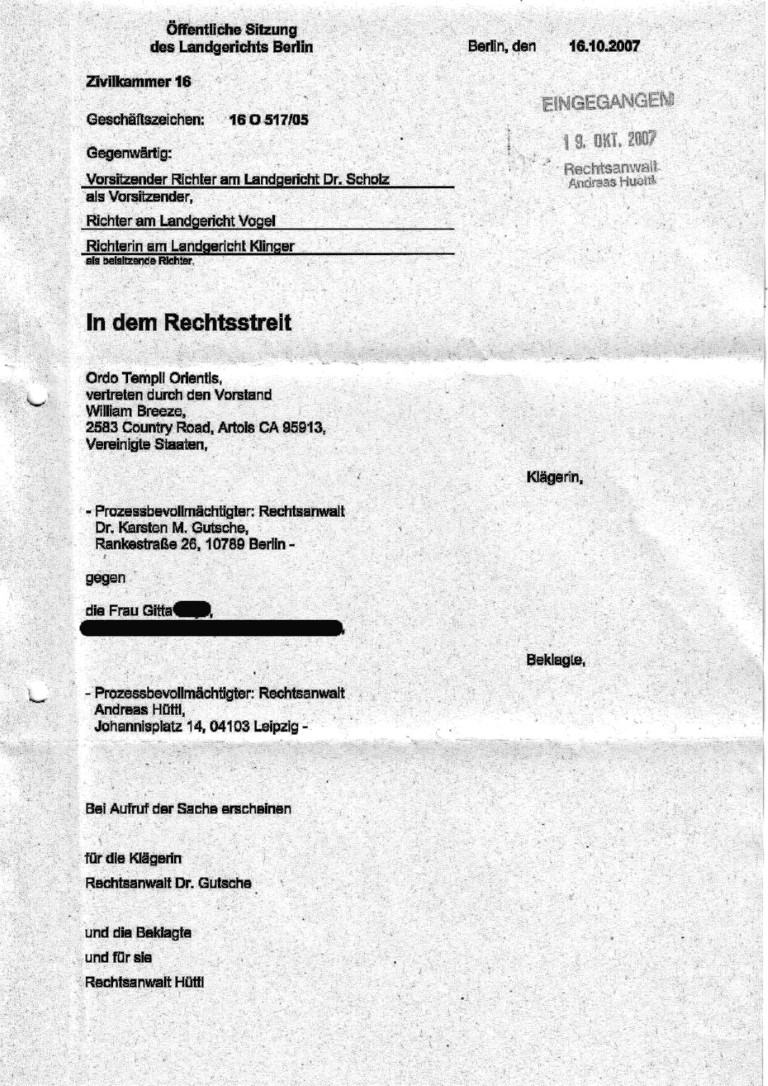
The hearing took place on 16.10.2007 before 16th Civil Chamber of the District Court in Berlin. At the start the presiding judge pointed out doubts as to the plaintiff O.T.O.’s ability to be a party in the dispute as well as to the power of representation of its head William Breeze. Both issues were contested and would have to be proven by submitting the relevant documents in German translation. So far the plaintiff O.T.O. had in particular neglected to state in what way it had acquired the rights to the works of Crowley. This, too needed to be accounted for by submitting the appropriate documents translated into German. Furthermore it was stated, that the decision of a foreign court was not binding for the decision of the District Court Berlin. A verdict in a law suit becomes only effective for both of the parties involved in a trial dependent on what those parties bring forward during the hearing and how they conduct the litigation. The District Court in Berlin had no knowledge of how a trial in an English court had been conducted or how the verdict had been reached. The District Court was basically not bound by that decision.
It was stated, that the defendant’s previously signed declaration of forbearance was no basis for the claimed damages. By her added lines the defendant had clearly intimated that she did not acknowledge any liability for damages.
Since the declaration of forbearance was useless as a basis for the O.T.O.'s claims, the O.T.O. had to bring forward the alleged acquisition of the rights to the works of Crowley in detail and prove the acquisition of these rights by submitting all necessary documents in German translation. According to the state of the proceedings at the time of the first court hearing, the complaint had to be dismissed.
"Moreover, the statute of limitation was discussed"
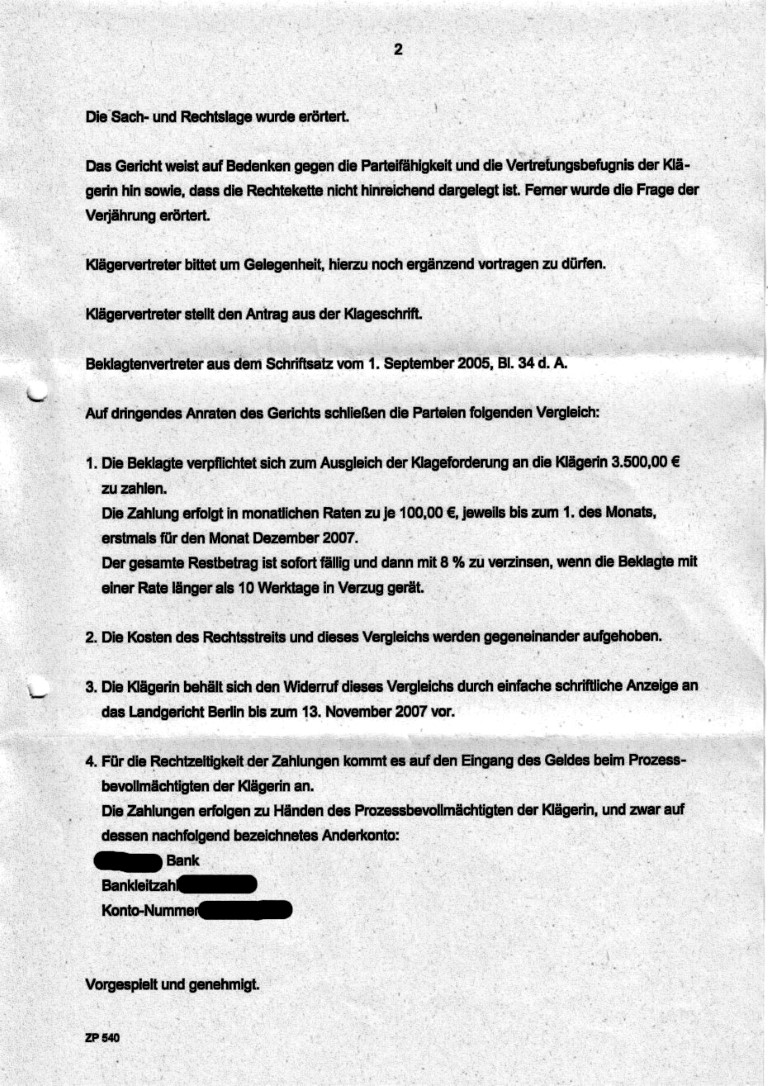
The Berlin District Court added that after all a large part of the alleged claims of the O.T.O. were time-barred. As the claims were filed in 2005 only, all claims of damage up to that time anyway and including 2001 were time-barred. Therefore the O.T.O. could not claim participation in the sales revenues of the year 1995 – 2001 even if proving ownership of the “Crowley-Copyrights” during further proceedings.
"On urgent advice of the Court the parties effect following compromise"
At the latest at this time it was clear that the risk of litigation had shifted to the disadvantage of the O.T.O. Finally, both parties agreed on urgent advice of the court to avoid further expenses and other costs as follows: The defendant pays a sum of EUR 3,500 in monthly instalments of EUR 100.00 to the O.T.O., which in return abandons its claims to the further sued for EURO 10,000.00.
Furthermore, the O.T.O. has to cover its lawyer's as well as half of the court’s fees by itself (the defendant was exempt from the cost burden due to a grant of legal aid).
Conclusion:
There was no verdict on the question whether the O.T.O. is holder of the rights of use of works of Crowley’s. Thus the O.T.O. avoided having to submit the decisive and (according to their lawyer) very extensive amount of documents. Because of having brought the action before court very late and the consequent barring due to the statute of limitation the O.T.O. was in any case unable to reach for a significantly higher sum during trial.
With this settlement the defendant escaped the risk of being sentenced to a higher amount and was granted a financially viable payment in instalments.
The risk of being held liable for copyright infringement by the O.T.O. headquartered in Artois, California, remains for everyone who publishes Crowley's works.
Should the O.T.O. be willing and able to extensively demonstrate and prove its rights to the works of Crowley, a plagiarist would be facing claims for damages, court costs and lawyer’s fees.
However, it is doubtful that it would suffice to produce a photocopy of an English court’s judgment.
As long as the copyright infringer does not sign an unrestricted commitment to liability for damages, according to the legal opinion of the District Court Berlin, the O.T.O. is forced to fully disclose the acquisition of the Crowley rights, in each and every case.
Andreas Huettl
lawyer
november 2007
Deutsche Version: 2007 'Caliphat' Kasino
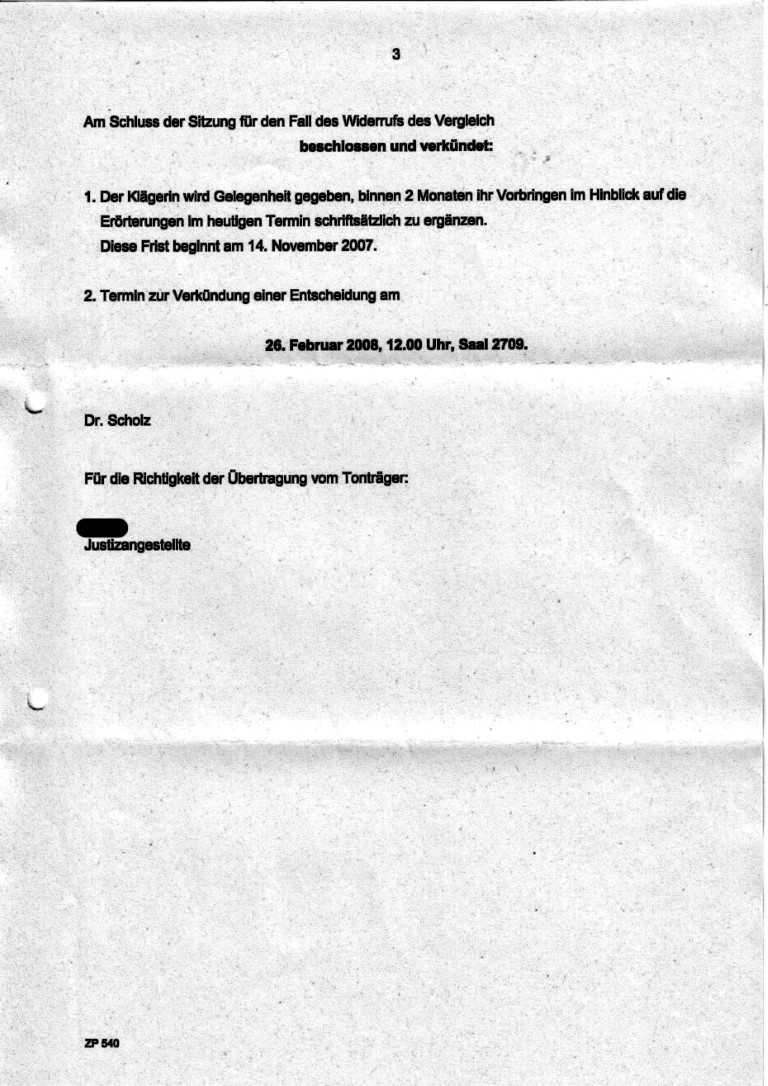
Protocol facsimiles
Context figures