Ordo Templi Orientis
Gnosis on Stage
Friedrich Mellinger
Election of H.J. Metzger as O.H.O.
by Peter-R. Koenig
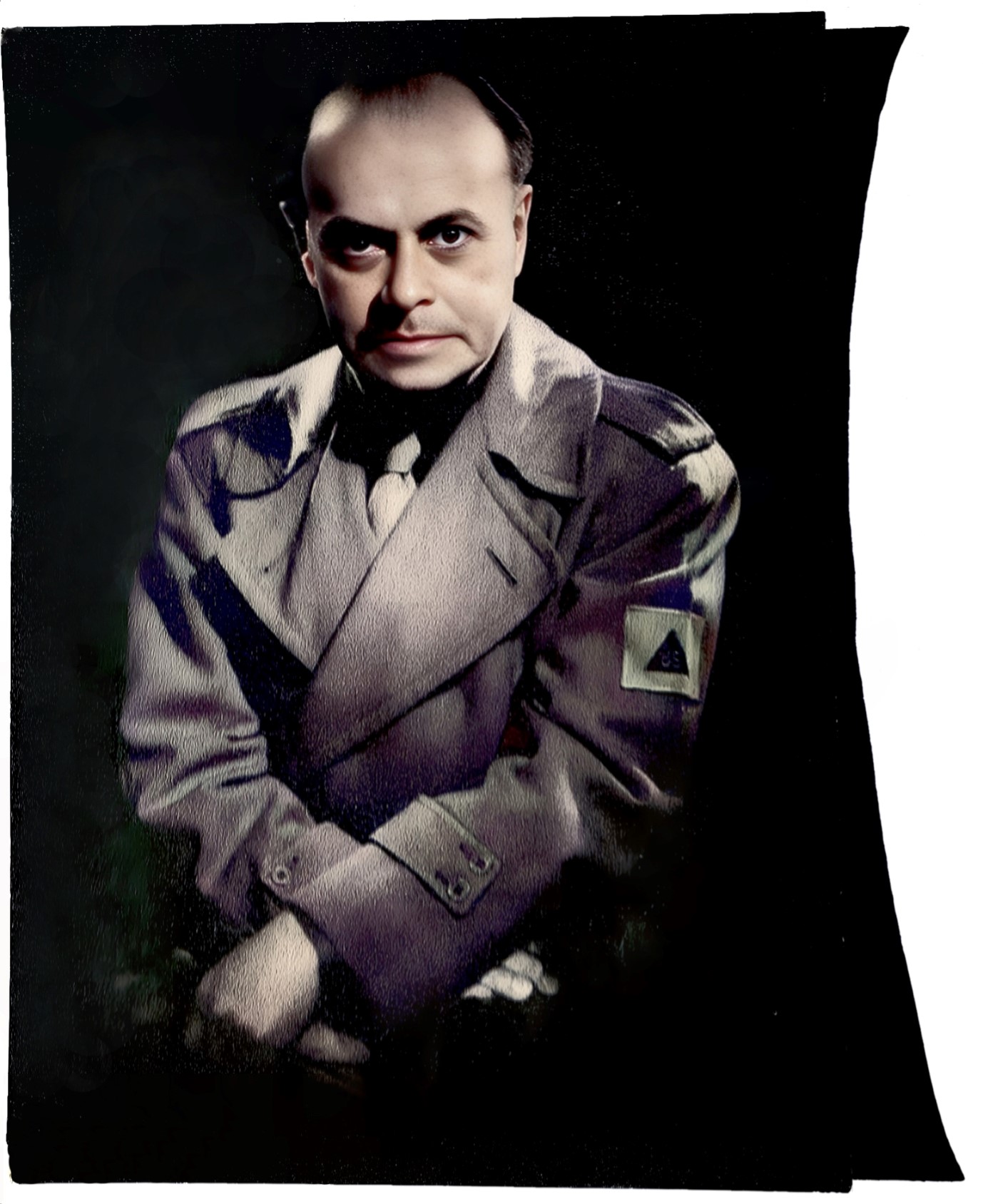
[Colored with AI] More picture material, e.g. Photos and signatures Friedrich Mellinger not only is an example of what kind of people were attracted to the O.T.O. but he is also one of its few members who have been linked to Theosophy. Most favoured in the American Crowley-O.T.O.-group and also in the Swiss-Reuss/Crowley-O.T.O., a rather well-educated individual Mellinger soon became disappointed with these O.T.O.-versions and its low-educated members and lent his strength and power for activities of the development of German Theosophy. Friedrich Mellinger entered the world at Berlin on November 15th 1890; by 1919 he had become a co-founder of and actor in 'The Tribune', the first left-wing agitprop avant-garde theatre in Berlin. He was a partner in this theatre with Karl-Heinz Martin, a particularly influential figure who was active as a theatre-director, and had appeared on stage with star performers of the era like Fritz Kortner and Rudolf Leonhard. [1] The Tribune's manifesto spoke of a theatre "without management and technology" free of "unnatural division between stage and audience" - instead, the performers would "reveal their hearts and minds." [2] The company had its first success with Karl-Heinz Martin's own production of Ernst Trotte's play "Die Wandlung". [3] However, the subsequently produced expressionist plays never achieved a consistant style, and the Tribune soon folded. [4] In 1921 Mellinger (who was now apparently a Ph.D.) founded the 'Schaubühne' ('The Stage') in Munich, with the producer Eugen Felber, using the remaining members of the Tribune's company and the scenery from Felber's previous theatre the 'Neue Bühne'. The 'Schaubühne' was homed at the Steinicke-Saal, a hall on Adalbertstrasse, where the initial season consisted of expressionist dramas by Kaiser, Büchner and Sternheim; the company was soon left in Mellinger's sole charge, and lasted only a little longer. [5] Between 1927 and 1931 Mellinger had various jobs: an assistant at the Propyläen-Verlag publishers, head of the theatre department at Ullstein Verlag, [6] and a drama-critic for the "Bildzeitung am Mittag" newspaper in Berlin. [7] On May 30th 1929 his son Michael Andreas was born. [8] After 1931 he worked as a freelance for the "Vossischen Zeitung" newpaper, writing literary and artistic criticism. Until 1932 Mellinger's name was regularly in theatrical yearbooks, but after 1933 he disappears. In the early autumn of 1933 the 'Reichsschrifttumkammer' was established as a department of the 'Reichskulturkammer' (Reich Chamber for Arts and Culture), as a Nazi-approved writer's union. It is debatable whether Mellinger actually applied to join this body, and was refused admission; certainly no trace of Mellinger's name has emerged in connection with it. [9] Rather, his literary activities at this time would seem to indicate a continuation of his personal development: as shown by his 1933 pieces "Der Verführer" ("The Tempter") and "Gernegross" ("Upstart"). [10] In the same year Mellinger revealed his esoteric ambitions in a book called "Zeichen und Wunder. Ein Führer durch die Welt der Magie" ("Signs and Wonders: A Guide to the World of Magic"). It dealt with such subjects as astrology, graphology, body-language, occultism, mediumship, and spiritualism. Honourable mentions were given to such "prophets and wonder-workers" as Madame Blavatsky and Rudolf Steiner, the miracle-doctors Weissenberg and Zeileis, and to the clairvoyant Hanussen. The reader learnt that the book's author had been involved with the 'German Society for Scientific Occultism', practised as a hypnotist, and had taken part in séances and evocations of the dead with his wife, the actress Eva Sinding. Ectoplasmic manifestations had been enthusiastically photographed, and the materialisation of 15 fresh lily-of-the-valley flowers was regarded not as a parapsychological phenomenon, but as a downright "miracle". [11] 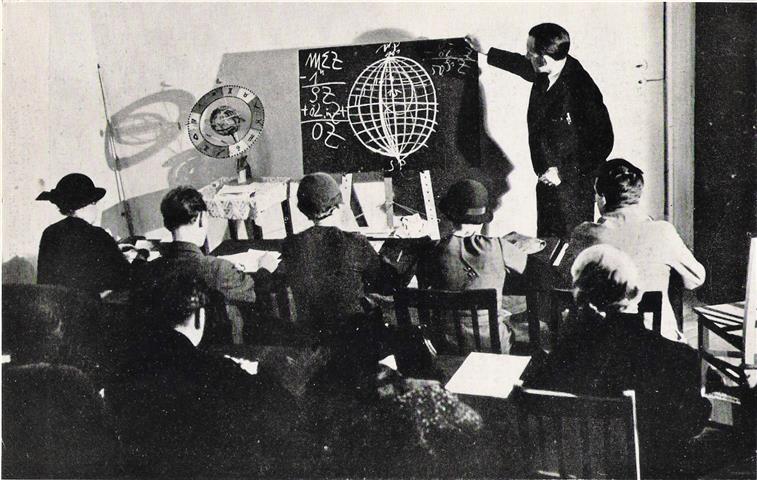
[Friedrich Mellinger: Zeichen und Wunder. Ein Führer durch die Welt der Magie, Berlin 1933, picture page 7] In 1934 Mellinger emigrated to London with his wife and his two sons, Michael and Lukas; there he wrote the film-script "The Emperor of the Sahara" (a). His son Michael thinks that his father then sent the script on to somebody in Hollywood, who had tried to sell it as their own work, an attempt which luckily failed (letter of 25.5.91). By 1936 Mellinger had arrived in Los Angeles, where he now sought to settle down in the theatre as an American citizen. "He had a rôle as an actor in the 'Freie Bühne' theatre-in-exile, which was managed by Walter Wicclair, who didn't pay him much heed. His next experiment was a theatre-company called 'DIE TRIBÜNE' [...] I've found out from interviews here that Die Tribüne only put on two performances. I couldn't verify that he had been a founder of the Santa Monica Playhouse [12] [...] He was a member of the German Jewish Club of 1933, Inc., in Los Angeles, where he gave a literary reading of his work "Der Kaiser der Sahara" (b) [by this time Mellinger had also written a script called "The Mirage"] [...] In addition he played bit-parts in Hollywood movies, too small to be put on the cast-list. He played a minute rôle in Leopold Jessner's stage-production "Wilhelm Tell", but the venture went bankrupt after two or three performances. The German-American [director and actor] William Dieterle [1893-1972] tried to give him bit-parts whenever possible. According to information from the actor Hans Schumm, Mellinger was so hard up that he couldn't afford to pay the $25 fee for membership of the Screen Extras Guild; he tried to borrow the money from Peter Lorre, but he didn't give him any. In April 1948 he gave yet another reading to the German Jewish Club, this time from "The Desert Dictator" (c) at Elliot Fisher's Theatre School [...] The overall situation then meant that any emigré, like a great many others, would seek in vain to get a foot in the door of stage or screen. And like very many others, as a German-speaking refugee he was repatriated back to Bremen in Germany, where he tried his chances of starting a new life. From Bremen he managed to get into West Berlin, in the U.S. sector." [13] [(a-c): From the 'Emperor' to a 'Kaiser' and then 'Dictator 'of the desert.] Strangely, Mellinger had no contact in Hollywood with Charlotte Dieterle, a well-known astrologer, and William Dieterle's wife. The aid-organisation, the European Film Fund could not find any record of Mellinger in its lists. Wilfred T. Smith "Voluntas Perfectas Omnia Vincat" (b. 1885) who had only met Crowley once, [14] was named as his Master's "successor" in a will dated January 1st 1932, and allowed his 2nd Agapé Lodge - which he had founded on September 21st 1935 - to be officially registered as the 'Church of Thelema', a move which was rejected by Crowley and upset Karl Germer. In late 1939 Mellinger wrote to Smith, meeting him face-to-face in February 1940; he became Smith's "friend indeed", speaking of him with "great affection, sincere regards and admiration for his intellegent [sic] judgements and frank criticism." [15] Mellinger complained about the "woman-run organisation" [16] and regularly scared these ladies: "Whenever he got to telling the story of their [the Nazis] tortures and killing of the Jews in Germany, I couldn't stand it and had to leave the room." [17] On April 23rd O.T.O. brother Mellinger "Merlinus" signed an A.·. A.·. certificate as a Probationer with the motto 'Arte Unionem Manifestabo Gnosticam'; his sponsor was Smith. [18] Mellinger earned small amounts of money with astrological readings. [19] Since his family didn't want anything to do with the O.T.O. crowd, [20] Mellinger was forced to spend days on end sitting at a loose end in the O.T.O. property that housed the 2nd Agapé Lodge's H.Q. Bored and unhappy, he was too proud to do anything like "menial" housekeeping (eg watering the grounds) [21] spending his time casting horoscopes for the members of the O.T.O. [22] On December 12th 1942 Mellinger quit the 2nd Agapé Lodge and took a job as a night-porter at a hotel in Arizona. After that he went to see Karl Germer in New York, who financed Mellinger's return to Germany, first to Bremen and later West Berlin. In April 1945 the Mellingers had another son. [23] Shortly after the end of the war Mellinger visited Aleister Crowley at Hastings in Sussex; 'Therion' was living at a boarding-house called 'Netherwood'. Mellinger helped Crowley to put his papers in order, and looked after his correspondence - Crowley was so impressed by his efficiency that he called him his "spiritual son". In a letter of July 15th 1947 Crowley even said that he was preparing his "beloved son" [24] Mellinger for "a position of supreme responsibility," meaning the office of OHO. [25] Crowley signed this letter with "a Father's Blessing in full measure, 666." [26] To Mellinger Crowley was the "spiritual hero of our century." [27] It was just as well that 'Merlinus' had kept his taste for spiritualism hidden from 'Therion', who had made his thoughts on the subject quite clear: "I always set my face against spiritualism." [28] Smith, who had followed C.S. Jones as X° of the 2nd Agapé Lodge, was soon succeeded in this office by J.W. Parsons, who in turn was succeeded by Roy Leffingwell. Smith died in 1957. Back in GermanyBack in Germany Mellinger found the theatrical field fertile. From 1946 to 1949 he worked for the American military administration in Bremen as supervising officer for theatres, and was a contributor to the "Dramaturgischen Blätter". He also paid further visits to Crowley in England at the start of 1946 and in May 1947. In March 1948 he mounted a production of Thornton Wilder's "Our Town" at the Kammerspiele, an 'intimate theatre' in Bremen, and later he produced at the Hebbel Theatre in Berlin; but the latter soon came to an end. In 1948-9 Mellinger worked as an actor at the Renaissance Theatre, putting on his own play, "Satanische Symphonie", on April 10th 1948. [29] "According to reviews in the local press ("Weser Kurier" and "Nordseezeitung" of April 12th 1948) this play got a very negative reception: the public reacted with disquiet; there was whistling and interruptions." [30] At this time Mellinger regularly gave lectures as Theatre-officer on American plays and theatre in Berlin, Bremen, and other German cities: in 1946 at Max Reinhardt's Deutschen Theater, on the occasion of Reinhardt's commemoration, and in June 1948 at a Peace Week in Duisburg. He also wrote small forewords to theatre-programmes, for example for Rose Fanken's play "Claudia" (which was performed at the Deutsches Theater in Berlin), Sidney Kingsley's "Men in White" (Theater am Schiffbauerdamm in Berlin), and Lindsay and Crouse's "The Master of the House" (Künstler-Theater in Bremen). In 1950 he published "The Theatre on Broadway", where Crowley gets a mention in the footnotes. Master of the TempleMellinger then made a short trip to the USA so as not to lose his American citizenship, and helped Germer in putting the Crowley-O.T.O.'s archive in order. [31] In January and February 1951 it seemed that there was something off-key with Mellinger's esoteric ambitions, [32] at least from Germer's point of view. As a 'Master of the Temple' (his grade in the A.·. A.·.), he began to cast doubt on Germer's authority; Germer, highly sensitive to every accusation, went so far as to class Mellinger "as dangerous" thinking that Mellinger wanted to usurp his office of OHO. [33] Perhaps after Mellinger failed to find a successful place in the growing theatrical worlds of Berlin and Munich, as a cultured, educated, and previously energetic man he simply seems to have got bored with the American Thelemites. Germer complained that he could not understand Mellinger's overbearing manner towards the members of the 2nd Agapé Lodge. Not surprisingly, Mellinger who moved in very cultured circles, was easily bored even by Karl Germer who admittingly did "not read books" (letter to Mellinger 8 July 1951). A shock not only for Mellinger. Although Friedrich Lekve was the most active person in the German speaking area of Europe, Germer favoured Mellinger and made him responsable for testing new candidates for Crowley's O.T.O. Kenneth Grant, Lekve and Metzger primarily have to deal with Mellinger. Although Metzger's mistress Anita Borgert had already exchanged letters with Sascha Germer in 1946, Metzger himself first got Germer's address from Lekve, who also referred him to Mellinger. As an IX°, Mellinger needed "no formal Charter" in his initiations, even in undertaking those to the IX° itself, as he was notified by Germer on September 15th 1951. Germer feared that he and Mellinger were making themselves look ridiculous in Metzger's eyes: "He knows all about Grosche and knows Tränker personally"; of course Germer had known both of them since the era of Pansophy. But Metzger was not well-informed about Thelemic matters: "it seems he confuses things of which he has no notion [...] He knows nothing about the A.A. at all." [34] MediatorIn October 1951, exactly a month after the birth of his son Parcival Peter on September 25th (his mother was Anita Borgert), Metzger travelled with Fräulein Annemarie Äschbach firstly to Hildesheim and Friedrich Lekve, and later to Hamburg, where Mellinger then lived. Mellinger reported to Germer in New York on October 31st that Metzger was completely obsessed with getting hold of as much occult and O.T.O. material as possible. Although Metzger liked to keep himself in the background, there were hints "that he is looked at as THE authority in every respect by his sheep." Mellinger tried to be useful to Metzger by making a new German translation of the "Gnostic Mass", and supported him as best he could. "In one respect, I told him, do I feel that he could not expect your [Germer's] authorisation to use the material you might send him"; though Metzger seems to have received this news "with splendid and convincing modesty." Unfortunately, they not yet had Genja Jantzen's papers, but Metzger would soon be negotiating with her through a promising mediator. Metzger and his seventeen "brethren" had gone through the three lowest rituals written by Theodor Reuss, and now wanted to receive and sign the initiation-certifiates as quickly as possible, so that they could gain knowledge of Crowley's rituals. Metzger was admitted to the Sanctuary of the Gnosis (IX°) "in a very original form, as it seems, which P[inkus]. might have devised by combining traditional instructions with the results of his own studies and experiences." [35] Later, Metzger saw his visit to Mellinger in the following light: "In October 1951, on the orders of Fra. Saturnus [Germer] the IX° O.T.O. was presented by Fra. Merlinus (Dr. Friedrich Mellinger) to Fra. Paragranus [Metzger] in Hamburg, in the presence of Sor. Chochmah [Fräulein Äschbach]." [36] There is documentary proof of the events on October 28th that year, when Metzger and Fräulein Äschbach sought initiation in Crowley's O.T.O. The document is signed by Mellinger, and Germer signed it later on as a witness. [37] Germer considered his papers to Metzger that is "authorisation only as continuation of his previous O.T.O. work, with the exception that he had been working the old Reuss rituals (which did not accept the Law of Thelema) and that he now adopted our rituals." [38] Extant apart from Metzger's authorisation: Germer and Mellinger signed nine forms for Metzger's group: Äschbach, Borgert, Gerard, Hanimann, Binder, Herr and Frau Weber and Rösli Metzger. Most of these stayed on to reach the O.T.O.'s IX° and are still alive. |
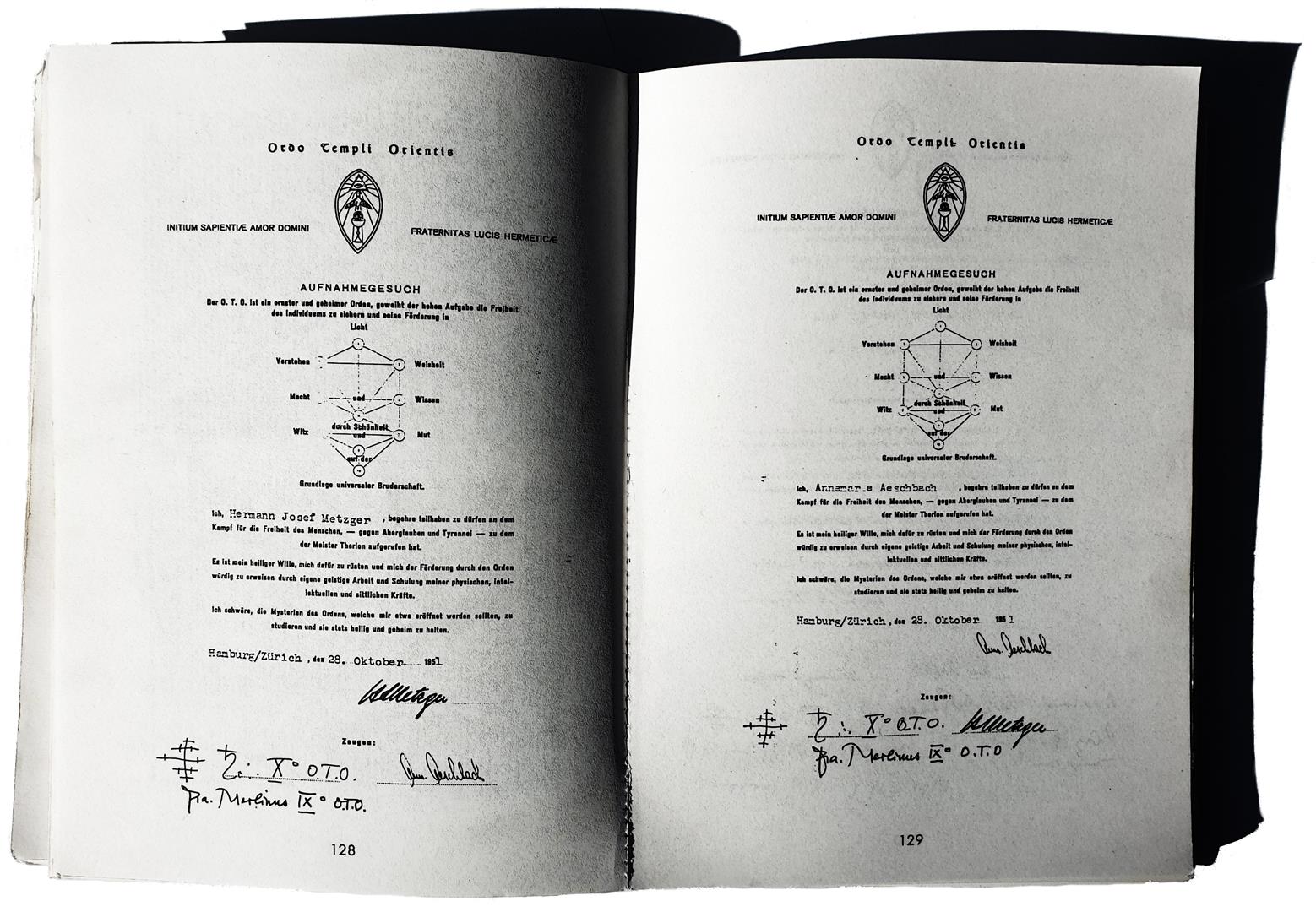
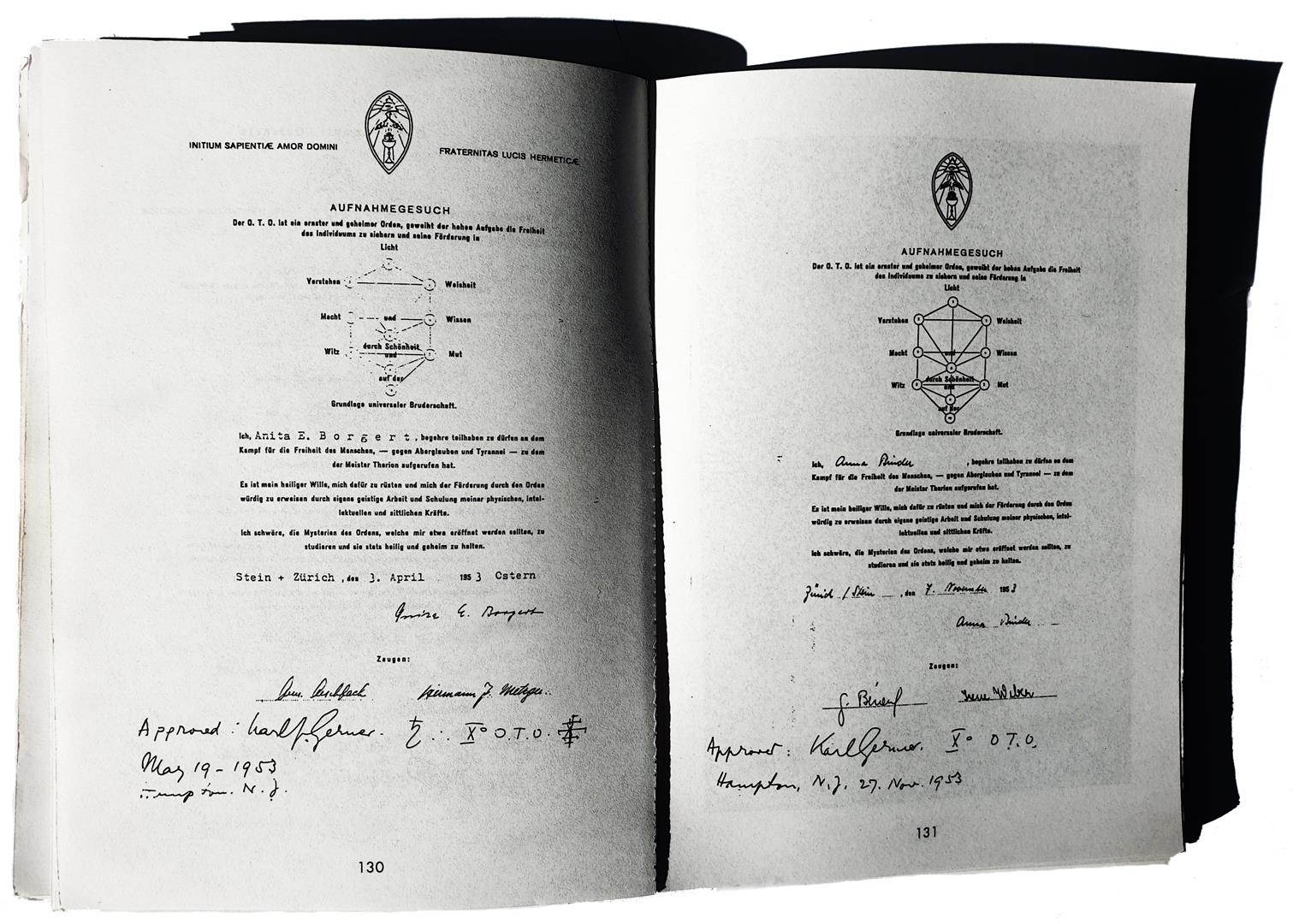
[From "Materialien Zum O.T.O."]
|
Mellinger started to hunt out Crowley's writings for Metzger, which
either Mellinger himself or H.C. Petersen then translated into German for
publication by the Psychosophical
Society.
On December 4th 1951 Germer included his wife Sascha and Mellinger in his Last Will and Testament: "I leave the whole of my property and possessions to my beloved wife Sascha Ernestine André-Germer as sole heir [...] As regards the property of the Order Ordo Templi Orientis [...] I direct that this is passed to the Heads of the Order [...] my wife [...] has to be the executor of this part of my Will, together with Frederic Mellinger." [39] The correspondence between Germer and Grant reveils that Mellinger gave Germer a great deal of advice about Thelemic matters. Probably spurred on by his wife Sascha, in early 1952 Germer reconsidered his association with Mellinger. "Sascha was jealous of any person Karl was liking too much [...] was quite nasty to Mellinger in some ways when he visited them and Karl was probably abrupt." [40] "Sascha caused the split between them." [41] Germer soon came to the conclusion that Mellinger was working as a spy for the American government, and their association ended, though Germer didn't change his will. Mellinger also intermittently lived in Zurich and waited in vain (like Lekve on occasion) for Oscar Schlag to subsidise him - in this case for mounting a production of his Shakespeare-inspired play "Timon of Detroit" - he had dusted off his old script and revised it. A few years before Germer had proved incapable of expressing a view on this play, saying: "I do not read books." [42] Just as Mellinger showed his enthusiasm for spiritualism in his book published in 1933, so Schlag is mentioned in various books as a medium; he worked (amongst others) for such figures as Fanny Moser (1872-1953) and Gerda Walther. Schlag was happy to give demonstrations for experimental purposes, and was studied in a trance-state by Bleuler, C.G. Jung, and other psychologists. For Metzger's publications, on the other hand, Mellinger translated one of Crowley's smaller works into German, a version of the Taoist classic the "Khing Kang King"; he also wrote book-reviews, maintaining in one of them that Richard Wagner had been the OHO of the O.T.O. [43] In 1956 Metzger had to do his military service as a Swiss citizen, [44] and it appears that Mellinger took over as editor-in-chief of Metzger's press for three months. Herbert Fritsche managed to persuade Ernst Klett to come to Stein that year, because he knew that "Frederic Mellinger is one of the most distinguished people in Stein, fresh in from America, and probably able to furnish us with new high grades." [45] One of Mellinger's partners was Charles Waldemar, who according to Schlag had published an authoritative book on cults under the pseudonym Gerhard Zacharias. [46] On October 12th 1955 Waldemar made his first contact with "Frater" [sic] Anita Borgert, using his "name in the World of Maya". He owned some rare Crowley manuscripts, over which he expressed his enthusiasm. He signed at least one of his letters as a 5°=6°, and wrote books containing his formulæ "for love without the worry of coitus", as well as for self-confidence, potency, attracting love, and yoga. Waldemar's Electro-Acupuncture Apparatus, Gold-Plated Back-rollers, Sunproof Sheets, Oxygen-Ionising Equipment, and Foot-Reflexers were all available for purchase at this time. [47] It was at this stage that Mellinger began to distance himself from Metzger and the O.T.O. in general, and devoted himself more to Theosophical activities. After Karl Germer died in 1962, and Metzger elected himself OHO in January 1963, the latter now concentrated his attentions on Germer's widow Sascha. |
Ladies and Gentlemen: We proudly present: The OHO"We, Grand Secretary-General of the Sovereign Sanctuary of the Order of Oriental Templars, hereby give notice [...] that [...] an Assembly has been convoked of the Prince Patriarchs Grand Conservators [...] by the Illustrious Grand Master [Metzger] X° of the Order of Oriental Templars, Sovereign Grand Master-General of the Fraternitas Rosicruciana Antiqua, and Sovereign Patriarch Ecclesiæ Gnosticæ Catholicæ, for the appointment of the Sovereign Grand Master, O.H.O. of the Order of Oriental Templars. Since the Succession and Rank has devolved to Us, We do Ourselves humbly accept the Charge of the Order being transferred to Us." ...or so Metzger deliberated in early 1963. [48] On the 6th of January Harnisch "Hilarius", Naber "Nathan", Scheidegger "Thaddaeus", 'Romanus' and 'Elieser' (this latter possibly a posthumous Pinkus?) had elected Metzger as OHO. The minutes of their convocation were plagiarised word-for-word from Reuss's "Oriflamme" of July 1913, [49] and Crowley's "Equinox" (Volume I Nº 10 of September 1913, page xxv). The record of the election was accompanied by an affidavit confirming the voting signed by the Notary-Public of Zurich Altstadt, and a certification of Metzger's standing as a "reputable and law-abiding citizen"; and thus his election as OHO was thoroughly officially attested. On this certificate, which is dated January 9th 1963, other titles besides those mentioned above are enumerated: "Patriarch Malachias, Vicarius Salomonis of the Sovereign Sanctuary of the Gnosis." The certificate is signed as follows: Order Bursar, Master Treasurer-General: Annemarie Äschbach "Chochmah" Grand Master of the Lodge: E. Engeler "Angelus" Order Chancellor-General: Anita Borgert "Ainyahita" Order Secretary Germaniæ: W. Harnisch "Hilarius" Deaconess, Gnostic Catholic Church: Dorothea Weddigen "Dodo". 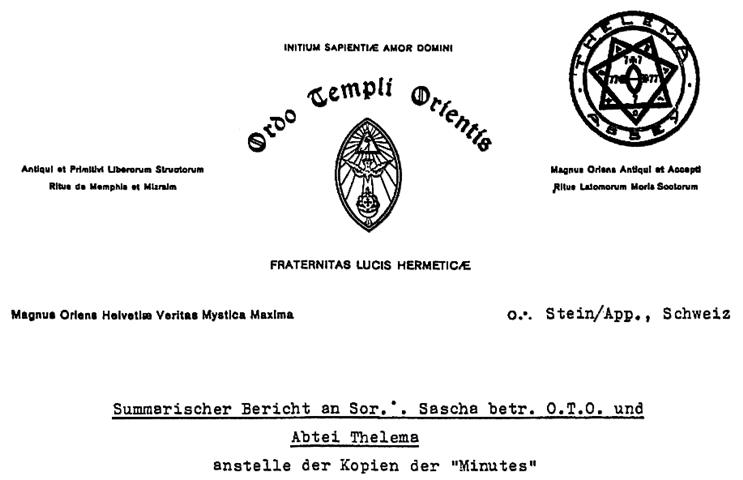
On February 9th Metzger sent a bilingual summons - witnessed by the American Vice-Consul in Zurich Charles Hill - to Sascha Germer, demanding that all Order properties be sent to Switzerland. This was followed by a remittance of two hundred dollars to cover the postal expenses; the document bore the same signatures given above. In reply, Sascha pointed out that she had inherited all her husband's property, but that Mellinger had been named her co-executor in O.T.O. matters. The trouble was that Frau Germer had lost touch with Mellinger twelve years before; she wrote to her lawyer Mr. Chisholm that Metzger would have "to fight for himself". But "After long and careful study of all Files and after Experience of 20 years of O.T.O. work I have to say that to the best of my knowledge, he [Metzger] is the only one who has all the Rights to be the next O.H.O." [50] Metzger's communications began to take on a harsher tone: "Whether or not it is a case of simple misunderstandings and possible intrigue, does not interest us in the slightest [...] We are forced to summons you [...] We are the only successors [...] God be with you." [51] Finally Frau Germer went through her husband's documentation, and came to the conclusion that: "Frater Saturnus' Will and Wish was: that Frater Paragranus takes the Heavy Burden off his shoulders." [52] Also others had heard Sascha express the same opinion: "I had met Mrs Germer, a very fine lady, and heard her speak rather highly of Metzger. This was after Germer's death." [53] Both Metzger's Frau Germer's lawyers got busy, and found out where Mellinger was living. His opinion, given on September 25th 1963, was terse and to the point: Metzger and Frau Germer had "violated [...] the Will of the deceased." First, nobody had asked him whether he would have voted for Metzger as OHO, and second, Metzger's only authority for his appointment was his excessive egotism. [54] This belief of Mellinger's was later used by the 'Caliphate' as their justification for not accepting Metzger as a me mber of the O.T.O., despite the fact they stated that Mellinger's judgements against other people "have been found incorrect and unreliable." [55] 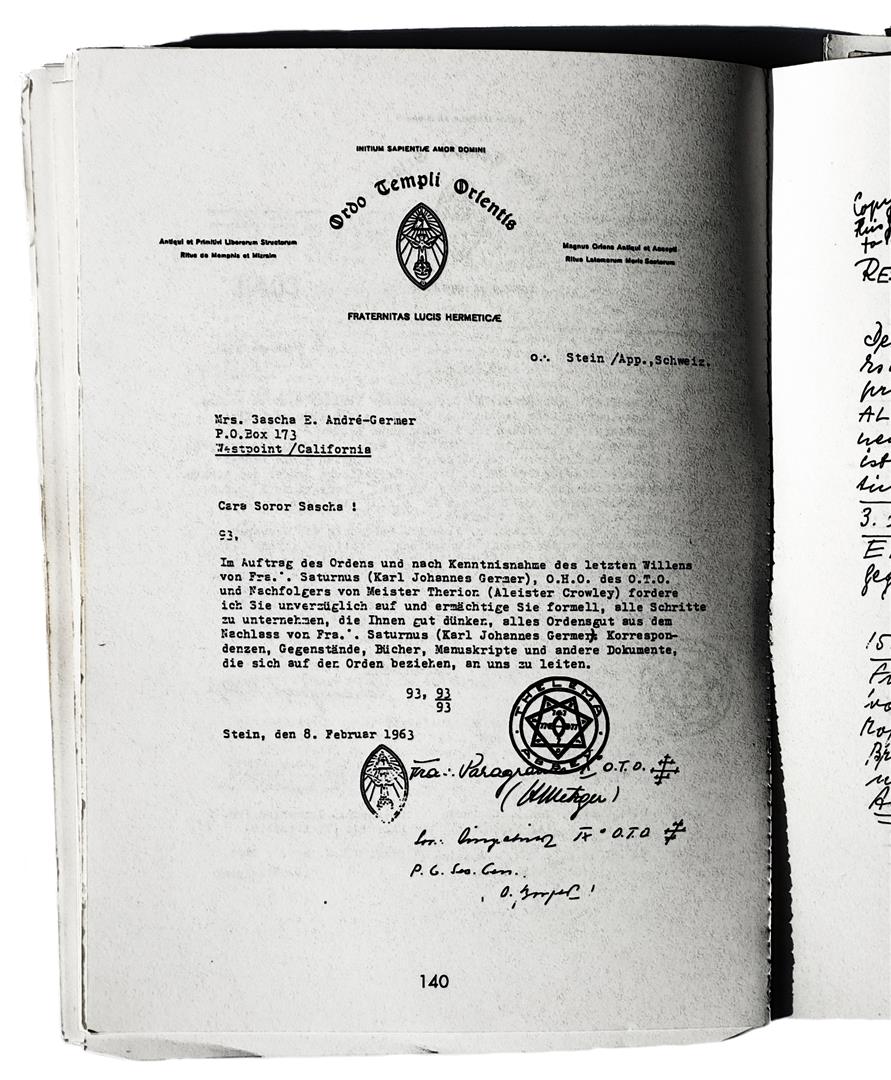
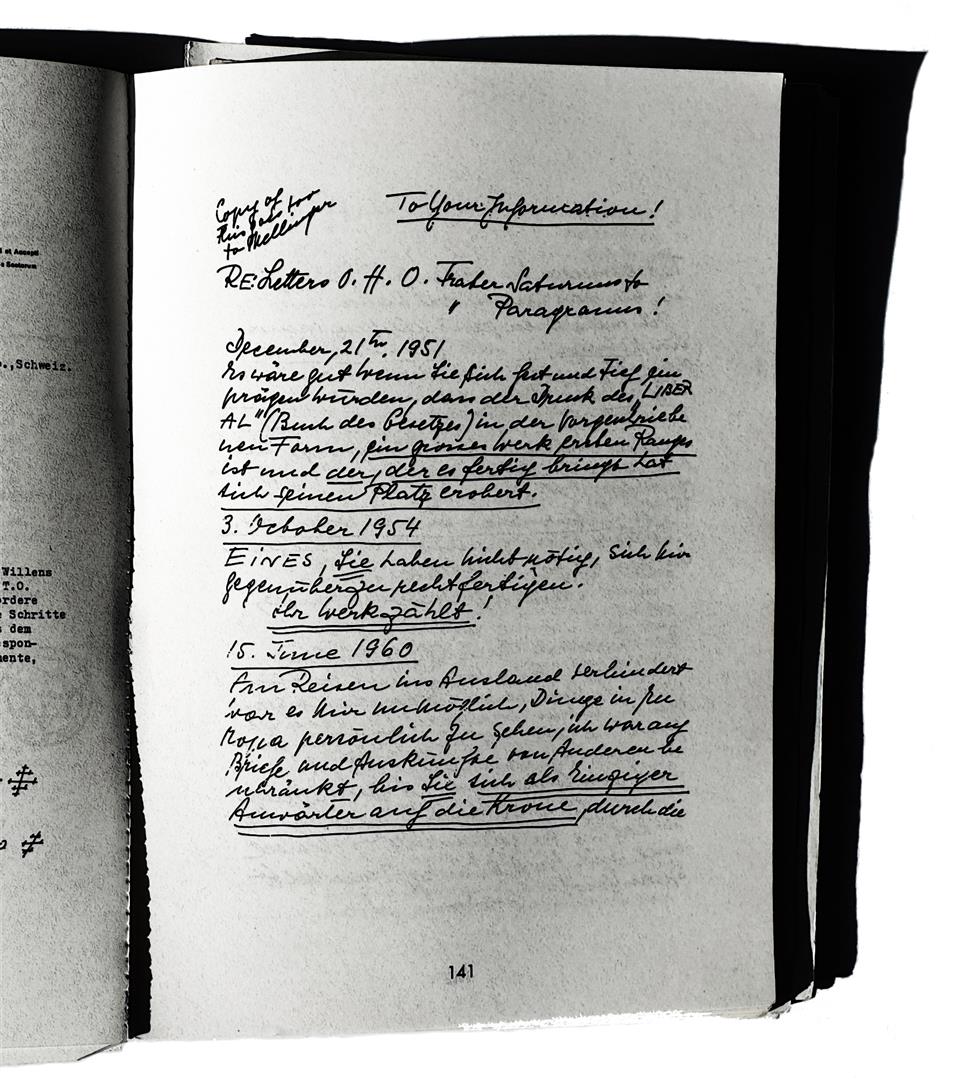
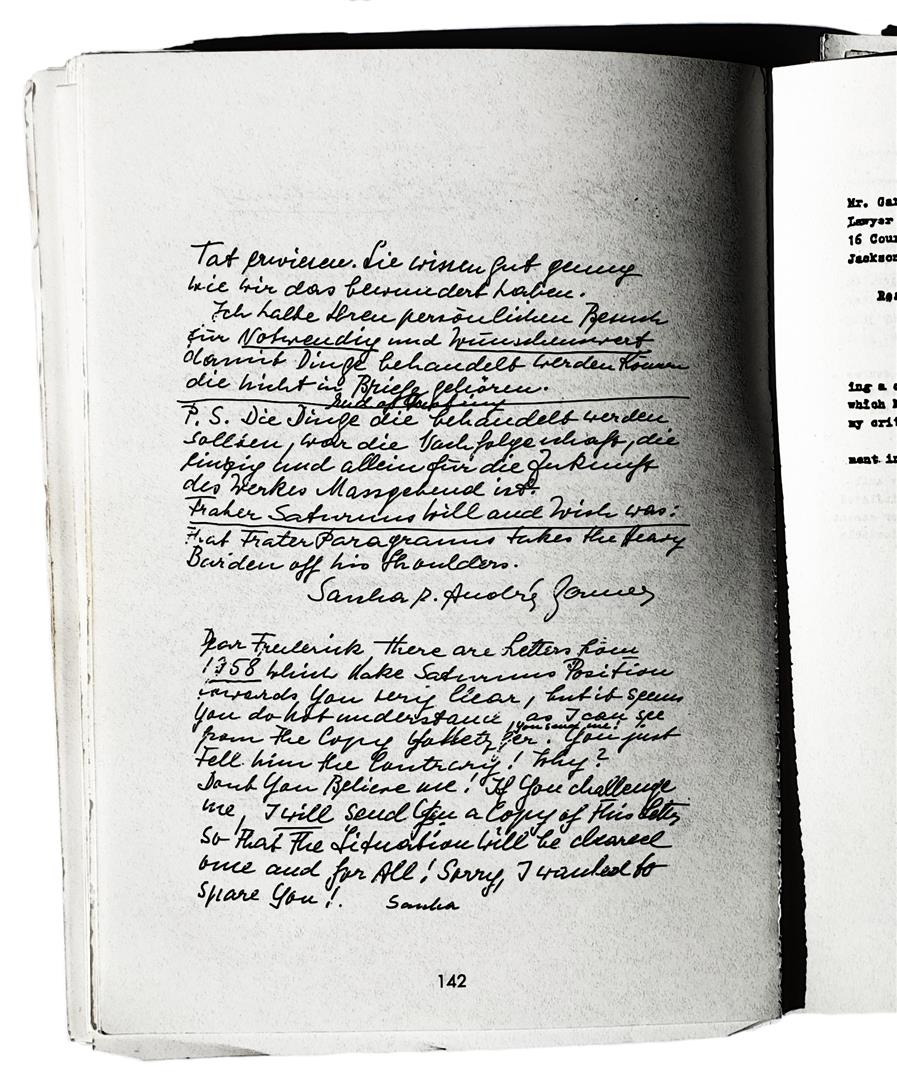
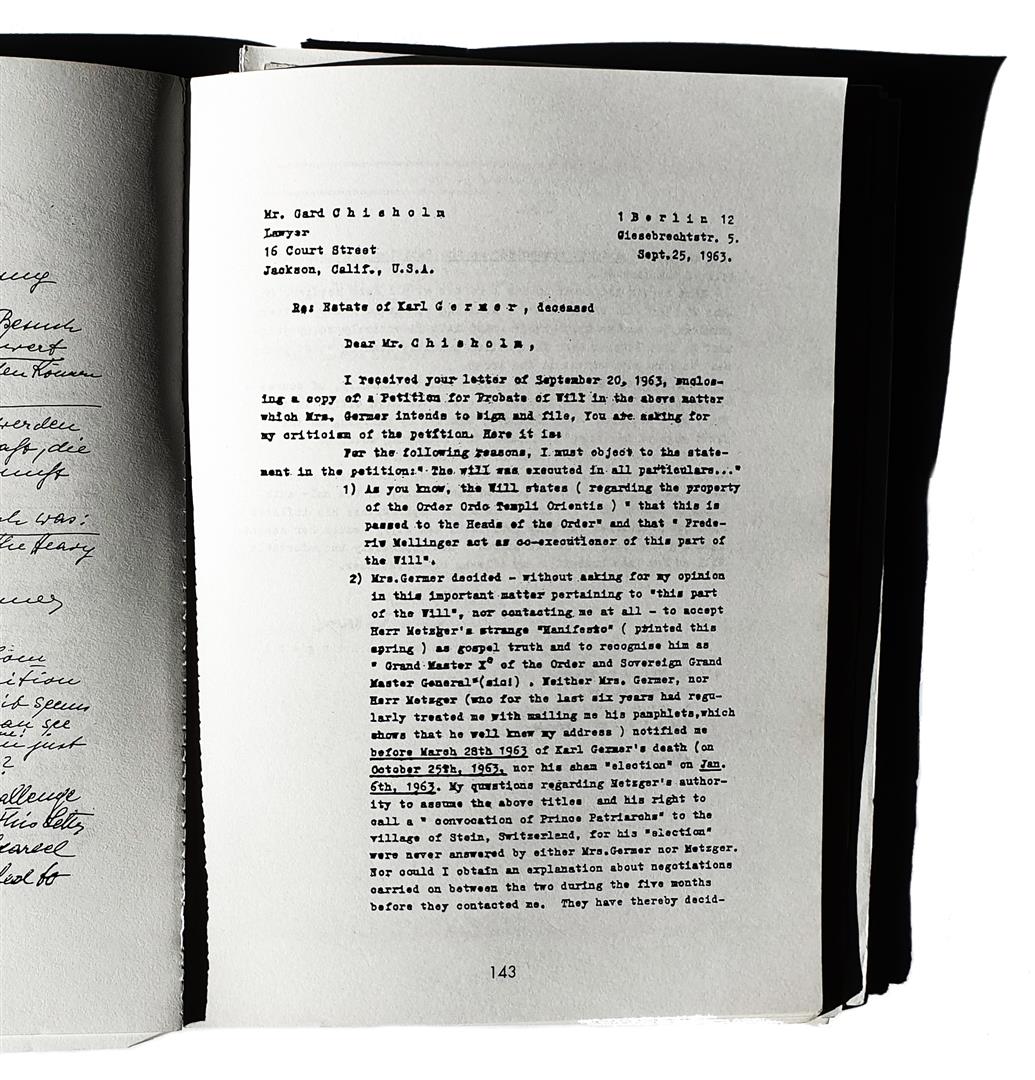
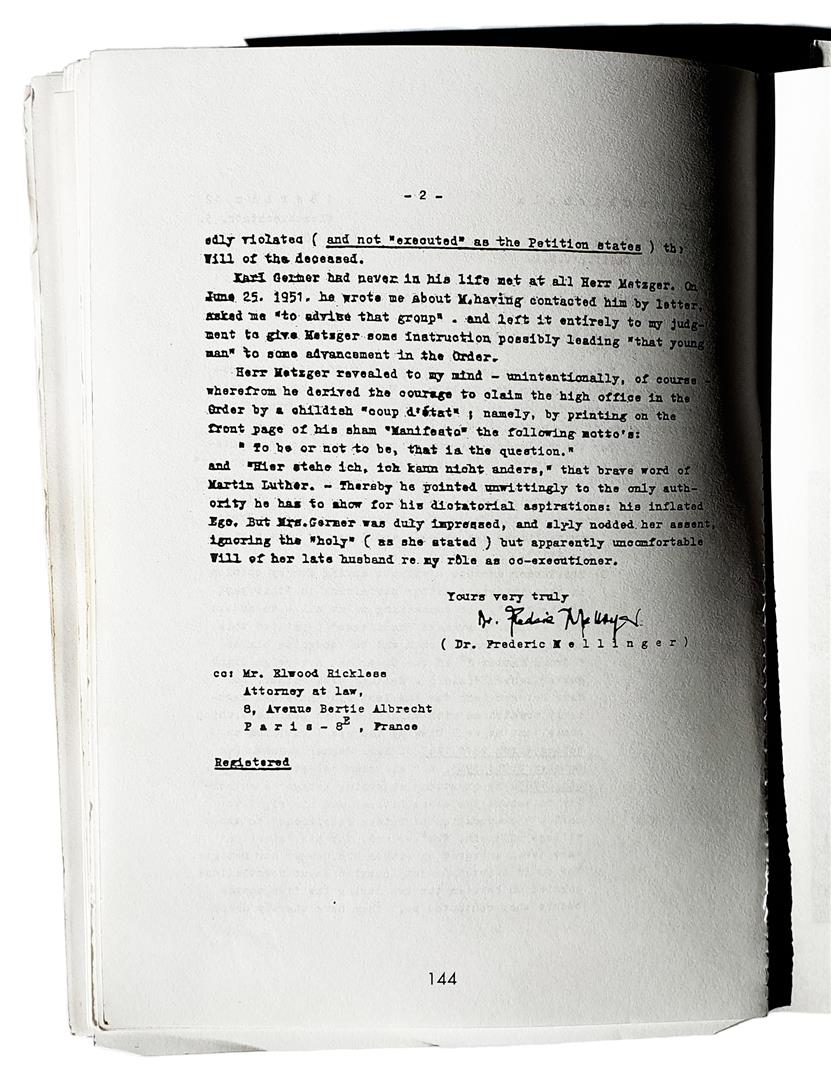
[From "Materialien Zum O.T.O."] For the lawyers the case was clear; any further legal action would be "entirely useless". [56] Metzger's lawyer made one final (but futile) foray: "Your late husband, Karl Johannes Germer, was a great leader of this Order and it would seem a shame for all of his works to lie in someone's basement." [57] TheosophySince about 1960 Mellinger had been a member of the 'Adyar' Theosophical Society in Berlin, where he was highly thought of: "He was a considerable feather in our caps, and for me a pleasant avuncular friend." [58] He gave public lectures and led a small internal study-group with various interested members: "All of this was filled with his profound wisdom, and with great idealism." [59] Friedrich Mellinger died at Bad Wiessee on August 29th 1970; his books had already found their way into Oscar Schlag's collection in 1957-8, while his 28 letters from Crowley were auctioned at Sotheby's in 1985. Frau Beate Mattern has tried and failed to find a publisher for Mellinger's autobiographical novel "Utinam" ('Manitu' spelt backwards), since his death. His son Lukas became an architect in London, while at the time of writing Micheal Andreas Mellinger lives in Kent, and has been involved in a considerable body of work on the English stage, as well as television and radio plays (Geheimakte M, Weisses Blut) [60] - though he is very modest about his contributions. Notes to Chapter Eight of "Das O.T.O. Phänomen", 1994
Translated and adapted from a chapter on the O.T.O. Protagonists in "Das O.T.O.-Phänomen" (1994) by Mark Parry-Maddocks. German original online. ГНОЗИС НА СЦЕНЕ — ФРИДРИХ МЕЛЛИНГЕР. See also the correspondence between Karl Germer and Frederic Mellinger. An outline of this article appears in "O.T.O. Rituals and Sexmagick" (1999). To a biography on Karl Germer Karl Germer's own autobiographical outline Of Booksellers And Other Grand Masters of the O.T.O.: Detailed biographies on Heinrich Tränker, Karl Germer, Henri Birven, Spencer Lewis, C.H. Petersen, Eduard Munninger — and their relation with the O.T.O. under Reuss, Crowley and Metzger — containing Henri Birven's "Obituary on Karl Germer" with interesting details about Crowley in Berlin in 1930 Friedrich Mellinger played a role in Metzger's OHO-election To the main page of Photographs and Documents Minutes of the Special Ninth Degree Caliphate Election — Same procedure like above: the IX°s elect their chief O.T.O. Phenomenon navigation page | main page | mail
|


 |
 |
 |
 |
 |
 |
 |
 |
 |
 |
 |
 |
 |
 |
 |
 |
 |
 |